OpenAI’s o1 Preview: A First Look at Longer Reasoning

Matthew Berman introduces the o1-preview and o1-mini models and tries a Python game prompt.

MBMatthew Berman登壇者 · Forward Future
チャンネル
Matthew Berman
公開日
2024年9月16日
動画
0:54
読了時間
1 分
スライド
1
原文
英語
YouTube で開く
スクロールすると動画は右下に小さくなって再生を続けます。字幕は閲覧言語に合わせて切り替わります。
閲覧言語2 言語で読めます
この記事はまだ日本語に翻訳されていないため、英語の原文を表示しています。
要約

30 秒でわかる

In this September 2024 short, Matthew Berman describes OpenAI’s newly released o1 models and tests a coding prompt. He highlights their longer reasoning time and OpenAI’s research benchmark claims.

  1. 1Two o1 modelsBerman introduces o1-preview and o1-mini, associated with the previously anticipated Strawberry model.
  2. 2More time to thinkHe says the models are designed to spend more time reasoning and cites OpenAI’s comparison with PhD students on research tests.
  3. 3A game promptHe tries a Python Tetris prompt and notes that ChatGPT shows a summary of the thought process, rather than the raw reasoning.

ポイント

  1. OpenAI introduced o1-preview and o1-mini as models designed to spend more time reasoning.
  2. Berman cites an OpenAI claim comparing performance on selected research tests with PhD students.
  3. His Python game prompt shows a reasoning summary and a reported 94 seconds of thinking.
全文

チャプターごとに整えた全文を読む

文字起こしのみ
01

Introducing and testing o1

Berman describes the new models and their reasoning approach. He then tries a Python game prompt and reacts to the result.

OpenAI’s long-awaited Strawberry model is here. There are two models, o1-preview and o1-mini. They are designed to spend more time thinking through a problem, and OpenAI says the model performs similarly to PhD students on some research tests.
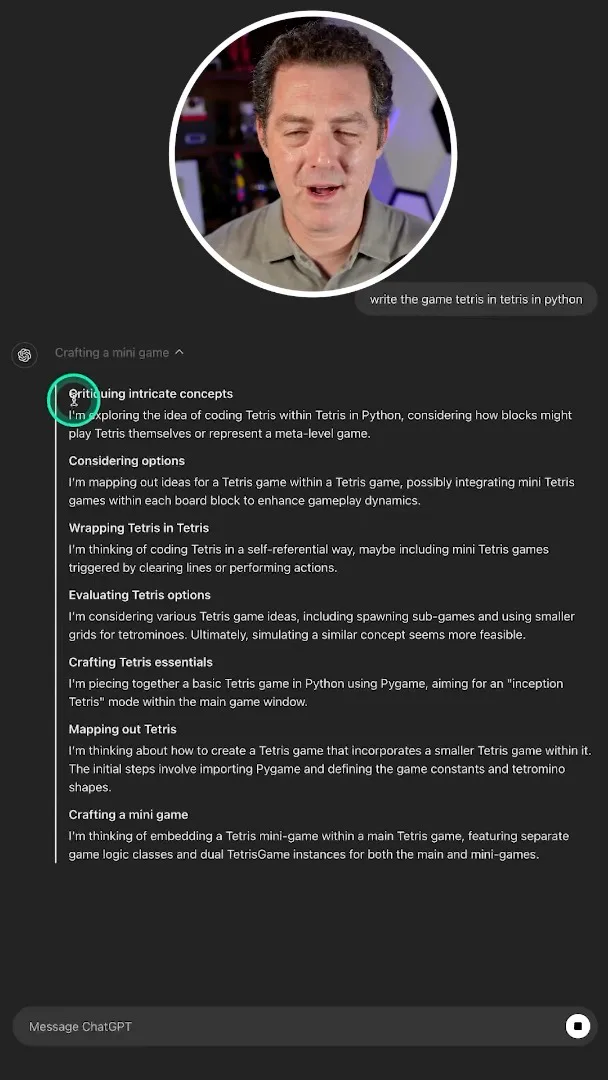
ChatGPT’s reasoning summary
スライド 1 / 1ChatGPT’s reasoning summaryThe interface shows the Python game prompt and a summary of the model’s reasoning.

I ask it to write a Tetris game in Python. ChatGPT shows a summary of its thought process, though not the raw reasoning, and reports thinking for 94 seconds. I try the result and react enthusiastically.

同じチャンネルの記事

スライド 6 枚25:50EN
MBMatthew Berman· 2026年10月24日Kimi K3.1 Pro Tested: Strong 3D Demos, Uneven Results and Competitive PricingMatthew Berman · Forward FutureMatthew Berman tests the open-weight model on coding, 3D rendering and visual explanations, then compares benchmark results and prices.Open-weight modelsBenchmarksAI cost & performance+1
スライド 2 枚32:20EN
MBMatthew Berman· 2026年10月23日Who Is Local AI For? The Costs, Trade-offs and a Hybrid FutureMatthew Berman · Forward FutureMatthew Berman weighs data control and independence against hardware cost, setup complexity and inference speed.Local inferenceOpen-weight modelsAI cost & performance+1
45:08EN
MBMatthew Berman· 2026年10月21日Sam Altman on AI Discovery, Consciousness, Compute and a Human-Centered FutureMatthew Berman, Sam Altman · Forward FutureIn a conversation with Matthew Berman, Altman discusses scientific progress, personal assistants, recursive self-improvement and the importance of human agency.AI for sciencePersonal agentsConsciousness+2
スライド 5 枚12:14EN
MBMatthew Berman· 2026年10月14日Gemini 4 Argon Tested: 3D Demos, a Spreadsheet Prototype and Benchmark ResultsMatthew Berman · Forward FutureMatthew Berman tests Google’s model on games and visual projects, then compares reported coding and agent benchmarks.GeminiBenchmarksコーディングエージェント+1
スライド 5 枚10:36EN
MBMatthew Berman· 2026年10月13日Meta Muse Wonder Tested: Strong Benchmarks, Mixed Demos and Quota FrictionMatthew Berman · Forward FutureMatthew Berman tests Meta’s models on browser demos and reviews their published benchmark scores, availability and cost.モデルと学習BenchmarksAI cost & performance+1
スライド 2 枚17:37EN
MBMatthew Berman· 2026年10月10日AI Coding, Game Mashups and the Value of Human TasteMatthew Berman · Forward FutureMatthew Berman explains decompilation and game mashups, then argues that iterative AI coding changes software and creativity.コーディングエージェントSoftware engineeringCreativity+1