30 秒でわかる
Matthew Berman wants local AI to succeed because it offers control over data and reduces dependence on a few providers, but he says current hardware costs, setup and throughput make hosted models more practical for his work. He discloses an investment in LM Studio. He compares illustrative hardware and cloud costs, then argues that local AI may reach more people through seamless operating-system integration and hybrid routing between device and cloud.
- 1Local versus open-weightLocal describes where inference runs; an open-weight model can also be hosted remotely.
- 2Control and independenceKeeping data on a device and retaining access without a provider are reasons Berman wants local AI to succeed.
- 3Throughput mattersA single GPU must share its throughput across agents, making parallel work a key constraint.
- 4A scenario-dependent cost comparisonHis chart uses a specified workload, hardware amortization and electricity assumptions; the resulting prices are not universal.
- 5A hybrid futureHe proposes operating systems that route sensitive or suitable work locally and harder tasks to the cloud.
ポイント
- Local inference and open-weight models are distinct: open weights can also be served from the cloud.
- Hardware cost, setup time, inference speed and concurrent workloads all affect the economics of local AI.
- Local models offer privacy, offline access and independence, while hosted models provide convenience and rapid updates.
- Berman sees hobbyists as the main users today and expects seamless hybrid routing to broaden adoption.
チャプターごとに整えた全文を読む
Why local AI matters
Berman explains why he wants local AI to succeed despite relying on hosted services for work. He distinguishes local inference from open-weight models.
Local AI makes little sense to me right now as a replacement for a hosted subscription for the average person. It can be expensive, difficult to set up and less capable than frontier models. Yet I want it to succeed: if local AI fails, I think that creates a bigger problem for the balance of power.
I should be an easy person to convince. I have substantial computing hardware, technical experience and time to configure models, and I care about control over my data. Still, when I need to get work done, I reach for ChatGPT or Claude. The conversation often centers on what model someone got running, rather than what they accomplished with it.
That raises three questions: who is local AI for, what happens if it does not work out, and do its practical economics make sense? I want to use it daily and value its benefits. Before spending thousands on a GPU or computer, though, it is worth examining the trade-offs.
Local and open-weight AI are different. A local model runs on your own computer and can answer even when the internet is disconnected. An open-weight model is made available for others to run, but it may be hosted in a data center and served over the internet. I strongly support open weights even when the model is not local.
Some open-weight models are excellent and close to the frontier, but the strongest tend to be enormous. They often do not fit on consumer hardware, and even professional equipment can struggle. Serving very large models at speed may require racks of GPUs and considerable expense.
Benefits and practical limits
Data control, access and offline use motivate local AI. Cost, model size, speed and parallel workloads complicate the choice.
Data sovereignty is one reason I want local AI. With hosted services, you send your information to the provider. I already entrust much of my life to online services, so I do not always treat this as a decisive issue, but I suspect I underappreciate how valuable retaining local control can be.
Access is another concern. A lab can change the rules or cut off a use it dislikes. I found restrictions on using an Anthropic subscription with OpenClaw frustrating; even when another provider is more permissive, its incentives can change. These concerns matter to individuals and can be critical for enterprises.
Local models can also work offline. For me that is usually an edge case because I have reliable internet, but a model on a drive could be a useful backup in an emergency. In that scenario, having some information available may matter more than having the fastest or strongest frontier model.
Some argue that local AI saves subscription fees. I do not think it automatically costs less than paying $20 or $100 a month, once hardware is included. Still, I like the idea of owning access to intelligence: dependence on a few labs could concentrate power in ways that make me uncomfortable.
For now, my immediate priority is finishing work, and local AI is not meeting that need. The open-weight models closest to the frontier are huge. Quantization can shrink them enough to fit on smaller machines, but it trades some quality for size, and inference speed and parallel use remain constraints.
A single GPU must share its capacity across concurrent agents. A machine that can run one model may not have enough throughput for five or ten agents working at once. You can build something closer to a home data center using multiple systems or GPUs, but the hardware cost and setup time rise sharply.
People showing off local models do not always report tokens per second. To me, 15–30 tokens per second is barely useful beyond simple questions; 70–100 feels much more usable. These are my working preferences, and multiple agents must share the available throughput.
A local system can run around the clock. If you already bought expensive hardware, keeping it busy can spread the capital cost over three to five years. Hosted subscriptions have quotas, and continuous heavy use can require a more expensive plan or additional spending.
Setup and hardware economics
Berman discusses the learning curve and discloses his LM Studio investment. He compares estimates for GPUs and Mac Studios.
The learning curve is substantial. I have worked as an engineer and built computers for years, and I still find local AI hard to configure. I enjoy some of the tinkering, but I would rather spend most of my time producing work than preparing the machine to produce it.
I invested in LM Studio, a company working to make local models easier to use. I find its product among the easiest, but it still has to handle different NVIDIA chips, operating systems, model sizes and architectures. Building one simple experience across all those combinations is a difficult problem.
I used a closed-source model to help calculate local AI economics, comparing GPUs and Mac Studios. The figures are estimates from the time of the video, not guaranteed prices or performance. Hardware availability, model choice, quantization and workload can all change the result.
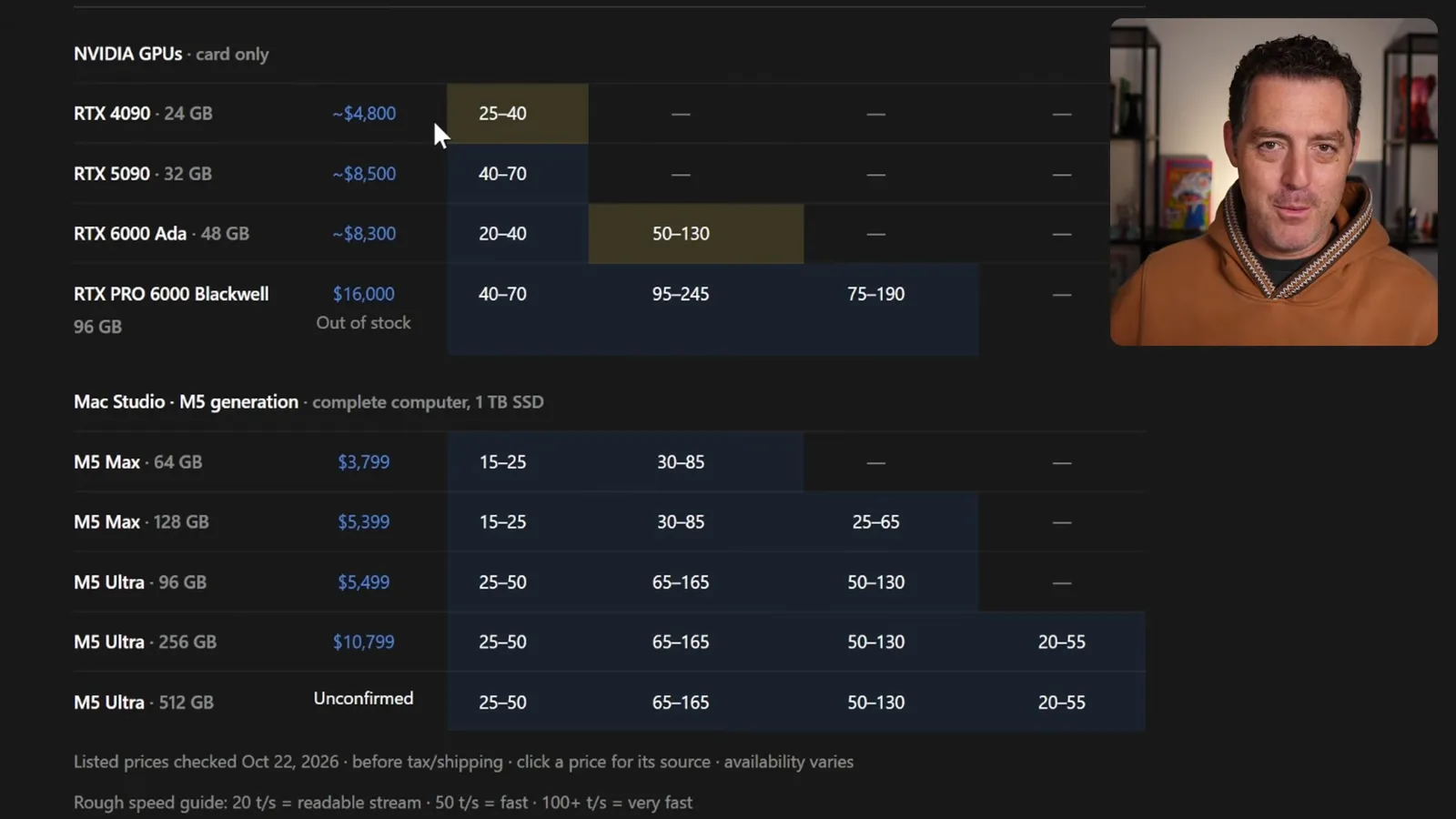
In my table, an RTX 4090 costs about $4,800 and runs a compact Qwen 3.8 27B model at roughly 25–40 tokens per second. An RTX 5090 at about $8,500 reaches 40–70 tokens per second on the same model. That is useful for one stream, but concurrent tasks have to share the hardware.
The table puts an RTX 6000 Ada at around $8,300 and estimates 50–130 tokens per second for Qwen Coder Next. An RTX Pro 6000 Blackwell at $16,000 can be faster still, but buying one is a major commitment. These single-stream estimates should not be mistaken for the same speed per agent when running many agents.
The newest large open-weight models may not fit on these devices without aggressive quantization. Even if the quality sacrifice is modest, it is part of the trade-off. A $16,000 card expected to last three or four years must earn its keep against subscriptions that do not require the same setup and maintenance.
For a Mac Studio with 256 GB or 512 GB of memory, my table estimates around 20–55 tokens per second on a large model. At the top end that may be usable for one task, but advanced users may want several agents working at once. Hardware availability and the quoted prices were uncertain.
Comparing cost and quality
A chart compares local hardware with hosted model costs under a particular workload. Berman discusses supply constraints and open-model incentives.
I plotted cost against benchmark quality under specific assumptions: 1,000 requests a day, each with 4,000 input and 1,000 output tokens, over 30 days. The local estimate amortizes a $4,000 machine over 36 months, assumes no resale value and includes electricity. This comparison depends heavily on those assumptions.
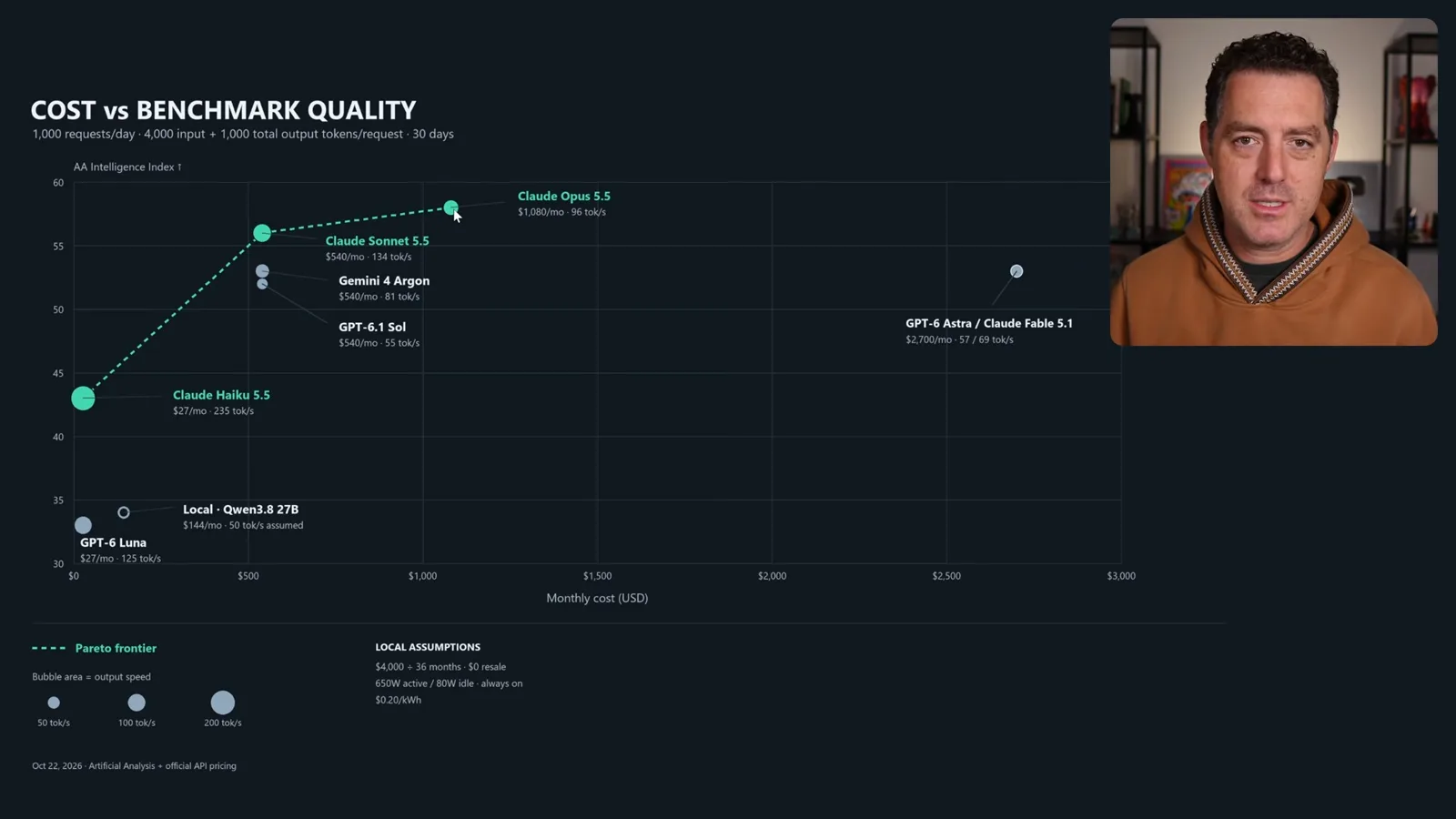
The local Qwen 3.8 27B point comes out at $144 per month, around 50 tokens per second and about 34 on the Artificial Analysis intelligence index. The plotted Claude Haiku 5.5 point is $27 per month and 235 tokens per second, with a higher index score. These are the chart’s scenario estimates, not universal subscription prices.
On my plotted Pareto frontier, the available points are hosted proprietary models. Alongside price and speed, they offer a simple experience: open an app, sync across devices and receive model updates. Those benefits make replacing a hosted service difficult for me, even though I have criticized some of the providers.
One reason the economics are difficult is demand for GPUs and memory from large data centers. In my assessment that constrains supply and raises consumer hardware prices without improving the model or tokens per second that the same chip delivers. The result is a worse calculation for someone buying hardware for home use.
I also see a business-model problem for open-weight labs: training can cost billions, but other providers can serve the resulting weights without paying that initial training bill. NVIDIA has invested heavily in the ecosystem and acquired companies, which I see as a potential backstop for investors. I also point to Chinese open-weight models and describe their funding environment as different.
My concern is that neither setting necessarily gives a lab a strong incentive to release frontier models for people to run at home. An open-weight company may need to earn revenue by serving inference itself. This is my reading of the incentives, not proof that no sustainable business model can exist.
Hobbyists and a hybrid future
He compares local AI tinkering with overclocking and proposes seamless routing between local and cloud models.
Today I think local AI is particularly suited to hobbyists. I run it and enjoy setup, tuning and experimentation, but I still turn to hosted models for much of my real work. It reminds me of overclocking: for many people, the process of extracting performance is itself the appeal.
A local AI enthusiast may need technical knowledge, disposable income, time for maintenance and an interest in the subject. That is fine for a hobby, but I want the benefits—control of data and less concentrated power—to reach people who do not enjoy configuring machines.
My preferred future is hybrid. Microsoft, Apple and Google could integrate local models into their operating systems so ordinary users do not need to think about which model is running. Sensitive documents or an internet outage could be handled locally, with a seamless fallback when the cloud is unavailable.
As smaller models improve and hardware becomes more efficient, more work could move onto the device. I see a similar distinction in enterprise usage between the volume of open-model tokens and the revenue earned by closed-model providers. A local router could choose the right place for each task.
An ambient assistant could handle suitable work locally and send harder requests to the cloud, without making the user manage that decision. Many assistant tasks do not require the strongest model. That is the hybrid vision I think could make local AI useful to a much wider audience.
There are still questions about persistent, separated and secure environments for assistants. Cloud-based agents have appealing always-on environments of their own. I remain enthusiastic about local AI and want it to work, even though its current form does not yet fit how I get my own work done.
同じチャンネルの記事
 25:50EN
 1:03:37EN
 0:53EN
 0:22EN
 45:08EN
 0:32EN