30 秒でわかる
Matthew Berman tests Gemini 4 Argon on a cyberpunk city, a Rube Goldberg machine, a game and an Excel-like prototype. He finds impressive results alongside visual flaws and limitations, and compares published benchmarks with other frontier models.
- 1Cyberpunk cityA short prompt produced an interactive Three.js animation running at 60 frames per second in Berman’s test.
- 2Rube Goldberg machineThe interactive simulation worked, though some clipping and realism problems remained.
- 3Spreadsheet prototypeA browser interface built in about 20 minutes handled basic arithmetic and SUM in a limited test.
- 4Benchmark resultsThe displayed chart reports strong DeepSWE and Vibe Code Bench scores alongside a lower Terminal-Bench score than Opus 5.5.
ポイント
- Argon produced interactive 3D scenes and a playable game, although realism and collision handling needed work.
- A short Excel-like prototype handled basic formulas in a quick test; it was not a full compatibility assessment.
- Reported coding and computer-use benchmarks place Argon among competitive models, with results varying by test.
- Box’s knowledge-work evaluation was presented by a video sponsor.
チャプターごとに整えた全文を読む
Interactive 3D tests
Argon builds a cyberpunk city and a Rube Goldberg machine. Berman praises interactivity while noting visual and physics problems.
I have had access to Google’s Gemini 4 Argon for about a week, and my early tests suggest Google has caught up to the frontier. I asked it to build a detailed cyberpunk city animation in Three.js, with neon lights, tall buildings and a flying car, targeting at least 30 frames per second.
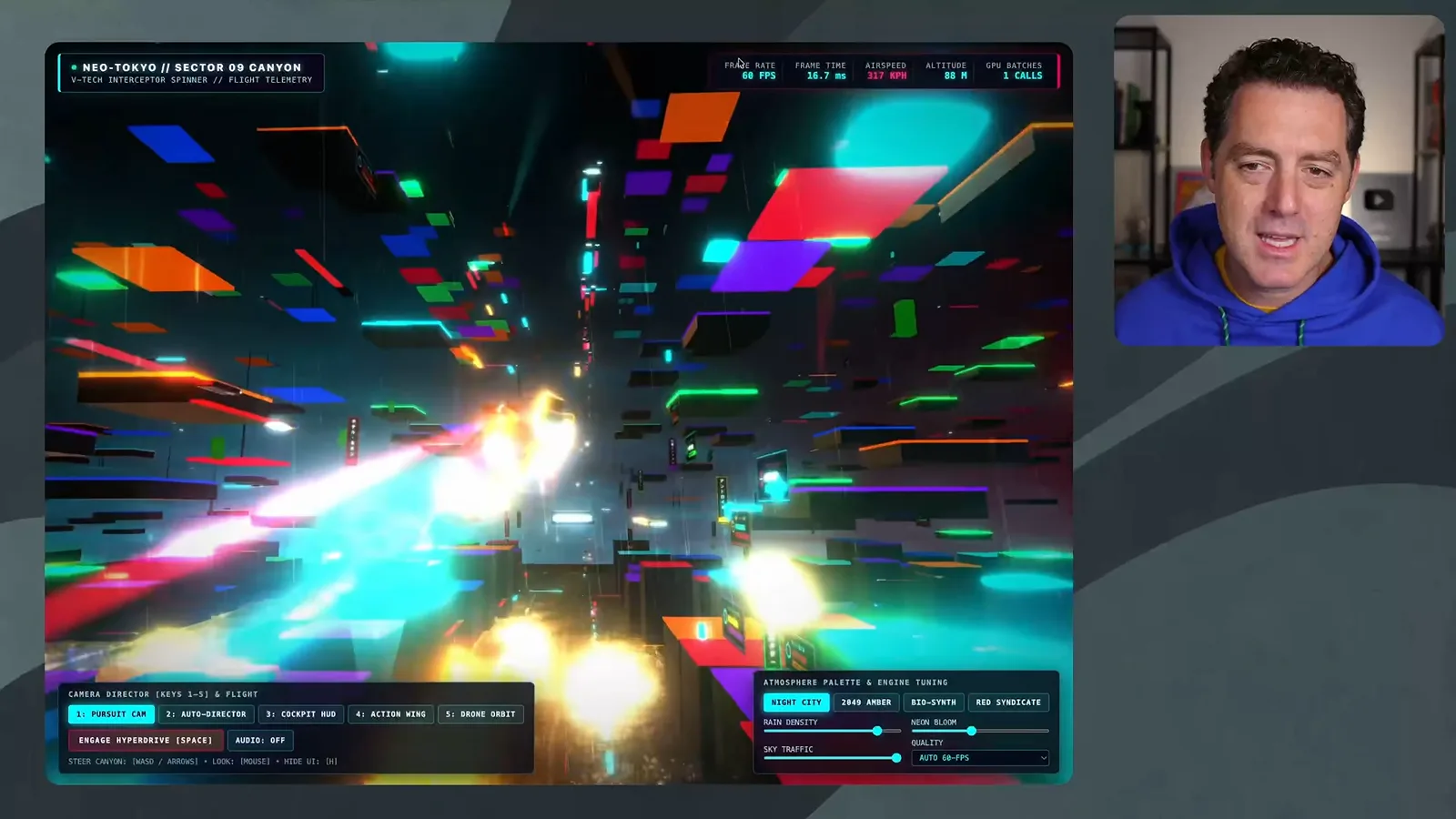
The result easily runs at 60 frames per second in my browser, with buildings, traffic and animated effects. It may overdo the neon, but controls let me adjust bloom, traffic, quality and color themes. A short prompt produced this in about 30 minutes, which is roughly how long Argon often chooses to spend without explicit time guidance.
I do not think Argon’s 3D work is as strong as the best results I have seen from Astra and Opus, though I find it better than Muse Wonder at this task. That is a judgment about these particular visual tests, not a claim that a model weak at 3D cannot be good at coding more broadly.
A Three.js Rube Goldberg machine looks excellent and is interactive: I can move the camera, start the ball, change speed and run individual stages. The ball gets stuck once and I see some clipping, but the domino and pinball effects work well. It took roughly 30 minutes.
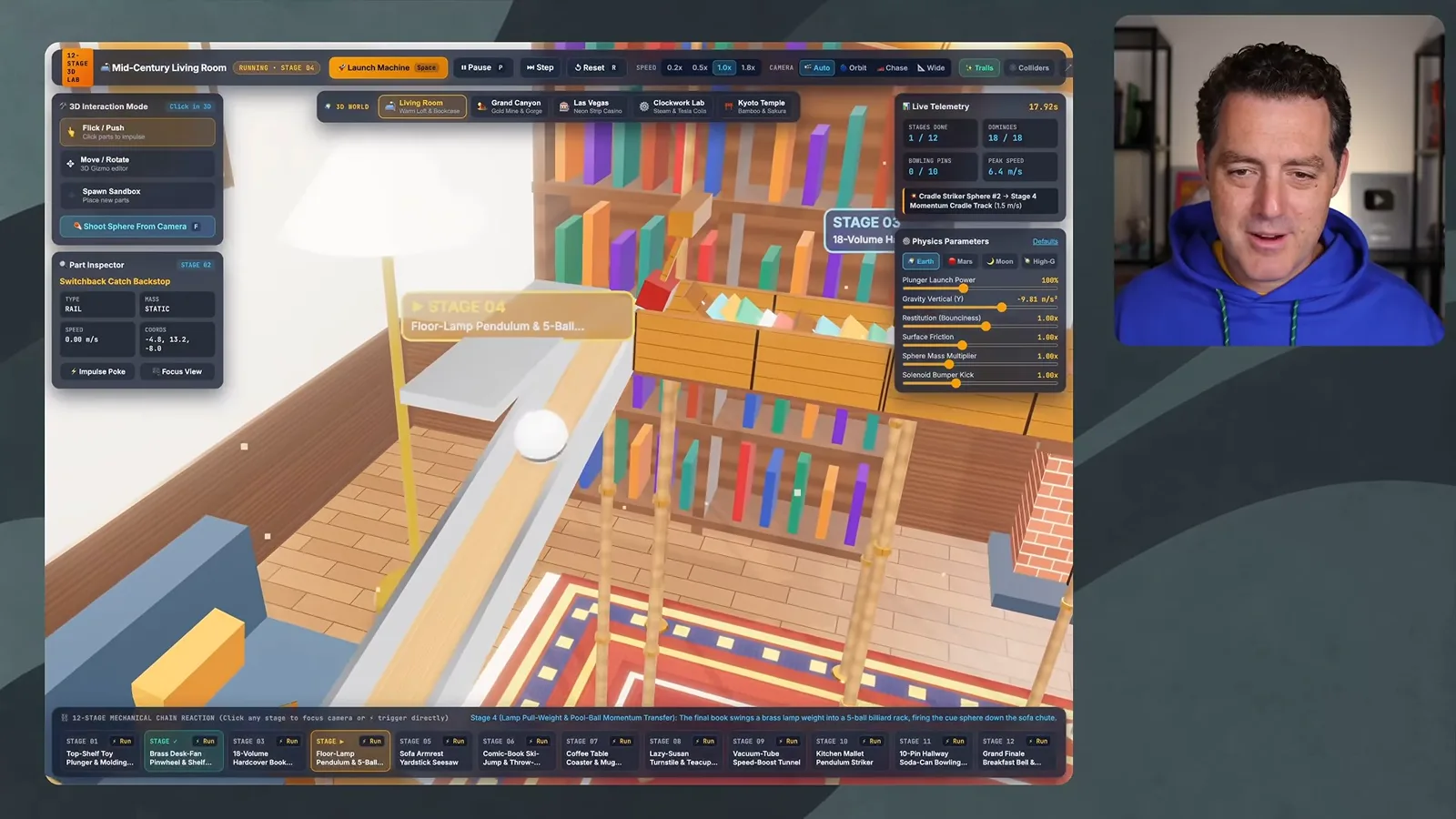
I asked for more complexity and themed levels such as a living room, Grand Canyon and Las Vegas. The model added themes, but they were not especially realistic despite repeated requests for hyperrealism. I wonder whether a different environment such as Unreal Engine or Blender would produce a better visual result.
Knowledge work and games
Sponsor Box presents knowledge-work results. Berman iterates on a playable obstacle game and tests an Unreal Engine boat.
Video partner Box tested knowledge work such as extraction from documents, spreadsheets, presentations and images. In its reported dataset, Argon scored 85% compared with 71% for Gemini 3.1 Pro. Box is a sponsor and the results are its own evaluation; they illustrate a particular set of tasks rather than all possible uses.
I also built a Fall Guys clone. The level was fun and challenging, and the character collisions looked good. The model produced a playable game, although there was still graphic flickering. The final animation looked good as well.
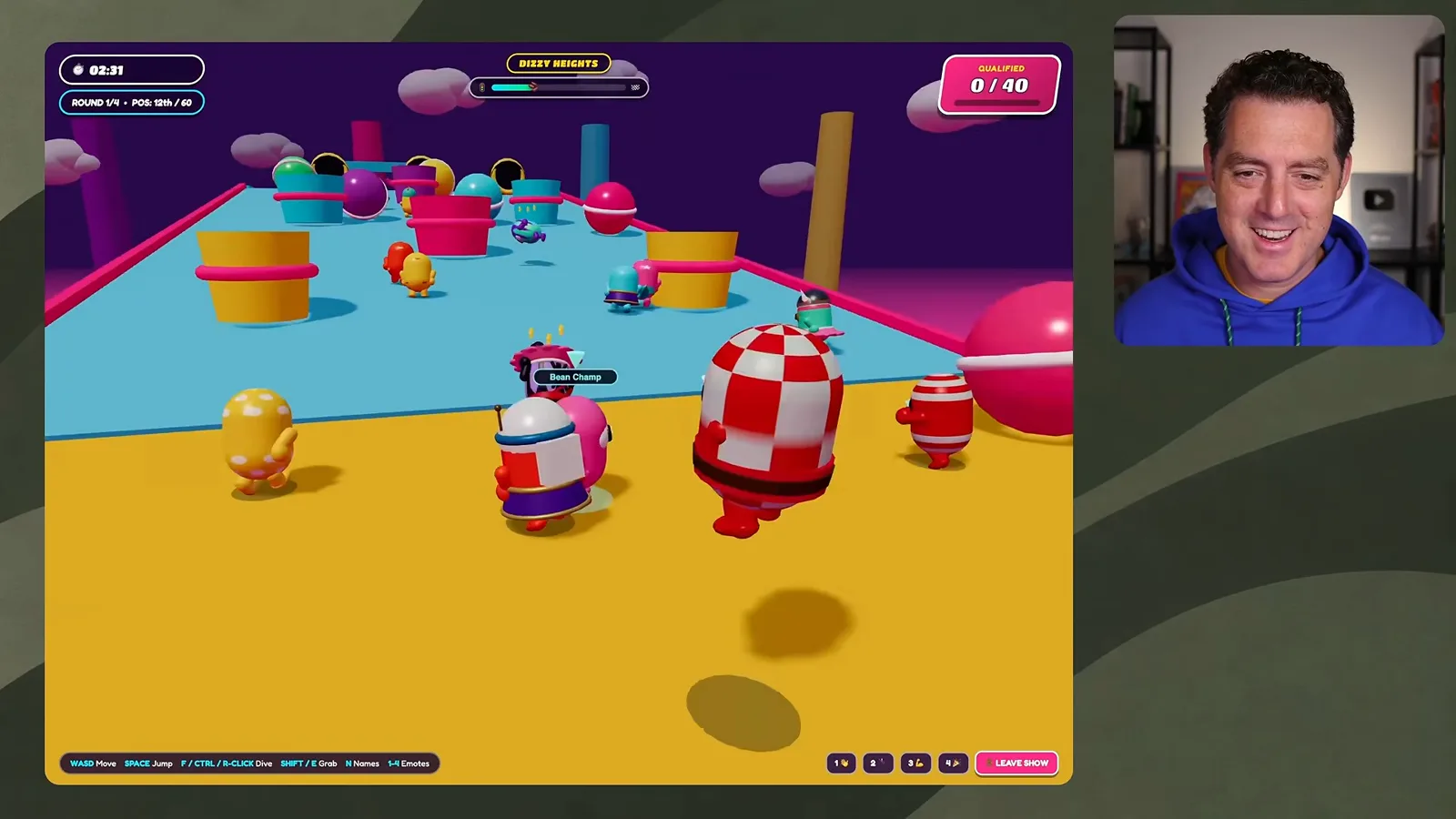
I began with a short request for a full-parity clone, then set a goal to iterate until there were ten complex, fun levels. I asked for bigger levels and better collision handling, including rolling balls. After several rounds of iteration, the result was substantially better, and I compared it with other models’ attempts.
To push 3D further, I asked it to render a boat on an ocean in Unreal Engine. The water and waves look good, though I see repetitive patterns. Unlike some other model-generated scenes I tested, this one did not let me go underwater.
Spreadsheet prototype and benchmarks
A quick Excel-like prototype handles basic formulas. Berman compares coding and computer-use benchmarks from several models.
I then asked Argon to clone Excel without setting an iteration loop. In roughly 20 minutes it inspected Excel on my computer and produced a browser interface that looked convincing. Basic arithmetic and a SUM formula worked in my quick test, although I encountered a small input error along the way.
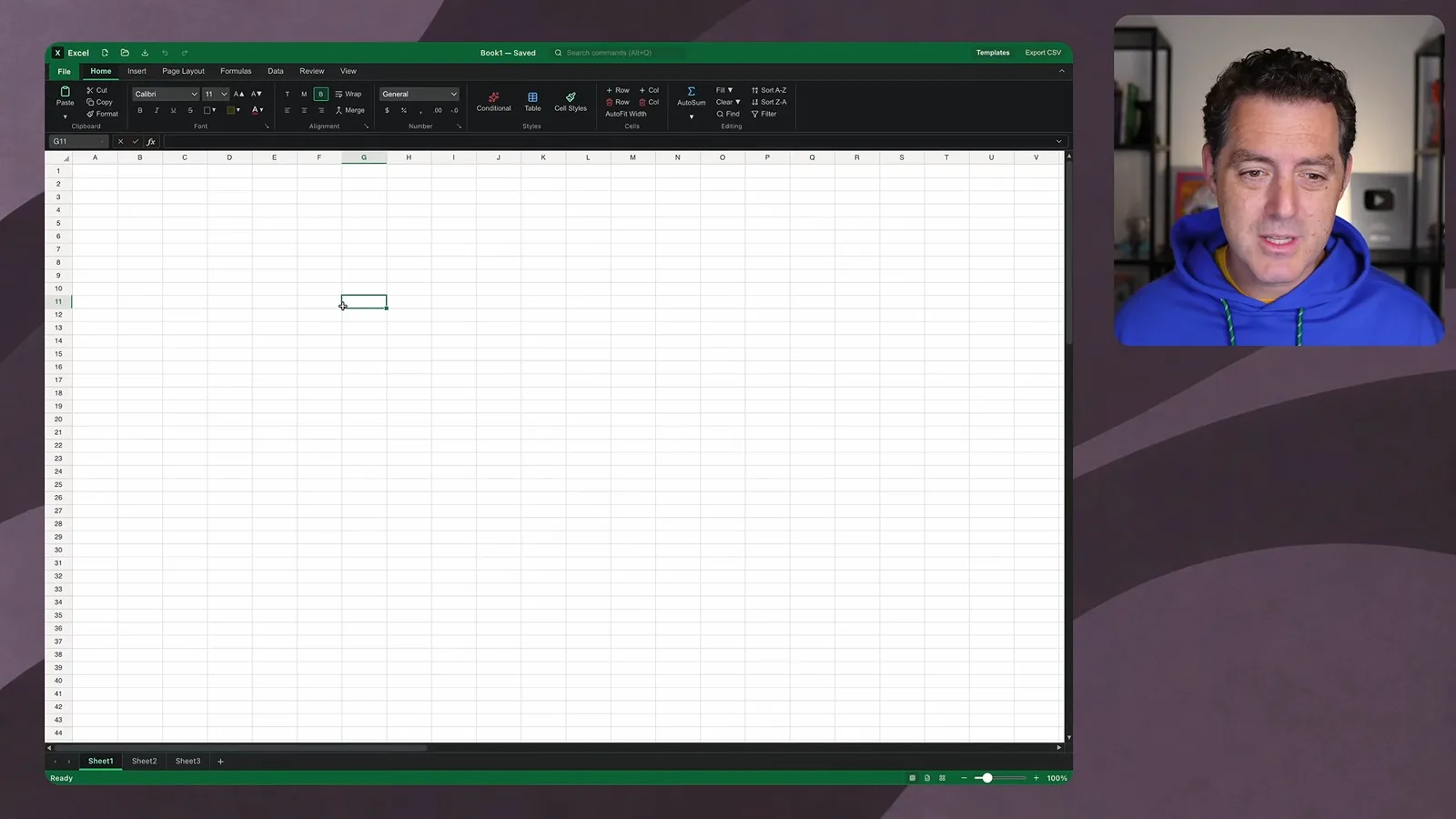
The speed of this prototype makes me think software code alone will become a weaker moat. In my view, products will need services and value that cannot be duplicated simply by asking a model to reproduce an interface. A short demo does not establish full compatibility with a mature spreadsheet product.
Google’s rollout was unusual: it announced the model and benchmarks before the public could use it, while early testers and security researchers received access. The benchmark chart compares Argon with several leading models; I added newer results for Muse Wonder Full and GPT-6.1 Sol.
In the displayed comparison Argon scores 77.9 on DeepSWE 1.1, just behind Muse Wonder Full at 79.0, and 91.9 on Vibe Code Bench. Its Terminal-Bench 4.0 result is 57.4, behind Opus 5.5 at 66.4 and some other models. I regard this as a strong, competitive showing.
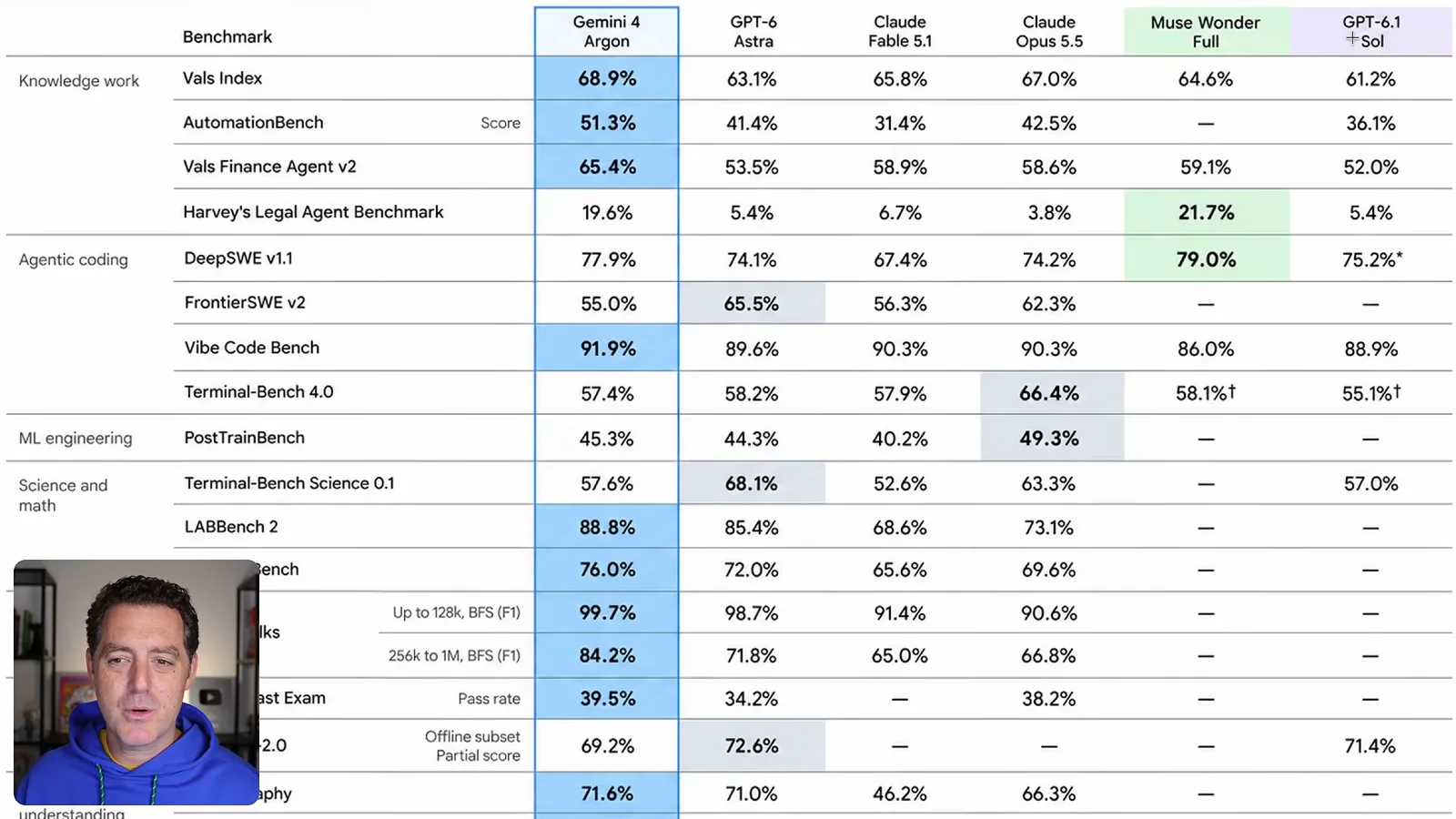
Argon scores 69.2 on the displayed OSWorld measure, close to GPT-6.1 Sol’s 71.4, and about 39.5 on Agents’ Last Exam. These scores are useful comparisons, but the choice of benchmark and evaluation method matters.
I am pleased to see Google, Meta, OpenAI and Anthropic all offering competitive frontier models. My hope is that competition gives users better, faster and cheaper models. For now, the practical demonstrations and the reported benchmarks together make Argon a model worth watching.
同じチャンネルの記事
 25:50EN
 32:20EN
 1:03:37EN
 0:53EN
 0:22EN
 45:08EN