In 30 seconds
Matthew Berman introduces an excerpt of Andrew Ng’s 2024 talk on agentic workflows. Ng discusses four design patterns and the tradeoff between model quality, speed and token costs.
- 1A talk on agentsBerman introduces Andrew Ng and the excerpt.
- 2Four patternsNg names reflection, tool use, planning and multi-agent collaboration.
- 3Speed and costNg considers whether faster tokens from a smaller model can improve some applications.
Takeaways
- Ng identifies reflection and tool use as practical agent patterns.
- He describes planning and multi-agent collaboration as emerging approaches.
- Faster, lower-quality models may be useful in some workflows, depending on costs and task performance.
Read the edited text by chapter
Agent design patterns
Ng introduces four patterns after Berman’s introduction.
Matthew Berman introduces a talk by Andrew Ng about practical approaches to AI agents. Ng says he wants to make the discussion concrete by describing recurring design patterns.
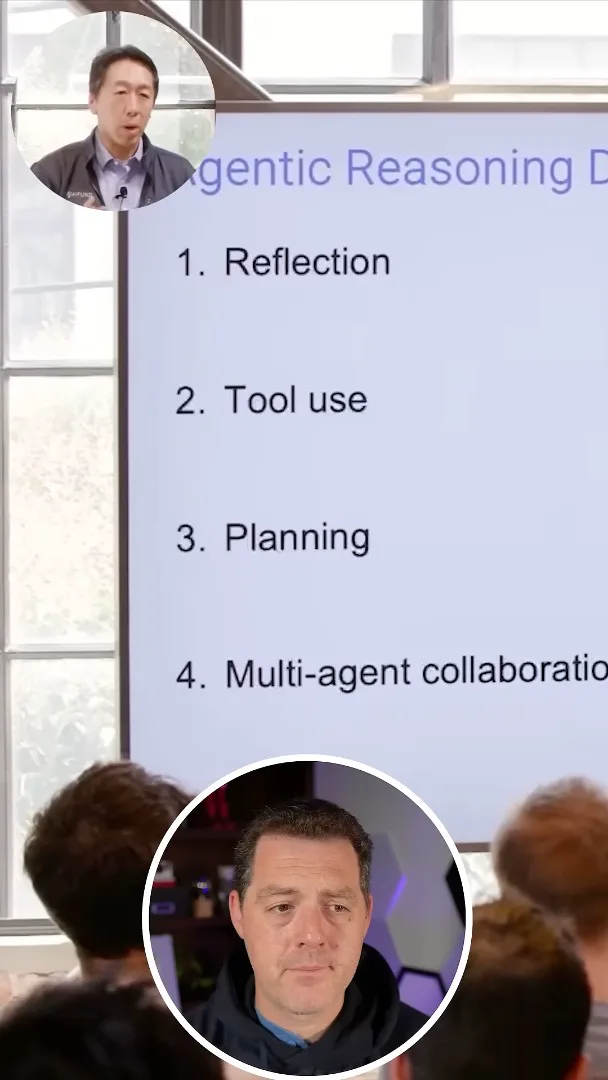
Ng identifies reflection and tool use as useful patterns, while describing planning and multi-agent collaboration as more emerging. He says these methods can sometimes produce surprisingly strong results.
Model speed and cost
He discusses a possible tradeoff between token speed, model quality and cost.
Ng suggests that generating tokens quickly from a somewhat less capable model might work well for some applications compared with a slower, stronger model. He says the cost of those tokens also matters; this is a conditional observation, not a universal benchmark result.
More from this channel
 34:21EN
 Matthew Berman· Oct 27, 2026Matthew Berman Examines Anthropic’s IPO Filing, AI Growth and GovernanceMatthew Berman, Sam Altman · Forward FutureThe presenter reviews the S-1’s financial metrics, compute strategy and voting structure while questioning the tension between rapid AI development and safety.
 0:26ENMatthew Berman· Oct 25, 2026Sam Altman on Human Values and Problem-Solving in an AI WorldSam Altman · OpenAIIn a short interview excerpt, Altman considers the enjoyment of solving hard problems and the human role in interpreting results.
 0:36ENMatthew Berman· Oct 25, 2026Kimi K3.1 and a Rubik’s Cube Solver DemonstrationMatthew Berman · Forward FutureMatthew Berman shows a scrambled virtual cube being solved and gives the Kimi K3.1 test a favorable assessment.
 0:21ENMatthew Berman· Oct 24, 2026An AI-Generated Kimi Benchmark Chart Used Invented ScoresMatthew Berman · Forward FutureMatthew Berman asks for a graph of Kimi K3.1 Pro benchmarks, then discovers that the displayed figures are illustrative placeholders.
 25:50ENMatthew Berman· Oct 24, 2026Kimi K3.1 Pro Tested: Strong 3D Demos, Uneven Results and Competitive PricingMatthew Berman · Forward FutureMatthew Berman tests the open-weight model on coding, 3D rendering and visual explanations, then compares benchmark results and prices.
 32:20ENMatthew Berman· Oct 23, 2026Who Is Local AI For? The Costs, Trade-offs and a Hybrid FutureMatthew Berman · Forward FutureMatthew Berman weighs data control and independence against hardware cost, setup complexity and inference speed.