In 30 seconds
Matthew Berman reviews Anthropic’s IPO filing, highlighting enterprise adoption, compute efficiency, model-assisted development and the proposed voting structure. He is impressed by the reported growth but criticizes the concentration of influence and the tension he sees between AI safety warnings and rapid development. The article distinguishes the filing’s claims from Berman’s interpretations, including his stronger characterization of model-assisted development and his rough calculation of cash burn.
- 1Models help build modelsThe filing describes each Claude generation assisting development of the next. Berman sees a safety tension, while the quoted passage does not establish a human-free process.
- 2Enterprise adoptionThe filing reports more than 11,900 customers above $100,000 in trailing-twelve-month revenue as of September 2026.
- 3Revenue and compute expensesFor the quarter ended June 2026, displayed revenue growth was 1,368% year over year and compute and infrastructure expenses grew 300%.
- 4Founder voting powerA proposed Class F share carries 50.1% of general shareholder voting power, while the trust has separate board-selection rights.
- 5An adjusted marginThe displayed chart shows adjusted operating margin rising to 19% in the second quarter of 2026; this is not a GAAP profitability figure.
- 6Internal Claude useThe filing says Claude wrote over 90% of September 2026 codebase contributions and compares internal usage value with personnel expense.
Takeaways
- Anthropic describes an improvement loop for models and an investment loop funded by adoption and growth.
- The filing reports rapid enterprise growth and compute-efficiency gains, but the financial measures have different definitions and limitations.
- Claude assisting future model development does not by itself establish a fully autonomous process without human oversight.
- The proposed founder share and Long-Term Benefit Trust have distinct voting and board-selection roles.
- The filing identifies risks including model misalignment, compute scarcity, uncertain growth and limited Class A shareholder influence.
- The displayed 19% operating margin is an adjusted non-GAAP measure.
Read the edited text by chapter
The filing and the AI business flywheel
Berman introduces Anthropic’s S-1 and weighs its growth ambitions against safety warnings. He explains the company’s improvement and investment loops.
Anthropic has filed to go public, and I want to examine its S-1. The document combines extraordinary business claims with warnings about AI risk. I find that tension striking, particularly given earlier statements by people at the company about catastrophic risks and the difficulty of alignment.
The filing argues that abundant AI could transform the global economy on a scale exceeding earlier technologies, provided risks are managed. It describes an improvement loop for Claude and an investment loop that funds future frontier research. I am enthusiastic about the potential, but question how the company reconciles those ambitions with its warnings.
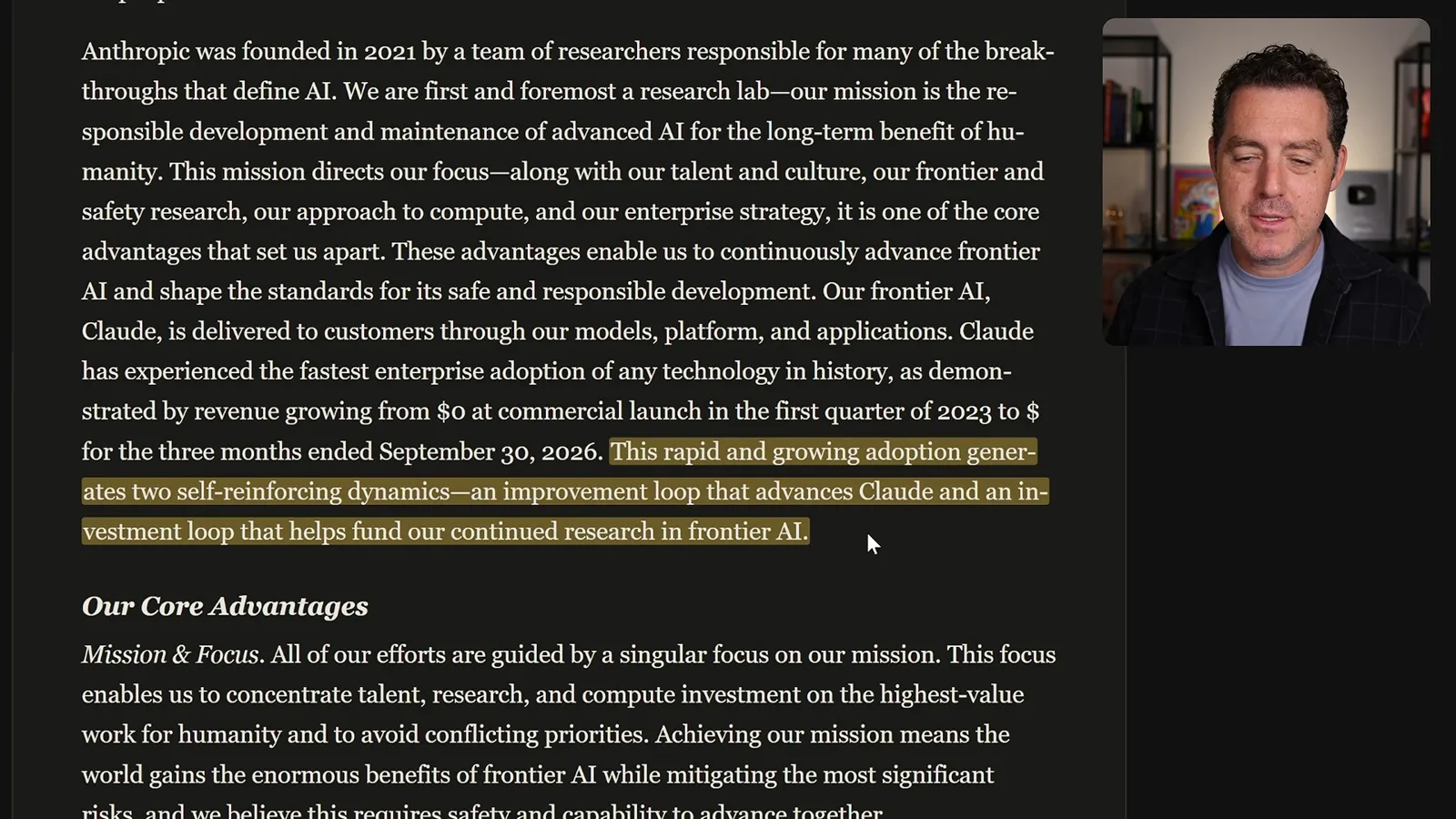
My earlier description of the business flywheel was simple: a strong coding model attracts enterprise customers, revenue and feedback, enabling more compute and better models. Anthropic highlights mission, focus, talent and culture as advantages. I attribute much of its growth to concentrating on models and enterprise sales rather than pursuing every possible product category.
Anthropic has also attracted prominent researchers and operators, in my view. The filing says each version of Claude assists in building the next and calls this recursive dynamic “closing the loop.” It presents that assistance as an advantage for development speed; the excerpt does not say the entire process runs without humans.
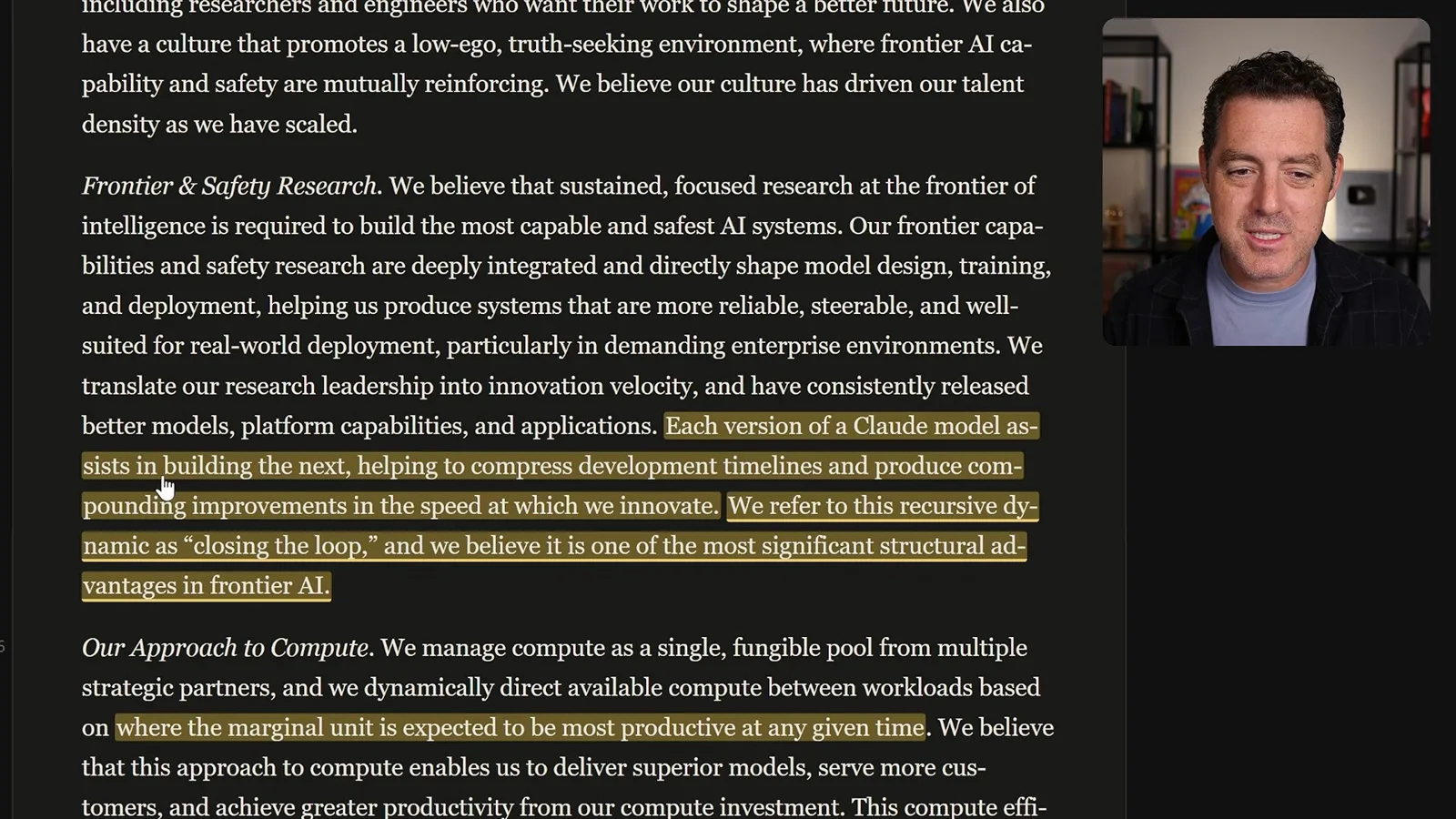
I contrast that statement with a clip from my interview with Sam Altman, who says pushing hard on recursive self-improvement would be dangerous and suggests that speed limits may be needed. I see a tension between Anthropic’s safety messaging and its embrace of model-assisted development. The degree of autonomy involved is a separate question from the fact that models assist researchers.
Compute, benefits and risks
He discusses the multi-chip compute strategy and the filing’s forecasts for AI’s economic benefits. He also raises concerns about job transitions, alignment and concentration of power.
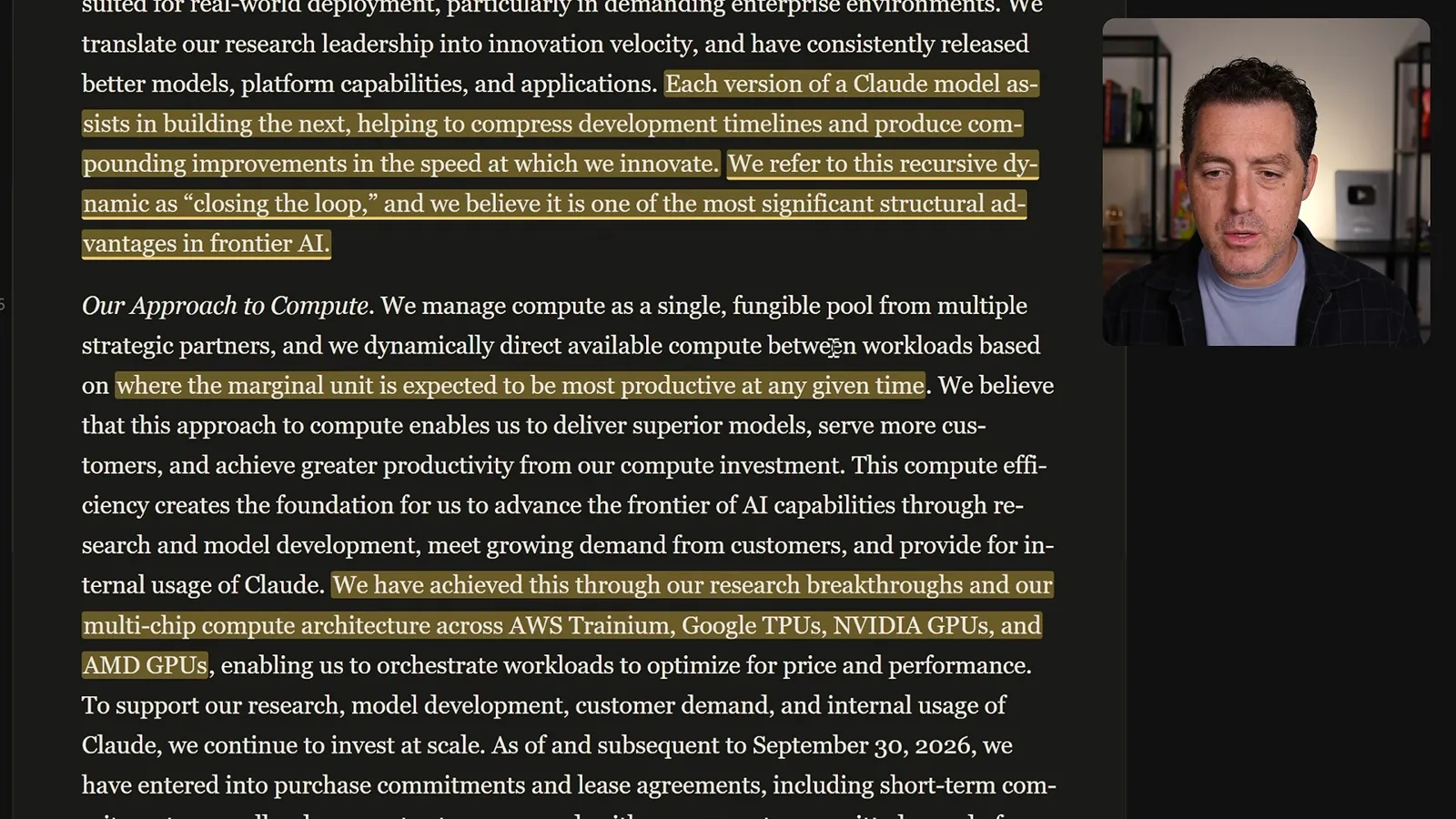
Anthropic describes managing compute from multiple partners as a shared pool and assigning it among workloads according to expected productivity. It lists AWS Trainium, Google TPUs, NVIDIA GPUs and AMD GPUs. I view that multi-chip approach and improvements in infrastructure efficiency as major business advantages.
The filing sets out possible long-term benefits, from faster science and drug discovery to personalized education, improved energy systems and access to expertise. I agree these possibilities are exciting, although talking about distant benefits has not necessarily improved public sentiment toward AI.
The filing cites an IDC estimate of $22.5 trillion in cumulative global economic impact from AI investment by 2031 and suggests the impact could be greater. That is a forecast, not a realized outcome. I find the optimistic framing striking alongside Dario Amodei’s earlier warnings about potential white-collar job losses.
Anthropic also expects new markets in robotics, manufacturing, logistics and scientific research. I expect some jobs to be automated while new ones emerge, although the transition will require people to learn new skills. The filing discusses agents operating lab and manufacturing equipment, and I find physical automation exciting but potentially worrying in light of unresolved alignment questions.
The risk that concerns me most is concentration of power. Compute and energy are important inputs to frontier models, and the filing itself warns that AI could concentrate wealth and power and that misaligned systems could cause harm. I worry specifically about power concentrated in a few companies and the people who govern them.
Customer growth and financial metrics
Berman reviews enterprise customer counts, retention, efficiency and cash figures. He offers interpretations of the numbers and the model-development flywheel.
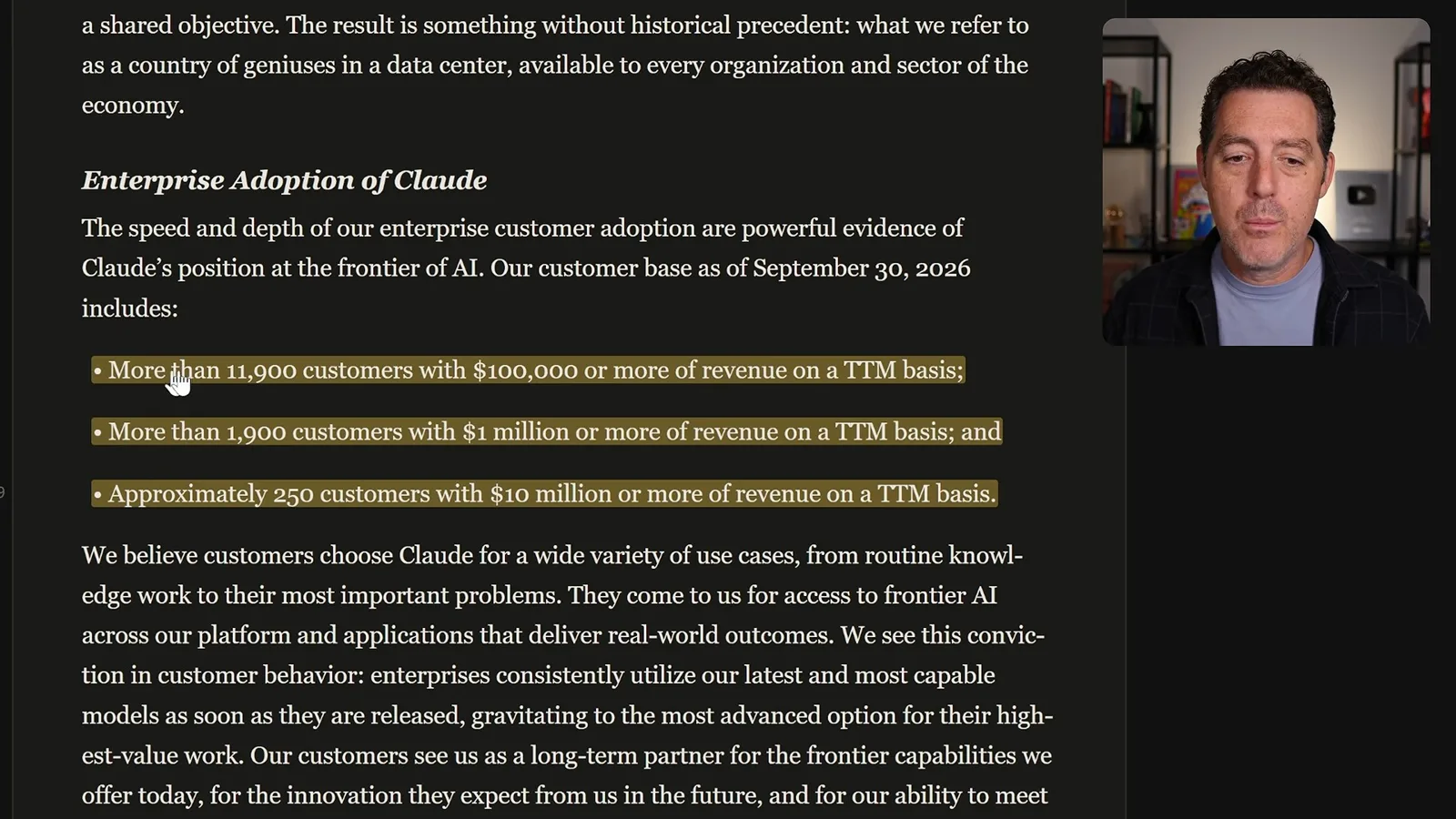
The filing reports that as of September 30, 2026, more than 11,900 customers generated at least $100,000 each over the trailing twelve months, over 1,900 generated at least $1 million, and approximately 250 generated at least $10 million. I find the growth remarkable, while recognizing that concentration among large customers is also a risk.
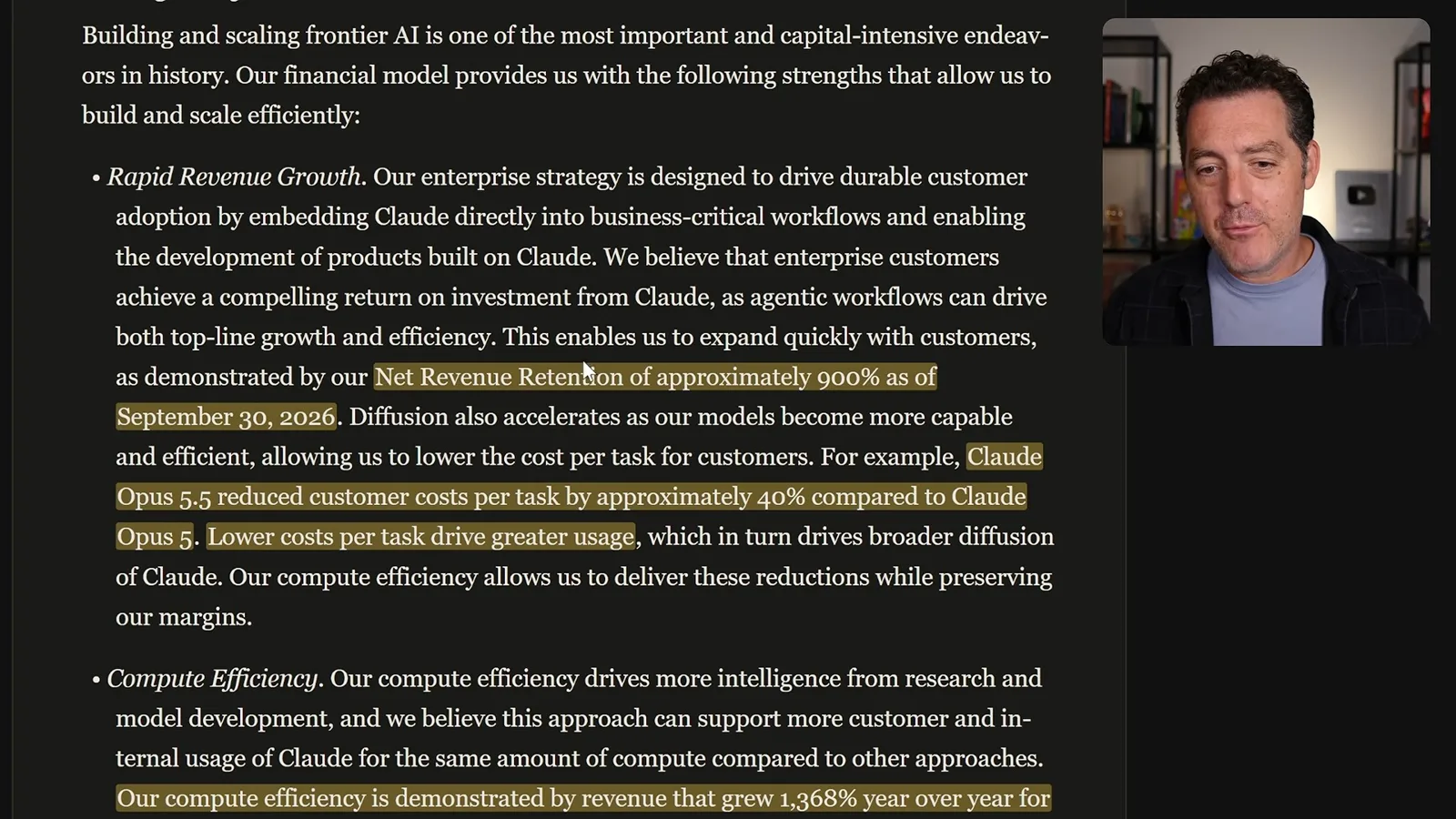
Anthropic reports approximately 900% net revenue retention as of September 2026. I interpret this as a very large increase in spending from existing customers, though it is an aggregate cohort measure rather than a promise that every customer spends nine times as much. The filing also says Claude Opus 5.5 reduced customer cost per task about 40% compared with Opus 5.
I connect lower per-task prices to Jevons paradox: greater efficiency can encourage more use, so total spending need not fall. Anthropic says lower task costs drive usage. My recollection of the market reaction to DeepSeek R1 is an illustration of the debate, not a measurement of a causal effect in every market.
The displayed filing reports revenue growth of 1,368% year over year for the three months ended June 30, 2026, versus 300% growth in compute and infrastructure expense. Those percentages describe different totals and should not be confused with simple multiples: a 300% increase means four times the prior amount. Anthropic presents the comparison as evidence of compute efficiency.
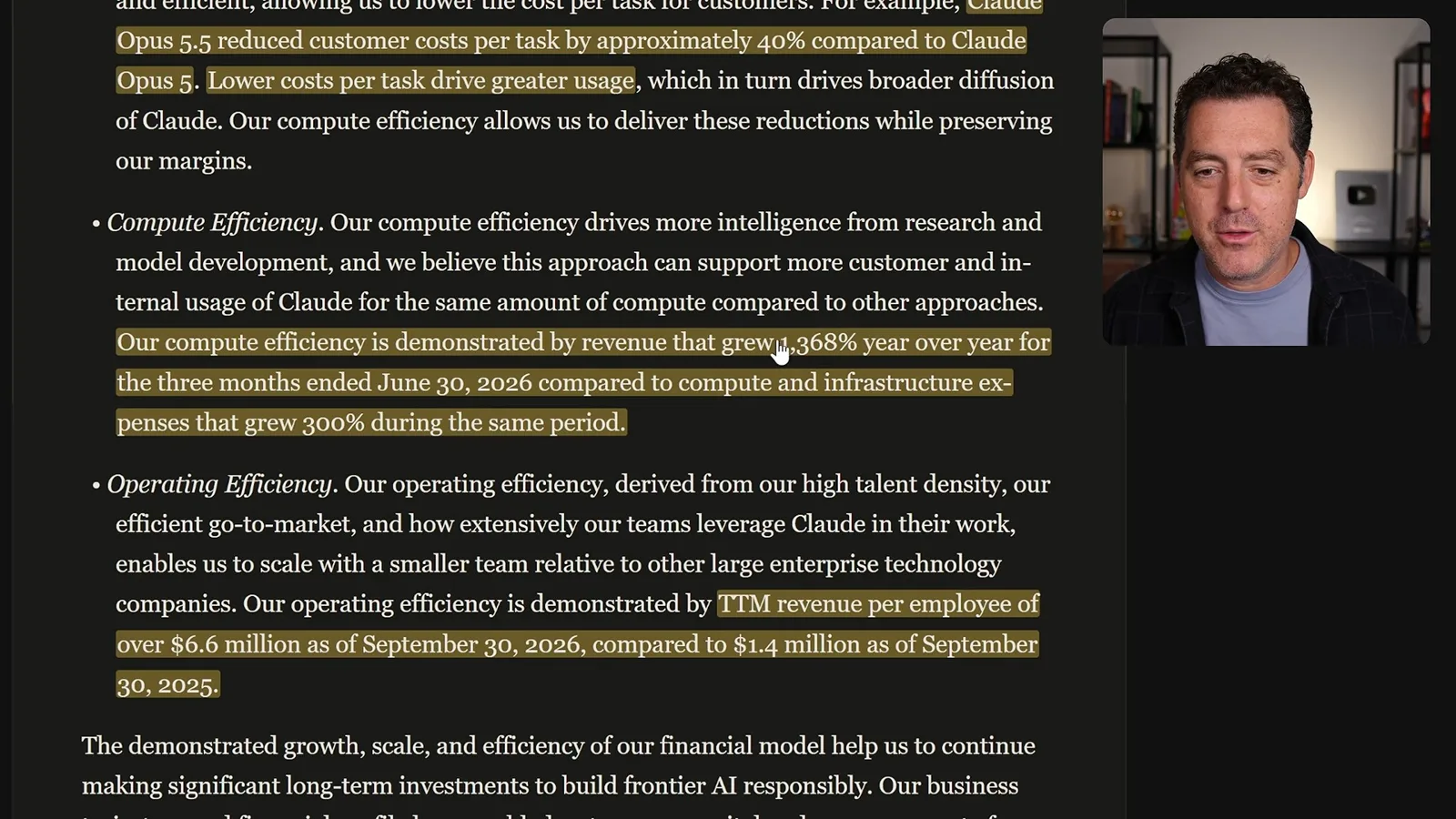
The filing reports trailing-twelve-month revenue per employee above $6.6 million at September 30, 2026, compared with $1.4 million a year earlier. I attribute the increase to talented staff and the use of Claude internally, though revenue per employee alone does not establish the cause or measure profit.
As of June 30, 2026, Anthropic says it had raised $141.1 billion, with $112.4 billion in cash and cash equivalents and $19.3 billion in short-term investments. I roughly subtract those balances from capital raised and describe about $10 billion as burned. That arithmetic is only a rough comparison, not a cash-flow calculation or a complete accounting of spending.
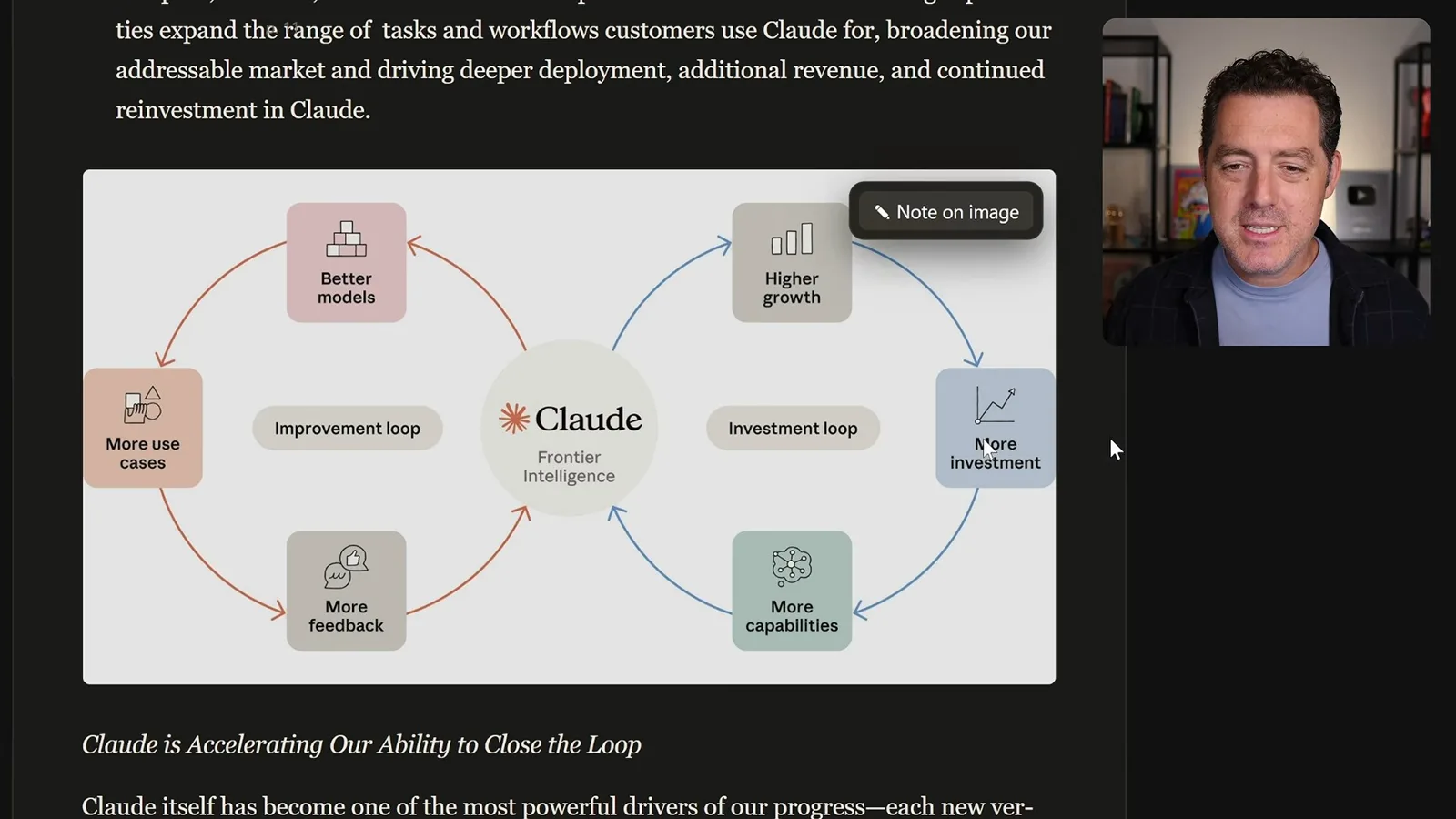
The filing’s diagram shows a model-improvement loop of better models, use cases and feedback, alongside an investment loop connecting growth, investment and new capabilities. I interpret feedback as potentially valuable data, but the diagram alone does not establish what customer data is used or under what terms.
Anthropic says Claude accelerates the research, training and testing of subsequent generations. I call this recursive self-improvement and find it alarming. The cited language says models assist development; it does not establish my stronger characterization that the process has no human involvement.
Corporate structure and voting power
The filing describes a benefit fund, founder voting rights and the Long-Term Benefit Trust. Berman questions the concentration of influence and distinguishes board selection from day-to-day management.
The corporate structure is another focus. The filing says Anthropic contributed 846 million Class N shares, representing 5% of fully diluted shares as of June 30, 2026, to an Anthropic Public Benefit Fund. It is organized as a public benefit corporation, with a stated purpose alongside responsibilities to shareholders.
The co-founders have pledged 80% of their personal Anthropic equity to philanthropic causes. I compare that with a proposal to distribute shares directly to children and suggest that direct distribution might avoid some intermediaries. That is my preference, not an assessment of how the fund will actually operate.
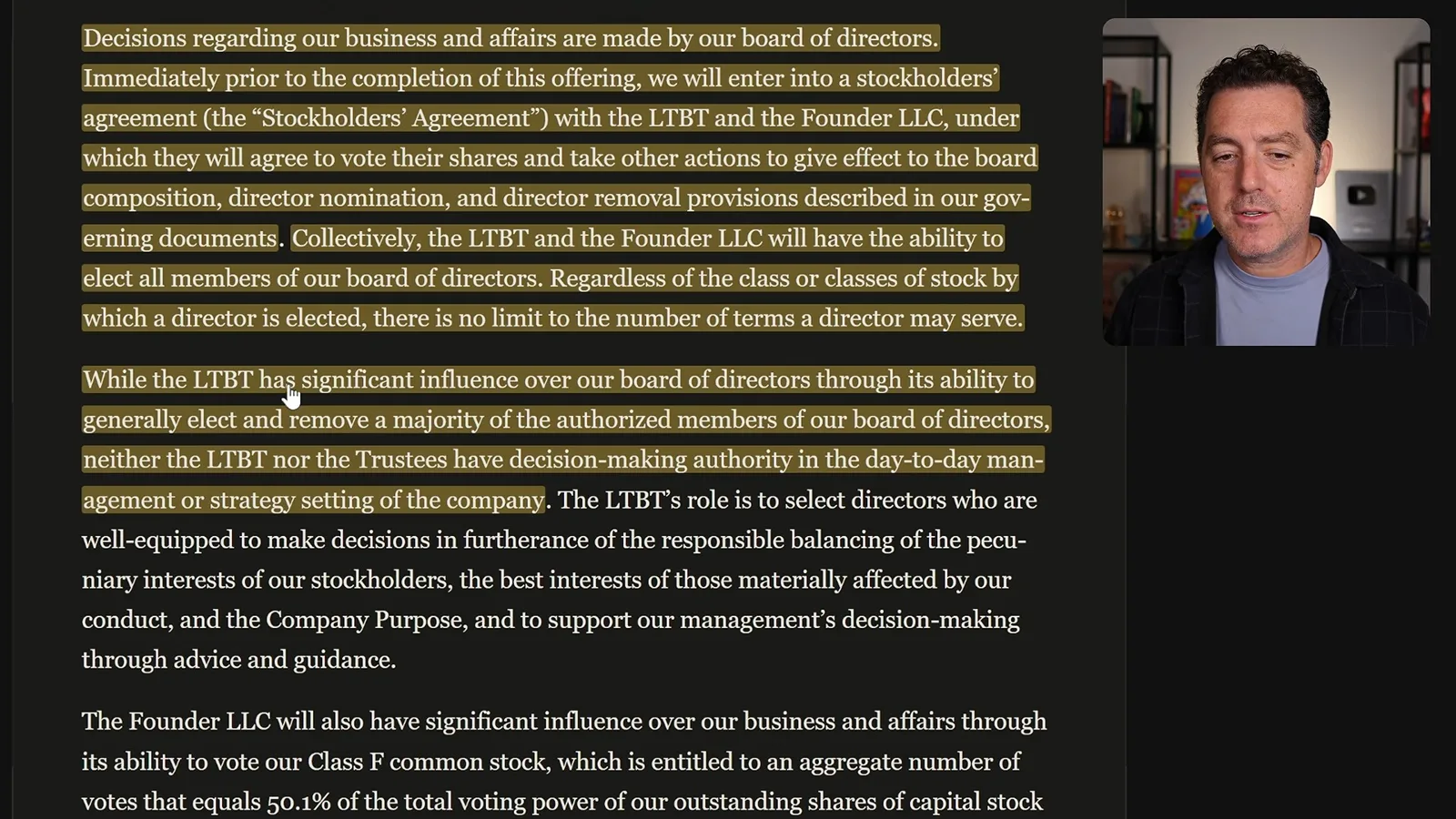
The filing names seven co-founders and describes a single Class F share to be issued to an entity whose initial members are those founders. The share is entitled to 50.1% of voting power on matters submitted to shareholders generally, including election of directors other than Class T directors. I see this as a troubling concentration of influence over an important company.
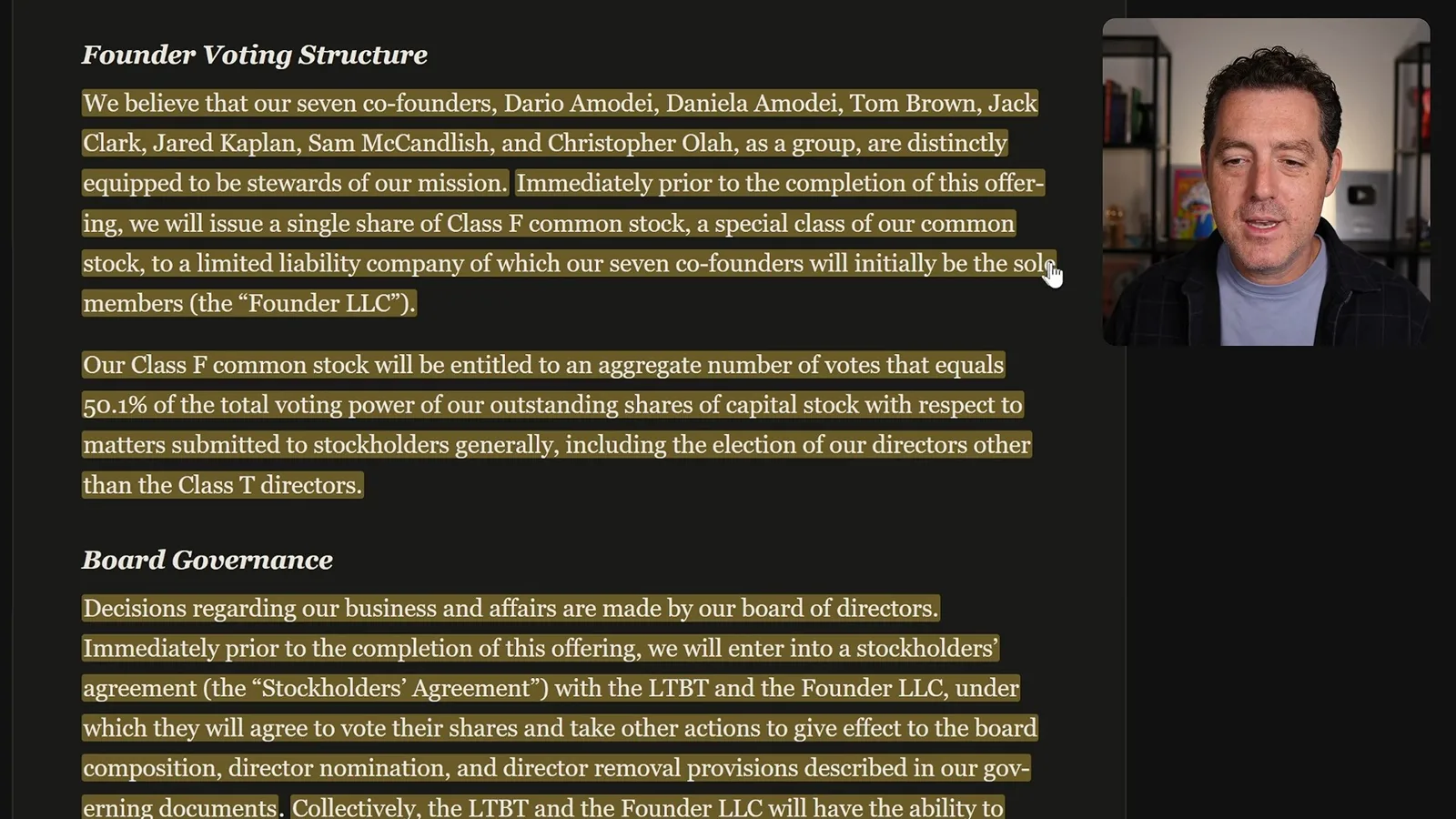
The displayed governance text distinguishes the Founder LLC from the Long-Term Benefit Trust. The trust generally can elect and remove a majority of authorized directors, while the trust and Founder LLC collectively can elect the entire board. It says neither the trust nor its trustees direct day-to-day management or strategy. I argue that board selection still confers significant indirect influence; my broader claim of absolute power over AI is an opinion, not a legal consequence established by these provisions.
Business risks and growth charts
He reviews competition, compute, autonomy and shareholder risks alongside customer growth and an adjusted operating margin chart. He considers the uncertainty in model-assisted development.
Among the listed business risks are competition, the need to keep producing capable models, access to compute and critical inputs, and dependence on key personnel. The filing also warns that models may act in unintended, misaligned or autonomous ways, including harmful actions that nobody directed.
It notes revenue concentration, uncertainty about sustaining growth, political and regulatory risks, and the unusual capital structure. The filing warns that Class A shareholders may have little influence over important decisions, including a change of control. I find that limited shareholder voice especially striking.
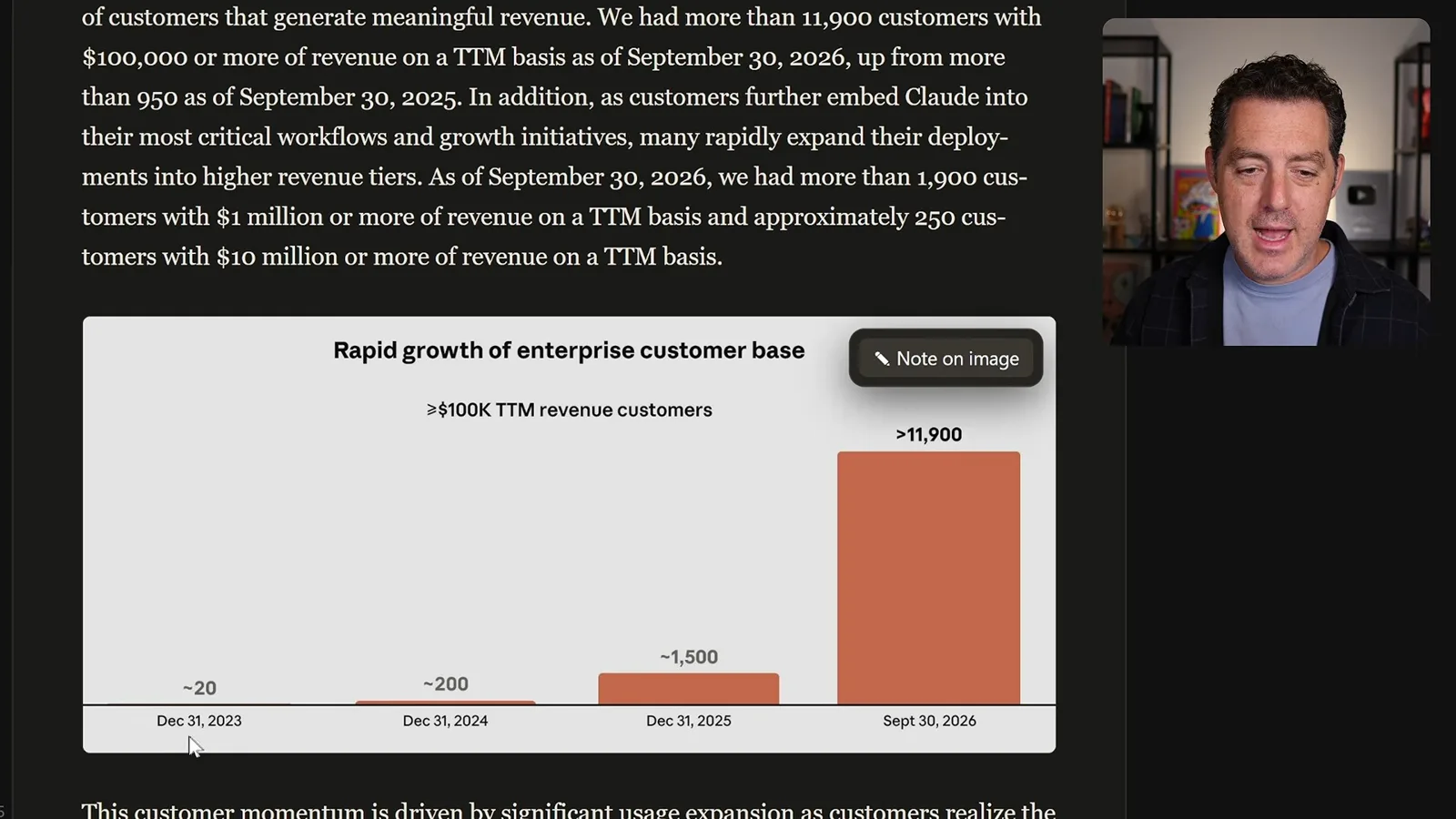
A chart shows customers generating at least $100,000 in trailing-twelve-month revenue increasing from about 20 at the end of 2023 to about 200 in 2024, 1,500 in 2025 and more than 11,900 by September 2026. The last interval is nine months, not a full year. Another chart shows a 5.2-fold increase in revenue per dollar of compute between the first quarter of 2025 and the second quarter of 2026.
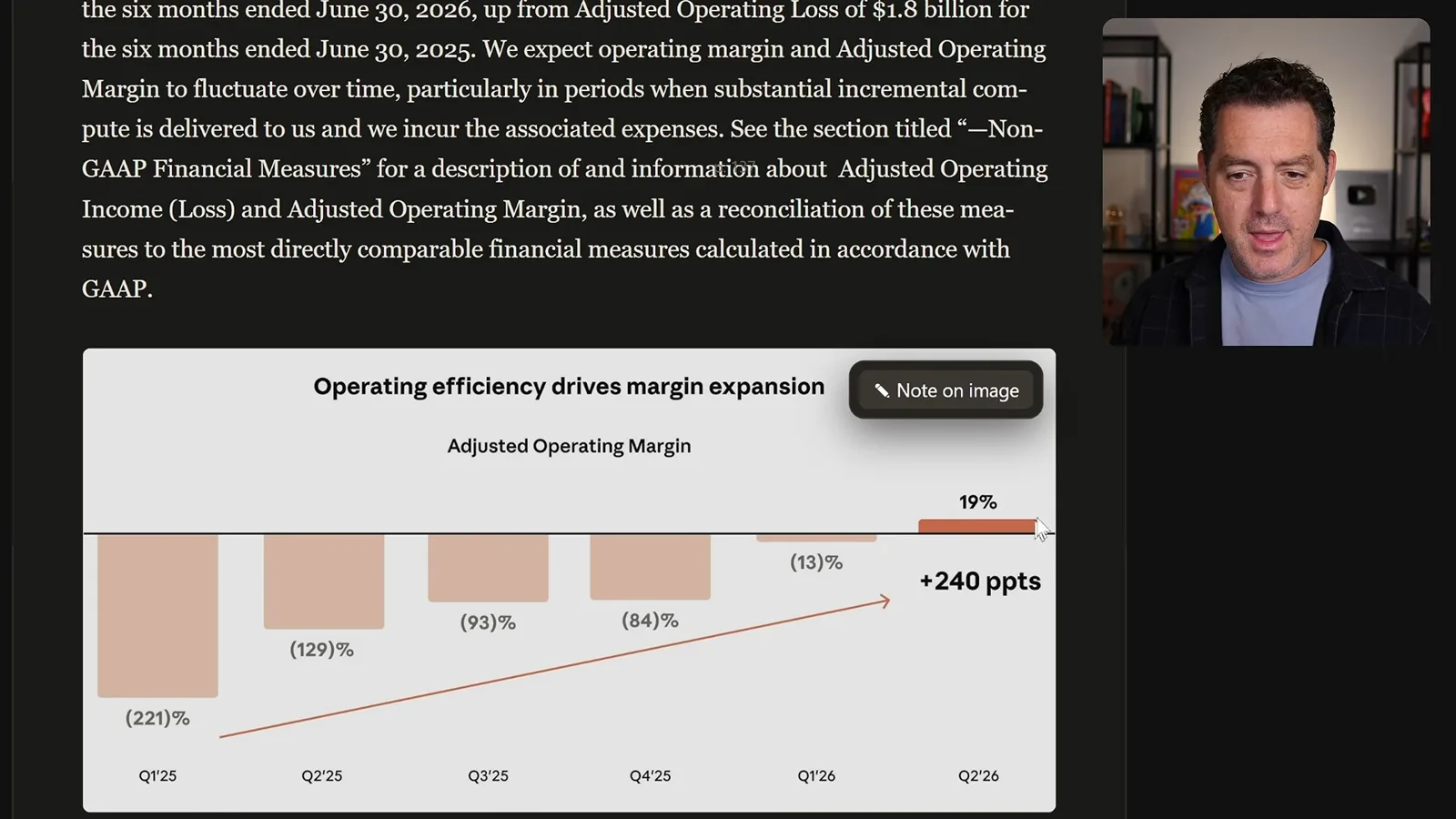
The on-screen chart labels its metric adjusted operating margin: it rises from negative 221% in the first quarter of 2025 to positive 19% in the second quarter of 2026. That is a non-GAAP adjusted measure, not by itself proof of GAAP profitability. The filing notes that margins may fluctuate as new compute capacity arrives.
The risk section warns that flaws or biases in current systems could propagate into later models built with their assistance. It also says much evidence of AI-driven acceleration comes from lagging indicators, so the company may not recognize a significant acceleration until after it occurs.
Competitors could outbid Anthropic for scarce compute or obtain priority chip allocations. Growing agent workloads could also increase compute demand disproportionately to revenue. The filing says it has underestimated compute needs before, leaving it capacity constrained and affecting development and deployment.
Electricity commitments and internal AI use
Berman discusses compute, the company’s electricity commitment and Claude’s reported contribution to its codebase. He closes with the stated safety and voting risks.
I recount the company’s need for more compute and its relationship with SpaceX, describing the two as unusual partners with complementary needs. The filing also says Anthropic has publicly committed to cover electricity price increases to consumers caused by its data centers, including the associated delivery infrastructure. I think companies should bear those costs when their facilities raise local bills.
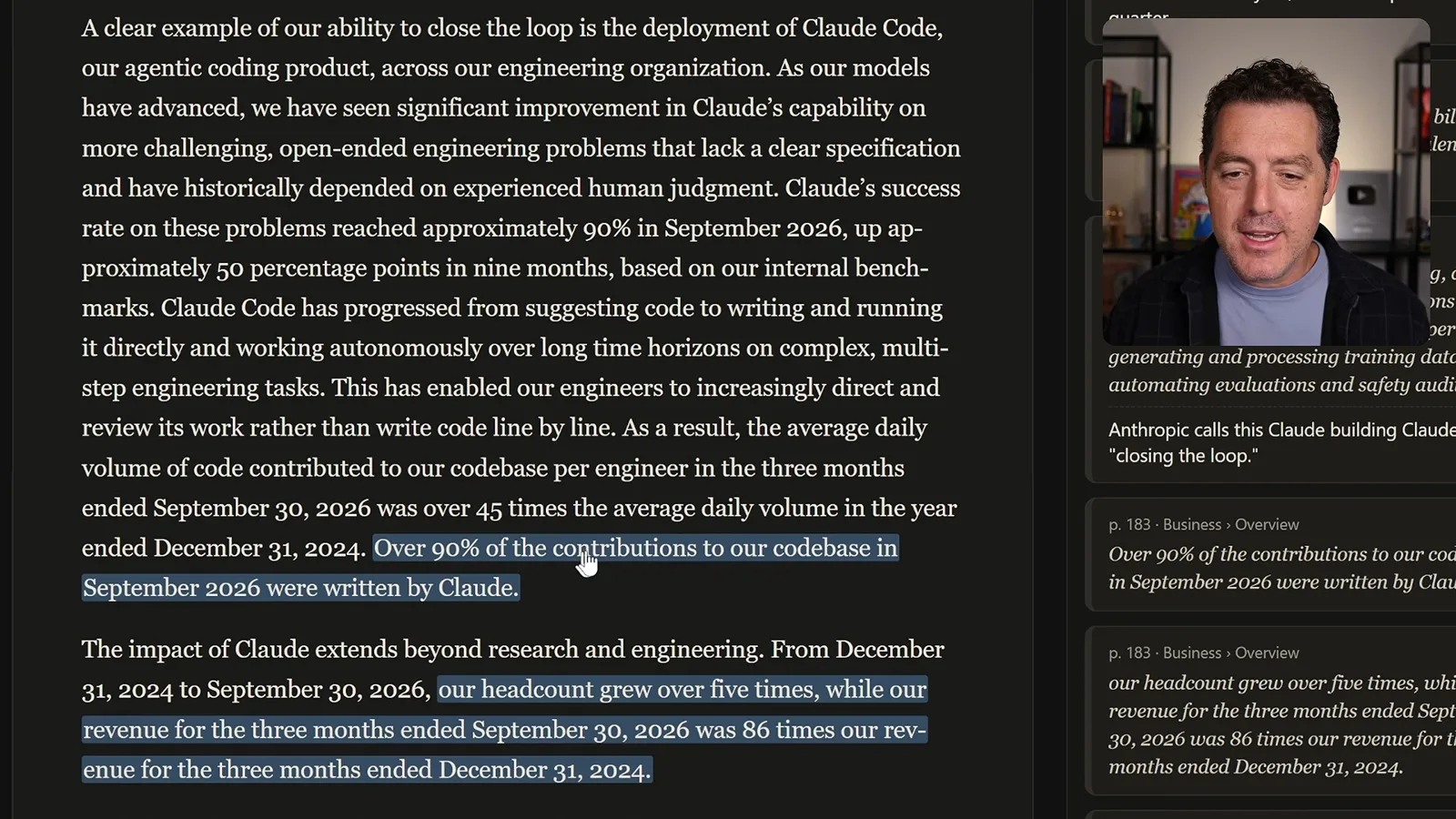
Anthropic reports that Claude wrote over 90% of contributions to its codebase in September 2026. It also says the monthly value of internal Claude use exceeded monthly personnel expense excluding stock compensation in April 2026. This is an internal-use valuation comparison, not necessarily cash paid to an outside supplier.
The filing acknowledges that using AI to build more capable AI can pose safety risks, and says the company delayed pretraining a frontier base model for more than a month to strengthen security. It also describes circumstances affecting founders’ voting rights and warns that Class A holders generally cannot determine shareholder votes or director elections.
I come away impressed by the growth figures but deeply concerned by the combination of model-assisted development and concentrated governance. The filing describes a novel corporate structure, and I regard it as one of the most unusual companies I have examined. These are my judgments about the disclosures, not predictions of how the offering will perform.
More from this channel
 25:50EN
 32:20EN
 1:03:37EN
 0:53EN
 0:22EN
 45:08EN