Andrew Ng on Four Agentic AI Design Patterns

A short excerpt identifies reflection, tools, planning and multi-agent collaboration as approaches to building AI agents.

ANAndrew NgVortrag
Kanal
Matthew Berman
Veröffentlicht
13. Mai 2024
Video
1:00
Lesezeit
1 Min.
Folien
1
Original
Englisch
Auf YouTube öffnen
Beim Scrollen schrumpft das Video in die rechte untere Ecke und läuft weiter. Untertitel folgen Ihrer Lesesprache.
LesespracheIn 2 Sprachen verfügbar
Diesen Artikel gibt es noch nicht auf Deutsch, daher wird das Original (Englisch) angezeigt.
ZUSAMMENFASSUNG

In 30 Sekunden

Matthew Berman introduces an excerpt of Andrew Ng’s 2024 talk on agentic workflows. Ng discusses four design patterns and the tradeoff between model quality, speed and token costs.

  1. 1A talk on agentsBerman introduces Andrew Ng and the excerpt.
  2. 2Four patternsNg names reflection, tool use, planning and multi-agent collaboration.
  3. 3Speed and costNg considers whether faster tokens from a smaller model can improve some applications.

Das Wichtigste

  1. Ng identifies reflection and tool use as practical agent patterns.
  2. He describes planning and multi-agent collaboration as emerging approaches.
  3. Faster, lower-quality models may be useful in some workflows, depending on costs and task performance.
VOLLTEXT

Den bearbeiteten Text nach Kapiteln lesen

Nur das Transkript
01

Agent design patterns

Ng introduces four patterns after Berman’s introduction.

Matthew Berman introduces a talk by Andrew Ng about practical approaches to AI agents. Ng says he wants to make the discussion concrete by describing recurring design patterns.
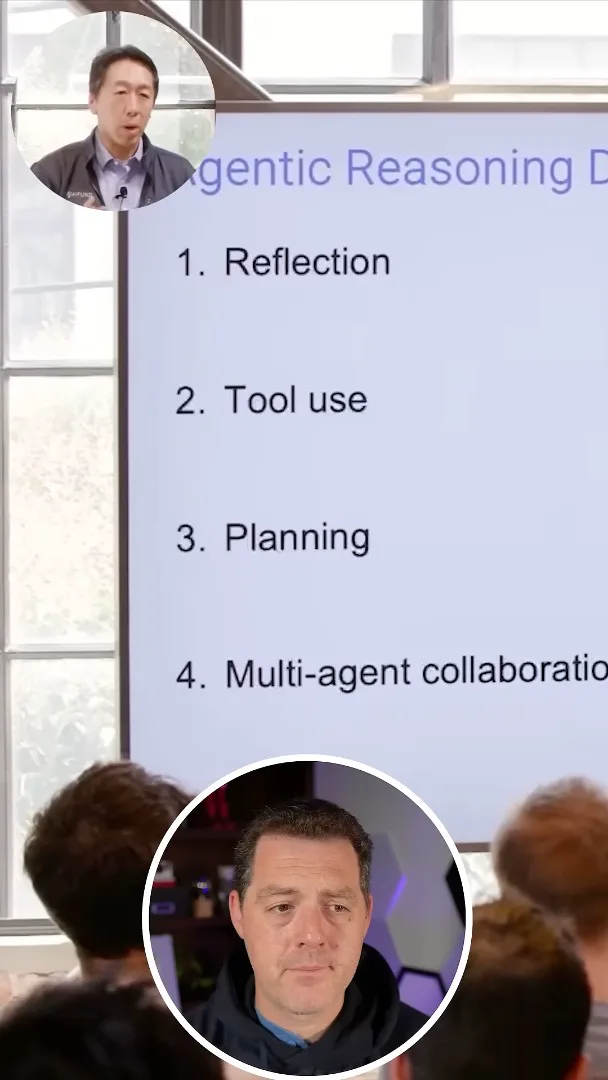
Four agentic reasoning patterns
FOLIE 1 / 1Four agentic reasoning patternsThe slide lists reflection, tool use, planning and multi-agent collaboration.

Ng identifies reflection and tool use as useful patterns, while describing planning and multi-agent collaboration as more emerging. He says these methods can sometimes produce surprisingly strong results.

02

Model speed and cost

He discusses a possible tradeoff between token speed, model quality and cost.

Ng suggests that generating tokens quickly from a somewhat less capable model might work well for some applications compared with a slower, stronger model. He says the cost of those tokens also matters; this is a conditional observation, not a universal benchmark result.

Mehr aus diesem Kanal

6 Folien25:50EN
MBMatthew Berman· 24. Okt. 2026Kimi K3.1 Pro Tested: Strong 3D Demos, Uneven Results and Competitive PricingMatthew Berman · Forward FutureMatthew Berman tests the open-weight model on coding, 3D rendering and visual explanations, then compares benchmark results and prices.Open-weight modelsBenchmarksAI cost & performance+1
2 Folien32:20EN
MBMatthew Berman· 23. Okt. 2026Who Is Local AI For? The Costs, Trade-offs and a Hybrid FutureMatthew Berman · Forward FutureMatthew Berman weighs data control and independence against hardware cost, setup complexity and inference speed.Local inferenceOpen-weight modelsAI cost & performance+1
6 Folien1:03:37EN
MBMatthew Berman· 23. Okt. 2026Matthew Berman’s Team Tests Kimi K3.1 on Animation, Games, and ChartsMatthew Berman, Alex, Brian · Forward FutureA live team AMA turns into an informal test of Kimi K3.1, from personal-agent workflows to motion graphics, a browser game, and a benchmark chart.Coding-AgentenGenerative mediaEvals+2
0:53EN
MBMatthew Berman· 22. Okt. 2026Sam Altman on AI and the Discovery of New KnowledgeSam Altman · OpenAIAltman expects progress in mathematical discovery to extend to biology, materials and energy.AI for scienceMathematicsComputational Biology+1
Folien0:22EN
MBMatthew Berman· 21. Okt. 2026A Robot Bodyguard Video Shows Dramatic Rescue ScenariosMatthew Berman · Forward FutureMatthew Berman reacts to a short robot demonstration depicting fighting and vehicle-rescue scenarios.RoboticsEvals
45:08EN
MBMatthew Berman· 21. Okt. 2026Sam Altman on AI Discovery, Consciousness, Compute and a Human-Centered FutureMatthew Berman, Sam Altman · Forward FutureIn a conversation with Matthew Berman, Altman discusses scientific progress, personal assistants, recursive self-improvement and the importance of human agency.AI for sciencePersonal agentsConsciousness+2