30 秒でわかる
Matthew Berman reacts to OpenAI's GPT-4o image-generation demonstration and shares his own early tests. He highlights image transformations, text in images, and conversational edits, while noting slow generation and mistakes in details, spelling, and image editing. The video is a launch-era snapshot rather than a current product comparison.
- 1Styles and visual examplesBerman shows transformations of photographs into several styles and generated infographics, emphasizing their creative possibilities.
- 2Multimodal generationOpenAI's launch demonstration describes working with text and image context in the same conversational workflow.
- 3Hands-on editsBerman tests transformations and follow-up edits, finding both impressive results and unwanted changes to details.
- 4Known limitationsThe launch page lists cropping, hallucinations, complex compositions, graphing, multilingual text, and editing precision as challenges.
ポイント
- The launch integrated image generation into a multimodal conversational workflow.
- Reference images and follow-up requests enabled style transformations and iterative edits in the examples shown.
- Clear text rendering improved in some demos, but Berman also found spelling and detail errors.
- The launch material listed limitations including cropping, hallucinations, complex object binding, graphing, and multilingual text.
- Generation speed, availability, and model behavior in the video reflect March 2025 conditions.
チャプターごとに整えた全文を読む
Early image examples
Berman shows style transformations, generated graphics, and edited images from the launch.
Matthew Berman opens with a rapid tour of images generated or transformed using OpenAI's GPT-4o image feature. Examples include versions of photographs in animation, voxel, watercolor, and toy-like styles, as well as an intentionally humorous neural-network infographic. These show possibilities for visual experimentation, not evidence that every generated image is accurate.
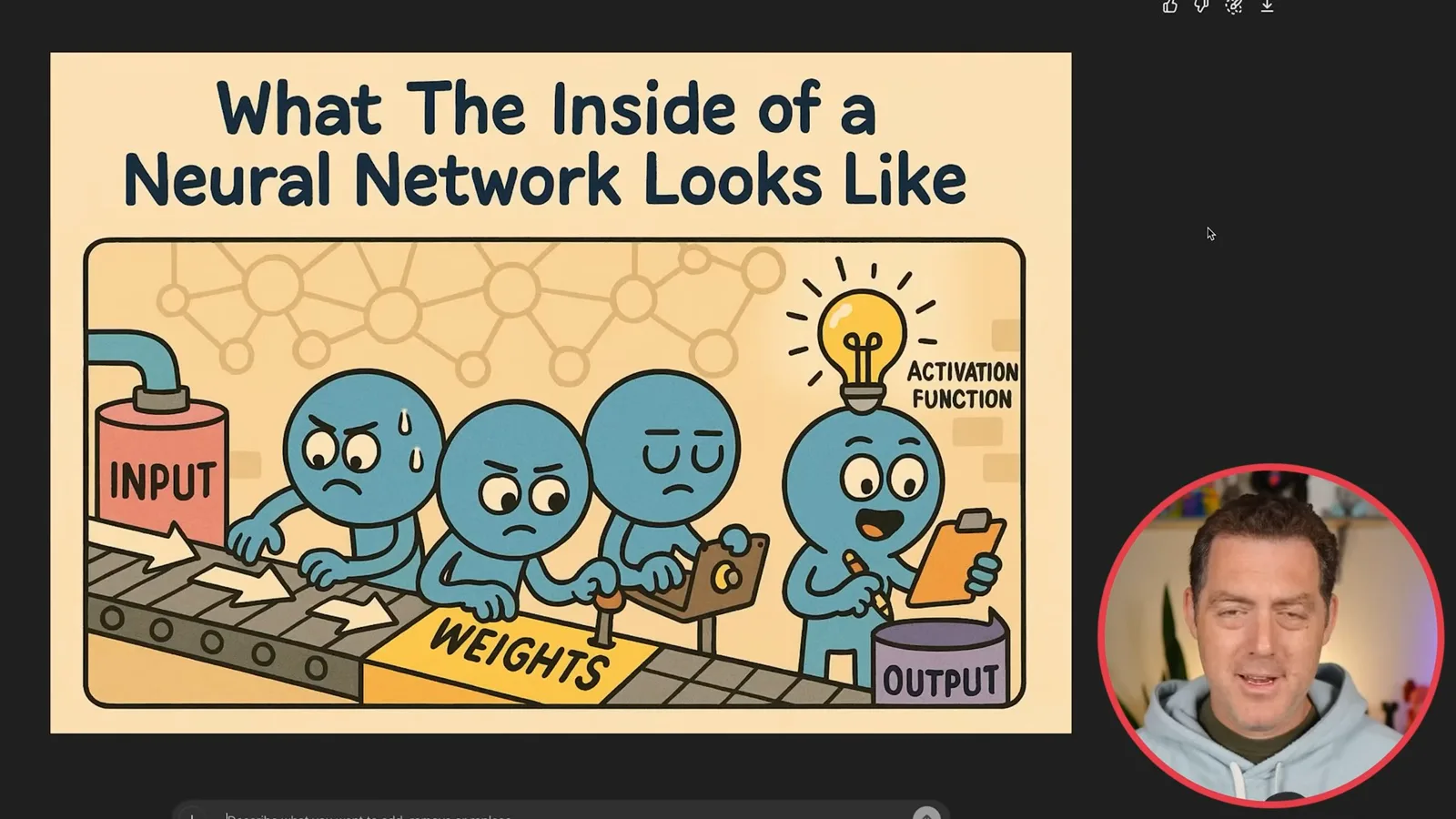
He also shows colorization, a fabricated Wikipedia-style image, and product-design concepts. The realistic-looking page is generated rather than an actual encyclopedia article, illustrating both creative potential and the importance of not treating a convincing image as proof of a real source.
OpenAI's launch demonstration
The presenters demonstrate native image generation, text rendering, and editing from an image reference. Berman notes the waiting time.
Berman plays portions of OpenAI's launch stream, where the presenters introduce native image generation in GPT-4o. He criticizes the model-specific interface and naming at the time, asking why image generation was not simply available across the chat experience. The interface and model choices in this video are historical and may have changed.
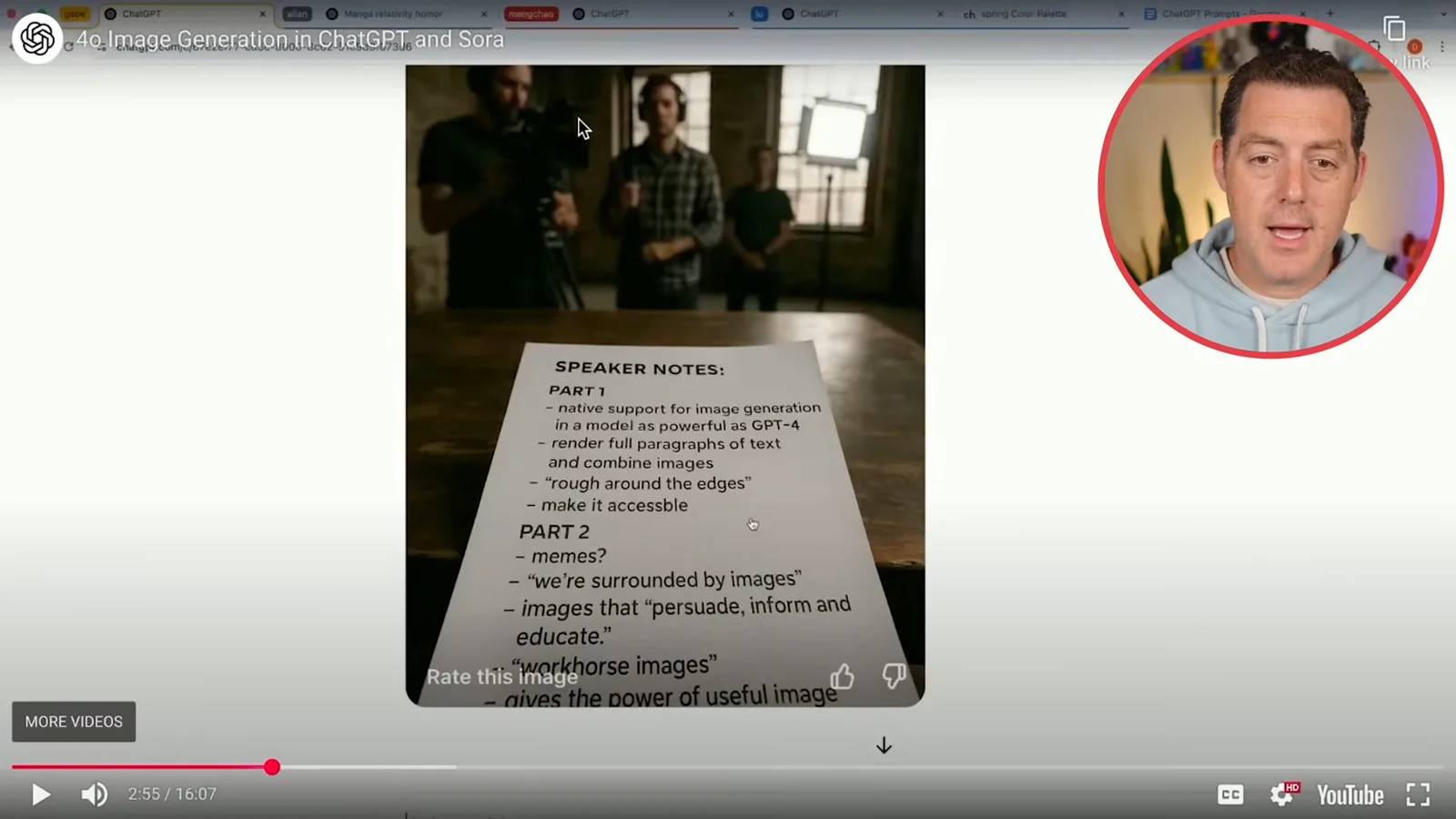
OpenAI's team shows a generated image containing speaker notes and discusses its ability to render extended text and combine visual context. Berman distinguishes a multimodal system from a separate image-only workflow, but admits he does not know the exact architecture. His speculation about diffusion should not be taken as a confirmed description of the model.
Berman is impressed by text, lighting, and visual details in the notes image, but says generation can take minutes in his early testing. OpenAI's presenters say the model had required refinement and could still make errors. Speed and quality depend on the system and conditions at the time of the demonstration.
The team uploads a group selfie and asks for an animated-style frame, combining the image with a text request. They then turn it into a meme. Berman likes the overall resemblance but notices a hand orientation has changed, an example of how an edit can preserve some details while altering others.
Berman discusses the appeal of a multimodal model that can work with image, text, and audio context. He contrasts direct audio processing with workflows that transcribe speech into text and then synthesize audio, noting that conversions may lose information such as tone. The launch demo itself focuses on images.
Manga, cards, and a commemorative coin
OpenAI's team combines text instructions and reference images to create several visual formats.
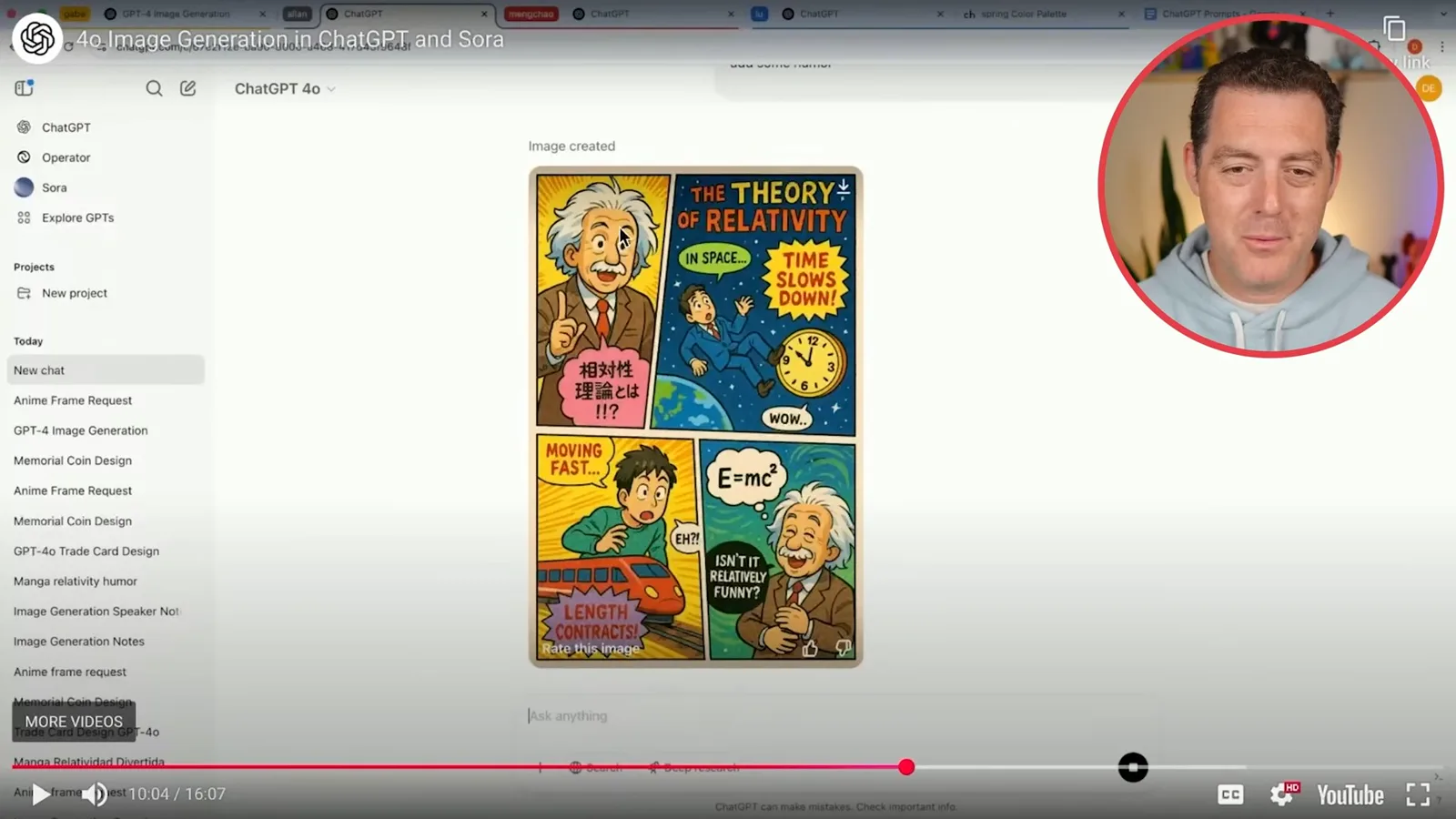
Another OpenAI demonstration requests a humorous manga page about relativity. The result combines a visual layout with text, and Berman praises its presentation while finding the joke weak. An attractive generated educational image still needs its scientific content checked.
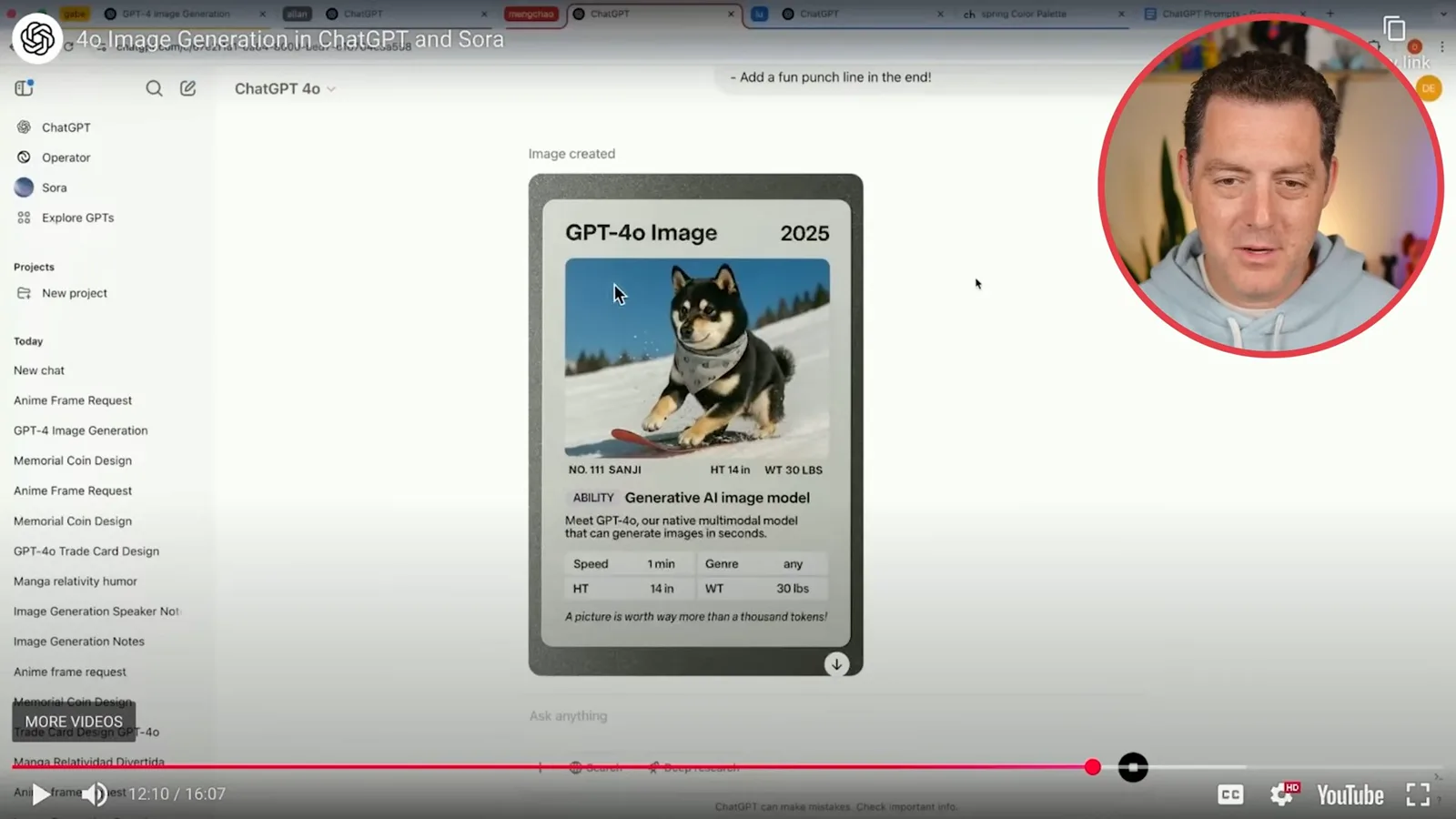
The presenters then use a reference trading card and a photo of a dog to create a new card with requested details. Berman notes that most of the small text appears legible, though the title treatment looks less natural to him. A later commemorative coin incorporates elements from earlier launch images, demonstrating reference-based iteration.
Berman's tests and additional examples
His tests cover stacked animals, portraits, background removal, dogs, and logos, with successes and mistakes.
In his own tests, Berman asks for a chicken on a duck on a dog on a horse, then requests a realistic version. He likes the composition but points out that the animals' relative scale is implausible. The example shows that a plausible image can still miss physical relationships in the prompt.
He transforms his thumbnail portrait into an exaggerated animation style and asks for a closer likeness in a follow-up. Some details are retained, but the model adds buttons that were not on his shirt. A background-removal test removes the background while also changing the appearance of his face in an unwanted way.
Berman generates a dog, adds glasses, and then asks for a meaner expression while retaining the glasses. He notices imperfect placement around the nose and ears. A separate logo test misspells the name on the first attempt and improves on another, demonstrating that readable text is not always correct text.
The launch examples include text on a glass whiteboard, magnetic poetry, a comic strip, and an illustration of a prism. Berman admires the combination of typography and scene details, though one requested high-five is missing. He also shows follow-up edits that place a visual concept in a different setting.
Additional examples include a menu, an advertisement built around a reference object, architectural transformations, and fictional scenes. Berman sees potential for creators and businesses to prototype visuals or modify an image through conversation. He also spots images whose faces or animals look less convincing than their surroundings.
Limitations
Berman reads OpenAI's published list of weaknesses and encourages viewers to test the tool.
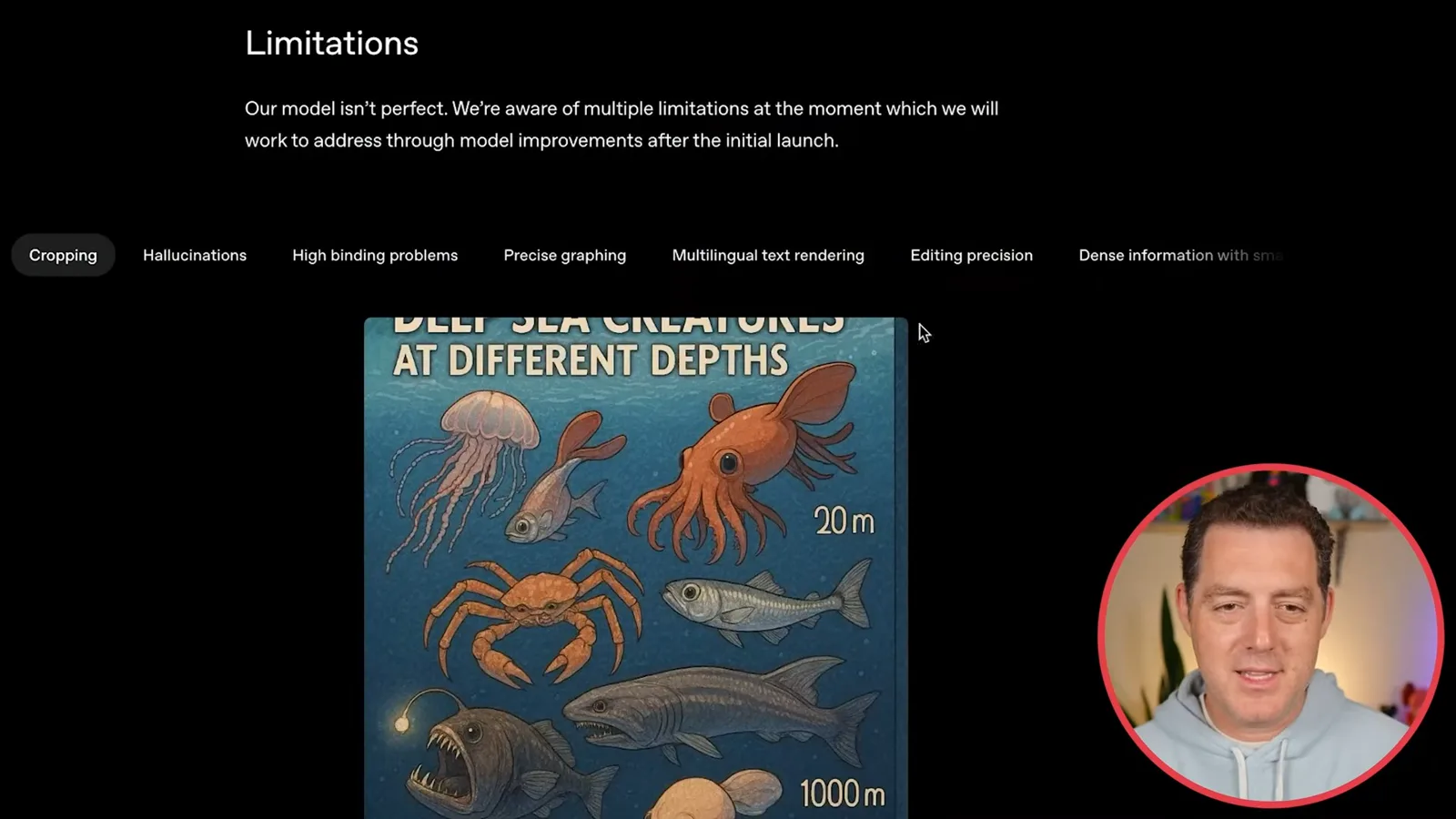
OpenAI's launch page lists limits: unwanted cropping, invented information, difficulty binding many distinct concepts, precise graphing, non-Latin text, small dense text, and editing precision. Berman concludes that the feature is promising but far from perfect and invites viewers to try it. These observations describe the initial 2025 release, not a current benchmark.
同じチャンネルの記事
 25:50EN
 32:20EN
 45:08EN
 0:32EN
 12:14EN
 10:36EN