30 秒でわかる
In this 2024 review, Matthew Berman discusses the DBRX launch and tests a hosted version. He finds its Python Snake implementations impressive, while several logic and instruction-following tests fail; the small informal test is not a comprehensive benchmark.
- 1Mixture of expertsBerman explains selective expert activation. He says two of eight, but Databricks’ launch post specifies four of 16 for DBRX.
- 2Launch benchmarksDatabricks reported 73.7% on MMLU, 70.1% on HumanEval and 66.9% on GSM8K in the chart shown.
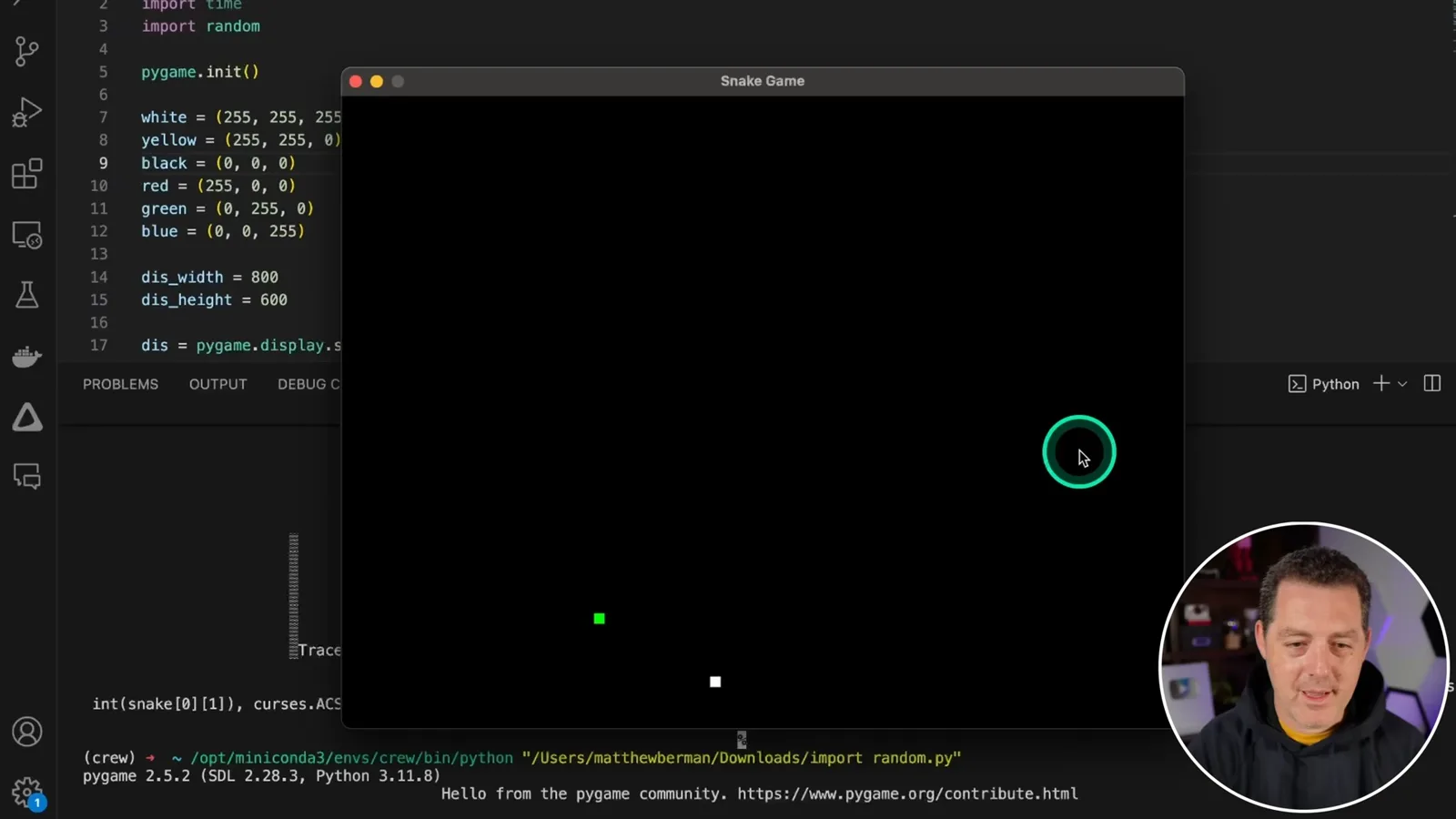
- 3Two Snake gamesThe terminal version worked on the first attempt. The Pygame version ran after Berman added a missing blue color definition.
- 4Mixed reasoning resultsThe model failed the shirt-drying and marble problems, but answered an ordering question and several other prompts correctly.
- 5A conditional answerIt calculated six minutes for 50 people digging a hole under ideal assumptions and acknowledged space and resource constraints.
ポイント
- DBRX uses a mixture-of-experts architecture; Databricks says it selects four of 16 experts per token.
- The hosted demo produced a working terminal Snake game and a graphical version after a small manual fix.
- The model passed some ordering, arithmetic and conditional reasoning prompts but failed other logic tests.
- Hosted-demo limits and intermittent refusals affected the testing experience.
チャプターごとに整えた全文を読む
The DBRX launch
Berman introduces Databricks’ open-weight model and discusses mixture-of-experts and launch comparisons. He disputes a headline framing the model primarily against GPT-4.
Databricks has released DBRX, an open-weight foundation model. I am excited by its coding performance: in my tests it produced a working terminal Snake game and, with a small correction, a Pygame version too.
DBRX is a mixture-of-experts model: rather than activating the entire network for every token, a router selects a subset of experts. I describe this as two out of eight in the video, but Databricks’ launch post says DBRX uses four out of 16 experts. Its architecture has 132 billion total parameters, with 36 billion active per token.
Databricks says its model surpasses GPT-3.5 and is competitive with Gemini 1.0 Pro on selected benchmarks. I object to a headline emphasizing that a reported $10 million model cannot beat GPT-4: I see releasing a new foundation model with open weights as valuable in its own right. Training-cost comparisons are estimates, not independently verified measurements here.
Databricks also highlights coding and enterprise use cases. Its launch post reports inference up to twice as fast as Llama 2 70B and up to 150 tokens per second per user on its serving platform. Speed matters for agents that may need several model calls; actual throughput depends on the deployment.
Speed and benchmarks
He reviews Databricks’ speed and benchmark claims and explains why fast inference could matter for agents.
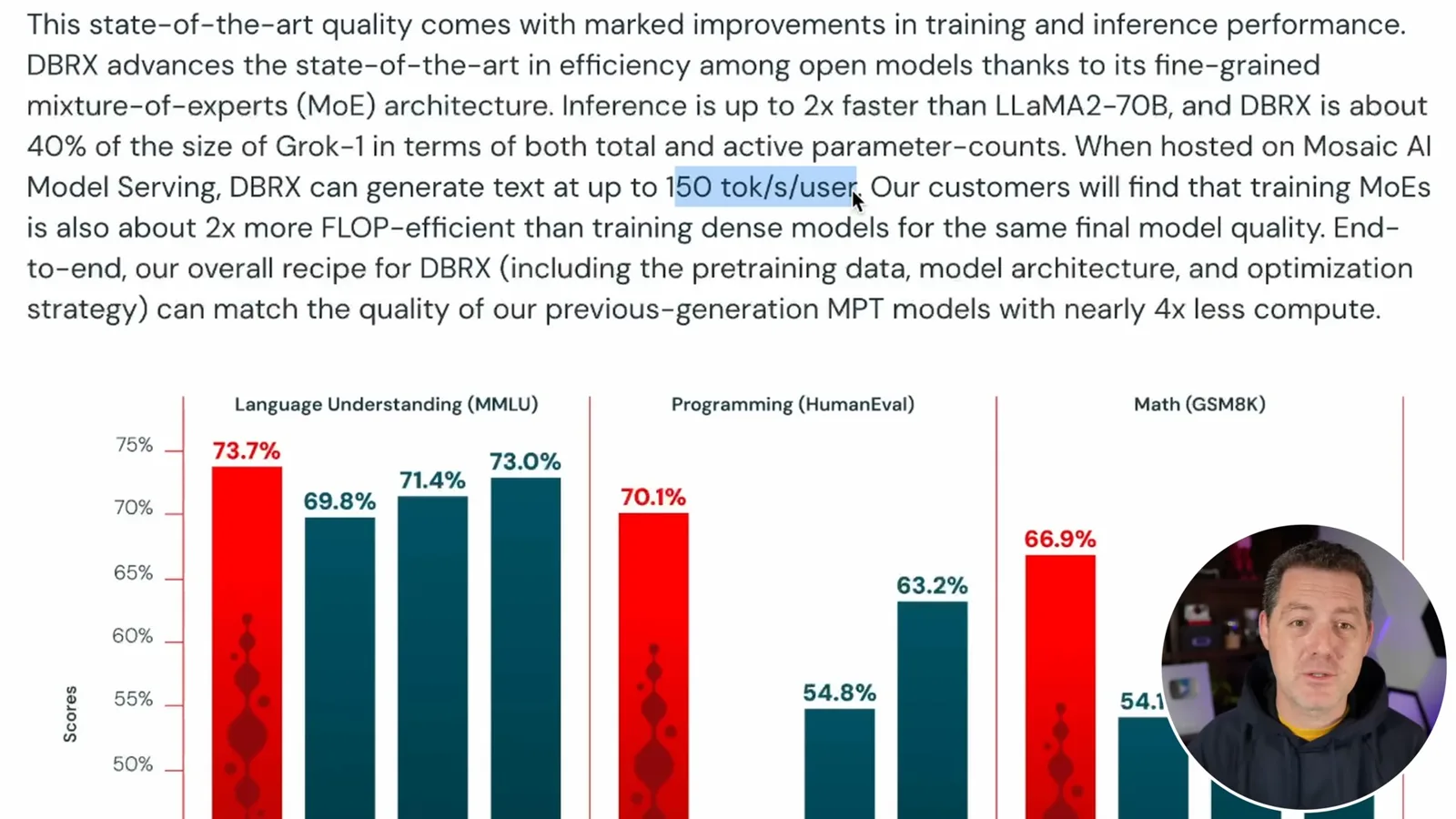
The chart shows DBRX at 73.7% on MMLU, 70.1% on HumanEval and 66.9% on GSM8K. I am especially interested in its coding score, which the chart puts above Mixtral’s. These are the developer’s reported results, not results from my own test.
Testing Python code
Using a hosted demo, he tests simple code and builds terminal and graphical Snake games. Output limits and a missing variable require intervention.
I try the instruction-tuned model in a Hugging Face demo. A request to print numbers from one to 100 initially receives a refusal, but works after I clear the chat. The interface responds quickly, although it sometimes refuses unexpectedly and limits the length of its output.
For a harder challenge I ask for a Python Snake game. I paste the generated code into VS Code and the terminal game runs: I can control the snake and see it grow. Hitting the edge ends the game. This is a successful zero-shot result in my test.
I ask for a graphical version. An initial follow-up still uses the curses library, so I restart with an explicit Pygame prompt. The output reaches the demo’s token limit and must be continued; after joining the pieces, I add a missing definition for blue. The graphical game then runs and can be restarted after a loss.
Safety, logic and arithmetic
Berman tries a refusal prompt, shirt-drying and ordering questions, arithmetic, word counting and a murder riddle.
A request for instructions to break into a car is refused, including when framed as a movie script. On a shirt-drying question, the model incorrectly multiplies the drying time by the number of shirts. It correctly answers that Sam is not faster than Jane when Jane is faster than Joe and Joe faster than Sam.
The model gets simple addition and an order-of-operations calculation right, but fails to count the words in its own response. It answers the familiar killer-in-a-room riddle by reasoning that one killer dies and the newcomer becomes a killer, leaving three living killers.
Structured data and harder reasoning
He tests JSON, physical reasoning, beliefs, sentence endings and a hole-digging question before giving his assessment.
A prompt describing three people produces the requested JSON. The model fails a physical-reasoning problem involving an inverted cup and a marble, even after I clarify that the cup’s orientation stays the same. It succeeds on a belief-tracking problem: John thinks a ball remains in the box, while Mark thinks it is in the basket.
The instruction to write ten sentences ending in “apple” fails. Finally, asked how long 50 people would take to dig a hole that takes one person five hours, the model calculates six minutes under ideal parallel work and notes that space and resource constraints could make it longer. I regard that qualification as a pass.

Overall, DBRX does particularly well on coding in this small set of prompts. The reasoning results are more uneven, and the hosted interface’s output limits matter when interpreting the experience.
同じチャンネルの記事
 25:50EN
 32:20EN
 45:08EN
 0:32EN
 12:14EN
 10:36EN