Will AI Change What Programmers Do?

Matthew Berman responds to Ryan Dahl's prediction about writing code and argues that systems thinking will remain important.

MBMatthew BermanPonente · Forward Future
Canal
Matthew Berman
Publicado
22 ene 2026
Vídeo
1:08
Lectura
1 min
Diapositivas
1
Original
inglés
Abrir en YouTube
Al desplazarte, el vídeo se reduce a la esquina inferior derecha y sigue reproduciéndose. Los subtítulos siguen tu idioma de lectura.
Idioma de lecturaDisponible en 2 idiomas
Este artículo aún no está en español, así que se muestra el original en inglés.
RESUMEN

En 30 segundos

Matthew Berman reacts to Node.js creator Ryan Dahl's statement that the era of humans writing code is over. Berman predicts that cheaper code generation will expand software demand and change developer work, while acknowledging uncertainty about new jobs. These are predictions, not proof that manual programming has ended or employment will rise.

  1. 1A prediction about codingBerman cites Ryan Dahl's claim about the end of humans writing code; the claim is a prediction rather than a demonstrated universal fact.
  2. 2Systems thinkingBerman believes programming judgment and the ability to direct agents will become more important.
  3. 3Demand and uncertaintyHe invokes Jevons paradox to argue cheaper code may increase demand, while the actual impact on jobs remains uncertain.

Conclusiones

  1. Dahl predicts that directly writing syntax will become less central to software engineering.
  2. Berman argues that system design and directing agents will remain valuable.
  3. Cheaper production can stimulate demand, but the effect on total software employment is not automatic.
TEXTO COMPLETO

Lee el texto editado por capítulos

Solo la transcripción
01

Dahl's prediction

Berman introduces the Node.js creator's view of manually writing code.

Matthew Berman cites Node.js creator Ryan Dahl's prediction that the era of people directly writing code is over. Berman says other programmers have voiced similar views. This is a forecast about how software work may change, not evidence that people have already stopped writing code.

02

Programming beyond syntax

He emphasizes systems thinking and directing agents.

Berman argues that programming as systems thinking remains important even if agents produce more syntax. He expects experienced engineers to direct agents and build more, while less experienced developers and people without coding backgrounds gain new ways to turn ideas into software. The quality of generated code still requires evaluation.

03

Demand and new work

Berman predicts cheaper software will create demand and possibly new occupations.
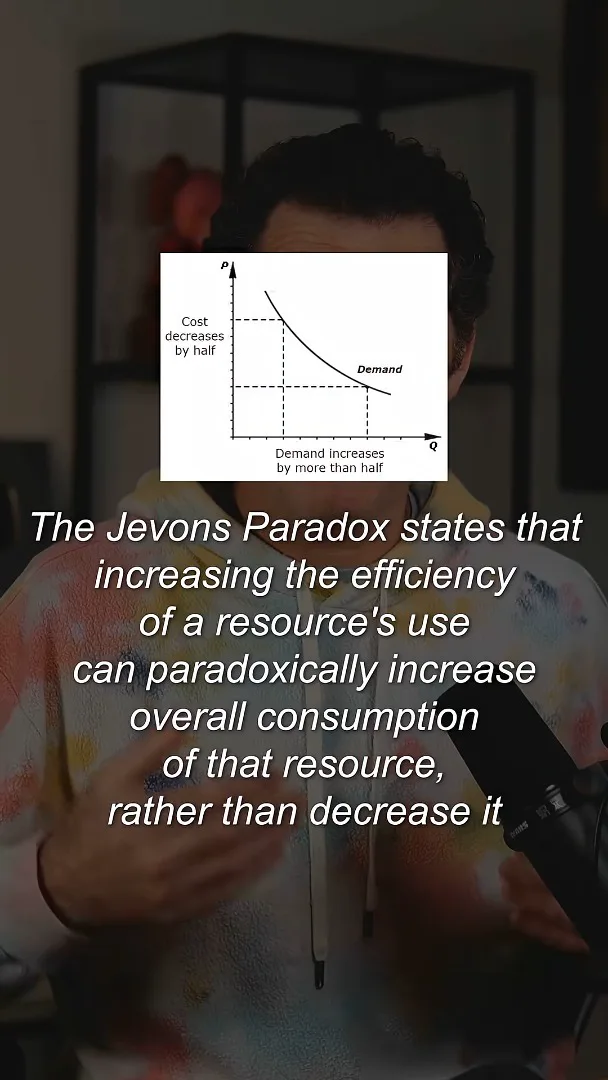
Jevons paradox illustration
DIAPOSITIVA 1 / 1Jevons paradox illustrationThe video illustrates the argument that efficiency gains can increase overall use, a possible outcome rather than a universal rule.

He invokes Jevons paradox: lower cost and greater efficiency can encourage more use, potentially offsetting savings. More demand for software is plausible but not guaranteed, and it does not establish what will happen to developer jobs or wages. Berman expects new kinds of work to emerge, while conceding that their nature is not yet known; the clip cuts off during his final example.

Más de este canal

6 diapositivas25:50EN
MBMatthew Berman· 24 oct 2026Kimi K3.1 Pro Tested: Strong 3D Demos, Uneven Results and Competitive PricingMatthew Berman · Forward FutureMatthew Berman tests the open-weight model on coding, 3D rendering and visual explanations, then compares benchmark results and prices.Open-weight modelsBenchmarksAI cost & performance+1
2 diapositivas32:20EN
MBMatthew Berman· 23 oct 2026Who Is Local AI For? The Costs, Trade-offs and a Hybrid FutureMatthew Berman · Forward FutureMatthew Berman weighs data control and independence against hardware cost, setup complexity and inference speed.Local inferenceOpen-weight modelsAI cost & performance+1
6 diapositivas1:03:37EN
MBMatthew Berman· 23 oct 2026Matthew Berman’s Team Tests Kimi K3.1 on Animation, Games, and ChartsMatthew Berman, Alex, Brian · Forward FutureA live team AMA turns into an informal test of Kimi K3.1, from personal-agent workflows to motion graphics, a browser game, and a benchmark chart.Agentes de programaciónGenerative mediaEvaluaciones+2
0:53EN
MBMatthew Berman· 22 oct 2026Sam Altman on AI and the Discovery of New KnowledgeSam Altman · OpenAIAltman expects progress in mathematical discovery to extend to biology, materials and energy.AI for scienceMathematicsComputational Biology+1
Diapositivas0:22EN
MBMatthew Berman· 21 oct 2026A Robot Bodyguard Video Shows Dramatic Rescue ScenariosMatthew Berman · Forward FutureMatthew Berman reacts to a short robot demonstration depicting fighting and vehicle-rescue scenarios.RoboticsEvaluaciones
45:08EN
MBMatthew Berman· 21 oct 2026Sam Altman on AI Discovery, Consciousness, Compute and a Human-Centered FutureMatthew Berman, Sam Altman · Forward FutureIn a conversation with Matthew Berman, Altman discusses scientific progress, personal assistants, recursive self-improvement and the importance of human agency.AI for sciencePersonal agentsConsciousness+2