30초 요약
Gurudev Sri Sri Ravi Shankar describes how he began teaching meditation and breathing, and discusses fear, forgiveness, relationships and a sense of belonging with Theo Von. He also recounts a role he says he played in Colombia's peace process and discusses addiction and mental health. His spiritual views and health claims are presented as his own; the article adds clinical context where appropriate.
- 1Ten days of silenceGurudev recounts the retreat after which he began teaching SKY breathing.
- 2Concern can motivateHe distinguishes useful concern about technology and society from fear that leaves people stuck.
- 3Forgiveness and changeA story about the Buddha illustrates his view that clinging to a past injury prolongs it.
- 4A visit to HavanaHe recounts meetings with FARC representatives and his appeal for nonviolence.
- 5Recovery and temptationTheo discusses unwanted thoughts in recovery; Gurudev describes meditation as a source of joy, alongside claims that need clinical context.
핵심 정리
- Gurudev traces his teaching of SKY breathing to a ten-day period of silence and his search for a way to address inner conflict.
- He distinguishes fear from concern, which he believes can motivate constructive action.
- He describes forgiveness as releasing a past event while turning regret into responsibility and compassion.
- His account of speaking with FARC representatives is one perspective on Colombia's much larger peace process.
- The episode's claims about meditation, trauma and addiction do not replace individualized, evidence-based care.
챕터별로 다듬은 전문 읽기
Childhood and the Art of Living
Gurudev recalls his early interest in scripture and science, his influences, and the start of his teaching. He describes the silence retreat that preceded his breathing technique.
Theo Von introduces Gurudev Sri Sri Ravi Shankar, the spiritual teacher and founder of the Art of Living. Their conversation ranges from his early life and breathing practices to fear, forgiveness, peacebuilding and what it means to live with other people.
Gurudev says that at age four he could recite the Bhagavad Gita. He describes the Hindu scripture as a conversation between Krishna and the warrior Arjuna about yoga and life, and notes that it was meaningful to Mahatma Gandhi.
Asked what it was like to be seen as a prodigy, he says it felt ordinary to him. He was more interested in spending time with adults than in many childhood activities and sometimes felt out of place, though he tried to fit in.
He calls becoming a guru an accident: he shared what he knew, and people began to look to him for guidance. As a teenager, he says, he was interested both in physics and astronomy and in spiritual texts, seeing parallels between them.
Gurudev recalls a teacher who had lived with Gandhi and told stories about him, as well as a grandfather who had been part of Gandhi's ashram. He describes growing up in an environment that valued nonviolence, friendliness and compassion.
He says he began teaching as a teenager and started the Art of Living in his early twenties. Two Indian Supreme Court judges, one religious and one an atheist, became trustees in their individual capacities; he corrects Theo's impression that the government set up the organization.
Theo asks about a ten-day period of silence. Gurudev says he was already teaching yoga and meditation but felt that people still struggled with internal conflicts and habits. After the retreat, he began teaching the breathing technique known as SKY to people in the area.
He describes the practice as learning to recognize the rhythm of the breath and its connection to the body, emotions and sensations. He says it takes several days to learn and regards harmonizing those experiences as a source of inner freedom.
When he began traveling to teach, he encountered skepticism about meditation and yoga, particularly in Europe and the United States. He remembers resistance to bringing the practices into prisons and argues that people who have hurt others may themselves have suffered.
Gurudev believes breathing practices can help people who feel trapped by difficult emotions, and he lists calm and clarity among their possible benefits. These are his claims about his approach, not evidence that a breathing technique can eliminate every emotional or physical health problem.
Consciousness, fear and technology
The two discuss consciousness, Theo's fears and the difference between concern and paralysis. Gurudev offers his view of AI and education.
Theo asks whether consciousness ages. Gurudev distinguishes an intellect that matures from what he sees as an unchanging reference point for experience. He describes consciousness in spiritual terms as an energy manifest in the world, a philosophical belief rather than a scientific finding.
Theo admits that he often feels afraid. Gurudev offers a reframing: fear can arise from caring about something and worrying that one might lose it or fail to get it. Theo recognizes the anxiety of imagining life turning out differently from what he hopes.
To explain perspective, Gurudev compares fear to a student facing an exam or a person performing onstage for the first time. Someone with experience may see the situation differently. He suggests recalling earlier difficult moments one has already lived through.
He also suggests attending to the breath and viewing life more playfully. Theo is candid that he still feels scared; his concern is that society may become so absorbed in technology that people lose sight of what it means to be human.
Gurudev distinguishes concern from fear. Concern about how technology is used, he argues, can motivate action rather than paralysis. He is concerned about mental health and the planet and says he sees humanity as one family.
When Theo speaks about losing a sense of purpose, Gurudev replies that many people may not yet have found one. Theo says the exchange makes him grateful for having a purpose at all. They turn to the uses of technology that could help rather than frighten people.
Gurudev remembers spending a day in a library looking for a book; now knowledge can be reached much more quickly. He sees AI as a challenge to human originality as well as a source of anxiety, and asks what people will do with the capabilities it gives them.
The discussion turns to children, education and human values. Gurudev says children begin with joy and argues that education should make room for qualities such as compassion and peace alongside academic knowledge.
Theo raises memories and the possibility of past lives. Gurudev discusses the subject from his spiritual perspective; the interview does not establish reincarnation as fact. Their broader question is how experiences, beliefs and emotions shape a person's sense of self.
Forgiveness, trauma and shame
They talk about forgiveness and veterans' experiences. Gurudev's treatment claims are considered alongside clinical guidance.
Theo says forgiveness has been difficult for him. Gurudev connects forgiveness with letting go of what one continues to carry and returns to meditation and breathing as practices he teaches. The exchange centers on their personal understanding of emotional change.
Gurudev describes work with veterans and claims that breathing practices helped people with trauma. His account and its rapid-recovery claims are not proof of a treatment effect. The [U.S. Department of Veterans Affairs](https://www.ptsd.va.gov/professional/treat/txessentials/overview_therapy.asp) describes evidence-based PTSD therapies and the importance of appropriate professional care.
He recounts seeing veterans and their families respond positively to the program. Theo reflects on how trauma can seem to stay in the body. The experience of participants is important, but individual testimony does not establish which intervention caused an improvement.
Returning after a sponsor break, Theo speaks about shame and times when he did not feel in control of his emotions. Gurudev encourages him to look at the circumstances and state of mind in which a mistake happened, rather than treating that moment as the whole person.
Gurudev tells a story about someone who spits at the Buddha and returns the next day asking forgiveness. The story's lesson, as he tells it, is that both people have changed since the incident: the event is over, while holding it in the present continues the hurt.
The conversation moves from forgiving others to forgiving oneself. Gurudev says that regret can recognize a mistake without requiring a person to remain stuck in self-condemnation. Theo asks what someone can do with the harm they know they have caused.
Gurudev suggests turning remorse into responsibility and compassion for others who struggle in similar ways. His point is not to pretend the past did not happen, but to ask what constructive action is possible now.
Love, belonging and education
Gurudev describes his spiritual view of love and the interdependence of people. He argues for emotional education.
Gurudev uses love as a broad metaphor for motives behind actions, while distinguishing love from every action someone takes. He discusses anger as a reaction to frustrated expectations; Theo asks how to understand destructive behavior within that framework.
They discuss God and love in explicitly spiritual terms. Gurudev says the divine is not a distant figure but something he understands through love and presence. Theo tests the idea against his own experiences of feeling connected and disconnected.
Gurudev says people depend on one another, comparing human life to a web in which no one can accomplish everything alone. Recognizing that dependence, he argues, can make the idea of a single human family more concrete.
Theo asks what happens when a person does not feel that sense of connection. Gurudev returns to the idea of giving and receiving help: a person can feel isolated, yet still be supported by the work and care of many others.
The subject returns to education. Gurudev argues that children need help learning to deal with their moods and emotions as well as mastering school subjects. He sees emotional education as relevant to relationships and to a more peaceful society.
Colombia and nonviolence
He gives his account of visiting Colombia and meeting FARC representatives. The article provides context about the 2016 peace agreement.
Gurudev recounts a visit to Colombia, where he saw people suffering after decades of conflict. He says he met President Juan Manuel Santos and offered to speak with members of the FARC when the president described the difficulty of the peace process.
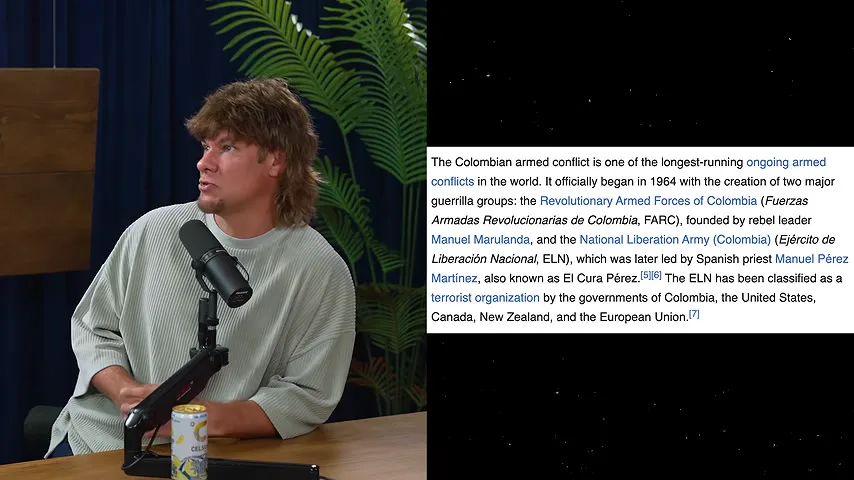
The episode displays background on the Colombian conflict, identifying FARC and the ELN as separate armed groups. The on-screen passage helps orient the audience before Gurudev explains the meeting he says he arranged.
According to Gurudev, he chartered a flight to Havana to meet guerrilla representatives. They initially questioned why they should meet a spiritual leader, he says, and identified their political philosophy with Karl Marx.
Gurudev recalls that the guerrilla representatives were initially reluctant to engage with him on religious grounds. After seeing his public talk and meditation in Havana, he says, they reconsidered and met with him.
He says two representatives attended a public talk and meditation and later met him. He describes several days of discussion in which he acknowledged their stated goal of social justice but urged them to pursue it through nonviolence.
Gurudev says the group subsequently announced a unilateral ceasefire and describes bringing victims and FARC members together for a forgiveness process. This is his account of his contribution, not a complete explanation of the negotiations or their outcome.
The [United Nations](https://www.unmissions.org/en/dppa/news/eight-years-of-building-peace-in-colombia) says the 2016 agreement was signed by the Colombian government and the former FARC-EP; other violence has continued in Colombia. Gurudev also mentions a film being made about the story and the actor playing him.
Relationships and recovery
Theo reflects on seeking love and navigating unwanted thoughts in recovery. Gurudev discusses connection, shared goals and practices he teaches.
Theo turns to relationships and admits that it can feel easier to ask another person to love him than to figure out how to love himself. He wonders whether he sometimes hands another person responsibility for his sense of worth.
Gurudev suggests assuming that a loved one cares, even when their way of expressing it differs. He argues that constant demands for proof can burden a relationship. This is his personal advice; another person's feelings cannot be presumed, and their boundaries matter.
He says that another person's expression of affection may not look the way one expects. His illustration is a partner who is repeatedly asked to prove their love; he considers the demand exhausting for both people.
He sees love as difficult to contain fully in words or actions and connects love of self with love of others. Theo jokes about interpreting an unanswered text as love that has not yet been expressed; Gurudev tells him to be patient.
Gurudev says attraction, attachment and love are not necessarily the same thing. When expressing interest in another person, he adds, it should be done in a way acceptable to them. Theo acknowledges that he sometimes seeks validation or reassurance.
He describes intention as preceding action and says a person attracted to someone must express that interest in a manner the other person can accept. Theo agrees that acceptability to the other person is key.
Asked what helps a relationship last, Gurudev proposes a shared purpose. He says attraction can change over time, while working toward a common goal can give two people a direction beyond concentrating exclusively on each other.
His other suggestions are to stop policing a partner and give each other room to grow. Theo compares watching a plant too closely to stifling it; Gurudev replies that growth takes its own time.
Theo says he often seeks love from outside himself. Gurudev tells him that wanting love is not inherently wrong, while suggesting that doubt can interfere once someone finds it.
After another sponsor break, Theo describes being in recovery and having unwanted thoughts about drugs, alcohol or other behaviors he does not want to return to. He likens such an idea to a tempting figure trying to draw him along.
Gurudev says an urge can promise pleasure even when a person's judgment says the behavior is harmful. He describes teaching breathing and meditation as a way of finding another source of joy. Theo hears the idea as replacing a harmful behavior with something of value.
Gurudev's claim that breathing and meditation can remove dependence is not established by the interview. [SAMHSA](https://www.samhsa.gov/substance-use/treatment/options) describes individualized substance-use treatment that can include medication, counseling and behavioral therapies; recovery support should be matched to the person.
He describes volunteers and teachers offering SKY breathing programs in schools and universities, and reports favorable feedback from parents. These are accounts from his organization; they do not independently demonstrate the extent or cause of the changes he describes.
Gurudev says he has heard from parents who felt their children became kinder after attending his programs. These reports are anecdotes; the conversation does not establish whether the program caused the changes.
Gurudev summarizes his preferred qualities as clarity of mind, purity of heart and sincerity in action. Asked how to make actions sincere, he emphasizes spontaneity. Theo then asks whether meditation affects younger people differently.
Intuition, service and meditation
Gurudev describes a program for children and the Art of Living's gatherings. They discuss generosity, education and attention.
Theo has seen videos of children taking intuition tests. Gurudev describes an 18-day program for children and teenagers combining breathing, meditation and exercises intended to develop intuition. He calls intuition a kind of gut feeling.
Gurudev claims that this intuition can be infallible and override ordinary calculations. That is his belief and is not demonstrated by the interview; a confident feeling alone does not establish that a judgment is correct.
Gurudev says adults can also learn practices he associates with intuition, though he believes children can learn more easily. Asked about age, he says practices differ for younger children and teenagers.
The interview moves to the Art of Living's broader educational and service work. Gurudev talks about bringing people together across backgrounds and using events and volunteer activities to cultivate a sense of belonging.
He summarizes the Art of Living's goal as making life a celebration. In his metaphor, anger about the past and anxiety about the future are like waves: the waves remain, but one can learn to surf.
He describes volunteers responding to disasters and trauma, then lists aspirations for a society with less violence and stress and for people with clearer minds. These are stated aims, not verified outcomes of the organization.
He contrasts a broad human identity with narrow prejudices and argues that a sense of belonging need not erase the different cultures people bring. Theo asks about the scale and experience of the organization's gatherings.
His list also includes overcoming inhibitions between generations, races and religions. In a technologically connected world, he argues, prejudice can persist even when distance has become easier to bridge.
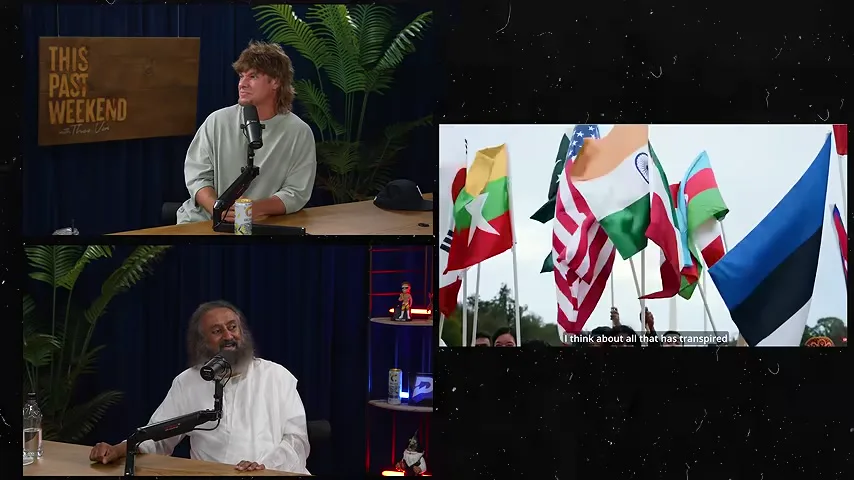
The episode shows footage from a gathering with flags from many countries. Gurudev describes festivals and collective meditation as ways people experience a common identity. The numbers he offers are his account of the events, not independently verified counts.
Gurudev describes festivals in Bangalore, Washington and New Delhi, including art, music and group meditation. Theo responds that the opportunity to be alive and encounter other people is itself something to celebrate.
Gurudev describes giving as a source of joy. He distinguishes what someone genuinely has to offer from giving in a way that depletes them, and connects generosity with the feeling that other people belong to one's wider family.
He compares the happiness of receiving a gift with a grandmother's pleasure in feeding her family. Theo admits that giving can bring up fears of not having enough; Gurudev says one should give what one can and can say no when one cannot help.
They discuss making time for meditation. Gurudev says a daily practice can fit alongside ordinary responsibilities and describes twenty to thirty minutes as a personal practice, rather than a universal prescription for everyone.
Theo says his own meditation practice sometimes gives him a little more space before reacting. Gurudev describes calm as something that, in his view, can continue into everyday activity after formal practice.
Theo asks whether anxiety and drug use among young people have changed during Gurudev's lifetime. Gurudev describes an Indian drug-free campaign and returns to the idea that schools should teach children how to connect with others and manage their emotions.
Gurudev says anxiety seems more widespread to him than when he was a student. This is his personal observation, and the absence of diagnoses from his recollection does not establish that mental illnesses were absent in the past.
Gurudev suggests encouraging children to make new friends and spend time away from devices. His larger point is that technology has useful applications, while relationships, time in nature and attention to the present also deserve space.
Theo worries that constant access to phones leaves less time to process experience. Gurudev views technology as a tool whose effects depend on use; he recommends making room for people, music, movement, meditation and nature.
Goals, self-knowledge and the end of life
The conversation turns to attachment to goals, Gurudev's book and his spiritual beliefs. He also recommends medical care for extreme symptoms.
On goals, he distinguishes having a direction from gripping the desired outcome so tightly that it occupies the whole mind. He describes self-knowledge as examining what changes and asking what, if anything, remains constant.
Gurudev compares fixation on an outcome to driving toward Hollywood while thinking so much about the destination that one misses the exit. He says a person can have a goal and still remain aware and open to other possibilities.
To explore self-knowledge, he suggests considering what the self is not: the body, thoughts and emotions all change. He regards meditation, knowledge, music and service as possible ways to approach a deeper sense of self.
Theo asks about animals at Gurudev’s campus. Gurudev says they have two elephants, Maheshwar and Indrani, and jokes with Theo about Indrani playing the harmonica.
Theo asks about Gurudev's family and animals, including two elephants. Gurudev says he is unmarried and considers everyone his family, an expression of the broad belonging he has described throughout the interview.
Gurudev explains that the book emerged from seven years of weekly discussions in which young people asked him questions. The resulting knowledge sheets were circulated and later compiled into a book.
Theo recalls visiting children's homes in India and asks about free schools. Gurudev says his organization runs schools in India, Nepal and elsewhere, with some yoga and meditation in the curriculum; the scale he cites is his own account.
Asked about schools and mental health, Gurudev describes educational projects and practices he hopes will help people. He also explicitly says that people with extreme symptoms should see a doctor and take prescribed medication. The [NCCIH](https://www.nccih.nih.gov/health/meditation-and-mindfulness-effectiveness-and-safety) advises against replacing or delaying conventional care with meditation.
At the end, Theo asks about what remains after death. Gurudev offers his spiritual belief that consciousness continues, using the analogy of a television signal remaining when a set is switched off. Theo thanks him for the conversation.
같은 채널의 다른 글
 2:03:29EN
 Theo Von· 2026년 9월 1일팟캐스트 · 2명Luke Bryan on Family, Football and Finding Humor in Country Life게스트 Luke Bryan · 진행자 Theo VonThe country singer joins Theo Von for a wide-ranging conversation about growing up in the South, parenting and music.
 2:28:21ENTheo Von· 2026년 8월 27일팟캐스트 · 2명Laura Delano on Psychiatric Treatment, Withdrawal and Informed Choice게스트 Laura Delano · 진행자 Theo VonThe author and advocate discusses her personal treatment history and the need for support when patients consider changing medication.