30초 요약
Laura Delano joins Theo Von to discuss her experience of psychiatric diagnosis, medication and withdrawal, and her advocacy for informed choice. The conversation includes disputed claims about diagnosis and treatment; clinical guidance recommends individualized decisions with qualified health professionals, and medications help many people.
- 1A diagnosis at 14Delano describes how a bipolar diagnosis and medication shaped her adolescence and identity.
- 2Withdrawal and supportDelano and Von describe difficult experiences after medication changes; symptoms need individual clinical assessment.
- 3Sexual side effectsThey discuss sexual dysfunction, including reports that symptoms can persist after some antidepressants are stopped.
- 4Informed choicesDelano advocates information, support and collaboration with a clinician for people considering a change.
- 5Supporting childrenShe encourages parents to listen to their children, ask questions and seek support.
핵심 정리
- Delano describes a difficult personal experience and advocates for patients to receive clear information about benefits, risks and alternatives.
- Withdrawal symptoms can occur after reducing or stopping some medicines; their causes and severity vary.
- Medication changes should be planned with a qualified clinician rather than copied from someone else’s experience.
- Peer support may help people feel less alone, but cannot determine whether a symptom is withdrawal, relapse or another condition.
- The existence of diagnostic uncertainty does not mean that mental disorders or effective treatments are unreal.
챕터별로 다듬은 전문 읽기
Diagnosis and identity
Delano recounts adolescent distress, diagnosis and treatment. She questions the way diagnosis was communicated to her.
Theo Von introduces Laura Delano, author of *Unshrunk* and founder of the Inner Compass Initiative. They plan to discuss her treatment history and both speakers’ experiences with psychiatric medication. Delano identifies herself as a former patient and advocate, not a physician.
Delano describes growing up in a well-resourced Connecticut family. She did well at school and played competitive squash, but says that the appearance of having everything together concealed questions about who she was and what mattered to her.
She says her childhood looked successful on paper: good grades, athletics and material security. Internally, she remembers a growing sense that she was meeting expectations without knowing herself.
At 13, she recalls a frightening experience in front of a mirror that left her feeling detached from herself. She now interprets it as an identity crisis; at the time she felt frightened and did not know how to describe it to other people.
Delano describes not having language for the experience and choosing not to tell anyone at first. She tried to maintain her familiar role as a successful student even as the distress intensified.
Delano says she kept performing well outside the home while struggling intensely at home. She describes self-harm and thoughts of death, and says her parents, frightened and unsure how to help, eventually sought professional support.
She says her parents did not see other families openly discussing similar problems at the time. The secrecy and stigma around mental health made their situation feel especially isolating.
A therapist referred her to a psychiatrist. Delano recalls being diagnosed with bipolar disorder at 14 after an appointment and being prescribed medication. She emphasizes how consequential it felt to be told she had a lifelong condition so young.
Von asks how the diagnosis was made. Delano criticizes psychiatric diagnostic categories and describes her concern about consistency between clinicians. Her critique is a viewpoint; the absence of a single blood test does not by itself mean a condition is unreal or that clinical assessment is arbitrary.
Delano objects to presenting a diagnosis to a child as an unquestionable explanation of their entire future. She wants families to understand what an assessment can and cannot tell them, and to have room to ask questions.
The [National Institute of Mental Health](https://www.nimh.nih.gov/health/publications/bipolar-disorder) explains that bipolar diagnosis considers the severity, duration and frequency of symptoms and a person’s history, with medical evaluation used when appropriate to rule out other causes. Misdiagnosis can happen, and an individual’s assessment deserves careful review.
She says her sense of relief at a diagnosis came later, after initially rejecting it. The meaning of the label changed for her as she searched for a way to understand and address her suffering.
Delano says that as an adolescent she initially resisted the diagnosis. She describes feeling vulnerable to others’ definitions of her because she was already struggling with identity and belonging.
She says she took medication inconsistently as a teenager and later went to Harvard. In her first year she experienced severe distress, poor sleep, substance use and thoughts of suicide. She sought help again because she wanted relief.
At college, Delano describes feeling distant from peers despite outward achievements. She says the combination of no sleep, substance use and distress left her feeling frightened and unable to see a path forward.
The gap between outward achievement and how she felt internally became hard to sustain. Delano recalls questioning whether she belonged among her peers and feeling overwhelmed by thoughts she could not easily quiet.
She remembers a debutante event as an especially sharp contrast between the role she was performing and her inner state. Von recognizes the tension between what other people see and what someone may be experiencing privately.
Von asks whether her experience might have been called psychosis. Delano does not offer a retrospective diagnosis; she describes the intensity of her thoughts and how desperately she wanted help.
At 18, Delano returned to psychiatric care seeking an explanation. She says receiving a diagnosis initially brought relief: it gave her a framework for her suffering and a sense that there might be a way forward.
She became highly focused on treatment, attending therapy and reporting symptoms. Over time she says medications were added or changed as sleep and other problems emerged. She interpreted the increased attention and treatment as evidence that she was being cared for.
She says the sense of purpose in becoming a patient was powerful: treatment offered a goal when her previous life felt empty. She now thinks that identity also made it harder to question whether the plan was helping her.
Looking back, Delano says diagnosis and medication also became part of her identity and her way of communicating distress. She extends that observation to social media culture, though her personal story cannot establish how common the pattern is.
Delano remembers carrying multiple prescriptions and feeling that the visible signs of treatment communicated the seriousness of her pain. She distinguishes the need to be understood from the later question of whether each treatment was useful.
Delano says her functioning and relationships deteriorated through her twenties despite extensive care. She describes hospitalizations, weight gain and feeling disconnected from herself. She attributes some difficulties to medication, but the interview cannot determine the causes of each symptom.
She notes that some antipsychotic medications have recognized metabolic side effects. Von shares his own concern that medication sometimes made it difficult to know how he felt. Both are describing individual experiences, not a result every patient will have.
Von says he has wondered whether medication affects decisions about relationships and what feels authentic to him. Delano responds with empathy rather than a general answer about how any particular drug affects everyone.
The discussion turns to crying and the discomfort people can feel when someone shows emotion. Delano says she values expressing grief and distress rather than automatically treating every difficult feeling as something that must be suppressed.
Von describes tears as a way of releasing the weight he feels. Delano connects their exchange to her broader concern that a consumer culture encourages people to treat discomfort as a problem to eliminate quickly.
Delano argues that people often feel pressure to hide tears. For her, being able to show sadness in front of others is part of feeling connected rather than proof that something has gone wrong.
Asked why distress may be medicalized, Delano points to social and economic pressures, limited time and the difficulty of accessing support. The two discuss how financial insecurity can add to anxiety and reduce opportunities for reflection.
Suffering and care
The speakers discuss emotional expression, social pressures and Delano’s subsequent treatment and hospitalizations.
The hosts connect time pressure, work and bills to the difficulty of exploring emotional problems. They argue that available care and social support are shaped by circumstances, not only by an individual’s wishes.
They look at a chart comparing rent and income and discuss the pressure of making ends meet. Delano argues that context matters when someone seeks help; economic hardship and mental disorders can also coexist, so a clinician should assess the individual situation rather than assume one explanation.
Von says he is not dismissing people who benefit from medication or have serious diagnoses. Delano likewise says she knows people helped by medication and frames her work as a call for informed choices, including information about alternatives.
Delano wants patients to know about alternatives as well as the benefits and adverse effects of medication. She notes that access to alternatives may depend on cost, time and the support available to a person.
Von describes feeling unsure how antidepressants affected his emotions and relationships. He says this uncertainty has motivated him to consider stopping. Delano listens and connects his question to her own experience of not knowing what her baseline felt like.
Returning to her twenties, Delano describes organizing much of her life around treatment while continuing to struggle physically and socially. She says repeated hospitalizations and a later description of her condition as treatment-resistant left her feeling hopeless.
She describes losing touch with friends and struggling to maintain work while her care intensified. She credits her family’s resources with helping her remain housed and supported through that period.
Delano recounts a suicide attempt and subsequent hospital care. She describes the despair she felt at the time and says her understanding of her future later changed. Her account is personal; suicidal thoughts warrant immediate professional support.
Her hospitalization after the attempt was a turning point in how she later told the story, though she says her circumstances did not immediately change. The conversation avoids treating a single event as a simple cure or resolution.
Asked about inpatient care, Delano describes restrictions, frequent checks and group sessions she found superficial. She also recounts witnessing another patient in distress and describes what she inferred happened afterward; she does not claim direct knowledge of every intervention.
Delano says the daily routine in hospital included medication, meals and structured group activities. She felt the group sessions did not address the depth of her situation; her description is limited to her experience.
She describes another person’s account of restraint during hospitalization and stresses the loss of control patients may experience. These are individual accounts, not evidence that every facility or treatment follows the same practices.
She stresses that restraint and involuntary treatment can be traumatic for patients. The interview recounts individual experiences without establishing the clinical circumstances or decisions in each case.
Delano reflects on the hopelessness she felt after her attempt. She says that, years later, she understands her wish differently: she wanted a radically different life and did not then see a way to reach it. Von responds to how constrained her choices felt at the time.
Delano says she could not have imagined her later life from the place she was in after the attempt. She places her eventual turning point two years later, rather than at the moment of hospitalization.
Even after the attempt, she says daily functioning remained difficult for years. Von recognizes how heavy ordinary tasks can feel during a period of severe depression, and Delano describes simply getting through a day as a battle.
Delano says she stopped drinking in 2010 while taking several prescribed medications. She hoped removing alcohol might improve her situation and allow her treatment to work better. Her account of mixing alcohol and medication should not be taken as a safe practice.
She describes how alcohol had become a way to escape distress while she was on medication. The interaction of alcohol, mental health and medicines can be dangerous and differs by medication; it should be discussed with a clinician.
After a period without alcohol, she began asking what life might feel like with fewer medicines. She says her doctor was initially reluctant to change the regimen, and that she wanted a fuller discussion of the possible benefits and risks.
Delano says the improvement she noticed after stopping alcohol prompted questions about other aspects of her regimen. She wanted to understand her own functioning and discuss a possible change with the doctor overseeing her prescriptions.
Deciding to change medication
Delano recounts her experience of stopping medication and Von describes his own attempts. Their experiences do not establish a tapering plan for others.
After the break, Delano discusses the label “treatment-resistant” and treatments such as electroconvulsive therapy and transcranial magnetic stimulation. She says these were not offered to her and questions their use; this is her critique, not a full assessment of their evidence.
The [National Institute of Mental Health](https://www.nimh.nih.gov/health/topics/brain-stimulation-therapies/brain-stimulation-therapies) describes ECT and repetitive TMS as treatments used for certain severe or treatment-resistant conditions, with benefits and risks to discuss with a clinician. Different treatments and diagnoses require different decisions.
Delano says a book critical of long-term psychiatric drug use led her to question whether some of her difficulties could be related to treatment. She describes that realization as a turning point in her decision to ask her doctor about reducing medication.
The book gave Delano a framework for questioning a treatment history she had previously accepted. She says she returned to the prescriber wanting to explore a reduction despite his reservations.
The book’s broad interpretation of long-term outcomes is contested; her identification with it is not proof that psychiatric drugs generally make people worse. For some patients medication is beneficial, and risks, alternatives and long-term needs should be assessed individually.
She recalls feeling both shock and uncertainty about whether medication might have contributed to her difficulties. Her interpretation of her own history is distinct from a conclusion about the effects of these drugs on all patients.
She distinguishes physical dependence from addiction, explaining that a body can adapt to a medicine without the compulsive behavior associated with addiction. Withdrawal risk differs by drug and person; experiencing withdrawal does not by itself establish a substance-use disorder.
Von says he was surprised that he had not been given an exit strategy when first prescribed an antidepressant. He describes having taken medication for many years and wanting a clearer review of whether and how to change it.
Von says he remained on an antidepressant for years after moving away from the clinician who prescribed it. He wishes there had been a later conversation reviewing whether continuing or changing treatment made sense for him.
He recounts a recent attempt to stop escitalopram, a period of emotional difficulty and a decision to resume medication while consulting a clinician. He hopes for better guidance if he chooses to try again.
Von describes a feeling of emotional flatness that became difficult to tolerate after stopping. He says he discussed his situation with a psychiatrist and eventually resumed medication; the conversation does not establish a diagnosis for those symptoms.
Delano says she reduced five medications over six months and later experienced severe difficulties. She believes the reductions were too rapid for her. The account illustrates a possible withdrawal experience, but cannot establish the cause of every symptom or a safe schedule for someone else.
Delano describes trouble speaking, emotional distress and sensitivity to stimulation during her own withdrawal. She emphasizes that her family’s financial and practical support allowed her time to recover, support many people may not have.
Delano describes ordinary activities such as shopping becoming overwhelming after medication changes. She says bright lights, sounds and movement felt difficult to manage, and that her symptoms took a long time to improve.
The speakers discuss tapering in progressively smaller steps and listening to symptoms. Delano describes approaches developed in patient communities; she is not offering a personalized prescription, and the conversation cannot determine which approach is safe for an individual.
[NICE guidance](https://www.nice.org.uk/guidance/ng222/chapter/Recommendations) recommends discussing antidepressant discontinuation with the prescriber, usually reducing in stages at a pace agreed with the patient. It says withdrawal varies and can require further adjustment or clinical review.
NICE recommends that clinicians take account of the medication, duration of use and the person’s symptoms when planning a reduction. It does not prescribe a single universal timeline for all patients.
Drug formulations differ, and changing, splitting, crushing or mixing a particular medicine may be inappropriate. A prescriber and pharmacist can determine whether a suitable formulation exists and how to measure any prescribed dose; the video’s examples are not a do-it-yourself protocol.
Von describes a period of feeling emotionally flat after his own reduction and says he eventually returned to medication. Delano interprets such experiences through withdrawal. Symptoms after a change may also reflect relapse or another cause, so they need clinical assessment rather than a single assumption.
Delano says many people may not recognize withdrawal and can interpret distress as a return of the original problem. She wants patients and clinicians to consider that possibility. NICE likewise notes that withdrawal symptoms and relapse may need to be distinguished.
Delano urges doctors to take patient reports of symptoms seriously. Distinguishing withdrawal from a recurrence may be difficult, and the timing and pattern of symptoms are among the factors a clinician can consider.
They discuss relationships and sexual side effects. Delano says she experienced sexual difficulties during treatment and later regained function; Von shares changes he noticed in his own experience. Their accounts are important to them but do not predict another patient’s outcome.
Delano says she had not understood the extent of her sexual difficulties until later in life. She describes the loss as emotionally significant and wants side effects to be discussed openly before and during treatment.
Side effects, evidence and criticism
The conversation discusses sexual side effects and critiques of psychiatric treatment. The article distinguishes personal and contested claims from clinical guidance.
Delano also discusses reports of sexual dysfunction continuing after antidepressants are stopped. The [European Medicines Agency](https://www.ema.europa.eu/documents/prac-recommendation/prac-recommendations-signals-adopted-13-16-may-2019-prac-meeting_en.pdf) recommended warnings about reports of persistent sexual dysfunction with SSRIs and SNRIs; the frequency and causes remain areas for research.
Von asks whether sexual effects can occur in women as well as men. Delano answers from her own experience; sexual symptoms have multiple possible causes and a patient can discuss them with a clinician.
The episode plays testimony from a young woman describing enduring sexual and emotional difficulties. The speakers respond with concern. Her testimony is an account of her experience; allegations made in the clip about a company’s knowledge are not established in the interview.
The testimony shown in the episode emphasizes the distress of losing intimacy and emotional connection. The discussion calls attention to a patient experience without establishing how often such outcomes occur.
Delano argues that patients should be able to read medication information and understand possible harms as well as benefits. She questions the duration and interpretation of trials. Evidence varies across drugs and studies, and a short trial duration alone does not describe the entire evidence base.
Delano says patients often receive short pharmacy handouts and may not see full prescribing information. She wants accessible explanations of uncertainty and side effects, as well as the evidence supporting treatment.
She says she sees an information problem affecting patients, families and prescribers. Von expresses distrust of pharmaceutical companies and interest in other approaches. These are their perspectives; the appropriate balance of medication, therapy and other support depends on the person.
The speakers ask how treatment rates and mental-health trends relate. Delano cautions that many factors may contribute to suffering, but her suggested explanations should not be taken as proof that treatment caused a population trend.
Asked what is driving mental distress, Delano names social, economic and environmental pressures and says she does not have a complete answer. The hosts discuss loneliness, food and modern routines as possible influences, rather than demonstrating a single cause.
They discuss the difficulty of maintaining relationships and community under financial and time pressure. Delano believes those contexts should be part of a conversation about distress, not treated as irrelevant background.
Delano argues that ordinary grief or distress can be medicalized too readily. Von agrees that not every painful emotion is a disorder, while recognizing that some people experience severe mental illness. A careful evaluation considers both the person’s circumstances and clinical symptoms.
Delano criticizes a simple “broken brain” story as an explanation for all suffering. This is different from ruling out mental disorders: people can experience both meaningful social hardship and conditions for which evidence-based treatment is helpful.
She tells a story about a man she knew whose difficulties began after a frightening experience with cannabis and who later received treatment for many years. She wonders whether a different early response could have changed his course; the anecdote cannot establish the diagnosis or cause of his later condition.
Delano summarizes three concerns: distress may be medicalized, medication side effects may be mistaken for worsening illness, and withdrawal may be mistaken for relapse. Each is a possibility worth evaluating; none means that medication is always harmful or that relapse never occurs.
She says medication harms and withdrawal are sometimes overlooked when clinicians interpret a patient’s condition. In practice, treatment benefit, adverse effects, withdrawal and recurrence all require attention and can overlap.
She describes the Inner Compass Initiative as providing information and peer community for people considering their options. She says the organization does not tell everyone to stop medication or shame people who benefit from it.
Support and policy
Delano discusses informed decisions, peer support and advocacy for access to care when reducing medication.
Asked what someone considering stopping might do, Delano emphasizes learning about the medicine, considering life circumstances, building support and communicating with a doctor. She also discusses tapering examples, but these are not a substitute for an individualized clinical plan.
Delano describes an approach in which reductions become smaller at lower doses. The right pace, formulation and monitoring vary; readers should not adopt the speaker’s examples as a dosing schedule.
She notes that people need practical access to appropriate prescriptions and formulations during a reduction. For some, obtaining a clinician willing and able to help can itself be difficult. The speakers call for better access to informed, ongoing care.
The speakers discuss the practical difficulty of measuring small doses. A pharmacist can advise on available liquid or compounded formulations and whether a specific product can be altered safely.
Delano argues that lived experience contains information that formal research can overlook. Individual accounts are valuable, though they cannot alone establish how common an effect is, identify its cause or replace clinical evidence.
Von says he has tried to manage his medication questions largely on his own. Delano says people benefit from companions who understand the experience and from practical support when the process is difficult.
The hosts discuss peer support from people with similar experiences. Delano values validation and hope during a difficult period; a support community can complement, but cannot replace, clinical care or determine the cause of a symptom.
Delano recommends choosing a time with manageable stress where possible and discussing plans with a prescriber. Support from family or friends can help, while a clinician can monitor for withdrawal, recurrence and other health concerns.
Von says returning to medication made him feel safer after his most recent attempt. Delano encourages him to take the time and support he needs. Neither account establishes that stopping is the right choice for another person.
Delano also mentions diet and lifestyle while discussing withdrawal, and later suggests people can work things out online. Peer information can be useful, but medication changes and new symptoms should be discussed with a qualified clinician; [NIMH](https://www.nimh.nih.gov/health/topics/mental-health-medications) advises against stopping prescribed psychiatric medication without professional help.
Von asks about Delano’s collaboration with the MAHA Institute and federal health officials. She says the aim is to support people who decide, with appropriate help, to reduce medication and to improve information and clinician training.
She describes working with her husband and colleagues on advocacy. She says their earlier assumption was that government would not partner with them, and she views the federal announcement as an opportunity to improve information and support.
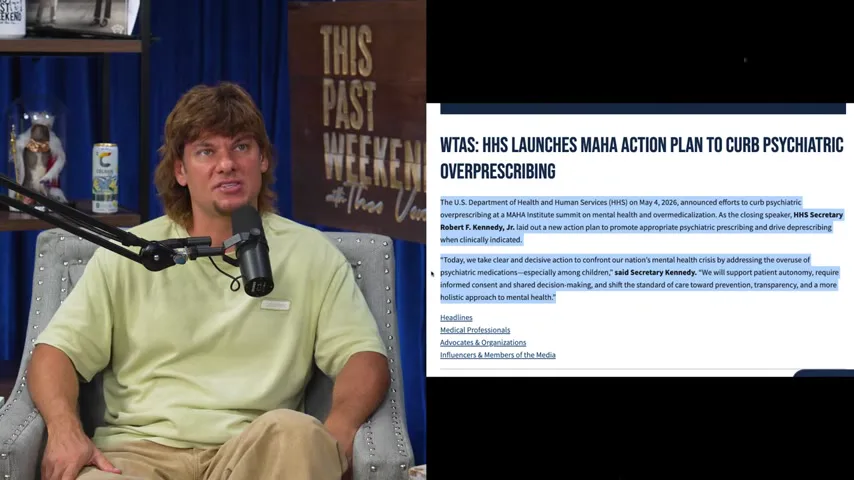
The [U.S. Department of Health and Human Services](https://www.hhs.gov/press-room/hhs-launches-maha-action-plan-curb-psychiatric-overprescribing.html) announced an action plan in May 2026 addressing prescribing and supporting deprescribing when clinically indicated. The announcement describes planned work; it does not mean every proposed measure was already implemented.
Delano and Von stress that the announced effort is not a direction for everyone to stop medication. They use a highway metaphor to describe wanting an available, supported path when a patient and clinician decide a change is appropriate.
Asked about her life now, Delano says she is not taking psychiatric medication and describes her own approach to health and daily routines. Her choice reflects her circumstances and is not a recommendation for others to stop treatment or skip medical care.
Family, community and meaning
The conversation turns to supporting children, community and Delano’s view of recovery.
Delano says she tries to care for herself through choices that feel meaningful in her daily life. A person’s preferred lifestyle does not make preventive healthcare or appropriate medical treatment unnecessary.
She says she thinks about connection to the natural world and the rapid changes of modern life. Von joins her in wondering how contemporary routines differ from those of earlier generations; their discussion is philosophical rather than a test of a medical intervention.
The speakers use a compressed timeline of human history to discuss how recently industrial life emerged. They treat it as a way to think about modern habits, not as proof that a particular traditional practice is medically superior.
Delano rejects the idea that recovery means being happy and balanced all the time. She says she now tries to listen to difficult emotions as possible signals about her life, while acknowledging that sometimes no simple cause is apparent.
She says the difference for her is that she is less afraid of emotional pain and more inclined to ask what it might be telling her. She acknowledges that she still has difficult days.
Both speakers talk about sensitivity and feeling alienated. They use humor as well as seriousness to describe how hard it can be to live with intense feelings and how important it is to feel understood.
Delano reads a brief passage from her book about community and the way societies respond to suffering. She argues for neighbors and families to support one another, alongside her broader criticism of the health industry.
Von asks what parents should do when a child is struggling. Delano encourages parents to listen closely, ask questions and stay engaged rather than assume that a diagnosis alone explains the whole child. She also says families may need support.
She says parents may feel frightened and vulnerable when a child is suffering. In her view, professionals and families should communicate in a way that makes room for parents’ knowledge and questions.
She suggests considering the child’s relationships and environment, and finding other parents who can offer support. These observations do not replace an assessment: serious symptoms in a child deserve timely evaluation and care from an appropriate professional.
Delano distinguishes seeking support from having to solve everything alone. Other parents and community members may offer perspective, while qualified professionals can assess symptoms and discuss care options.
The conversation briefly moves to Delano’s home-birth experience and a humorous exchange about the placenta. She presents this as a personal story, not evidence for a health intervention.
The hosts’ story about childbirth becomes playful and personal. No conclusion about the safety or efficacy of the practices described is established by their conversation.
Delano encourages parents to ask about a proposed diagnosis or treatment, its benefits, risks and alternatives, and to obtain the information they need to participate in decisions. When a child is in immediate danger, urgent professional assessment should not be delayed.
She says her parents acted out of concern and the information they had at the time. She does not present blame as the point of telling her story.
Asked whether she resents her parents, she says no: they were frightened and sought the help they believed was available. She sees her writing and advocacy as a way to make meaning from painful experiences.
For Delano, the work of her nonprofit and writing gives meaning to what she went through. She describes connection to other people as part of that purpose.
Delano describes purpose, relationships, art and community as important to her life. Von reflects on how difficult experiences can sometimes become material for connection or creative work, without suggesting that suffering is necessary or desirable.
The two reflect on art, humor and telling one’s story. They see the possibility of transforming painful experiences into something useful, while recognizing that people’s circumstances differ.
They close by discussing the value of sharing vulnerable experiences and helping people feel less alone. Delano says her recovery has not meant the absence of pain; her relationship to it has changed.
She recalls a moment, years after stopping medication, when she chose to sit with a period of agitation and found that she could tolerate it for a time. This was meaningful for her, but persistent or severe symptoms can require clinical support.
The moment of sitting with agitation did not make her pain disappear, Delano says. It gave her a sense that she could face a difficult feeling for a while; she regards that as a personal milestone.
Von thanks Delano and says he hopes to navigate his own medication questions with more support. Delano offers friendship and encouragement. The conversation ends with appreciation for being able to speak openly about difficult experiences.
The guests exchange thanks, and Von says he will continue to speak about his own experience as he works through questions with support. Their discussion is an invitation to ask informed questions, not a personal treatment plan.
같은 채널의 다른 글
 2:03:29EN
 Theo Von· 2026년 9월 1일팟캐스트 · 2명Luke Bryan on Family, Football and Finding Humor in Country Life게스트 Luke Bryan · 진행자 Theo VonThe country singer joins Theo Von for a wide-ranging conversation about growing up in the South, parenting and music.
 1:35:56ENTheo Von· 2026년 8월 25일팟캐스트 · 2명Gurudev Sri Sri Ravi Shankar on Breath, Fear, Forgiveness and Peace게스트 Gurudev Sri Sri Ravi Shankar · 진행자 Theo VonThe Art of Living founder talks with Theo Von about his spiritual practice, relationships, service and his account of peacebuilding in Colombia.