30초 요약
Luke Bryan and Theo Von trade stories about football, hunting, childhood and life in the public eye. Bryan also talks about raising his sister’s children after their parents died and the online reaction to his song “Fish Hunt Golf Drink.”
- 1Watching his son playBryan recalls his son’s first start and the heat at a nationally televised game.
- 2Growing up around peanutsBryan describes life in a small Georgia town near peanut fields and a mill.
- 3A song becomes an online storyBryan discusses reactions and rumors about “Fish Hunt Golf Drink.”
- 4Family after lossBryan explains how his extended family supported his sister’s children after their parents died.
핵심 정리
- Bryan describes supporting his son’s football journey while recognizing the work of the whole team.
- The hosts trade stories of growing up in Southern towns and on farms.
- Bryan discusses how his extended family supported his nieces and nephew after loss.
- The conversation shows how online criticism can become a story of its own around a song.
챕터별로 다듬은 전문 읽기
Football and growing up
Bryan talks about watching his son play football, and the hosts swap memories of their own school sports.
Theo Von introduces Luke Bryan as a country musician, American Idol judge and outdoorsman. The conversation opens with jokes about reading glasses and trying to decipher the names of beers without them.
The two compare how hard it has become to read a menu without glasses. Bryan says ordering draft beer can turn into guesswork, especially when an unfamiliar beer name gives him no clue what is inside.
Bryan recalls ordering a keg of a strong bourbon-barrel beer and inviting friends over. The group underestimated its strength, he says, and he jokes about what his wife found when she came home.
Bryan explains that the beer he tried was stronger than the beer he was used to. The story is a comic recollection of a party that went further than the group expected.
The pair trade stories about products associated with musicians. Bryan describes a beer that spoiled in some cases and the unpleasant calls that followed. The experience made him less eager to put his name on another product.
Bryan says the bad batch made him call distributors and friends who had tried it. Von notes that attaching a name to a product also means being associated with whatever happens after it reaches customers.
Von asks about Bryan’s son playing quarterback. Bryan says their school traveled to Alabama for a game against a team coached by Philip Rivers; the game was moved to midday for television, creating punishing heat for the players.
The Alabama game was scheduled for Friday before the television broadcast moved it to the middle of the day. Bryan says parents worked to help players deal with the weather while families watched from the stands.
Parents brought misting coolers to help, but Bryan jokes that the hot water and heat limited their effect. He was nervous watching his son’s first start on national television and says his son played well.
Bryan says the heat index was so high that the cooling equipment could not do much with hot tap water. Von responds with his own memory of trying to escape heat through the soles of his football shoes.
The heat brings back memories of youth football. Von remembers hot ground coming through his cleats, while Bryan recalls playing in South Georgia and being knocked down by a much larger quarterback.
Bryan describes a hard hit in an eighth-grade game and waking up to see the other player running toward the end zone. Von turns the memory into another joke about the perils of Southern football.
They joke about itchy fields and the conditions they remember from school. Bryan says his son’s team has strong receivers and that his son waited behind an accomplished quarterback before getting his chance as a senior.
Bryan says his son’s team includes talented receivers, and emphasizes that the quarterback did not accomplish everything alone. He is proud of the preparation and patience his son showed while waiting for an opportunity.
Bryan mentions that a teammate’s father is bodybuilder Brandon Curry. The hosts look at pictures and joke about how imposing a professional bodybuilder appears, returning to their earlier jokes about needing reading glasses.
The hosts continue riffing on bodybuilding photos and the way competitors present themselves onstage. Bryan jokes about explaining to his friend why he has brought up the pictures on the show.
Their conversation wanders into a disputed sports-policy story and jokes about players. They acknowledge that they are learning the details as they speak, so their speculation should not be read as an explanation of eligibility rules.
The sports discussion becomes a series of jokes and a search for more information. The hosts do not verify the legal or league rules on the episode and explicitly acknowledge uncertainty about the details.
Von asks about quarterback camps. Bryan says he did not want to send his son before he felt ready to compete. At a Nike Elite 11 regional camp, Bryan himself was also learning how the recruiting process worked.
Bryan says his concern was that a camp entered too early could be discouraging if a young player felt outmatched. He chose to wait until his son wanted the experience and was better prepared.
At a camp in Louisiana, Bryan says his son threw alongside highly rated quarterbacks and was invited back the next day to throw for receivers and defensive backs. The unexpected invitation changed their travel plans and gave them another day in New Orleans.
The invitation to return for another day surprised Bryan, who had already planned to leave. He recalls enjoying New Orleans while his son prepared to help showcase other players the next morning.
Bryan enjoyed watching the young players compete, knowing many hoped to play in college. The hosts then joke about how early children now appear in sports videos and how young some are when adults put microphones on them.
The footage of very young athletes wearing microphones makes both men wonder how early sports now become public performance. Von jokes that some of the children are more interested in ordinary needs than in the cameras.
Bryan says the camp helped his son see that he could compete with highly rated players. He also cautions against judging a young athlete by a single game: a season gives a fuller picture, and teammates and opponents shape the result.
Bryan notes that the opposing quarterback was injured and says the game might have been tougher had he stayed in. He resists turning one result into a complete judgment of any child’s ability.
Watching his children enjoy themselves now supplies much of his own joy, Bryan says. He asks Von whether he wants children, and Von says he hopes to have a family while joking about what marriage and commitment might look like.
Von says taking better care of himself makes family life feel more possible. The pair keep the tone light, joking about a marriage contract renewed as frequently as a short sports contract.
Their jokes lead to a discussion of mayflies and fishing. Bryan remembers fishing a mayfly hatch and catching bream; the two use the insect’s short adult life as another opening for playful comparisons.
Bryan explains that an adult mayfly has a short life after spending much longer underwater. The sight of a hatch reminds him of fishing for bream and the excitement of seeing fish feed.
Bryan recalls taking Von fishing and says a guide noticed his natural ability. He teases that Von is still in “kindergarten” as an angler and can graduate to more demanding techniques with practice.
Bryan describes fly-fishing in the West, including a cutthroat trout on the Snake River. The two joke that a proper fishing trip also requires negotiating time away from family responsibilities.
Bryan explains that a riffle is water running over rocks, and pictures Von catching a large trout. The increasingly elaborate trip becomes a joke about how fishing plans expand once the conversation starts.
Von remembers an uncle whose jaw did not work properly, and the pair compare older childhood health problems with treatments available today. They recall school screening rituals before the episode’s sponsor break.
Childhood memories and Hawaii
The pair trade stories about school, pets and growing up in the South, then recall meeting in Hawaii.
After the break, they recall childhood head-lice checks. Bryan says one of his children needed treatment and jokes about the contrast between a modern clinic and the improvised methods he remembers from school.
Bryan describes taking a child to a specialized lice clinic and jokes about its amenities. Von contrasts that with the routine of school staff checking children’s hair with wooden sticks.
They trade exaggerated memories of combing hair and trying to deal with lice. Von’s jokes about gender and cleanliness give way to a reminder that head lice are not a sign of dirty hair.
They joke about whether lice prefer a particular kind of person, then note that anyone can get them and that clean hair does not prevent an infestation. Their childhood stories are comic memories rather than treatment advice.
Bryan tells a story about staying at a friend’s house despite a severe cat allergy and finding fleas in the bedding. Von recalls strange childhood sleepovers too, and both laugh at the conditions adults once expected children to endure.
Bryan says his parents kept a long-haired Persian cat despite his allergy. He remembers wheezing around cats and jokes about how difficult it was to keep the family pet out of his room.
Their memories move to pets: Von remembers seeing a golden retriever inside a house for the first time, while another friend kept many animals in a bedroom. The hosts embellish the smells and the noise of an unforgettable sleepover.
Von describes a friend’s room full of caged pets, an extremely powerful ceiling fan and the difficulty of sleeping there. Bryan laughs that he has similar stories but admires Von’s storytelling.
School dances bring back memories of inexpensive clothes, awkward slow dances and trying to look presentable. Von recalls borrowing makeup to cover a rash and realizing afterward that it had made him more conspicuous.
The two remember the pressure of wearing the right brands to a school dance. Bryan jokes about lookalike shoes and clothes that did not quite match what the other children wore.
Von recalls how exciting and awkward a slow dance felt as a child, even when the interaction was only a whisper or a hand on someone’s back. The pair wonder whether today’s children experience those moments the same way.
Bryan clarifies that he grew up in a small Georgia town near peanut fields and a peanut mill, rather than in a house surrounded by farmland. He remembers the dust and smell from the mill and picking green peanuts to boil.
Bryan says the peanuts were picked from the vines, washed carefully and boiled in their shells. He associates the finished snack with time spent outside with family and a cold drink.
They describe washing peanuts, cooking them in their shells and eating them with salt. The food prompts more joking memories of the few household remedies and medicines they remember from childhood.
The conversation moves from food to childhood memories of familiar remedies. The speakers joke about what was kept in the house, without offering medical recommendations.
The two recall meeting unexpectedly in Hawaii. Von was traveling with a new security guard after a freeze disrupted his return to Nashville, and Bryan kept trying to work out why the two men were there together.
Bryan remembers first seeing Von at the resort and repeatedly asking who had accompanied him. He says it took several explanations before he believed Von was simply vacationing with his new security guard.
Bryan thought Von might have a surprise role on American Idol, which was filming nearby. Instead, Von says, he and his guard ate together for days while romantic couples around them got engaged. The awkward trip eventually became the start of a friendship.
Von says the trip became five dinners with someone he barely knew at the time. The men joke that a vacation surrounded by honeymooners and marriage proposals was an unusual way to get acquainted.
The two discuss why someone in public life might want another person nearby. Bryan says help managing requests for photos allows him to watch his son’s football games without constantly having to negotiate with fans himself.
Bryan says he tries to meet fans and take photographs, but having a helper can create a boundary during the game itself. That lets him pay attention to his child rather than managing every interaction.
Von says he has been dating and describes how Nashville’s layout and nightlife make meeting people complicated for him. Bryan jokes that the city has no shortage of visitors, while Von says crowded, intoxicated settings can feel unpredictable.
Hunting, food and childhood jobs
They discuss hunting, cattle, childhood memories and work on farms.
After a sponsor break, the pair talk about hunting. Von recalls a turkey hunt with Michael Waddell and jokes that the ammunition in his gun was not real. Bryan offers to take him out again and teases him about his equipment.
Von remembers wearing the wrong clothing and borrowing oversized glasses for the hunt. Bryan teases him but says they can go again, turning a frustrating outing into a shared story.
The hosts joke about leaving the hunting grounds and encountering more birds by the road. The conversation then turns to beef prices and the practical challenges facing cattle producers.
Bryan says he has spoken with Agriculture Secretary Brooke Rollins through work connected with farmers. He describes how animal disease, egg prices and other problems can occupy officials’ attention at the same time.
They discuss New World screwworm and the release of sterile male flies to limit reproduction. Bryan says the pest can affect livestock and wildlife; the hosts are struck by the specialized work required to manage agricultural threats.
Bryan describes the difficulty of monitoring wildlife for the pest compared with a livestock herd that a farmer checks regularly. The hosts marvel at the scale of a response that requires coordinated work beyond a single farm.
The two consider why cattle herds might be smaller and discuss drought, costs and losses in cold weather. They read an on-screen summary during the conversation; it is not an independent analysis of the causes or current market conditions.
Childhood fears become the next topic. Von remembers worrying about nuclear war and dangerous neighborhood dogs. Bryan says his mother warned him about packs of dogs, a story he now suspects may also have kept him close to home.
Von remembers being afraid of large dogs running loose in his neighborhood. Bryan jokes that a group he believed was a wild pack may have been ordinary local dogs following a female dog.
Von tells stories about growing up around neighbors and hearing adults talk about local dangers. The two joke about their younger selves’ understanding of the world, without presenting the anecdotes as a general account of public safety.
Bryan remembers building tree forts from saplings and later realizing how dangerous a fall could have been. Von describes childhood discoveries in the woods and the odd things children hid from adults.
The hosts remember hiding magazines, snacks and other forbidden objects from adults. They use the details to contrast the freedom and embarrassment of childhood with what they imagine children do now.
The talk circles back to alternative meats. Bryan recalls eating squirrel as a child and becoming ill afterward. The story becomes an exchange of jokes, not a recommendation about preparing or eating wild animals.
Bryan recalls a neighbor preparing the squirrels with rice. He became sick afterward and has not eaten squirrel since. Von plays up the idea of a future food shortage as the pair riff on increasingly unlikely alternatives.
Bryan says he enjoys elk hunting and describes having meat professionally processed and shipped home. Von says he worries about disruptions to the food supply; Bryan jokes that his friend could come to his house if things got difficult.
Bryan explains that his family keeps processed elk meat in the freezer. His story turns an outdoor trip into a discussion of how the food is brought home and shared.
The hosts reminisce about convenience-store drinks and snacks after youth sports. They joke about the families who brought refreshments and how memorable a small treat felt after practice.
Asked about the worst jobs he has done, Bryan recalls being sent to clean an old grain elevator. He describes stagnant water, decaying material and animals, and says the smell followed him to a diner afterward.
Cleaning the grain elevator meant shoveling accumulated material into buckets for someone above to pull out. Bryan remembers being covered in the smell by the end of the job, to the dismay of people at the diner.
Von remembers cleaning farm machinery after it sat through the winter, while Bryan recalls snakes arriving with farm loads. Both treat the stories as a mixture of hard work and childhood absurdity.
They watch footage from a robot sporting event. A robot falls during a race, prompting jokes about how far the technology still has to go and speculation about what people might do if machines become much more capable.
Robots, road trips and music
A robot sports clip leads to more family stories and a road trip. Bryan discusses his song and its online reception.
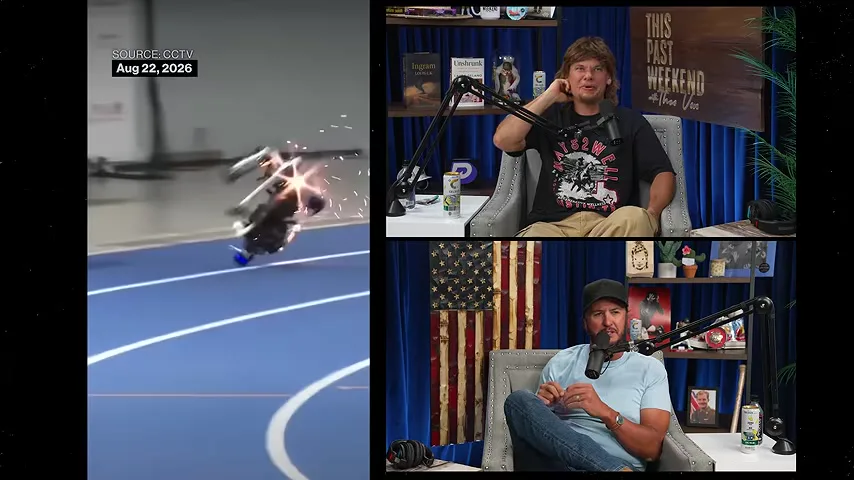
The hosts laugh at the robot’s fall but acknowledge that performance could change over time. Von wonders aloud how robotics could alter work, framing it as a question rather than a prediction.
The topic turns to their mothers. Bryan says his mother lives near the beach and jokes about her finding ways around him to ask members of his staff for help or purchases. Von describes his own mother’s visit.
Bryan jokes that his parents know how to find the newest member of his team and ask for tickets or other favors. The story conveys both the closeness of his family and the comic complications of his public career.
Von recalls a road trip with friends in a rented camper. The vehicle rattled so much, he says, that everyone crowded toward the front; they alternated between sleeping in it and staying with friends.
Von says the camper trip was noisy and sleep was difficult, but his friends found humor in the discomfort. They shared the driving and used friends’ homes as occasional places to rest.
The group went to the Field of Dreams baseball event. Von says the game and seeing Hall of Fame players were worth the uncomfortable drive. The hosts joke that corn mazes are an unusual use of a crop when people are discussing food costs.
Von describes the baseball park built near the film set and the unusual experience of seeing many retired greats together. The trip was about the event and the company, despite the less comfortable parts of the drive.
Von describes other stops, including an ATV track and an interview with musician Billy Strings. Bryan praises Strings, and the two discuss how much they enjoy performers who are open about their lives.
Von asks about Bryan’s song “Fish Hunt Golf Drink.” Bryan says he and his collaborators wrote it and recounts how online claims that AI had written it spread. His denial is his own account of how the song was made.
Bryan says criticism of the song became unusually personal in some online videos. Von suggests that social media can turn a reaction into a shared event, though Bryan says the hostility is still difficult to understand.
Von wonders whether online commentators are participating in a daily social spectacle as much as expressing a settled opinion. Bryan says visibility has a downside when people direct harsh personal comments at a performer.
Bryan says he heard the song played at his son’s football game, where people were enjoying it. He recalls earlier criticism in his career and says the song was meant to be fun, even if not everyone likes it.
Bryan recalls that earlier songs also attracted criticism. He argues that a lighthearted song need not satisfy everyone, and that he has spent much of a long career hearing different versions of the same objection.
The pair briefly discuss books, including John Irving’s *A Prayer for Owen Meany*, and joke about a supposed rumor involving Jason Aldean and American flags. The rumor is presented as a joke, not as a reported fact.
Family, loss and what comes next
Bryan describes helping raise his nieces and nephew after their parents died. The conversation closes with music, performing and fishing.
Von asks how Bryan came to help raise his sister’s children. Bryan explains that his sister and her husband died at different times, leaving three children. The extended families were close and gathered to decide how to support them.
Bryan says his nephew Til, then 13, wanted to live with him and his wife Caroline. Their two younger sons suddenly had an older boy in the household. The older nieces remained in Georgia at that point, so they were also supporting family from a distance.
The older girls were at different stages of school and college. Bryan says the family did not want to uproot one niece in the middle of high school, so their support took different forms for each child.
Bryan remembers making room for a teenager while trying to understand what he was going through after losing his parents. He says they learned as they went, with help from relatives and support networks in both places.
He describes his wife spending hours talking with the older girls about relationships, school and everyday choices. Looking back, Bryan is grateful that the children had people to turn to and that the families could support one another.
Bryan describes how the children grew up and how much he values spending time with his nephew now. He also speaks warmly of the next generation in the family, whom he treats as grandchildren.
Bryan says sharing stories of loss can help other people feel less alone. Von agrees that people are all dealing with something, and that speaking honestly can help both the storyteller and the listener.
Von says sharing does not have to be performed as a lesson: people can simply talk about what they have experienced. Bryan responds that knowing others have faced difficulties can make a person feel less isolated.
They express sadness about divisions between groups and hope people can show one another more patience. The mood turns playful again as they invent a joking version of Bryan’s song based on Von’s daily routine.
Bryan suggests that listeners could someday create their own versions of the song with AI. They thank each other for the conversation, and he says it took a little time to settle into an unfamiliar podcast setting.
Von tells Bryan he could have been a comedian. Bryan says he has kept a file of funny ideas and enjoys interacting with audiences at the piano. He imagines a future performance that leaves room for conversation as well as music.
Bryan says that once he relaxes into a show, speaking and joking with people around a piano brings him joy. Von encourages the idea of a performance built around that interaction.
They mention Bryan’s album *Signs* and return to fishing. Bryan invites Von to come out again, and the two joke about bait and where to find a good place to fish.
They joke about using unconventional fishing bait before Bryan offers to take Von to his lakes farther south. Their conversation returns to the pleasure of being outdoors and spending time with a friend.
Bryan says the point is to set aside a day without feeling guilty or rushing to the next obligation. Von thanks him for the conversation and the invitation, and the episode closes with an exchange of thanks.
같은 채널의 다른 글
 2:28:21EN
 Theo Von· 2026년 8월 27일팟캐스트 · 2명Laura Delano on Psychiatric Treatment, Withdrawal and Informed Choice게스트 Laura Delano · 진행자 Theo VonThe author and advocate discusses her personal treatment history and the need for support when patients consider changing medication.
 1:35:56ENTheo Von· 2026년 8월 25일팟캐스트 · 2명Gurudev Sri Sri Ravi Shankar on Breath, Fear, Forgiveness and Peace게스트 Gurudev Sri Sri Ravi Shankar · 진행자 Theo VonThe Art of Living founder talks with Theo Von about his spiritual practice, relationships, service and his account of peacebuilding in Colombia.