30초 요약
Sawyer solves the previous Real Numbers challenge by equating the volumes of a hemisphere and a cone, both with radius 5 cm, to find a cone height of 10 cm. He then poses a new problem about the intersection of the sphere and cone and the volume of displaced ice, leaving that challenge to viewers.
- 1The cone’s constraintsIts rim matches the equator of a sphere of radius 5 cm, and its volume equals that of the lower hemisphere.
- 2Equating volumesThe hemisphere has volume 250π/3 cm³ and the cone has volume 25πh/3 cm³, so h is 10 cm.
- 3A new reshaping challengeSawyer asks for the radius of the intersection circle and the volume of shaved ice moved into the cone’s tip.
핵심 정리
- A hemisphere of radius 5 cm has volume 250π/3 cm³.
- A cone of base radius 5 cm with the same volume has height 10 cm.
- The new challenge asks for the lower intersection radius and, as a bonus, the volume of ice moved.
챕터별로 다듬은 전문 읽기
The previous snow-cone problem
Sawyer restates the requirement that the cone rim fit the equator of a 5 cm sphere and its volume equal the hemisphere. The cone’s unknown dimension is its height.
Sawyer introduces an extension of the previous Real Numbers challenge and first solves that earlier problem. The goal was to design a cone-shaped snow-cone holder whose rim fits the equator of a sphere of flavored ice and whose volume equals the lower hemisphere.
A cone is determined by its base radius and height. The sphere has radius 5 cm, so the matching rim gives the cone a base radius of 5 cm. The remaining unknown is the height that makes the two volumes equal.
Solving for the height
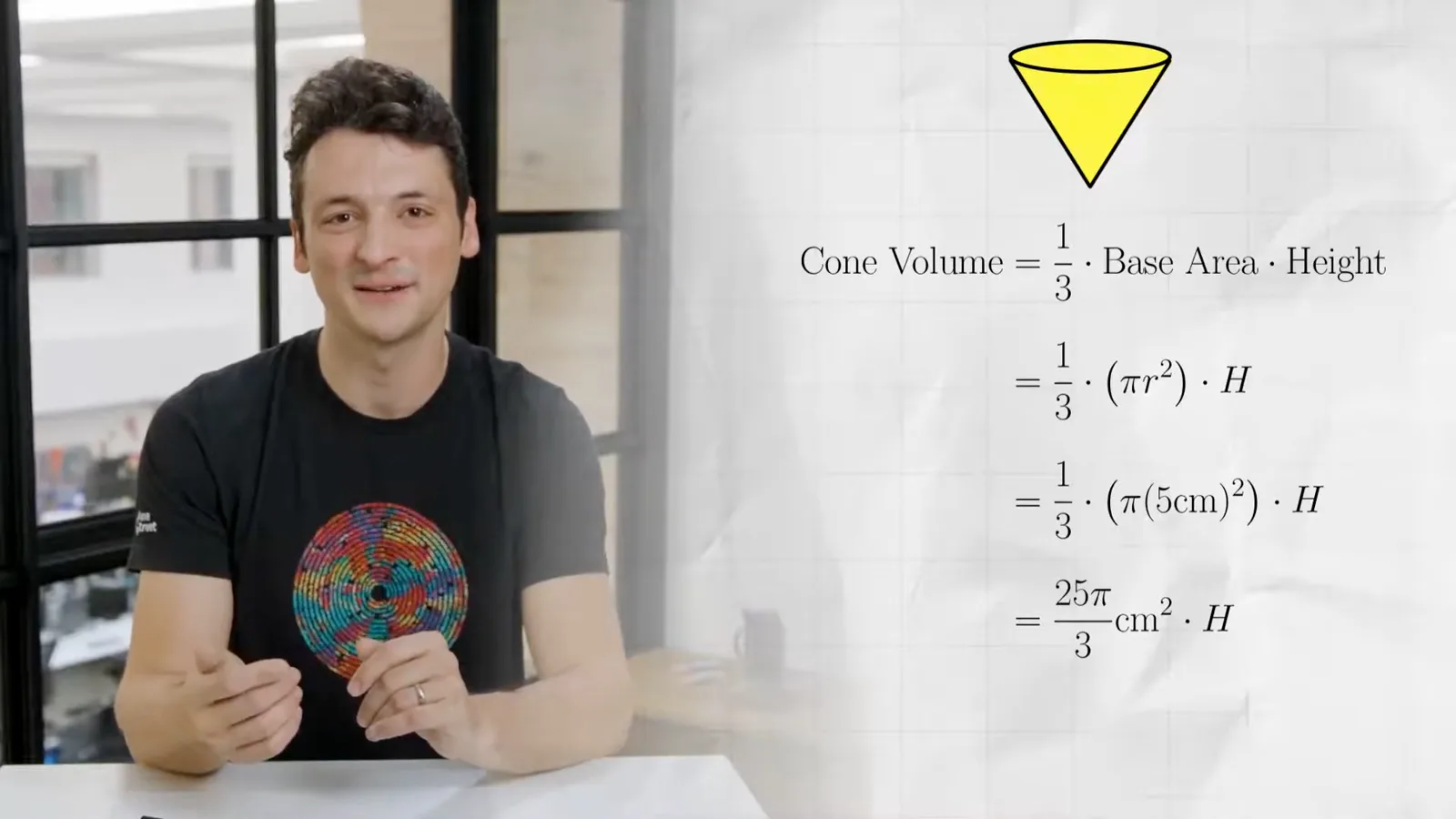
The hemisphere and cone volume formulas give 250π/3 and 25πh/3. Equating them yields a height of 10 cm.
The hemisphere’s volume is half of 4πr³/3, or 250π/3 cm³ for r = 5 cm. The cone’s volume is one third of its base area times its height: 25πh/3 cm³. Setting them equal gives h = 10 cm, the diameter of the original sphere.
A new intersection challenge
Sawyer asks how to reshape the lower hemisphere into the cone while moving as little ice as possible. The intersection radius and displaced volume are left for viewers to calculate.
The new challenge is to reshape the lower hemisphere into the inverted cone of radius 5 cm and height 10 cm while moving as little slush as possible. Ice is shaved from the portion of the sphere wider than the cone and packed into the cone’s tip below the sphere.
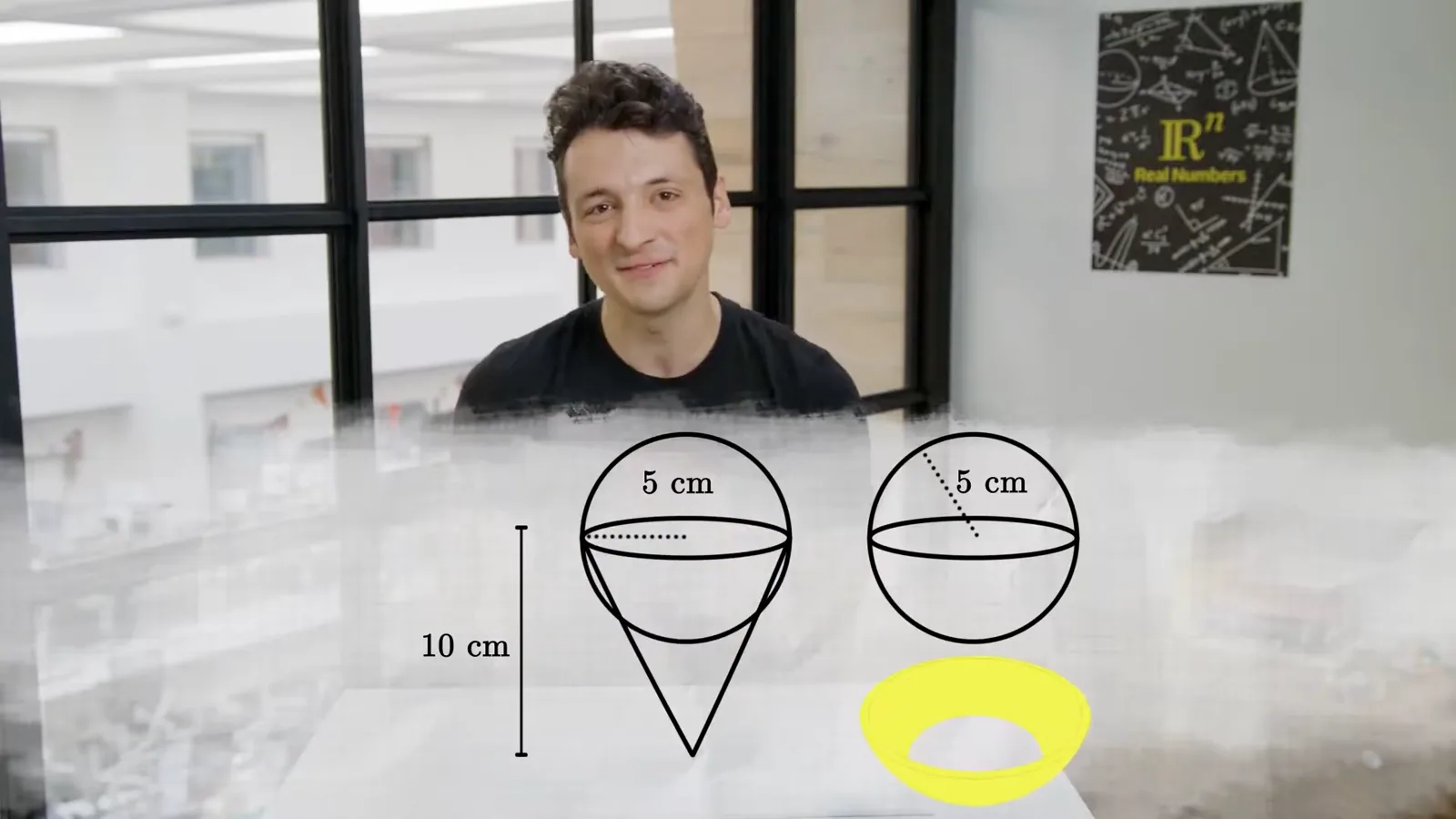
What is the radius of the lower circle where the sphere and cone intersect? As a bonus for readers familiar with integral calculus, Sawyer asks for the total volume of shaved ice that must be displaced. The episode leaves both questions for viewers to solve.
같은 채널의 다른 글
 1:48:29EN
 1:05:45EN
 1:25:00EN
 1:16:29EN
 4:41EN
 1:34:29EN