Snow Cones and Spheres: A Volume Solution and a New Geometry Puzzle

Sawyer derives the height of a cone with the same volume as a hemisphere, then asks how to reshape the ice with minimal movement.

SaSawyerPresenta · Jane Street
Canal
Jane Street
Publicado
19 jun 2020
Vídeo
3:35
Lectura
2 min
Diapositivas
2
Original
inglés
Abrir en YouTube
Al desplazarte, el vídeo se reduce a la esquina inferior derecha y sigue reproduciéndose. Los subtítulos siguen tu idioma de lectura.
Idioma de lecturaDisponible en 2 idiomas
Este artículo aún no está en español, así que se muestra el original en inglés.
RESUMEN

En 30 segundos

Sawyer solves the previous Real Numbers challenge by equating the volumes of a hemisphere and a cone, both with radius 5 cm, to find a cone height of 10 cm. He then poses a new problem about the intersection of the sphere and cone and the volume of displaced ice, leaving that challenge to viewers.

  1. 1The cone’s constraintsIts rim matches the equator of a sphere of radius 5 cm, and its volume equals that of the lower hemisphere.
  2. 2Equating volumesThe hemisphere has volume 250π/3 cm³ and the cone has volume 25πh/3 cm³, so h is 10 cm.
  3. 3A new reshaping challengeSawyer asks for the radius of the intersection circle and the volume of shaved ice moved into the cone’s tip.

Conclusiones

  1. A hemisphere of radius 5 cm has volume 250π/3 cm³.
  2. A cone of base radius 5 cm with the same volume has height 10 cm.
  3. The new challenge asks for the lower intersection radius and, as a bonus, the volume of ice moved.
TEXTO COMPLETO

Lee el texto editado por capítulos

Solo la transcripción
01

The previous snow-cone problem

Sawyer restates the requirement that the cone rim fit the equator of a 5 cm sphere and its volume equal the hemisphere. The cone’s unknown dimension is its height.

Sawyer introduces an extension of the previous Real Numbers challenge and first solves that earlier problem. The goal was to design a cone-shaped snow-cone holder whose rim fits the equator of a sphere of flavored ice and whose volume equals the lower hemisphere.

A cone is determined by its base radius and height. The sphere has radius 5 cm, so the matching rim gives the cone a base radius of 5 cm. The remaining unknown is the height that makes the two volumes equal.

02

Solving for the height

The hemisphere and cone volume formulas give 250π/3 and 25πh/3. Equating them yields a height of 10 cm.

The hemisphere’s volume is half of 4πr³/3, or 250π/3 cm³ for r = 5 cm. The cone’s volume is one third of its base area times its height: 25πh/3 cm³. Setting them equal gives h = 10 cm, the diameter of the original sphere.
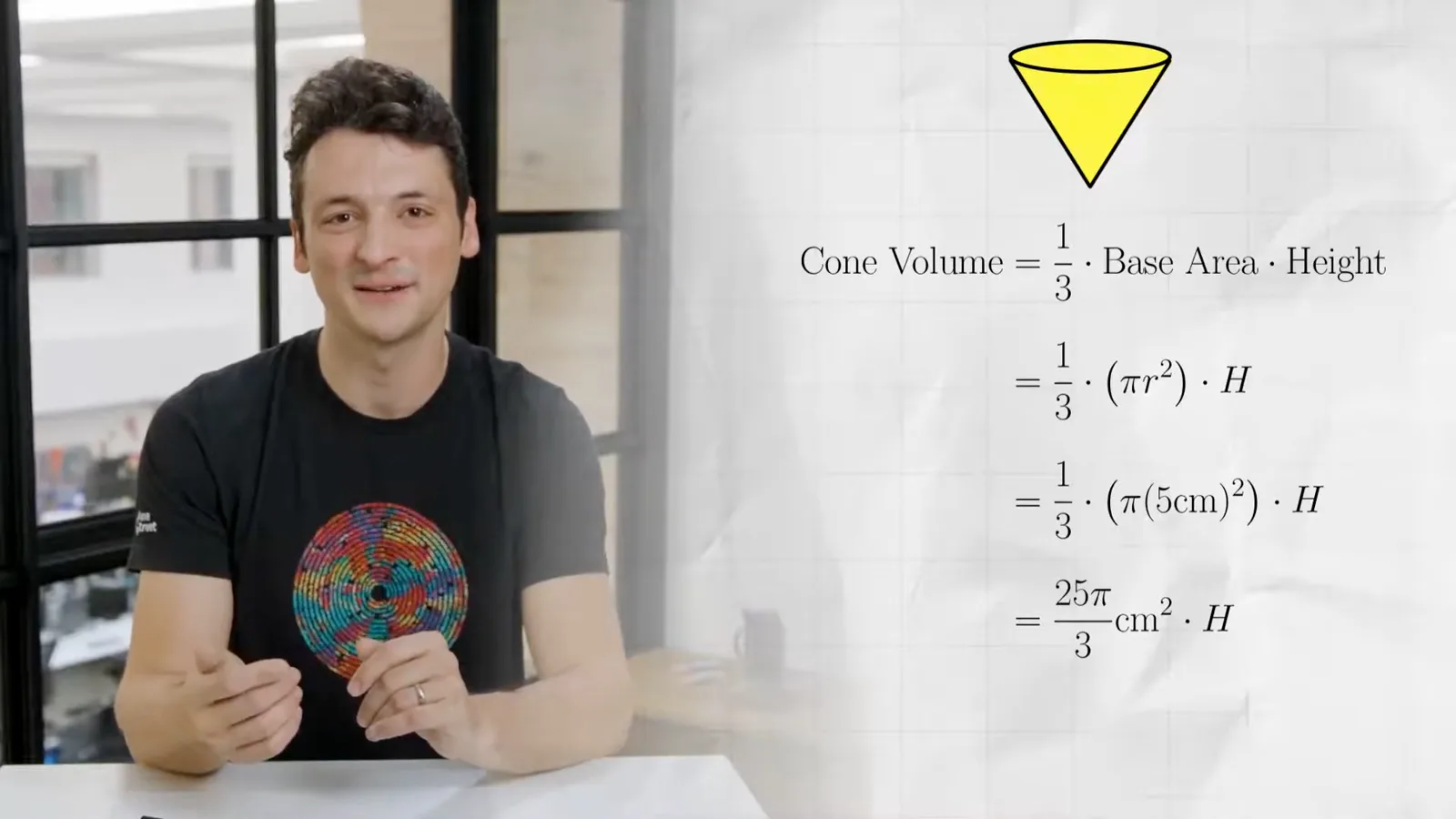
Cone volume with a 5 cm radius
DIAPOSITIVA 1 / 2Cone volume with a 5 cm radiusThe formula expresses the cone’s volume as 25πh/3, ready to compare with the hemisphere.
03

A new intersection challenge

Sawyer asks how to reshape the lower hemisphere into the cone while moving as little ice as possible. The intersection radius and displaced volume are left for viewers to calculate.

The new challenge is to reshape the lower hemisphere into the inverted cone of radius 5 cm and height 10 cm while moving as little slush as possible. Ice is shaved from the portion of the sphere wider than the cone and packed into the cone’s tip below the sphere.
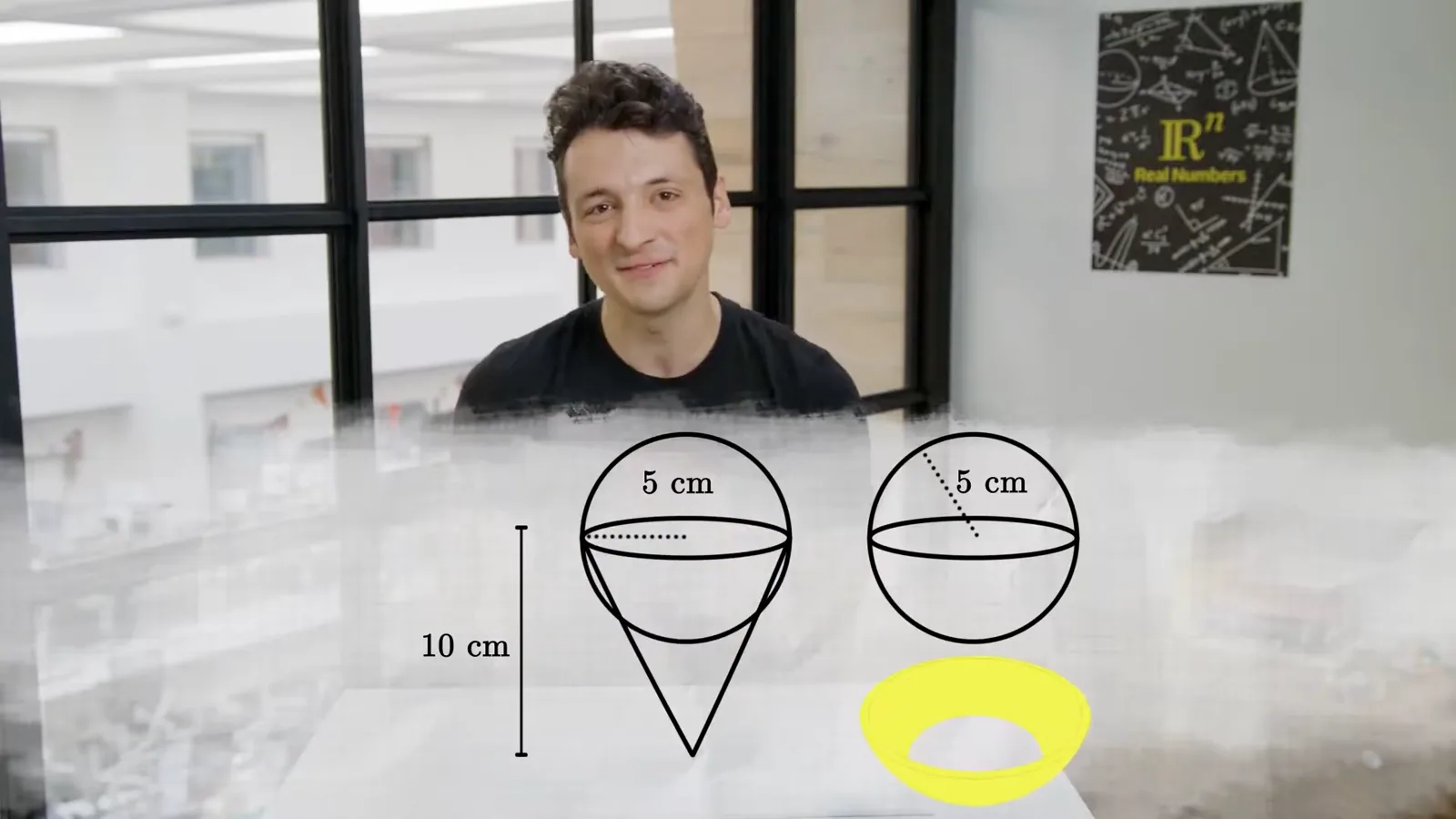
Sphere and cone superimposed
DIAPOSITIVA 2 / 2Sphere and cone superimposedThe illustration shows the ice to be shaved and the cone extending below the sphere.

What is the radius of the lower circle where the sphere and cone intersect? As a bonus for readers familiar with integral calculus, Sawyer asks for the total volume of shaved ice that must be displaced. The episode leaves both questions for viewers to solve.

Más de este canal

1:48:29EN
JSJane Street· 16 oct 2026How AI Is Changing Programming: John Krazit and Ron MinskyRon Minsky, John Krazit · Jane StreetJane Street’s AI tooling lead and the Signals and Threads host examine agent infrastructure, security, code review and the changing experience of writing software.Agentes de programaciónDeveloper productivityEvaluaciones+2
1:36:37EN
JSJane Street· 23 sept 2026Aaron Bauer on Teaching Software Engineering in the Age of AIRon Minsky, Aaron Bauer · Jane StreetHow learning goals, active practice and editor design shape engineering education when models can generate the code.AI in EducationSoftware engineeringEducation+2
9 diapositivas1:05:45EN
JSJane Street· 11 sept 2026Cyrus Omar on Live Programming and a Computational Commons for Humans and AICyrus OmarA demonstration of Hazel shows how immediate feedback, structured collaboration and carefully scoped permissions could support people and AI agents working together.Programming LanguagesHuman-AI CollaborationFlujos de desarrollo y pruebas+2
1:25:00EN
JSJane Street· 2 sept 2026Eric Mannes on Turning Messy External Data Into Trading ResearchRon, Eric Mannes · Jane StreetFrom commodity futures and an Excel risk system to point-in-time datasets and AI, Eric Mannes explains the domain knowledge behind data engineering at Jane Street.Data quality & curationFlujos de desarrollo y pruebasInvesting+2
7 diapositivas1:16:29EN
JSJane Street· 26 ago 2026Grant Sanderson and Alok Puranik: Positional Encodings Through Group TheoryGrant Sanderson, Alok Puranik · 3Blue1BrownStarting with assumptions about attention, they derive matrix exponentials and connect rotations, decay and Jordan blocks to RoPE and ALiBi.Transformers & attentionMathematicsFundamentos de ML+1
27:39EN
JSJane Street· 21 ago 20263Blue1Brown and Jane Street on Trading, Machine Learning and CultureGrant Sanderson, Nitya, In Young, Craig, Alok · 3Blue1BrownGrant Sanderson talks with Jane Street colleagues about market making, shared compute, research and the paths that brought them to the firm.Machine LearningFintechCompany Culture+2