30초 요약
In the first Real Numbers episode, Sawyer asks for the probability of at least two uninterrupted nights while looking after a poodle that independently wakes its sitter with probability 2/3 each night. He leaves the puzzle for viewers and reviews the probability rules needed to approach it, illustrating them with a coin and a die.
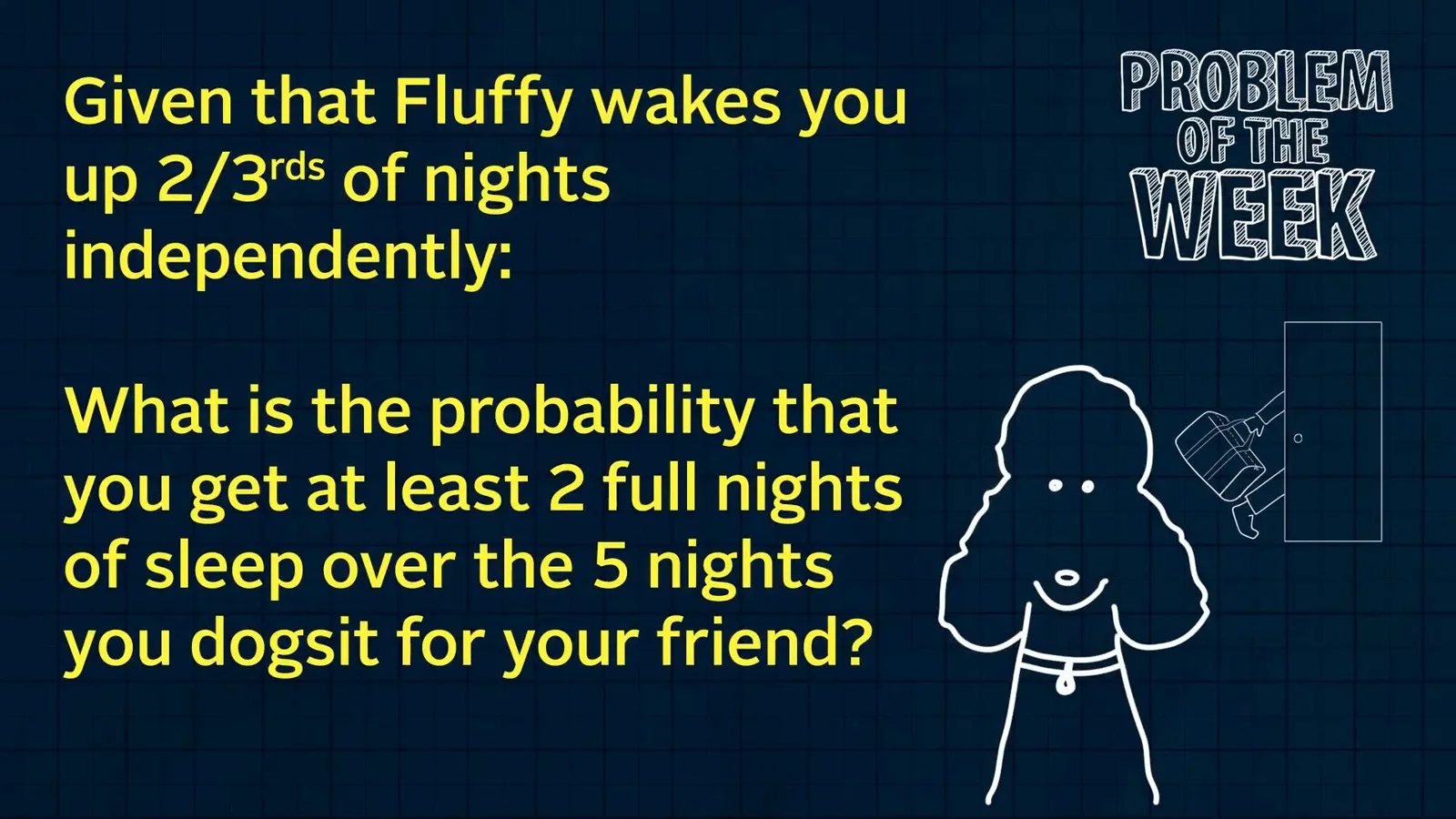
- 1Five nights with FluffyFluffy independently wakes the sitter with probability 2/3 each night. The challenge asks for at least two full nights of sleep out of five.
- 2Multiply independent eventsA fair coin landing heads and a fair die showing 1 have joint probability 1/2 × 1/6 = 1/12.
- 3Add disjoint eventsA single die roll cannot be both 5 and 6, so their probabilities add to 1/3.
- 4Subtract the overlapHeads or a 1 has probability 1/2 + 1/6 − 1/12 = 7/12.
- 5Use the complementThe same probability is 1 minus the probability of tails and a number other than 1, giving 7/12 again.
핵심 정리
- Independent events can be combined by multiplying their probabilities.
- Probabilities of mutually exclusive events can be added.
- For overlapping events, subtract the intersection once to avoid double-counting.
- The probability of an event is one minus the probability of its complement.
- The dogsitting question requires accounting for independent outcomes across five nights.
챕터별로 다듬은 전문 읽기
The dogsitting challenge
Sawyer asks for the chance of at least two full nights of sleep out of five. Each night the dog independently wakes the sitter with probability 2/3.
Welcome to Real Numbers, a weekly show about discovering math by analyzing and solving real-world problems. I’m Sawyer. Each episode presents a problem of the week; in the following episode we discuss different ways to solve it.
Your friend is away for five nights and asks you to look after his poodle, Fluffy. Once your friend is far away, you learn that Fluffy wakes you up and demands a walk on two-thirds of nights. Assume the nights are independent: what is the probability that you get at least two full nights of sleep during the five nights? Show your work when you submit an answer.
The rest of this episode reviews probability, the mathematics of random or uncertain events. It connects to statistics, combinatorics and discrete mathematics, and gives us a way to model questions about an unknown future.
Independent and disjoint events
A fair coin and die illustrate independence and multiplication. Mutually exclusive outcomes on one die illustrate addition.
Consider a fair coin and a fair die. Heads and tails each have probability 1/2; each of the six numbers on the die has probability 1/6. If we flip the coin and roll the die together, what is the chance of heads and a 1?
The two events are independent: learning the result of one does not change the probabilities of the other. For example, revealing that the coin landed tails does not change the die’s distribution. We therefore multiply the probabilities of heads and 1: 1/2 × 1/6 = 1/12.
Now ask whether the next die roll is a 5 or a 6. Those events are disjoint: one roll cannot be both numbers. Their probabilities add, giving 1/6 + 1/6 = 1/3.
Overlapping events and complements
A Venn diagram explains why the intersection must be subtracted. A complement gives a second route to the same result.
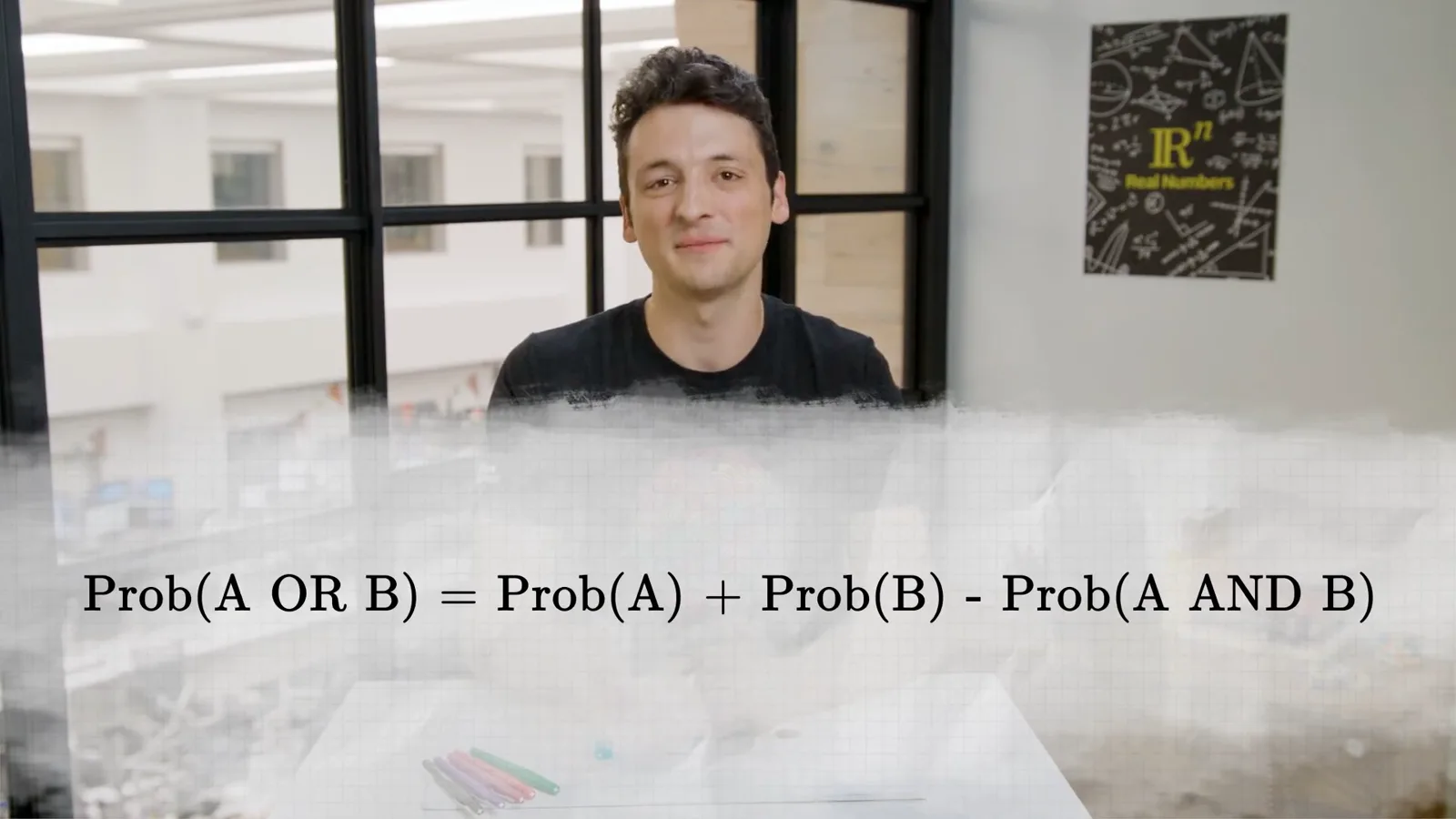
Heads or a 1 is different because the events can both happen. For any events A and B, P(A or B) = P(A) + P(B) − P(A and B). A Venn diagram shows why: adding both circles counts their overlapping region twice, so one copy must be subtracted.
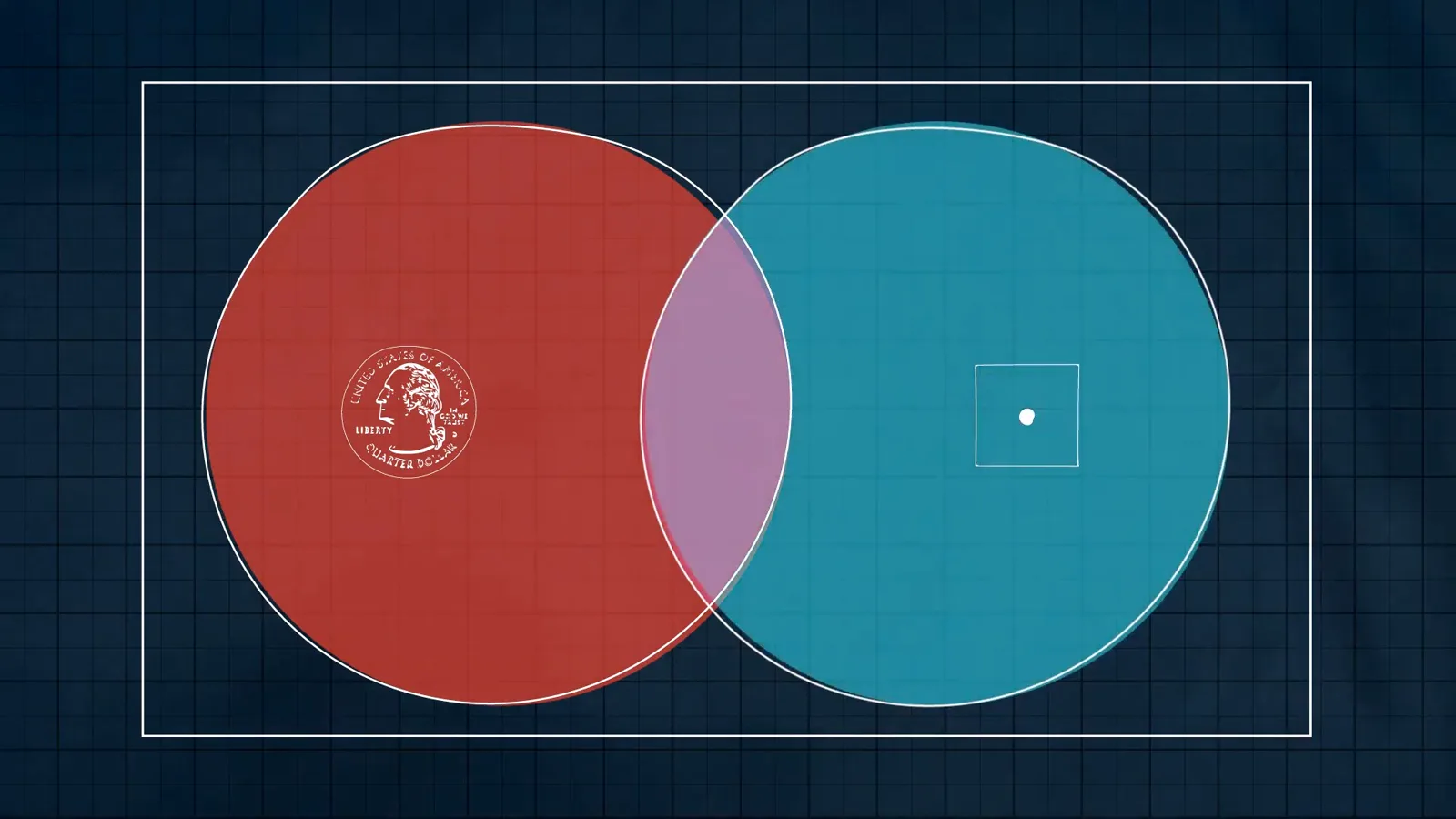
For the coin and die, the result is 1/2 + 1/6 − 1/12 = 7/12. There is another way to calculate it using complements: for any event A, P(not A) = 1 − P(A), because exactly one of A and not A occurs.
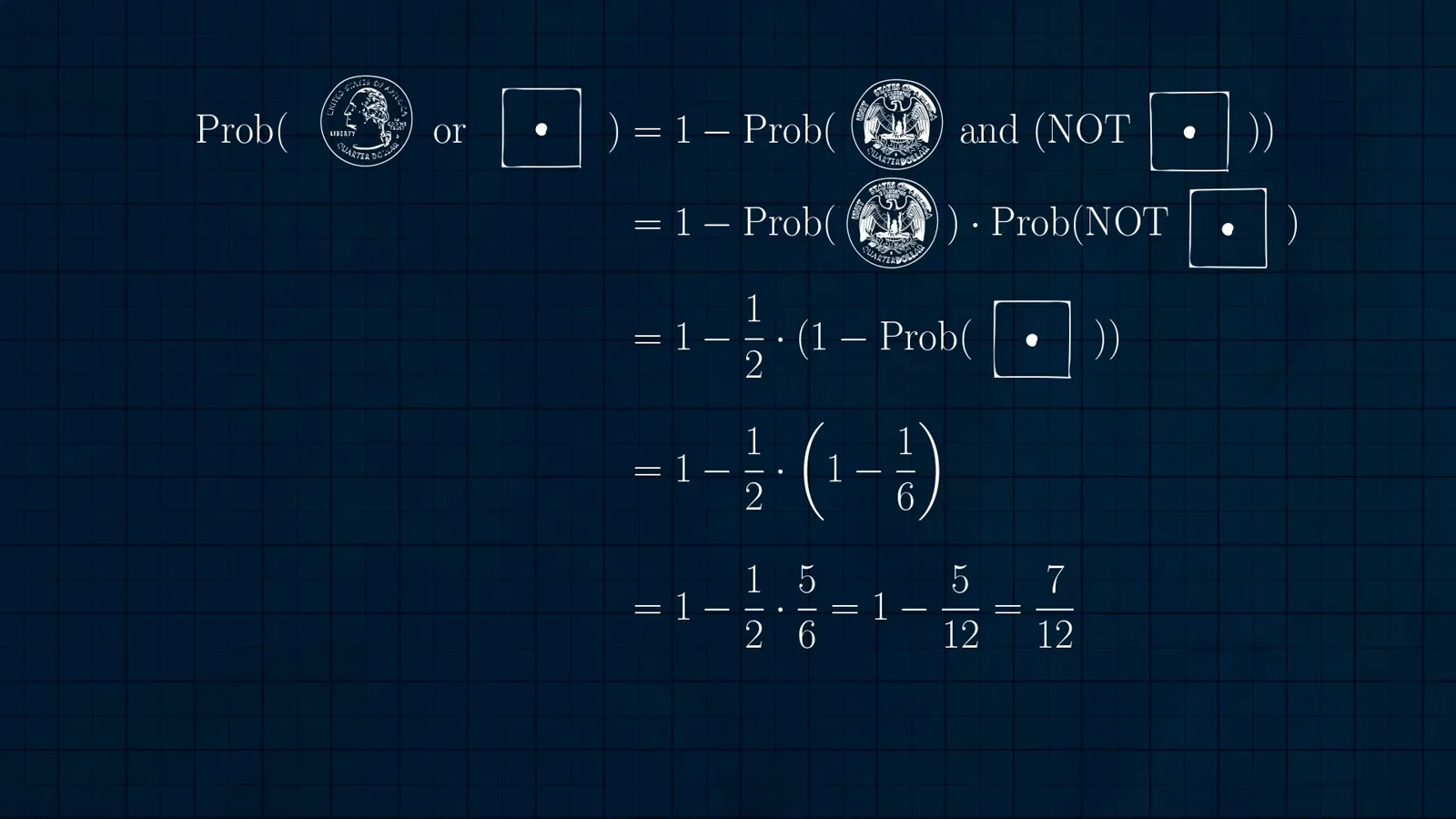
The complement of heads or a 1 is tails and a number other than 1. Independence gives P(heads or 1) = 1 − (1/2 × 5/6) = 7/12, agreeing with the first method.
Try the problem
Sawyer returns to the five-night challenge and invites viewers to show their work. The solution is reserved for the next episode.
Use these rules carefully on the problem of the week: if Fluffy independently has a 2/3 chance of waking you each night, what is the chance that at least two of the five nights are uninterrupted? Good luck, and remember to show your work. We will discuss a solution next week.
같은 채널의 다른 글
 15:33EN
 1:48:29EN
 1:36:37EN
 1:05:45EN
 1:25:00EN
 1:16:29EN