30초 요약
In April 2026, Matthew Berman discusses Google’s Gemma 4 model family and its potential for local inference and agent workflows. He reviews Google’s size and capability claims, a displayed Arena comparison and an independent tool-calling test, while noting his preference for hosted frontier models for coding and disappointment with the larger models’ context limit.
- 1Local model strategyBerman sees smaller models as useful complements to hosted frontier systems for everyday tasks.
- 2Size and preferenceA displayed chart compares Gemma 4 with larger models by total parameters and Arena Elo.
- 3Four sizesThe family includes two effective-size models, a 26B mixture-of-experts and a 31B dense model.
- 4Agent featuresGoogle lists function calling, structured JSON and system instructions among the capabilities.
- 5Multimodal and contextThe announcement describes image, video and selected audio support alongside context limits.
- 6Tool callingA displayed third-party ToolCall-15 result scores the 31B version 30 out of 30.
핵심 정리
- Google describes four Gemma 4 sizes: E2B, E4B, 26B mixture-of-experts and 31B dense.
- The E2B and E4B effective parameter labels describe inference footprint and should not be confused with total stored parameters.
- The video’s Arena chart compares model size and preference scores at a particular point in time, not performance on every task.
- Google says all versions handle images and video, while E2B and E4B also accept audio input.
- Google lists 128K context for edge models and up to 256K for larger models.
- One displayed ToolCall-15 test reports 30 out of 30 points for 31B; that result is limited to the test shown.
챕터별로 다듬은 전문 읽기
Local models and performance
Berman introduces Gemma 4 and compares model size with a displayed preference rating. He explains why he sees local inference as useful.
Google has released Gemma 4, a new family of open-weight models. I welcome its continued investment in models that people can run and adapt locally. Google describes the family as designed for reasoning and agentic workflows, and I am excited to try it.
I think smaller, faster models can complement hosted frontier systems: use the most capable remote model for difficult tasks and local compute for many others. Hardware requirements depend on the model, precision, context and device; a parameter count alone does not guarantee that a particular setup will run it comfortably.
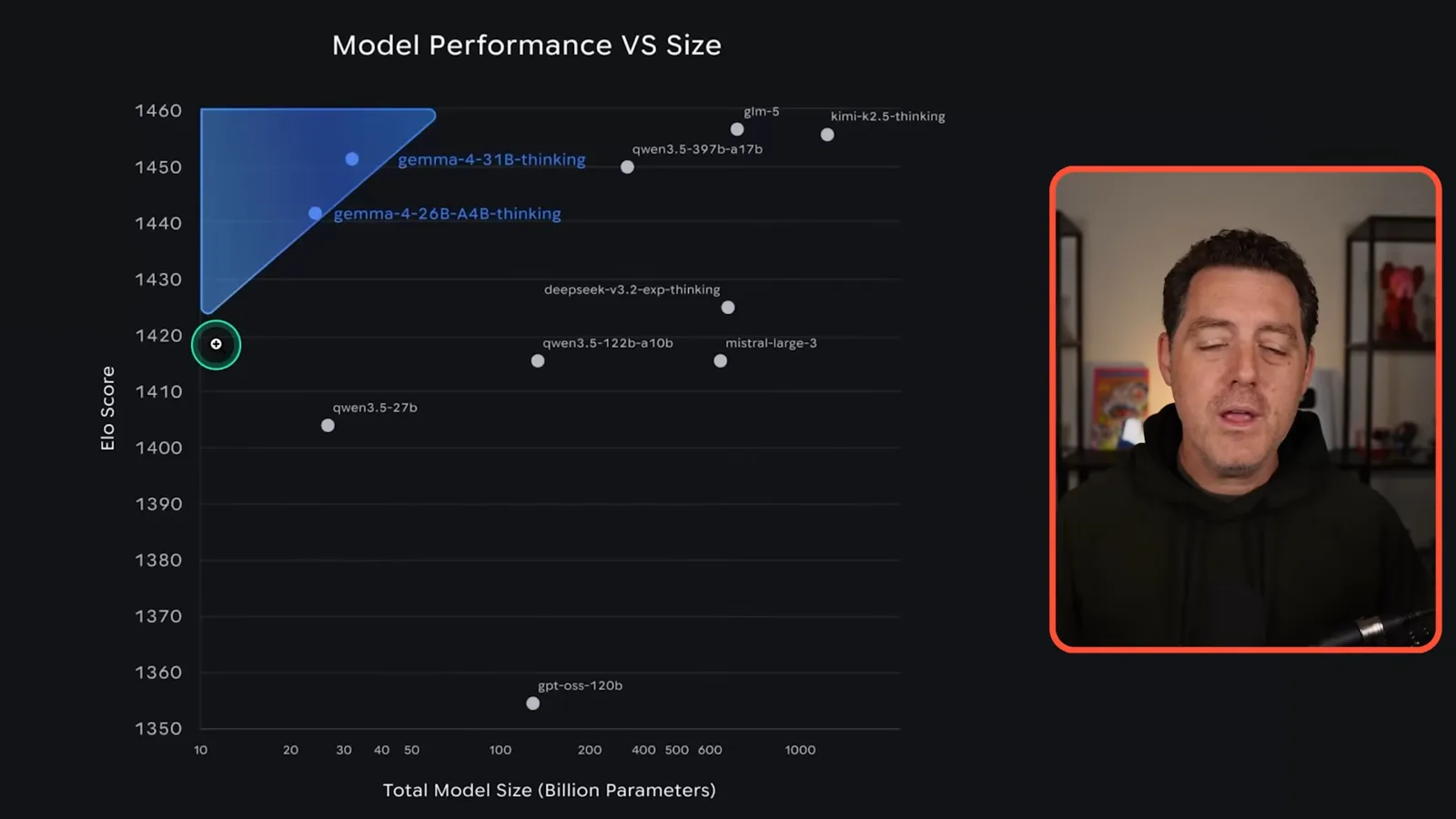
A displayed chart plots total model size against Arena Elo. Gemma 4 31B and 26B-A4B appear close to larger models on that particular preference measure. The 26B model is a mixture of experts with four billion active parameters; a similar plotted score does not mean the models are equivalent on every task.
I contrast the 31B model with much larger Qwen, GLM and Kimi models, some of which require substantial memory. I expect a smaller model to be more accessible for local use, although the precise hardware and quantization determine whether it fits and how quickly it runs.
Sizes and effective parameters
He introduces the four model sizes and explains per-layer embeddings. He also reviews Google’s Arena ranking claim.
The family has four sizes: effective 2B, effective 4B, a 26B mixture-of-experts model and a 31B dense model. I look up what “effective” means: the smaller models use per-layer embeddings, whose tables are used for lookups, so the active inference footprint is described separately from the total number of stored parameters.
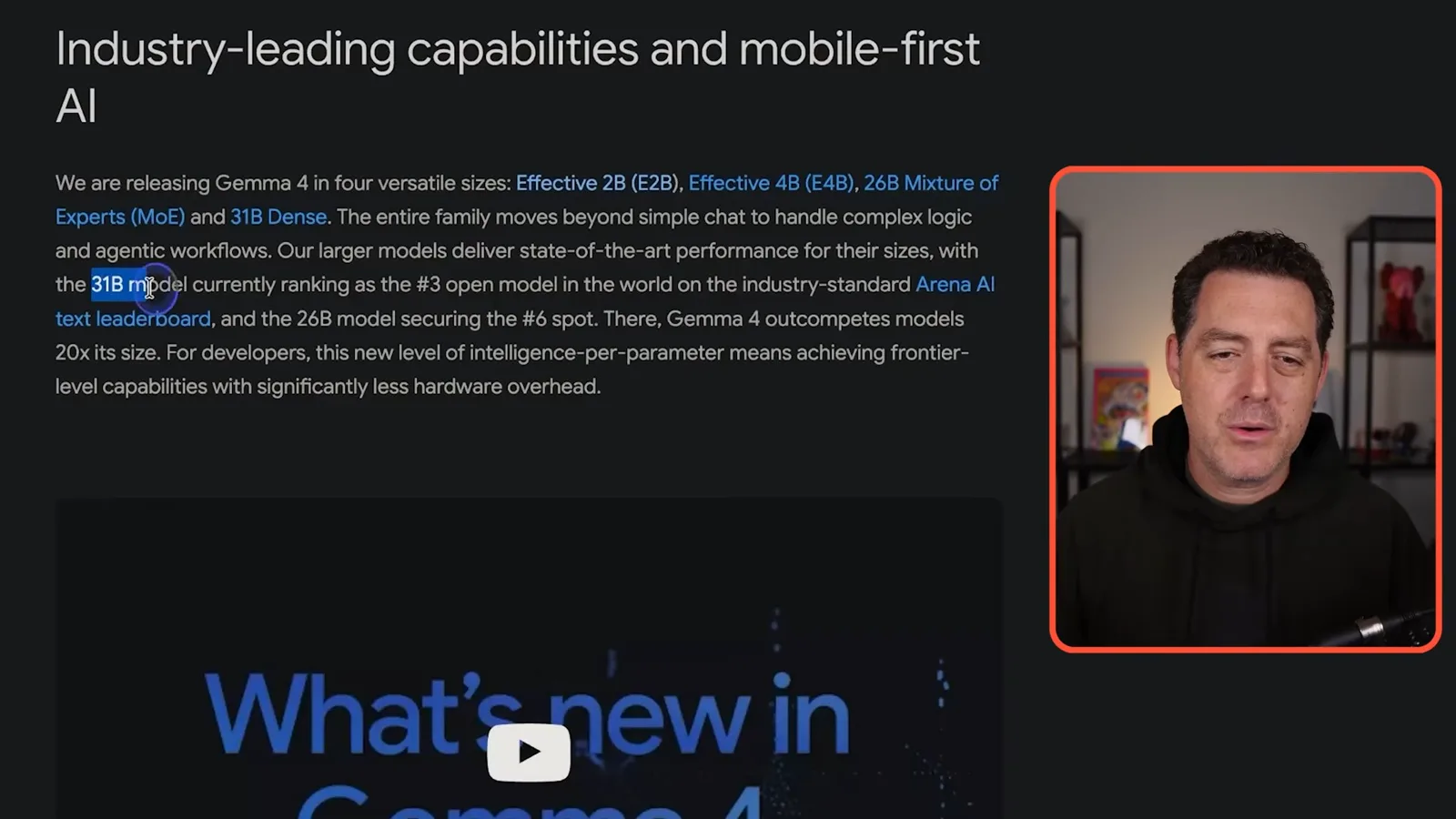
Google says its 31B model ranked third among open models on the Arena AI text leaderboard at the time, with the 26B model sixth. I find the size-to-score relationship impressive. This is a snapshot of a specific leaderboard, not a universal ranking across tasks.
Features, deployment and benchmarks
He discusses agent workflows, vision, audio, context and deployment options. He closes with reported benchmark and tool-calling results.
Google lists multi-step reasoning, function calling, structured JSON and system instructions as features for agent workflows. I want to test Gemma with OpenClaw. Google also presents it as an offline coding assistant, though I personally prefer hosted frontier models for demanding coding work.
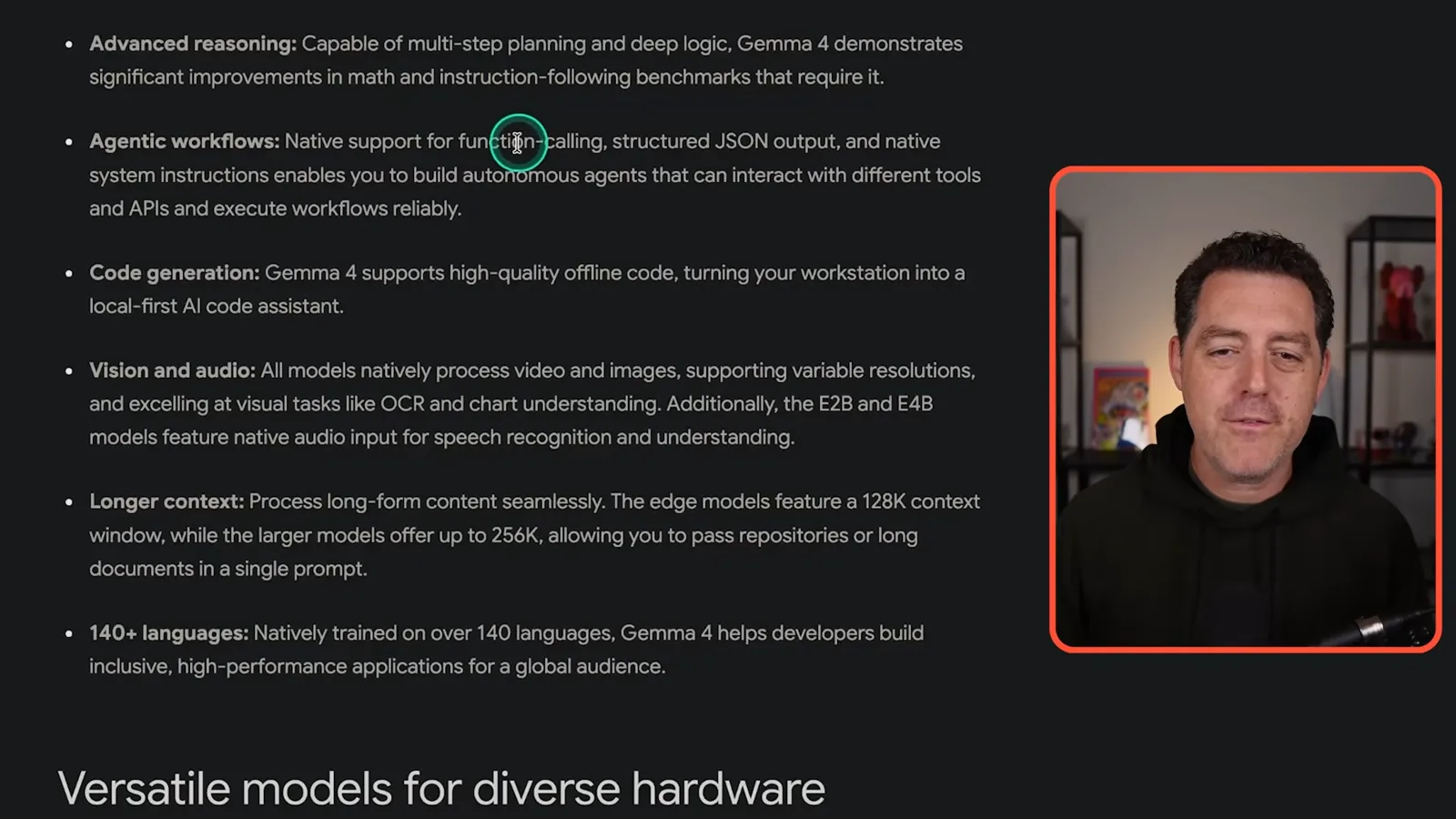
According to Google, all models handle images and video, while E2B and E4B also accept audio for speech recognition and understanding. The edge models have a 128K context window and the larger models up to 256K. I am satisfied with the edge limit but had hoped for more context in the larger versions.
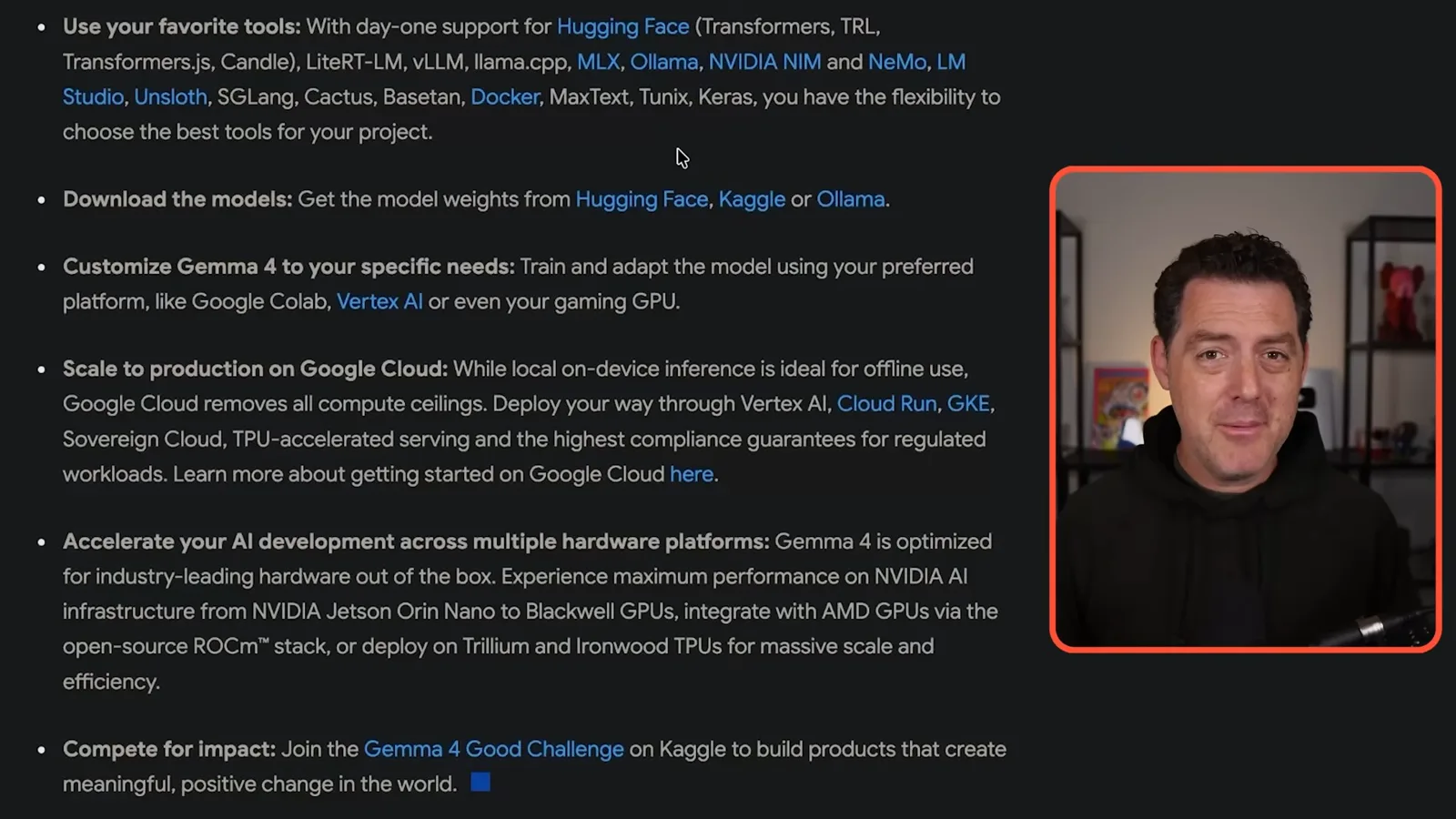
Google positions E2B and E4B for offline use on mobile and edge hardware, citing collaborations with Pixel, Qualcomm and MediaTek. It mentions devices such as phones, Raspberry Pi and NVIDIA Jetson Orin Nano. I speculate that such models could eventually appear on Apple devices; that is my prediction, not an announced deployment.
I point to a range of download and runtime options including Hugging Face, llama.cpp, MLX, Ollama and LM Studio, and encourage experimentation and fine-tuning. I also describe the release as commercially permissive and say Apache 2.0; that is my statement in the video, so users should check the actual model terms for their intended use.
I read several reported metrics for the 31B model, including an Arena text score of 1452, MMLU 85.2, AIME 2026 at 89%, LiveCodeBench at 80%, τ2-bench at 86% and GPQA Diamond at 84.3%. These are reported benchmark results, whose settings and scope matter when making comparisons.
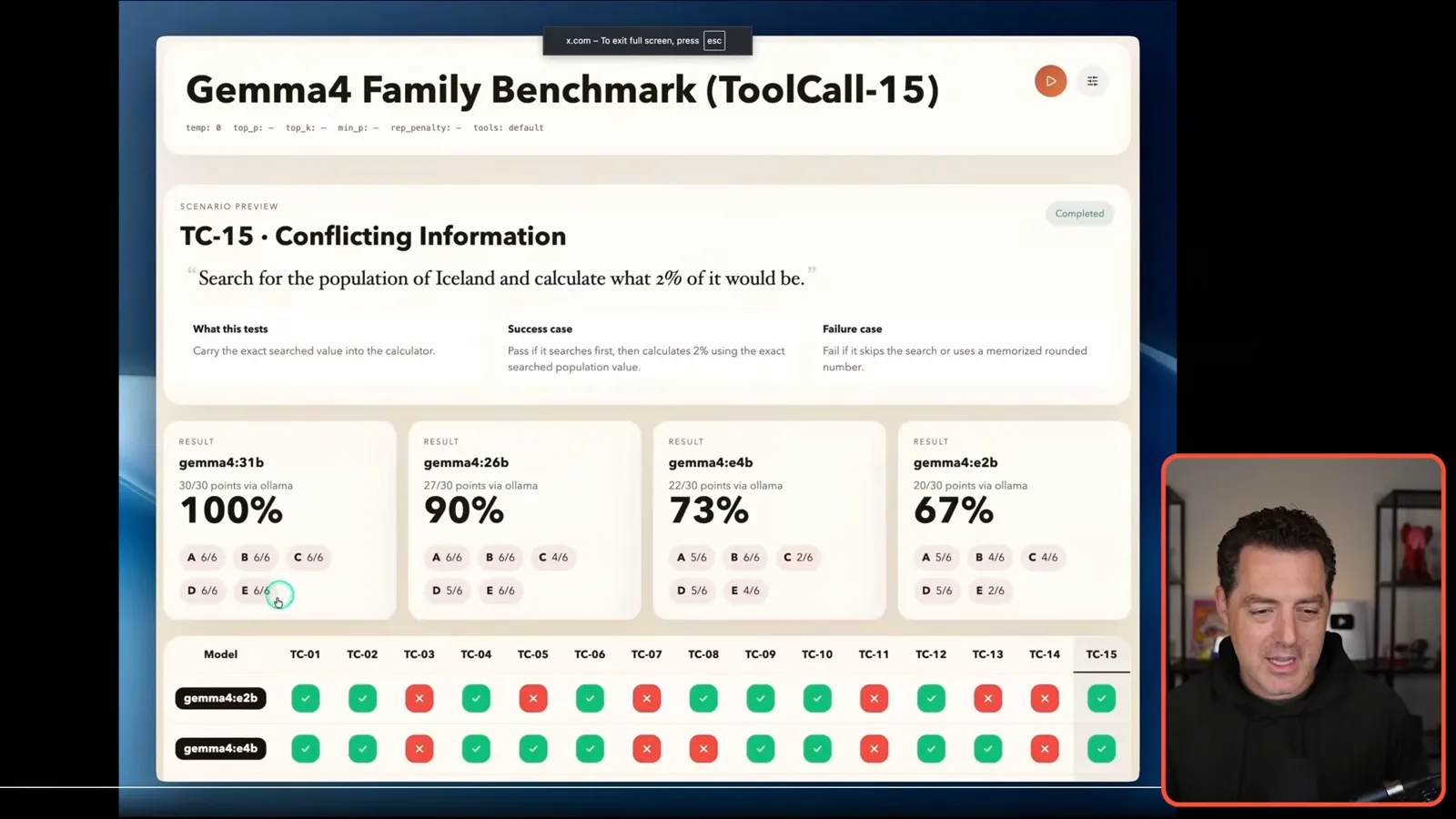
I also show a ToolCall-15 test posted by Steve Vibe. The displayed results give 31B 30/30, 26B 27/30, E4B 22/30 and E2B 20/30. The 31B result is perfect on that specific test, not proof of flawless tool use in every real-world workflow.
같은 채널의 다른 글
 34:21EN
 Matthew Berman· 2026년 10월 27일Matthew Berman Examines Anthropic’s IPO Filing, AI Growth and GovernanceMatthew Berman, Sam Altman · Forward FutureThe presenter reviews the S-1’s financial metrics, compute strategy and voting structure while questioning the tension between rapid AI development and safety.
 0:36ENMatthew Berman· 2026년 10월 25일Kimi K3.1 and a Rubik’s Cube Solver DemonstrationMatthew Berman · Forward FutureMatthew Berman shows a scrambled virtual cube being solved and gives the Kimi K3.1 test a favorable assessment.
 25:50ENMatthew Berman· 2026년 10월 24일Kimi K3.1 Pro Tested: Strong 3D Demos, Uneven Results and Competitive PricingMatthew Berman · Forward FutureMatthew Berman tests the open-weight model on coding, 3D rendering and visual explanations, then compares benchmark results and prices.
 32:20ENMatthew Berman· 2026년 10월 23일Who Is Local AI For? The Costs, Trade-offs and a Hybrid FutureMatthew Berman · Forward FutureMatthew Berman weighs data control and independence against hardware cost, setup complexity and inference speed.
 1:03:37ENMatthew Berman· 2026년 10월 23일Matthew Berman’s Team Tests Kimi K3.1 on Animation, Games, and ChartsMatthew Berman, Alex, Brian · Forward FutureA live team AMA turns into an informal test of Kimi K3.1, from personal-agent workflows to motion graphics, a browser game, and a benchmark chart.
 0:53ENMatthew Berman· 2026년 10월 22일Sam Altman on AI and the Discovery of New KnowledgeSam Altman · OpenAIAltman expects progress in mathematical discovery to extend to biology, materials and energy.