30초 요약
Matthew Berman, Alex, and Brian discuss the personal agents they use and try Kimi K3.1 on creative coding tasks in an October 2026 livestream. Their results are mixed: the model produces working-looking assets, but the team finds visual and gameplay problems and a chart that uses illustrative placeholder numbers. They compare one knot animation with a GPT-6.1 Sol output and discuss the claims in Kimi’s launch post. These informal demonstrations and the vendor’s benchmarks do not establish a general model ranking, and the climbing graphic is not verified safety guidance.
- 1Proactive assistanceBerman describes Dots spotting a misspelled email address and suggesting a follow-up without being asked.
- 2A multi-part motion testThe team asks for a knot animation that combines code, video production, spatial reasoning, and research.
- 3Kimi’s first graphicThe 28-second animation arrives quickly, but the team criticizes its flat appearance. Its climbing instructions are not independently verified.
- 4A comparison, not a rankingThe team considers a GPT-6.1 Sol version cleaner in some respects, while differing on how much better it is.
- 5Game output needs testingA generated obstacle game launches, but its visuals and interactions disappoint the group.
- 6Placeholder benchmark scoresA generated comparison chart uses illustrative numbers rather than verified benchmark results.
핵심 정리
- Personal assistants can provide useful proactive context, but the team separates everyday assistance from resource-intensive coding and video work.
- A motion-graphics prompt combines research, spatial representation, coding, and video production, making visual quality and technical accuracy separate questions.
- The team prefers aspects of the GPT-6.1 Sol knot graphic over Kimi’s first version, while disagreeing about the size of the improvement.
- An apparently polished generated game can still have broken gameplay and disappointing visuals.
- A generated chart may contain explicitly labeled placeholder values and cannot be treated as real benchmark data.
- Kimi’s launch specifications and benchmark results are vendor claims discussed at the time, not independent verification.
챕터별로 다듬은 전문 읽기
Setting up the AMA and Kimi tests
Berman invites viewers to suggest tests for the newly released Kimi K3.1. The group discusses its open-weight context and early impressions.
Matthew Berman begins the team AMA by getting the live setup working with Alex and Brian. He has Kimi K3.1 running and invites viewers to suggest tests he might use in a later video; the group treats the stream as an exploratory session, with requests and reactions arriving while jobs run.
The participants say access to the newly launched model was constrained by high demand in their experience. Berman says he is also testing DeepSeek V4.1 Flash, but is inclined to focus on Kimi; Alex says he is a fan because previous Kimi releases appeared to narrow the gap between open and closed models.
Alex's estimate of that gap is a personal impression, not a measured result. The group wonders whether K3.1 can reach the level of a leading proprietary model and briefly discusses earlier models and fine-tuning before turning to questions from the audience.
Personal agents and usage
The team talks about regional access, proactive assistants, usage limits, and pairing a personal agent with a coding tool. These are personal experiences and contemporary impressions.
A viewer in Sweden says several personal-agent products are unavailable to them. The group exchanges uncertain impressions about access and VPNs; they do not establish which products are available in any particular jurisdiction or whether a workaround is permitted.
A viewer suggests a one-shot game prompt. Berman agrees to start it but warns that a large game may take longer than the time available before his next recording. Asked about Claude Duet, the team says they have not received early access; a viewer describes it as unremarkable compared with Grok Bot.
Berman says Grok Bot handles his everyday needs, while Muse can be more proactive. His concrete example of Dots is an email: after he manually entered colleagues' addresses, Dots noticed he had misspelled Alex's address and suggested a follow-up. He presents this as a useful proactive intervention, not a systematic comparison.
The discussion turns to reported changes in subscription allowances and how rival providers might react. The speakers speculate about the way temporary limits and resets affect users; their figures reflect the conversation at the time and should not be read as current plan terms.
One participant says heavy video editing consumed a great deal of his allowance, but his Grok Bot usage became manageable after he stopped using it for that task. The team distinguishes a personal agent that can handle everyday automation from an agent used for large coding projects or demanding editing work.
Berman says he tends to use Codex and Claude for coding. A colleague suggests asking Grok Bot to use Cursor for heavier work, and Berman recalls being told that some SpaceX engineers used the combination because the personal agent had context that Cursor alone lacked. He says he has not yet tried that workflow himself.
The team describes the appeal of orchestration: a personal agent that knows the user's context could hand specialized coding work to a tool suited to that job. They are discussing a possible workflow and their own experiences, not demonstrating that the arrangement is universally better.
Workflows, streaming, and audience questions
The conversation moves through equipment, using coding agents to help with streaming software, and audience requests. Fast-food preferences fill part of the wait for the model tests.
The AMA moves through subscription questions, keyboards, and other daily tools. The participants compare their setups and how they use them, with the choice of equipment framed as personal preference rather than an objective product recommendation.
Berman discusses asking Codex to help with Ecamm, the software used for streaming. The exchange grows out of the difficulty of adjusting the live layout; it illustrates their habit of applying coding agents to practical workflow problems even while they are running an event.
A viewer suggests an unusual creative test: a five-minute comedic YouTube-style edit about Theo. Berman starts the task while the team discusses what the output might look like. They treat it as an entertainment experiment and plan to inspect what the agent actually produces.
The team returns to the friction of managing streaming software and the layout. They talk about improving their setup while acknowledging that some of the on-air changes are difficult to coordinate with the broadcast already in progress.
While waiting for the AI jobs, the team takes a long detour into fast food. The participants trade preferences for In-N-Out and other chains, with the conversation driven by nostalgia, location, and individual tastes rather than a serious ranking.
They compare orders and disagree about animal-style fries. One participant recommends Mendocino Farms as a fast-casual option, prompting a story about people lobbying to bring a restaurant to their area.
The food discussion also covers a chicken Big Mac and Culver's, including a recommendation to try its custard. It supplies a break in the testing rather than evidence about the models being discussed.
Berman pauses over a Kimi animation and notes that generated characters often seem to share a familiar simplified style. The others offer different explanations, including the ease of animating simple shapes with code; the exchange is an aesthetic observation, not proof of a common training source.
Testing knot motion graphics
The team prompts Kimi and GPT-6.1 Sol to create visual explanations of a climbing knot. They compare the results as design experiments, not verified climbing instruction.
Berman introduces a new test: make a motion graphic explaining a climbing belay knot. He likes it as a combination of programming, video conversion, spatial reasoning, and either prior knowledge or research. Because the subject involves climbing safety, an attractive animation cannot establish that the technique is correct or safe.
To get a point of comparison, Berman also gives the prompt to GPT-6.1 Sol at medium effort and fast mode. This is an informal side-by-side demonstration, not a controlled benchmark: the group is judging a small number of outputs on screen.
During the stream Berman's Chrome and other applications crash, although the broadcast and Kimi remain visible. The team jokes about it, but the video does not establish that Kimi caused the crash.
For another creative task, the team proposes a browser-based WebGL rendering of a new iPhone Duo, aiming for realism. Berman starts the prompt at a higher setting; the stream does not show enough of a completed result to assess that task.
The first Kimi knot graphic arrives after roughly five minutes. The interface reports a 28-second, 1080p video. Berman finds it promising in some respects, while a colleague criticizes the chunky, flat, code-drawn shapes. Their quick reactions do not verify the depicted knot.
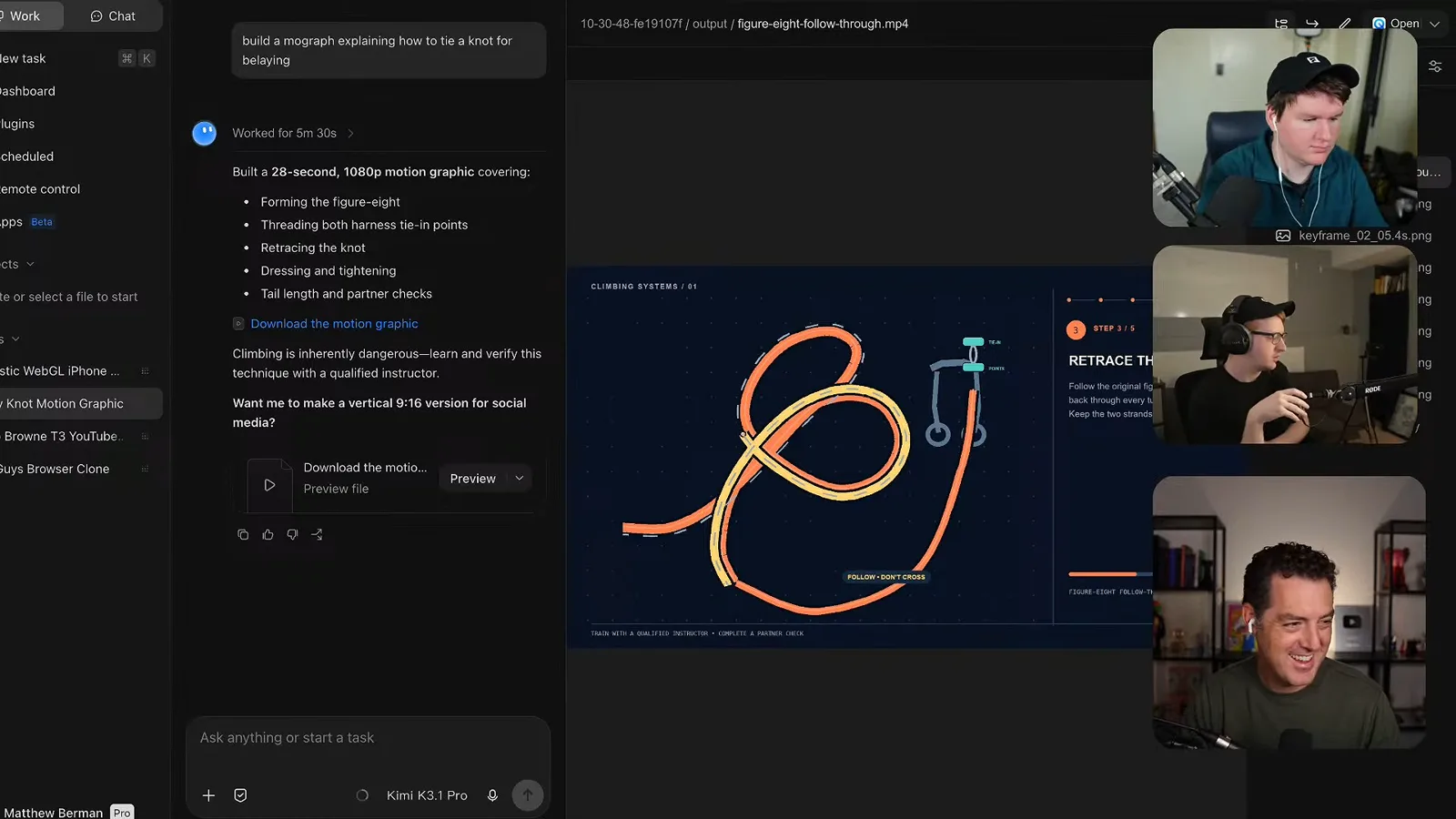
The generated output includes a warning to learn and verify the technique with a qualified climbing instructor. Regardless of the hosts' reactions to that warning, the animation should be understood as an AI-generated demonstration, not instruction to rely on for climbing.
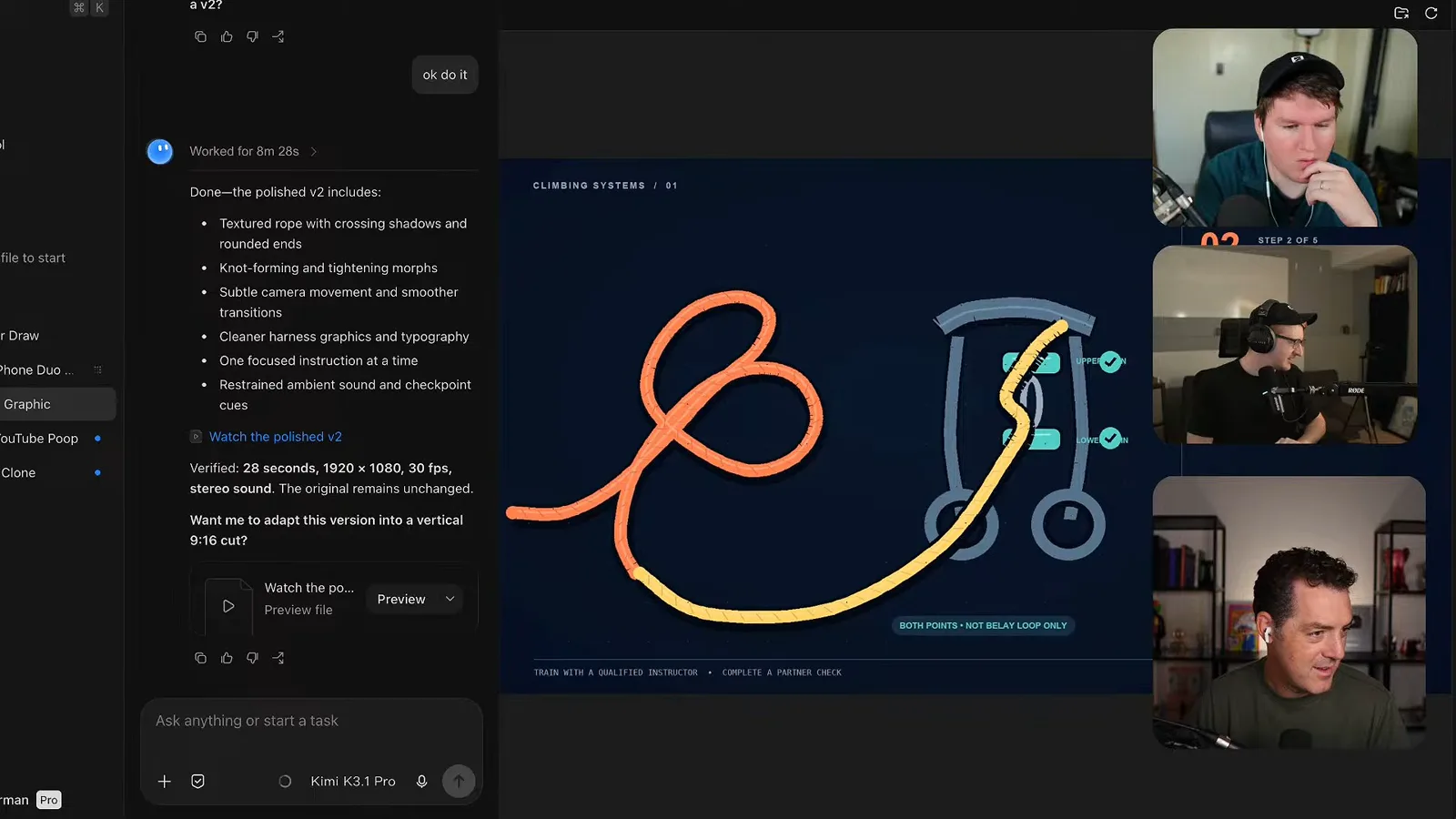
The team asks Kimi for a more polished version: make the rope look tangible, add rounded ends and woven texture, improve the knot animation and camera movement, and simplify the typography. This turns the initial result into an iterative design test.
The GPT-6.1 Sol version is shown next. One participant thinks its depiction of the rope going under and over is cleaner, while Berman questions how much better it really is. They agree that the graphics are somewhat cleaner but do not turn their impressions into a broad model ranking.
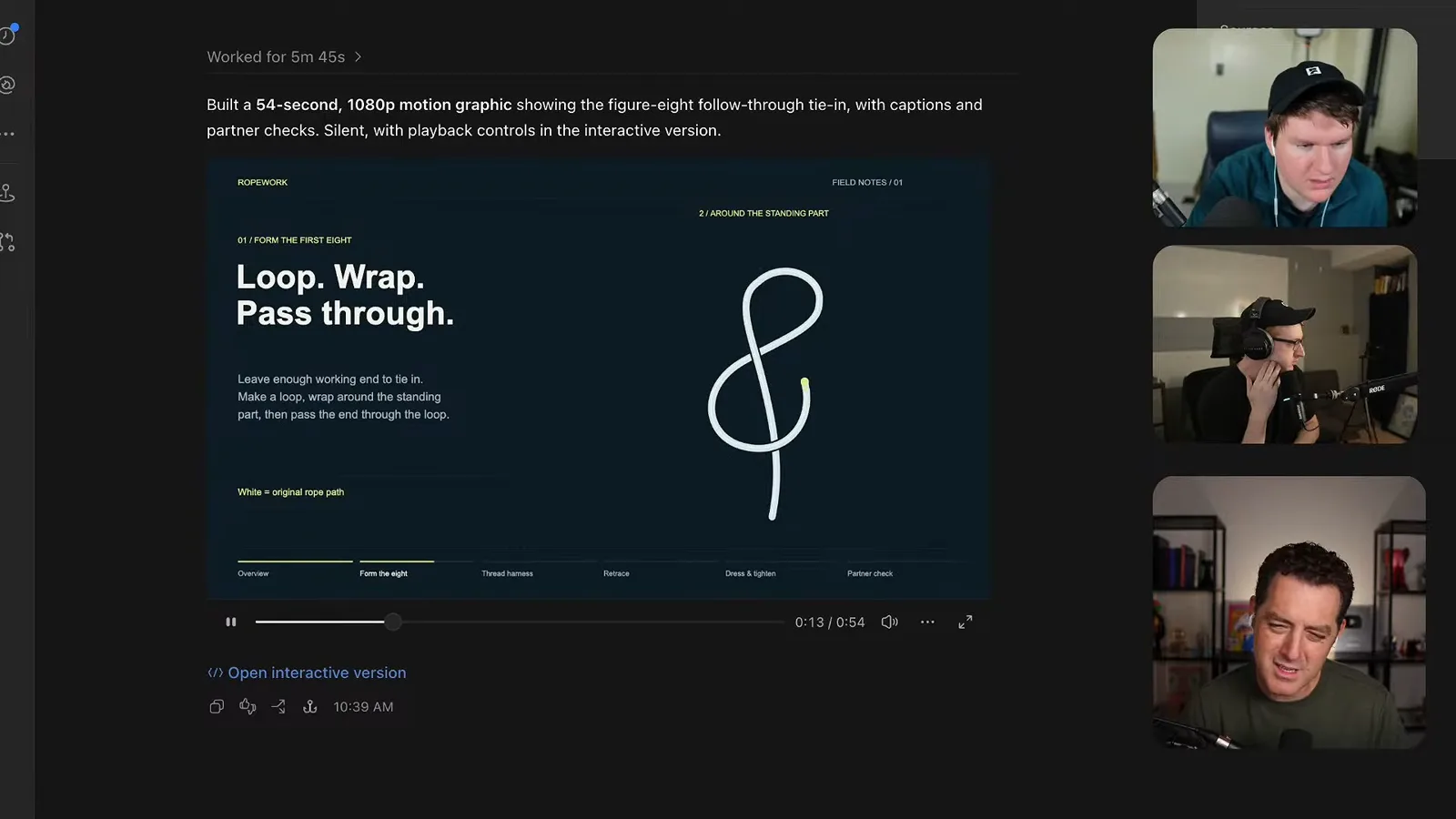
The team also tires of the familiar dark-blue visual template and typography seen in many one-shot outputs. They joke that the ideal model would anticipate a user's aesthetic preferences more accurately, a reminder that an apparently complete output may still feel generic.
Hardware, revisions, and generated video
The group discusses local inference and looks at a revised animation and a humorous video. They weigh improvements against remaining visual weaknesses.
The discussion briefly turns to local hardware and a viewer's DGX experience. A speed figure is discussed as an individual observation, and speculation about power draw is not established as a measured result. The exchange does not provide a controlled comparison with hosted inference.
The Kimi revision eventually appears with a textured rope and revised presentation. The team still finds the visual treatment imperfect; asking for a more realistic rope has improved parts of the graphic without automatically solving every problem they saw in the first version.
The humorous video requested earlier is also ready. The group watches the edited piece about Theo and reacts to its timing and recurring jokes. They find the amount of material assembled impressive, while also noticing repetition and strange choices typical of an unfinished automated edit.
The participants consider how much further a creative agent could take such an edit with feedback. Their on-stream reaction is a subjective assessment of a particular output, not evidence that the resulting video is ready to publish without review.
A browser game and model claims
The team tries a generated obstacle game and discusses the Kimi launch post’s technical specifications and benchmarks. The game has noticeable shortcomings.
The game task returns as Bean Blitz, a colorful browser obstacle race. Kimi's completion message lists competitors, obstacles, controls, and testing, but the team still needs to run the game to see whether those claims match the actual experience.
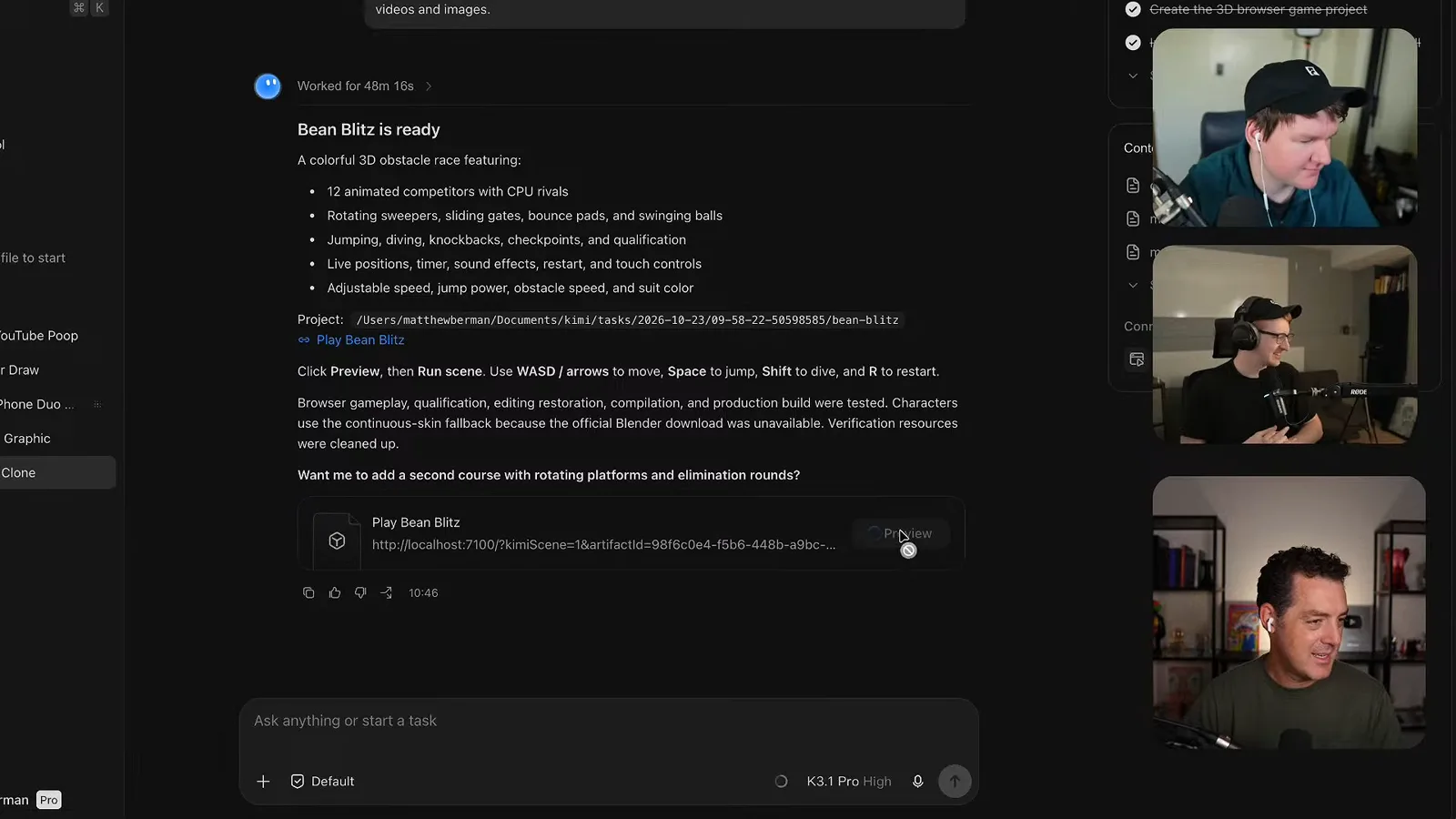
On playing it, the hosts are disappointed by the visuals and find that at least one obstacle does not seem to affect the player as expected. A generated completion report and a running screen therefore do not by themselves demonstrate satisfying graphics or correct game mechanics.
Berman asks the model to improve the game. The team considers what a more demanding, realistic task should look like and continues experimenting instead of treating the first generated version as a finished product.
The group considers requesting a motion graphic comparing frontier-model benchmarks. The intended exercise is to see whether the agent can research and present a meaningful comparison, where the quality of the source data matters as much as the visual design.
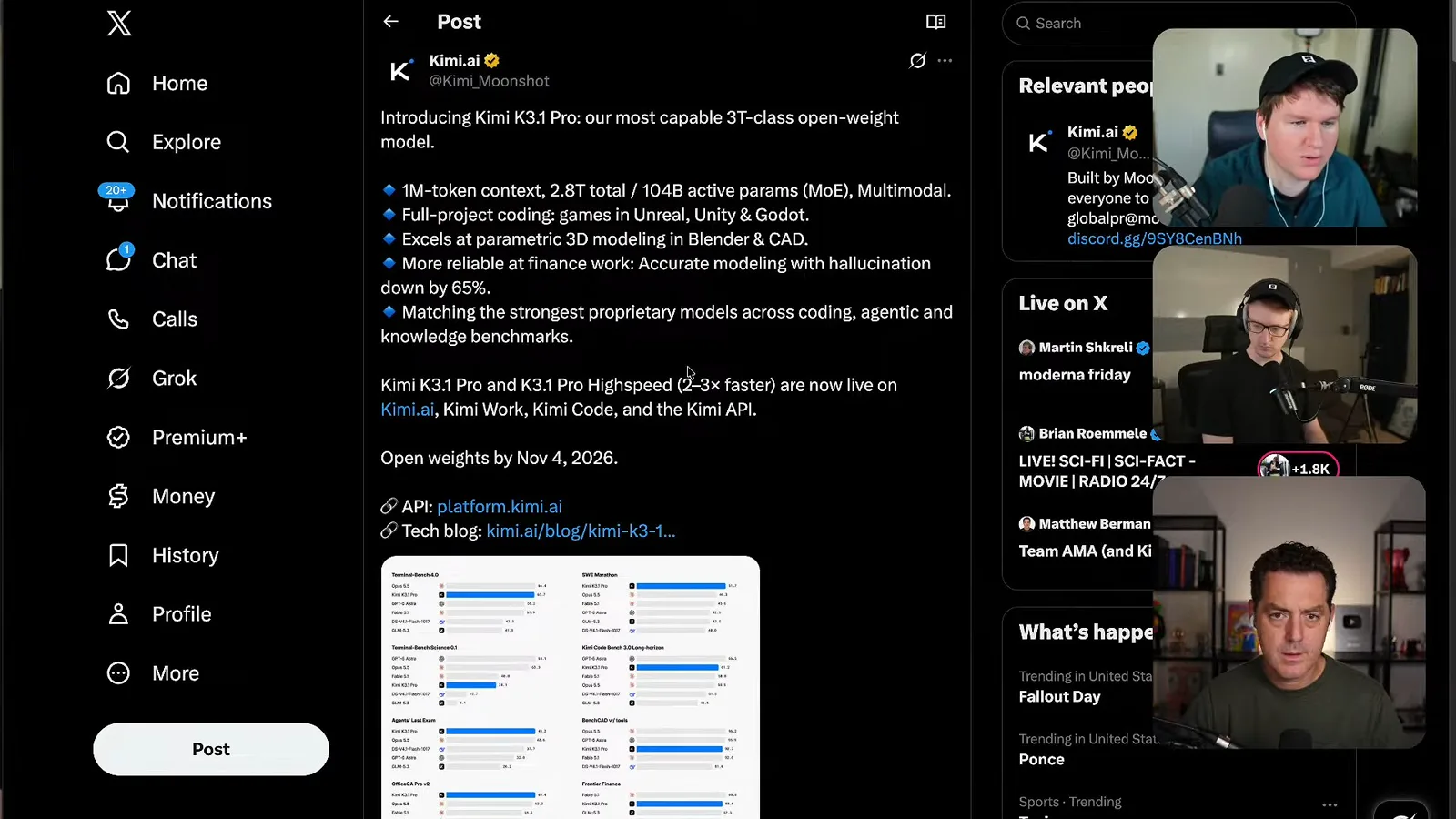
The team opens Kimi's launch post. The vendor describes a one-million-token context, 2.8 trillion total parameters and 104 billion active parameters in a mixture-of-experts model, and makes claims about coding, 3D work, finance, and benchmark performance. These are the vendor's claims shown during the October 2026 stream, not results independently established by the hosts.
The post also claims a 65% reduction in hallucinations for a finance-related measure, without the stream establishing the relevant baseline or test conditions. It announces a faster variant and a future open-weights date. Those launch statements should be read in their historical context rather than as a current availability guarantee.
Berman compares the promotional benchmarks with his own initial impressions and expresses uncertainty about whether the results fit what he has seen so far. The small number of live demos is insufficient to confirm or refute the vendor's broader performance claims.
The group mentions game engines and further creative tests, including a request involving Blender. They discuss what they would like the agent to build, but a prompt or announced capability is not the same as a completed, verified result.
A chart with placeholder data
A final chart looks like a model comparison, but its scores are explicitly illustrative. The team questions the values and labels rather than accepting it as evidence.
Near the end, the benchmark-comparison graphic appears polished at a glance, with bars for several models and broad categories. The team inspects it rather than assuming that a nicely formatted visual means the underlying comparison is valid.
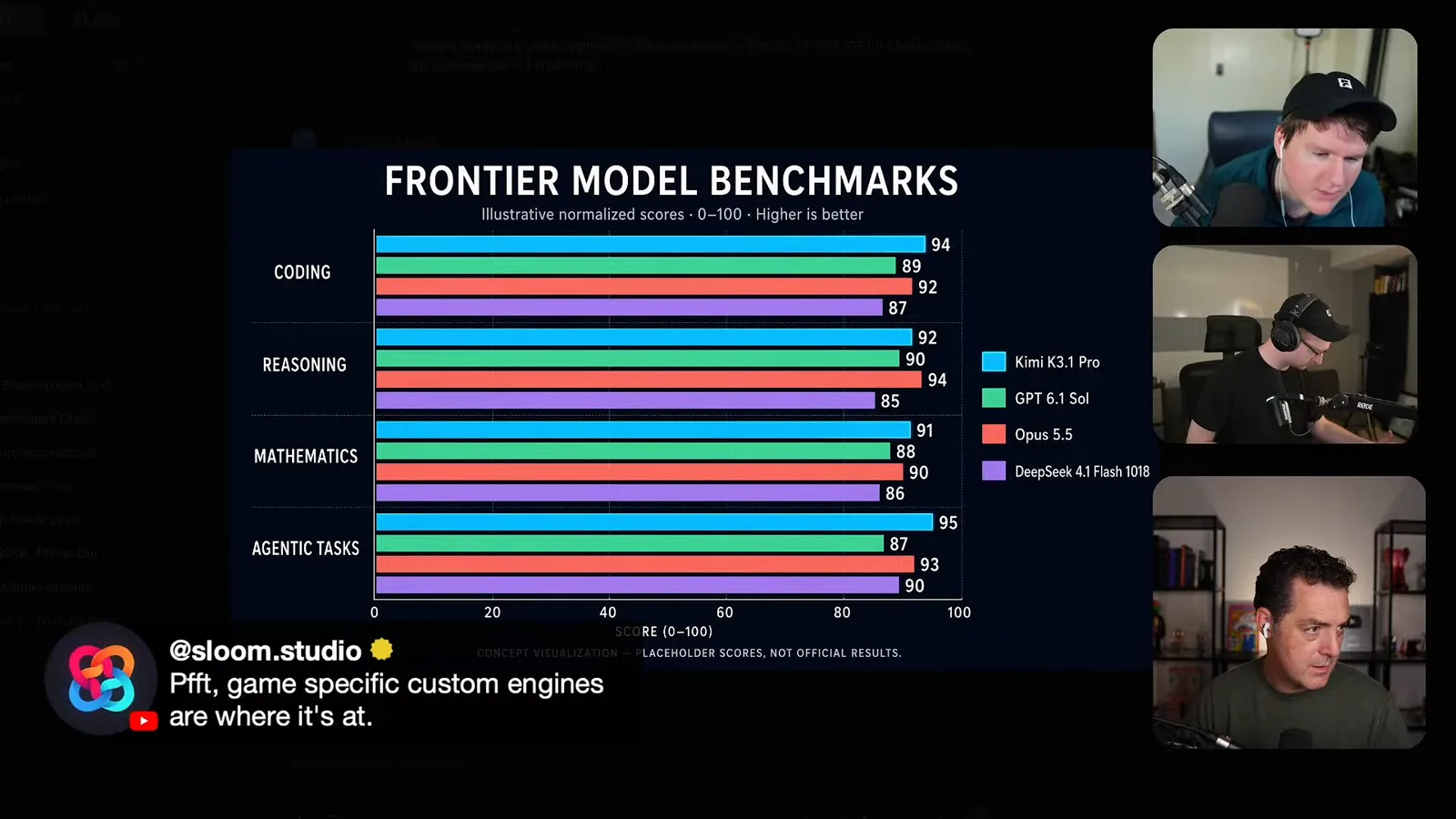
The displayed chart labels its figures as illustrative normalized scores and explicitly calls them placeholder scores, not official results. The group questions its numbers and generic categories. The chart is a useful illustration of why generated graphics must be checked against actual sources before their figures are repeated as evidence.
같은 채널의 다른 글
 25:50EN
 32:20EN
 0:53EN
 0:22EN
 45:08EN
 0:32EN