30 秒でわかる
Matthew Berman presents a Cortical Labs demonstration in which activity from cultured human brain cells is connected to Doom gameplay through an electronic interface. The short clip describes the setup but does not establish that the cells visually perceive the game, understand it, or play independently of the surrounding equipment.
- 1A new take on playing DoomBerman describes a demonstration connecting a culture of human brain cells to the game rather than using a human player.
- 2Cultured cells and an interfaceHe says Cortical Labs used about 200,000 cells and measured their activity while the game ran.
- 3From activity to game inputBerman describes neural responses being measured and passed into the game; the short clip does not detail the full encoding or evaluate performance.
ポイント
- The clip shows Doom running in a Cortical Labs demonstration involving cultured human brain cells.
- Berman says the setup uses approximately 200,000 cells and translates measured neural activity into game input.
- The cells interact with the game through equipment and software; the video does not explain enough to establish independent understanding or game performance.
チャプターごとに整えた全文を読む
A neuron-controlled Doom demonstration
Berman introduces a Cortical Labs clip showing Doom and describes the role of cultured human neurons. He says the game is not controlled by a human player.
A group of scientists has connected a culture of human brain cells to Doom. In the Cortical Labs footage, the game is running without a human directly controlling the player. The cells are part of an experimental system with equipment and software translating their activity into game inputs.
Measuring and translating neural activity
He describes the cell culture and an interface that measures neural responses and sends them into the game. The brief explanation does not show that cells understand or visually see the game.
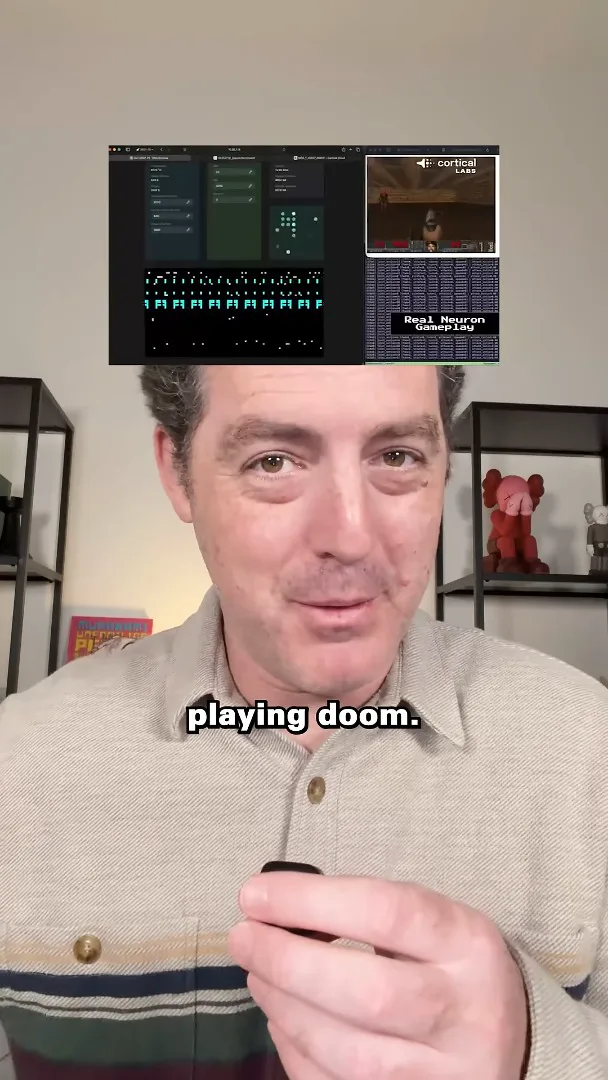
I describe the setup as roughly 200,000 human brain cells in a dish, with researchers measuring neural activity as the game runs. When a demon appears, I say the neurons respond and a device measures their firing, which is then fed into the game. The short video does not explain the full interface or show that cells literally see the screen or understand the game.
It gives the familiar question “Can it play Doom?” a very different meaning: neural activity is being used as input to a game, rather than a person operating the controls. The clip does not provide enough detail to assess how well the system plays.
同じチャンネルの記事
 34:21EN
 Matthew Berman· 2026年10月27日Matthew Berman Examines Anthropic’s IPO Filing, AI Growth and GovernanceMatthew Berman, Sam Altman · Forward FutureThe presenter reviews the S-1’s financial metrics, compute strategy and voting structure while questioning the tension between rapid AI development and safety.
 0:36ENMatthew Berman· 2026年10月25日Kimi K3.1 and a Rubik’s Cube Solver DemonstrationMatthew Berman · Forward FutureMatthew Berman shows a scrambled virtual cube being solved and gives the Kimi K3.1 test a favorable assessment.
 25:50ENMatthew Berman· 2026年10月24日Kimi K3.1 Pro Tested: Strong 3D Demos, Uneven Results and Competitive PricingMatthew Berman · Forward FutureMatthew Berman tests the open-weight model on coding, 3D rendering and visual explanations, then compares benchmark results and prices.
 32:20ENMatthew Berman· 2026年10月23日Who Is Local AI For? The Costs, Trade-offs and a Hybrid FutureMatthew Berman · Forward FutureMatthew Berman weighs data control and independence against hardware cost, setup complexity and inference speed.
 1:03:37ENMatthew Berman· 2026年10月23日Matthew Berman’s Team Tests Kimi K3.1 on Animation, Games, and ChartsMatthew Berman, Alex, Brian · Forward FutureA live team AMA turns into an informal test of Kimi K3.1, from personal-agent workflows to motion graphics, a browser game, and a benchmark chart.
 0:53ENMatthew Berman· 2026年10月22日Sam Altman on AI and the Discovery of New KnowledgeSam Altman · OpenAIAltman expects progress in mathematical discovery to extend to biology, materials and energy.