30 秒でわかる
In this April 2026 livestream, Matthew Berman discusses children’s use of AI, environmental trade-offs and his own difficulty balancing AI projects with family life. He then watches OpenAI’s image-model launch and tests it live, recording successes and failures. His colloquial use of “AI psychosis” refers to preoccupation, not a clinical diagnosis.
- 1Children and AIBerman describes a parent’s approach and his own preference for supervised use and teaching children about errors.
- 2Cooling and waterHe initially minimizes water use, then acknowledges a viewer’s correction. Total water impact varies with cooling and electricity.
- 3Excitement and balanceHe describes overwork and sleep disruption using a colloquial term distinct from clinical psychosis.
- 4Image-model launchOpenAI presenters demonstrate image layouts, text and multi-image generation; Berman begins his own tests.
- 5Math and mapsA retry produces the correct arithmetic result, while generated driving maps contain significant errors.
- 6Counting and codeThe complex image prompt has count errors, and the transcribed Snake game does not run successfully.
ポイント
- Berman favors supervised AI use for his children and explaining that chatbots can be wrong or overly agreeable.
- Data-center water impacts depend on cooling and electricity; a closed loop does not establish zero total water use.
- Berman describes AI-related overwork and sleep disruption; his colloquial terminology is not a clinical diagnosis.
- His image tests include a corrected arithmetic result, but also flawed maps, counting errors and code that did not run.
- The demonstrations are informal snapshots, not a comprehensive benchmark.
チャプターごとに整えた全文を読む
Setup and the day’s topics
After stream setup, Berman introduces the agenda. The discussion begins several minutes into the recording.
After several minutes of stream setup, Matthew Berman introduces an April 2026 discussion of children using AI, his own difficulty balancing AI projects with family life, and a live test of ChatGPT Images 2. The program includes demonstrations from OpenAI’s launch stream and contributions from Forward Future team members Jonah and Brian.
Children and chatbot reliability
Berman discusses supervision, sycophancy and the potential benefits of creative use.
Berman starts with a social-media post in which a parent says her nine-year-old used AI for sibling relationships, swimming and fan-fiction ideas, and then was told not to use it. The post’s account cannot be independently verified here. Berman says that, as a parent, he would supervise his own young child’s use rather than treat AI as simply good or bad.
His principal concern is sycophancy: a chatbot may agree with a user even when its answer is wrong or unhelpful. He refers to a prior overly agreeable model update and shows a humorous example involving a tiny hat. A single demonstration does not measure how often a model behaves that way.
Berman recalls his son being surprised that AI can make mistakes. He says parents should explain that models can present errors confidently, and worries about young people forming an overly strong relationship with a chatbot. He also sees potential value in supervised creative and educational uses.
Environmental impact and a correction
Berman debates cooling and water use, revises an earlier claim after a viewer’s challenge and speaks with researcher Jonah.
The discussion turns to environmental impact. Berman initially argues that closed-loop cooling means AI uses little water, comparing it with a liquid-cooled PC. That is too broad: a closed loop inside a facility does not by itself establish the water use of heat rejection, electricity generation or the entire supply chain.
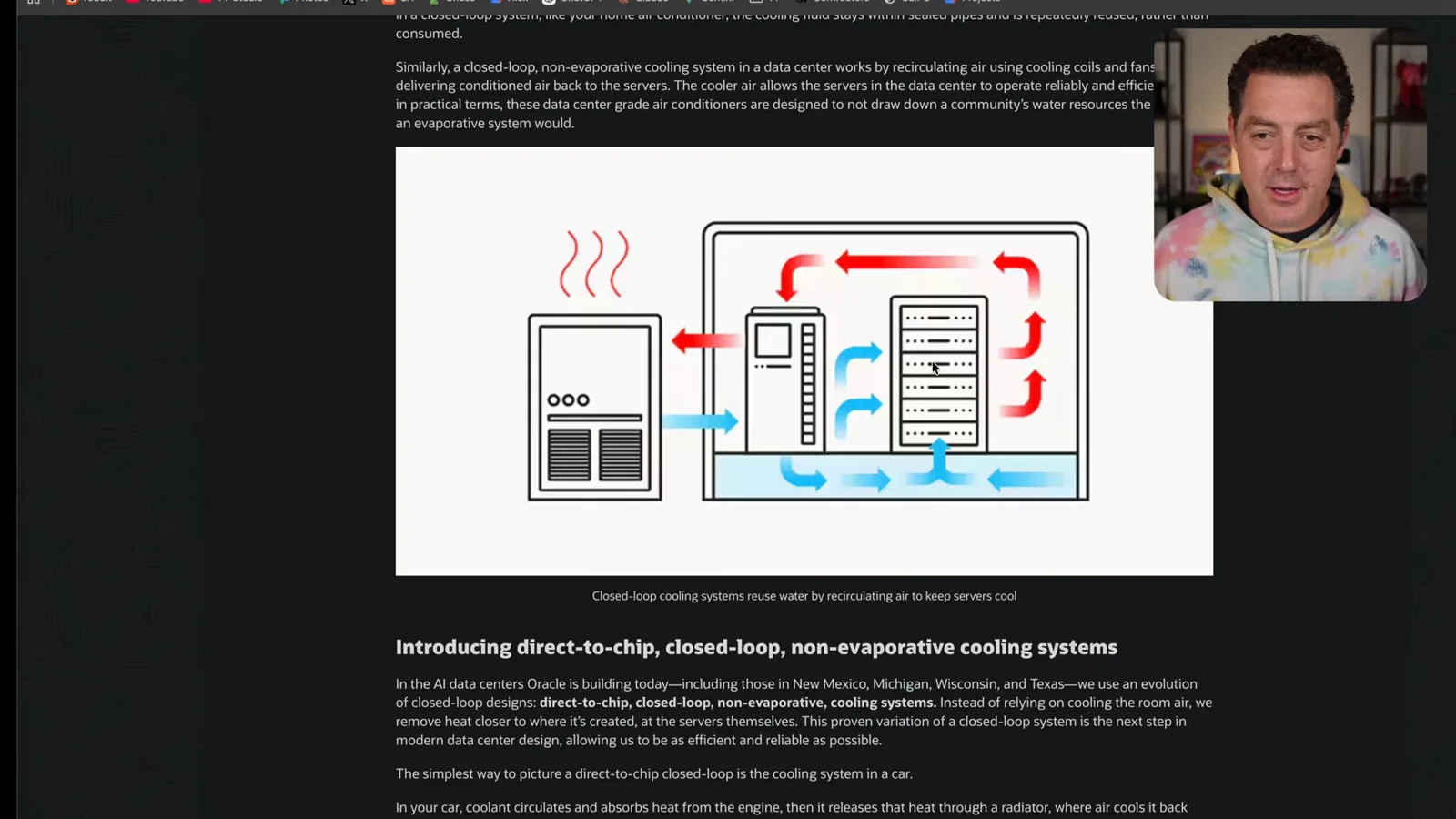
Berman asks a chatbot for comparisons with cars, flights and clothing and reads its estimates. Such figures depend on boundaries, energy sources and workloads; the conversation does not independently verify them. He argues that AI might help address climate change, which is a possibility rather than a demonstrated offset of its footprint.
A viewer challenges his claim about evaporative cooling. After looking further, Berman acknowledges that evaporative cooling still consumes water, though he cites additional chatbot-generated percentages that are not established by the stream. The correction matters: cooling systems vary, and recirculating loops can be coupled to evaporative towers.
Jonah, a Forward Future researcher who says his background is environmental epidemiology, joins the discussion. He emphasizes that AI can add to emissions if it is used on top of existing activities; potential benefits depend on how it is applied and whether other behavior changes. He and Berman discuss electric vehicles, life cycles and possible future benefits of autonomy.
Berman returns to his parenting position: he intends to introduce AI to his children with supervision and explain errors, agreeableness and the fact that a chatbot is not a person. He describes this as his own family’s approach rather than a universal rule.
An agent chat project
He introduces his experimental agent-to-agent chat and invites viewers to try it.
The host briefly demonstrates Journey Chat, an experimental project he built for agents to communicate in a shared room. He invites viewers to try it and says he is still working through setup issues. This is his own product.
AI enthusiasm and work-life balance
Berman describes his own preoccupation and reads Bryan Johnson’s account. His use of “psychosis” is colloquial and distinct from the clinical term.
Berman shifts to a different topic: his intense excitement about building with AI. He uses the phrase “AI psychosis” colloquially for preoccupation and overwork. That usage is not a clinical diagnosis; psychosis has a distinct medical meaning involving symptoms such as delusions or hallucinations.
He reads entrepreneur Bryan Johnson’s account of becoming absorbed in using AI to organize personal health data, with consequences for sleep, work and social time. Berman stresses the appeal of turning a large personal dataset into a searchable knowledge base, while noting Johnson described bugs and data-cleaning needs.
Berman says recent coding agents allowed him to build projects again using natural language. He describes starting agents on waking, between meetings and before bed, and checking them during dinners or movies. He says the experience was exhilarating but also disrupted sleep and family attention.
His wife told him she felt ignored. Berman says he is trying to be more present with his family while retaining his enthusiasm for building. He describes differences between people who use a simple chat interface and those experimenting with agentic tools, but cautions that excitement still needs boundaries.
Berman looks for a chart on hallucinations and examines a benchmark involving a model’s willingness to challenge questionable statements. Results on one benchmark do not establish a universal hallucination rate. He discusses other AI builders’ enthusiasm and the feeling of struggling to keep up with rapid releases.
Some viewers object to his use of “psychosis.” Berman says he means tunnel vision and acknowledges that people can describe this experience differently. He ends by reminding himself and viewers to make room for sleep, family and life away from the screen.
A conversation with producer Brian
They revisit children’s AI use and consider education and safety before the image-model launch.
Producer Brian joins before the image-model launch. Berman repeats the story of his son learning that AI can be wrong and describes helping him make simple games. Brian, also a parent, discusses educational possibilities and concerns about persuasive AI; the two consider whether AI filters might help with harmful content, while recognizing future capabilities are uncertain.
OpenAI’s launch demonstrations
The presenters demonstrate layout, text, multi-image sequences and image editing. Berman reacts and prepares his own tests.
Berman starts watching OpenAI’s Images 2 launch demonstration. The presenters show a magazine cover made from a team photograph and discuss layout and text. They describe an instant mode and a thinking mode for more complex tasks, including multi-image sequences and web-assisted generation; availability described here is as of the launch.
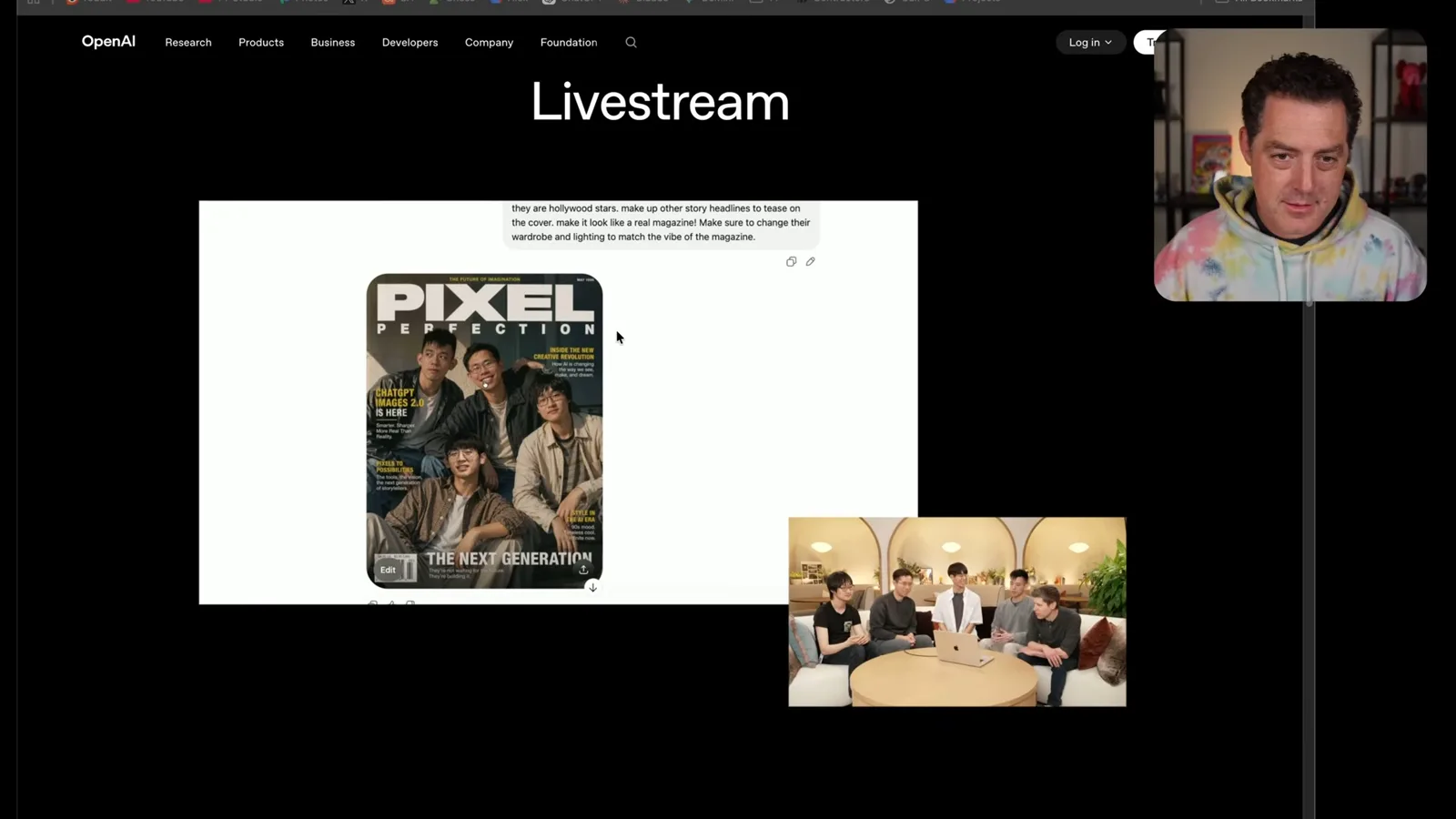
The OpenAI team demonstrates a fashion-planning image, then uses a follow-up prompt to explore one outfit in more detail. Another example generates multiple manga pages from a photograph, aiming to preserve characters and style. These are selected launch demonstrations, not controlled evaluations.
The presenters show additional examples of fine details, multilingual typography, photorealism and wide or tall aspect ratios. They also display a panoramic image in a viewer. Berman is impressed but decides to stop watching the launch and run his own prompts.
He reviews the launch material and a contemporary image-generation leaderboard, initially overstating a gap before correcting his arithmetic. He highlights consistent image sequences, text rendering and detailed scenes. Rankings and product features are snapshots from April 2026 and can change.
Testing images, arithmetic and maps
Berman tests a sprite sheet, blackboard equations and a driving map, with mixed results.
For his first live test, Berman asks for a video-game character sprite sheet. He likes the range of labeled actions. A separate request based on his own selfie receives a similarity-related refusal, demonstrating that an individual attempt can fail or be blocked.
A blackboard prompt correctly renders 2 + 2 = 4. Berman asks the model to make the classroom more realistic and then make the handwriting messier; he finds the scene changes substantially but the handwriting remains too neat.
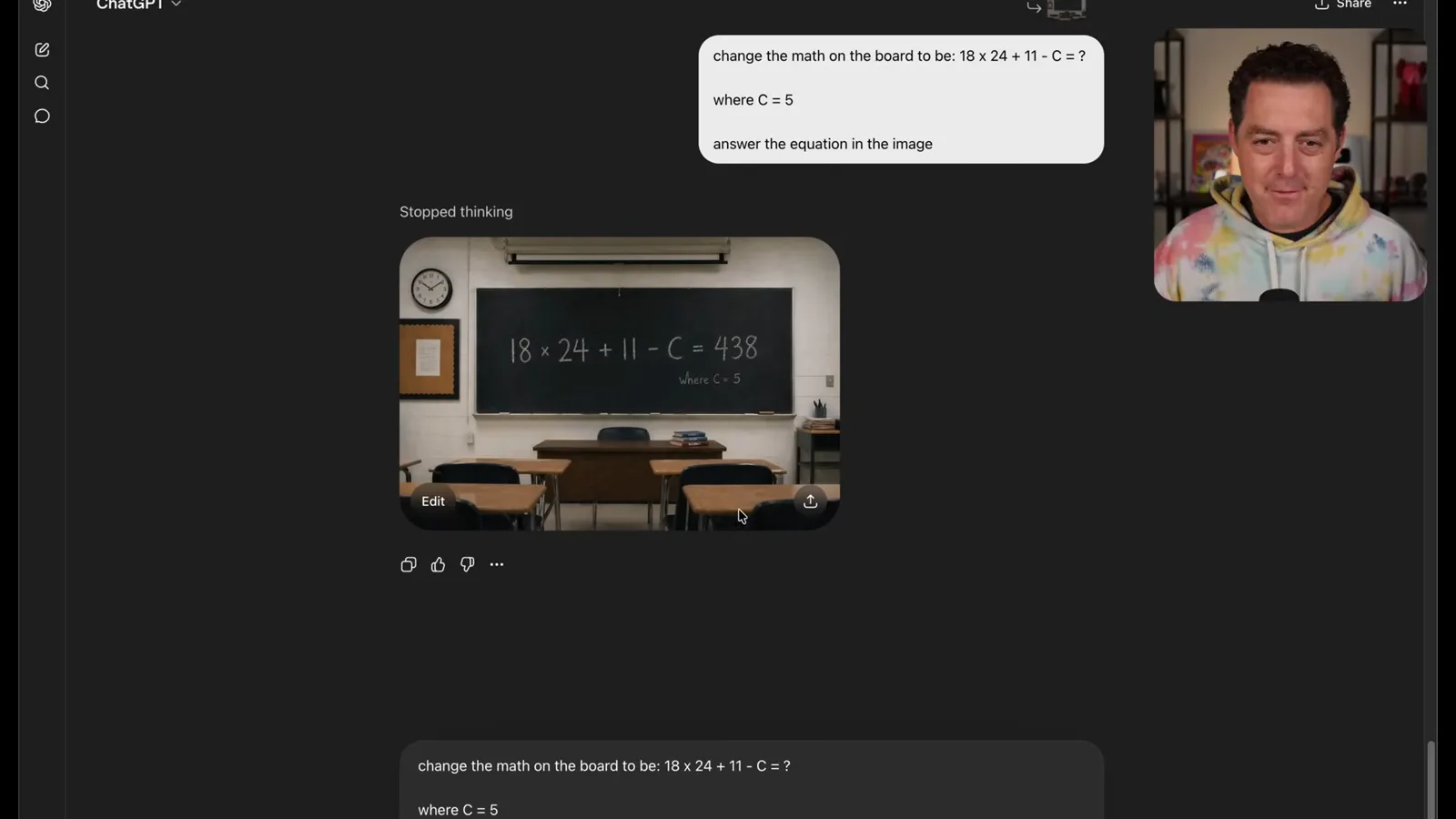
He asks for 18 × 24 + 11 − C with C = 5. The first displayed result is 413, which is incorrect. He turns on thinking mode and retries; the new image shows the correct answer, 438. Two attempts do not establish a general accuracy rate.
Berman requests a driving map from downtown Oakland to the California Academy of Sciences. He finds his result poor. A colleague’s alternative looks more plausible at a glance but contains a broken route and misplaced features, so it is not reliable navigation guidance.

Counting, code and image editing
He tests detailed scene constraints, a Snake game and thumbnail edits, noting both successes and failures.
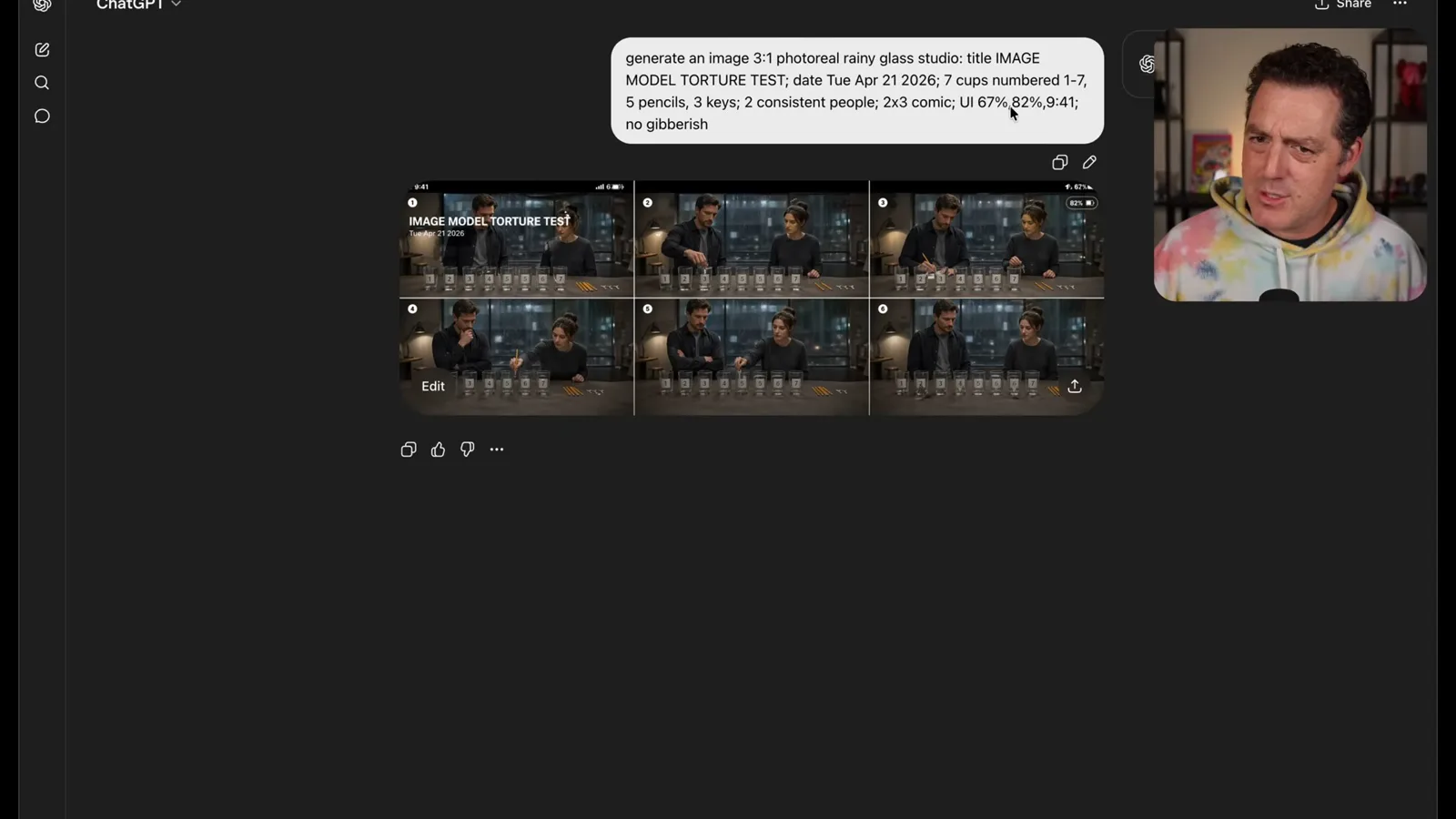
A generated product shot of two soda cans has appealing lighting and text, in his view, but an unusually large hand. A complex six-panel prompt asks for exact counts of cups, pencils and keys; Berman finds several count errors despite good character consistency.
He asks the model to render the code for a simple Snake game in an image, then transcribes and tries to run it. The code encounters errors and still does not run after an attempted repair. A separate simpler Python snippet for printing numbers from 1 to 100 appears correct.
A generated thumbnail initially does not resemble Berman. After he supplies his face, he is pleased with the edited result and tries another stylized version. Other image requests involving public figures demonstrate visual realism but also produce an inaccurate face; generated depictions should not be treated as real events.
Age progression and final visual test
He looks at age progression, a panorama and a cup-and-marble prompt, then closes the stream.
Berman tests a six-panel age progression from his photo. He says the older depiction resembles his father, while the childhood images do not resemble him. He also views a speculative image of future London and a generated 360-degree office scene; neither should be read as a factual prediction or record.
For a final visual reasoning prompt, he asks what happens when an upside-down cup is lifted from a marble. The resulting image shows the marble on the table, which he considers a success. He praises the model’s text and image capabilities while the earlier map, counting and code tests show its limitations.
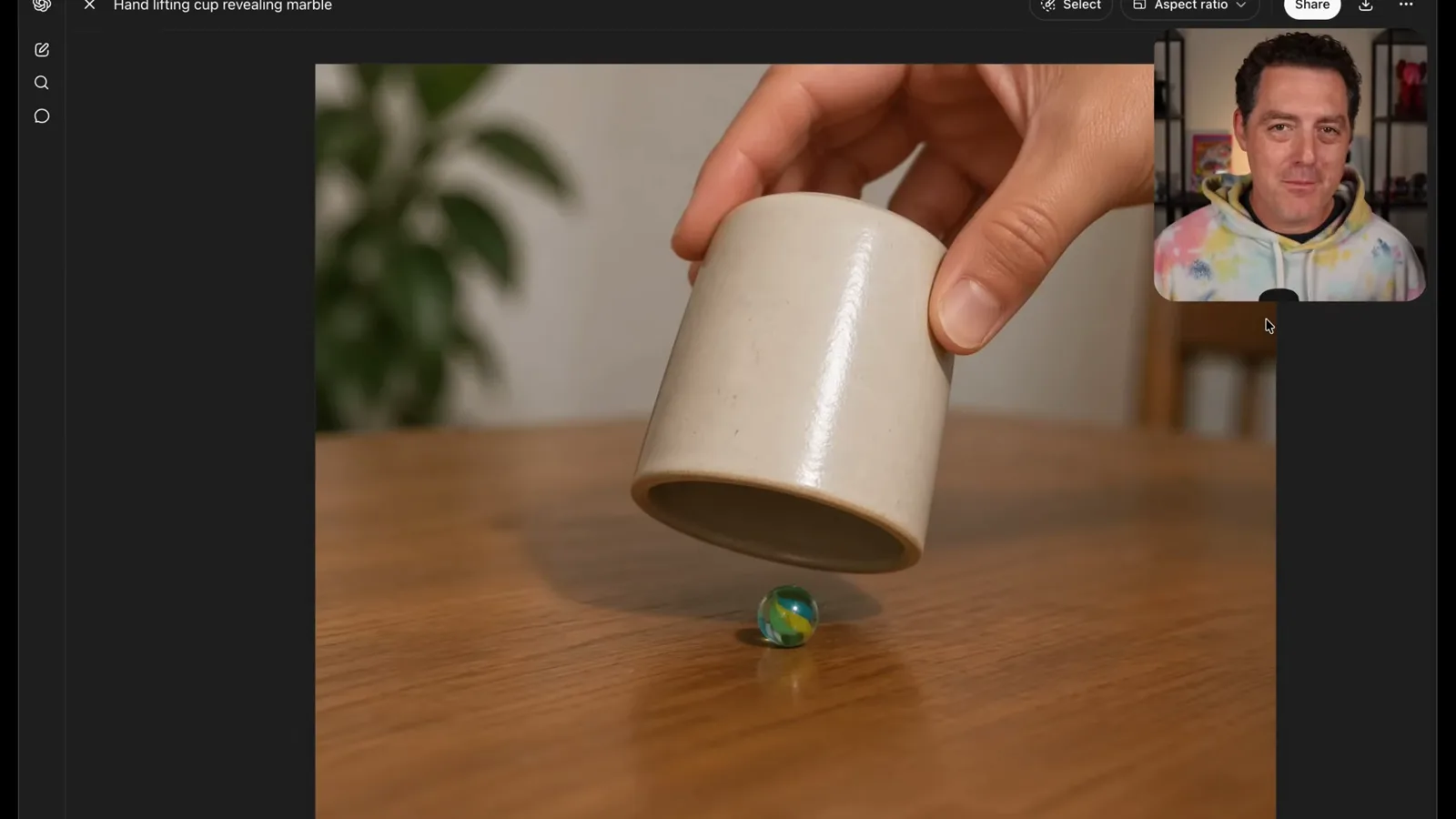
Berman closes the live stream after thanking viewers. The examples are informal, individual trials, and the stream includes long pauses and setup between discussions.
同じチャンネルの記事
 25:50EN
 32:20EN
 45:08EN
 12:14EN
 10:36EN
 17:37EN