30 秒でわかる
Matthew Berman puts Gemini 2.5 Flash Image, nicknamed Nano Banana, through a series of generation and editing tests. He highlights consistent characters and convincing composition while noting missed instructions, anatomical or visual inconsistencies, and the limits of inferred details.
- 1Viewpoint changesThe model generates alternate views, though it initially rotates the wrong number of figures.
- 2Convincing fictional editsAn imagined soundstage is blended into a moon-landing image; it does not document the real event.
- 3Continuity with gapsA four-panel comic keeps a character in three panels but omits her from one.
- 4Restoration limitsColorized and repaired photographs may look plausible without establishing historical accuracy.
- 5Small counting errorsSeven apples appear, but they are not identical as requested.
ポイント
- The model can preserve visual details across a series of edits and viewpoint changes.
- Generated hidden views and restored colors are plausible inventions, not verified reconstructions.
- The tests show failures in counting instructions, character continuity and face replacement.
- Image sequences and material changes can maintain much of the surrounding composition.
- Each generated output still requires visual inspection.
チャプターごとに整えた全文を読む
Viewpoints and character consistency
Berman edits phones, figures and a portrait to test viewpoint changes. He notes both convincing results and missed instructions.
Gemini 2.5 Flash Image, nicknamed Nano Banana, is an image generation and editing model that I find particularly strong at preserving a character across edits. I test it on viewpoint changes, composition, image restoration, text, object counting and image sequences, while pointing out places where it fails.
I ask it to flip over two phones in an MKBHD thumbnail. The generated screens resemble iPhone and Android interfaces, although some icons and letters are wrong. This is a convincing imagined reverse view, not a way to recover details actually hidden in the original image.
In another test I ask it to rotate the two rightmost KAWS figures. It rotates three and changes one position, but a follow-up instruction improves the result. With a Coca-Cola can, it produces three viewpoints while preserving the logo and condensation convincingly.
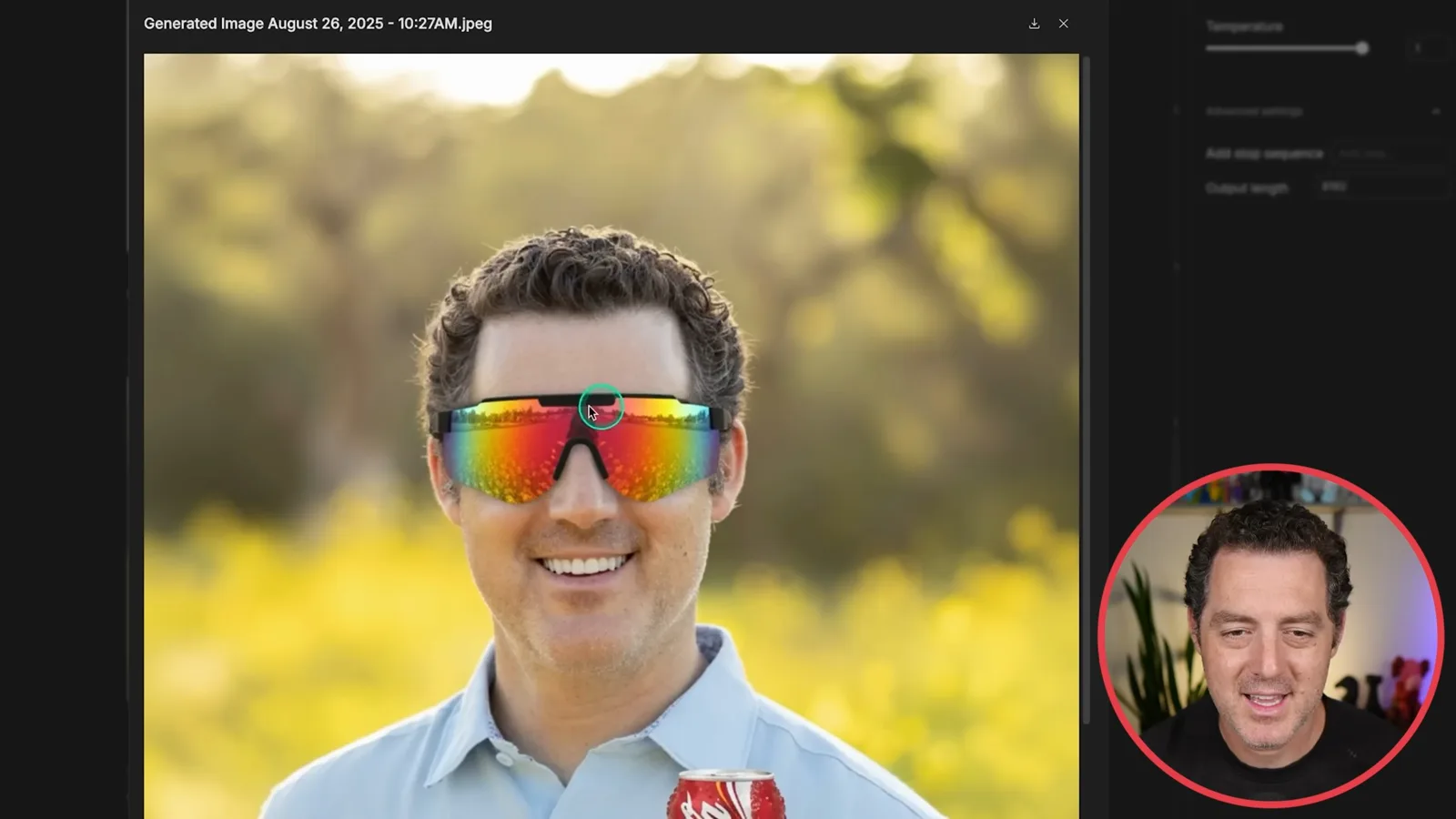
I add the can to a photograph of myself, then add reflective glasses. The glasses reflect yellow flowers, matching the surrounding scene. A further request generates a plausible rear view of my head. These edits show how the model can invent coherent details, even when those details were not visible in the source.
I ask for several poses and angles of two characters. The model maintains their appearance across the images, though it produces fewer images than requested and has a little clipping. A group image includes two front views and a rear view.
Composition and portrait edits
The video demonstrates fictional compositing and changes to portraits. Some visual details remain consistent, while others fail.
For a composition test, I edit a moon-landing photograph to add camera operators, then expand it into an imagined soundstage. The generated additions match the original’s grain and lighting while preserving the astronaut. This is a fictional edit, not evidence about the actual moon landing.
At launch, Google’s announcement and the displayed image-edit leaderboard rank the preview highly. I then transform my portrait into a pilot in front of an SR-71 and ask to zoom out. The model retains facial details across edits and adds a photographer-like reflection to the helmet.
In a group photograph I remove two people and insert myself. The generated pose, expression and shadows fit the scene surprisingly well, although the result is a synthetic alteration. I also try adding a beard, changing hair and editing another person’s expression; generated tears look artificial, so I remove them.
Comics and generation
A comic tests continuity and a portrait becomes a character sheet. New images also reveal visual inconsistencies.
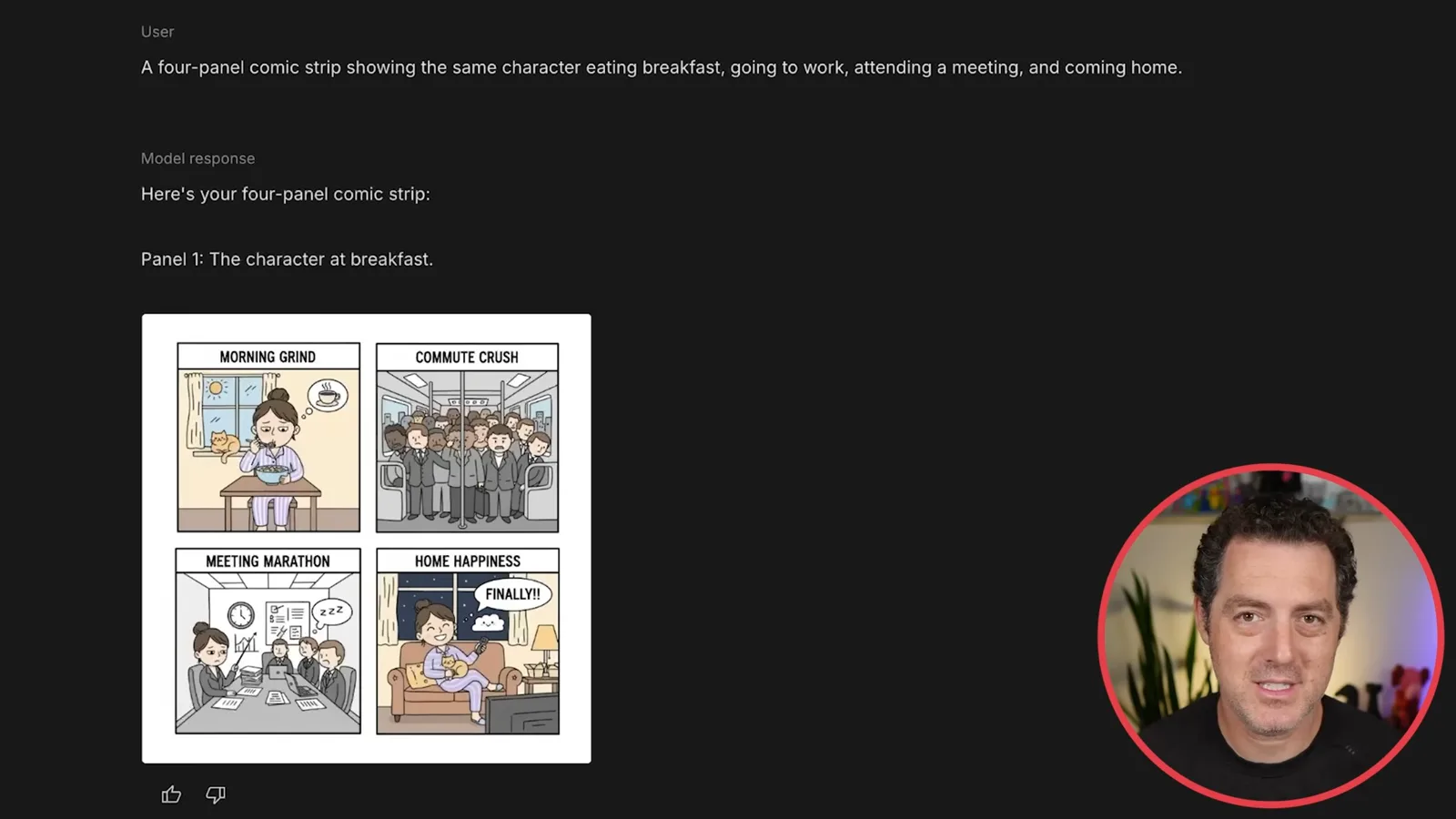
A four-panel comic mostly keeps the same character across breakfast, a meeting and home, but omits her from the commute panel. A cat appears first in the background and later on her lap. The example shows both continuity and a missed instruction.
Background removal works well on a portrait, but a subsequent muscular edit leaves an inconsistent sleeve on a hand. I also turn a portrait into anime, then a 3D-style character, a full-body image and a sheet of different poses. The sequence suggests uses in character design and product imagery.
For generation from scratch, I ask for an arbitrary everyday moment. One output has effective shadows but a stylized lens flare; another includes a floating leash and a very large pigeon. I like the depth-of-field effect, even as these small inconsistencies remain visible.
Thumbnails and restoration
Berman tests reflections, thumbnails and photo restoration. Plausible edits do not necessarily preserve historical facts.
A car prompt tests reflections: the generated grille and wet ground show reflected elements, including a photographer. In thumbnail experiments, I remove the background, change facial expressions and request a challenge-style composition. One attempted face replacement does not follow my request well.
Changing thumbnail text from “big news” to “huge news” preserves the original style reasonably well. I also repair damaged black-and-white photographs and colorize them. The results look convincing, but a plausible generated color or reconstructed detail is not necessarily historically accurate.
At the time of the video, I demonstrate access through Google AI Studio and the Gemini interface. I discuss settings such as temperature and show where the image generation option appears. Availability, names and limits can change after the demonstration.
Sequences, materials and counting
The final tests cover time sequences, material substitution, counting and hands. Berman checks the outputs for small errors.
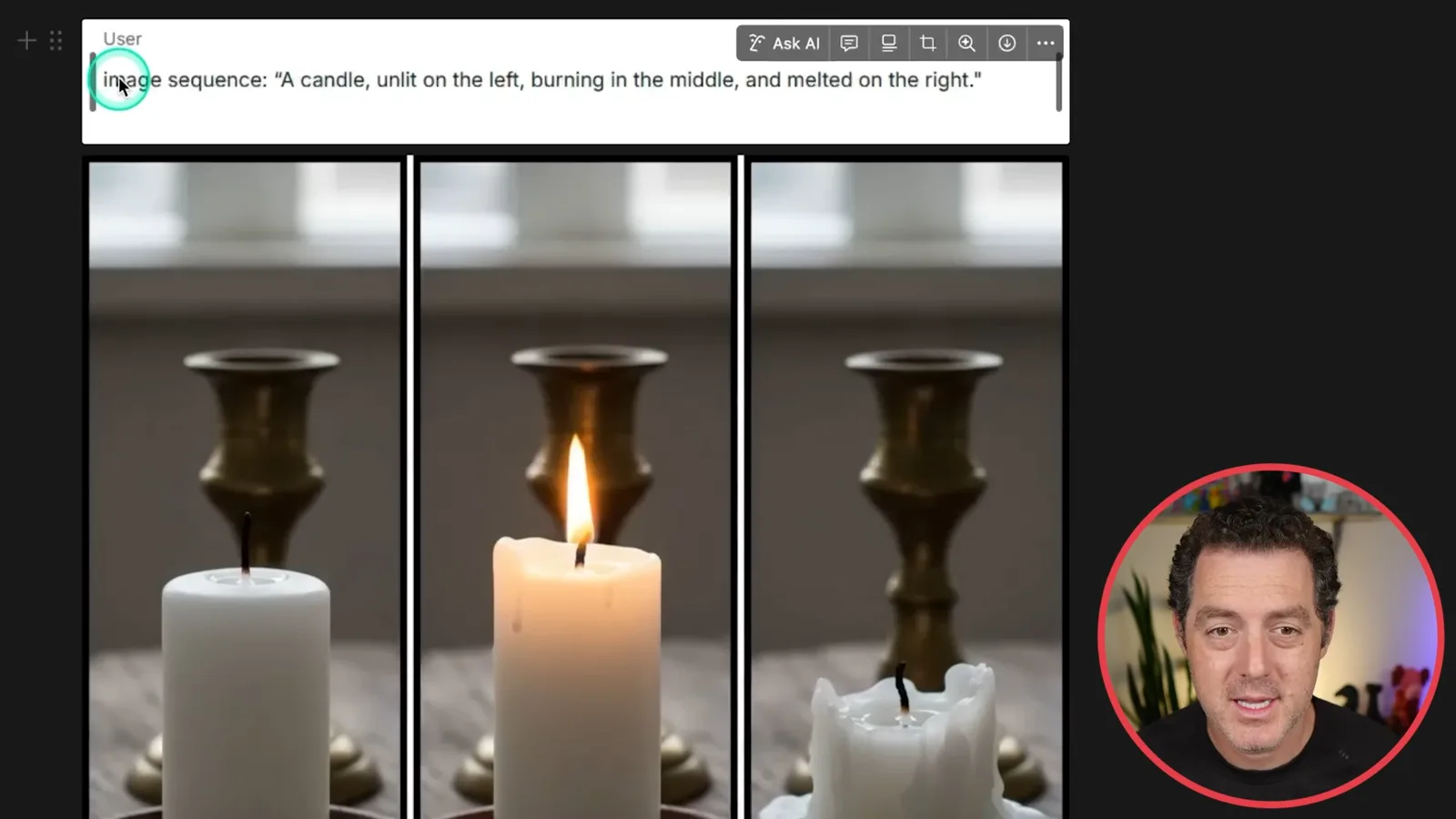
A sequence prompt shows a candle unlit, burning and melted. The three panels mostly follow the timeline, though the burning candle appears taller than the unlit one. A second prompt requests a burger decaying over years and generates several stages of mold and decay.
For material changes, I ask the model to replace an ice teapot with a metal one while keeping the rest of the scene. Much of the composition, including the steam, remains similar. I also create a meme by adding a banana and text to a whiteboard.
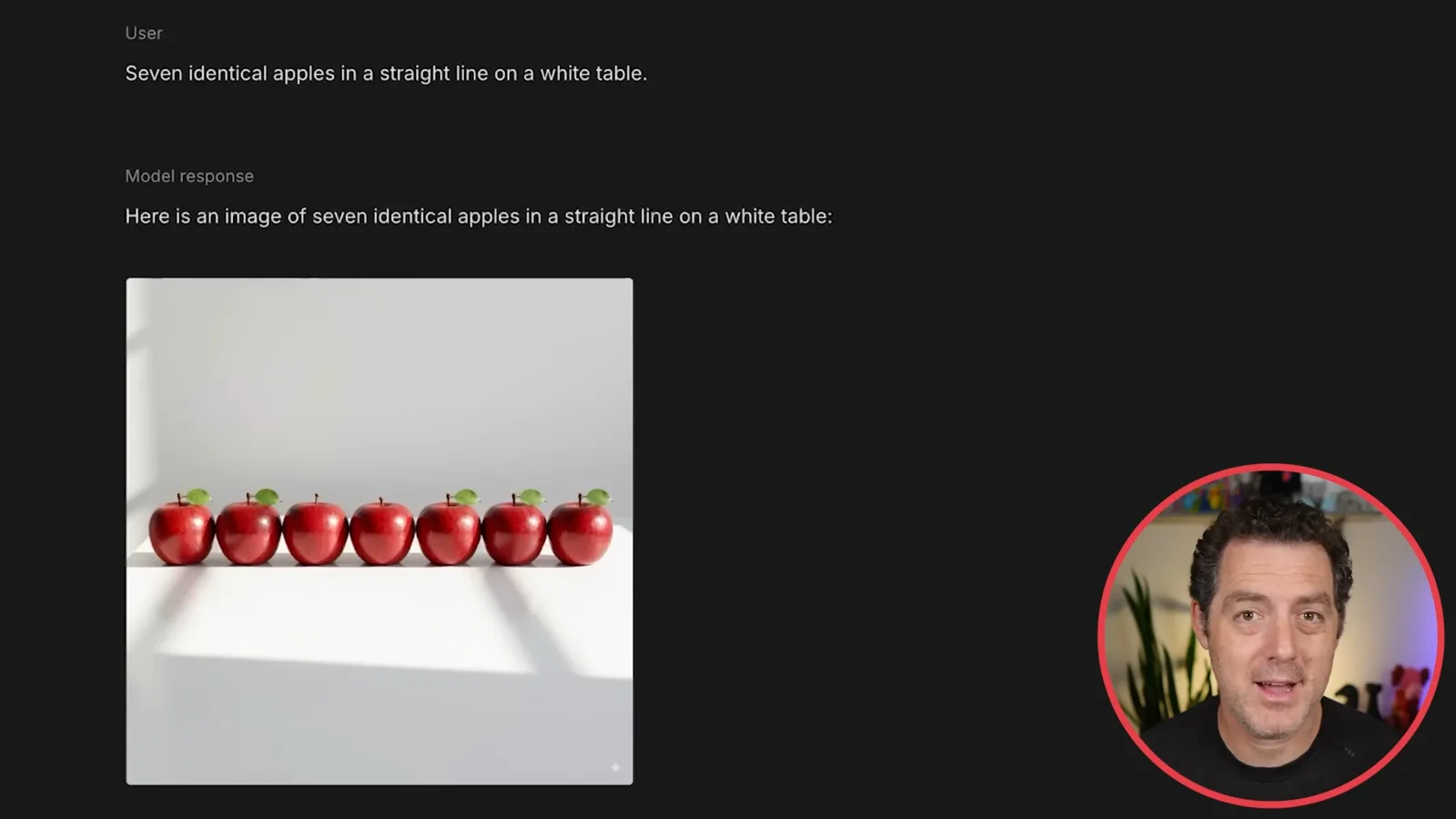
A counting test asks for seven identical apples. There are seven, but two lack leaves that appear on the others, so they are not truly identical. A final close-up of interlocking hands has five fingers and convincing skin texture in this example. The successes are impressive, but individual outputs still need inspection.
同じチャンネルの記事
 25:50EN
 32:20EN
 45:08EN
 0:32EN
 12:14EN
 10:36EN