30 秒でわかる
Matthew Berman watches OpenAI’s launch presentation and explains the developer tools shown at the time: the Responses API, three built-in tools and the open-source Agents SDK. A personal stylist demo combines retrieval, web search and computer use before adding specialized agents and tracing.
- 1Search toolsWeb search retrieves current information; file search queries uploaded documents and supports metadata filtering.
- 2Computer useThe application supplies an environment and executes actions requested by a model that sees screenshots.
- 3Responses APIThe interface brings model turns and tool calls together for agent workflows.
- 4Agent handoffsA triage agent can hand a conversation to a specialized agent with different instructions and tools.
- 5TracingThe dashboard exposes handoffs, function calls, parameters and outputs for debugging.
ポイント
- Web and file search give agents access to current public information and selected private documents.
- Computer use operates through a screenshot-and-action loop in an application-provided environment.
- The Responses API combines model interactions and tool calls in an agent workflow.
- The Agents SDK supports specialized agents, handoffs, function tools and tracing.
- The video’s API availability and retirement plans reflect the time of the launch.
チャプターごとに整えた全文を読む
The agent building blocks
Berman introduces the launch and discusses the infrastructure needed around capable models. OpenAI presents search and computer-use tools.
OpenAI has announced tools for developers building agents, which it defines as systems that act independently to perform tasks on someone’s behalf. In this video I react to the launch presentation, including web search, file search, computer use, the Responses API and the open-source Agents SDK.
OpenAI points to Operator and deep research as examples of agentic products. In my experience at the time, Operator is inconsistent, while deep research has been valuable in day-to-day work. The new announcement brings related capabilities to developers through an API.
I agree with the presenters that models have become capable enough for many multistep workflows. The missing pieces are often the surrounding infrastructure: tools, local environments, code execution and coordination. Developers have previously had to assemble these parts from several low-level APIs.
The first built-in tool is web search, which retrieves current information rather than relying solely on a model’s training data. The presenters describe a fine-tuned search model that selects relevant material and cites sources. Their SimpleQA chart reports higher scores with search than the comparison models without it.
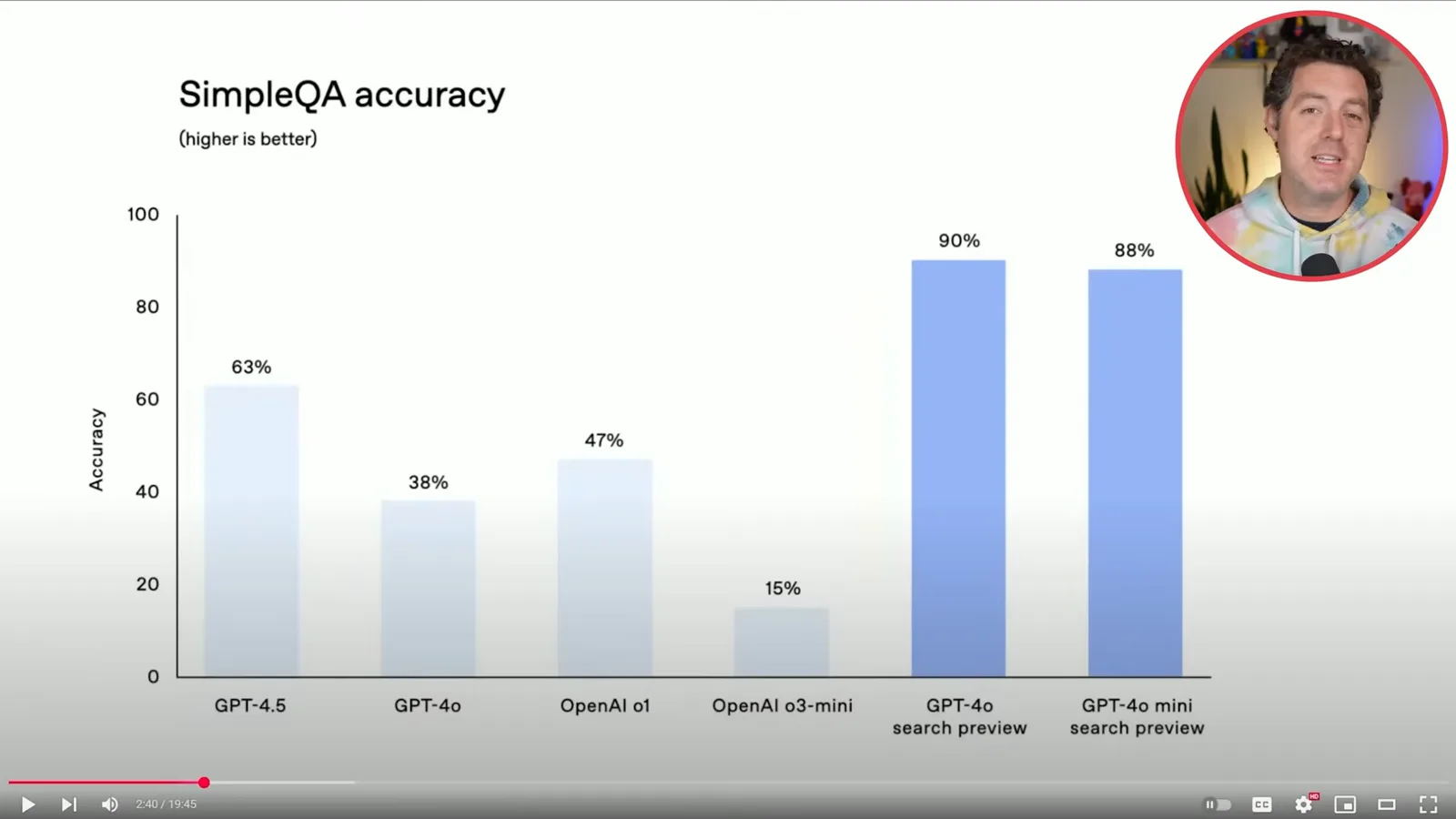
File search addresses a different need: finding information in uploaded documents. OpenAI announces metadata filtering to narrow results and a direct search endpoint for querying vector stores. Together, web and file search give an application ways to retrieve public information and its own relevant data.
The third tool, computer use, exposes an Operator-like model to developers. The application supplies a computer environment, which could include a virtual machine or an older graphical application without an API. The agent can then request actions through that interface.
I compare this combination to Manus: an agent can search the web, operate in a dedicated environment, write code and save its work in files. OpenAI is providing building blocks for developers to assemble similar workflows rather than a single finished application.
Responses API and stylist demo
The team demonstrates an assistant that uses file and web search. A separate computer-use example acts through screenshots and an application-provided environment.
The presenters introduce the Responses API as an interface designed for multimodal inputs, tools and multiple model turns. Chat Completions began as a text-in, text-out interface; the newer API is intended to make tool-driven workflows easier to express.
To demonstrate it, the team builds a personal stylist. The initial request looks familiar: choose a model, provide instructions and ask about current trends. The difference is that the example uses the Responses endpoint and will add tools to the same workflow.
The team has placed example clothing preferences in a vector store. It adds file search to the request, supplies the store ID and uses a metadata filter to select one person’s records. The assistant can then summarize that person’s style from the relevant files.
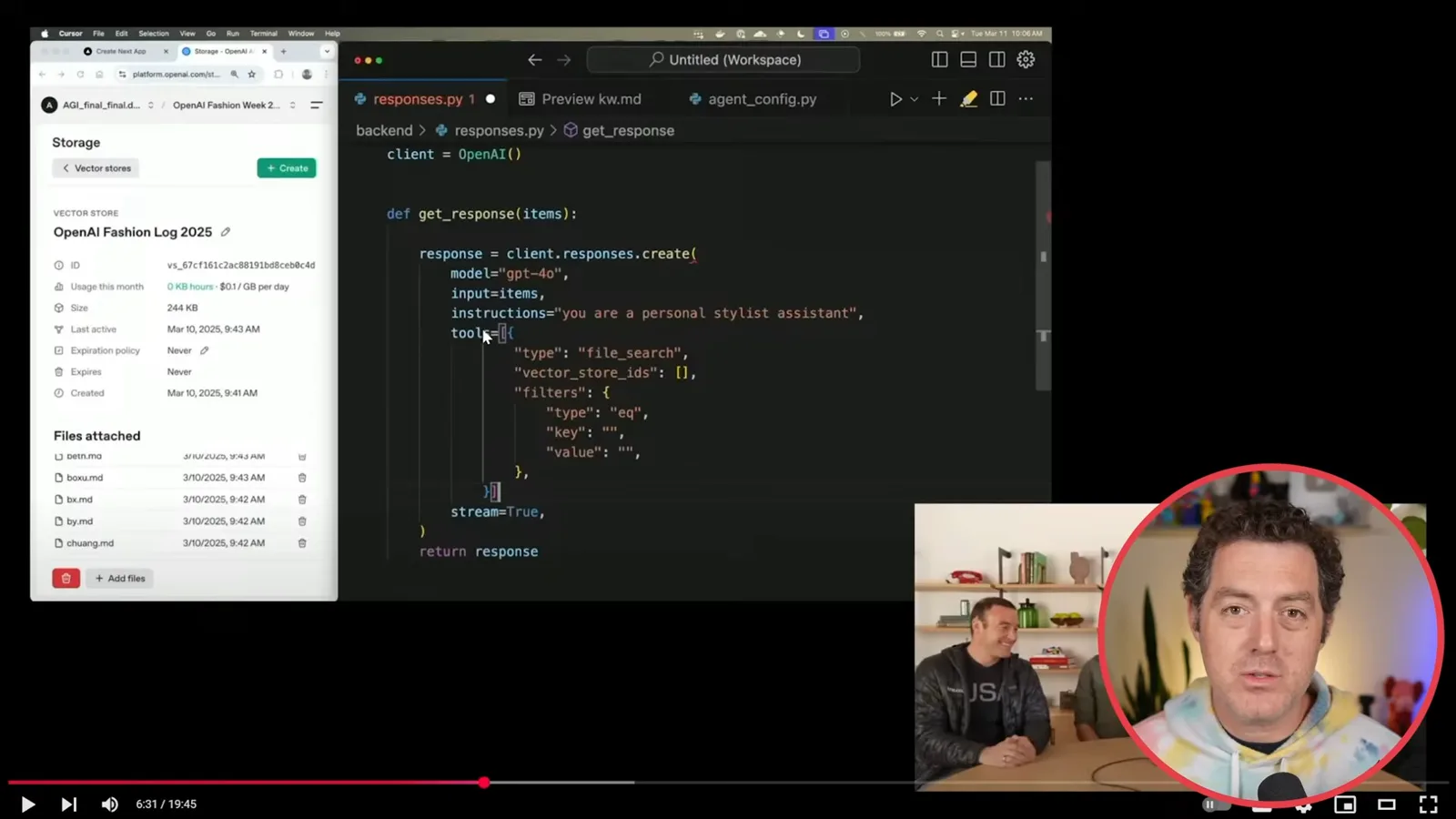
Next, the demonstrators add web search and a location. Their instructions ask the model to use file search for the customer’s preferences and web search for nearby stores. In the example, one API interaction combines both tools and recommends Patagonia stores in Tokyo.
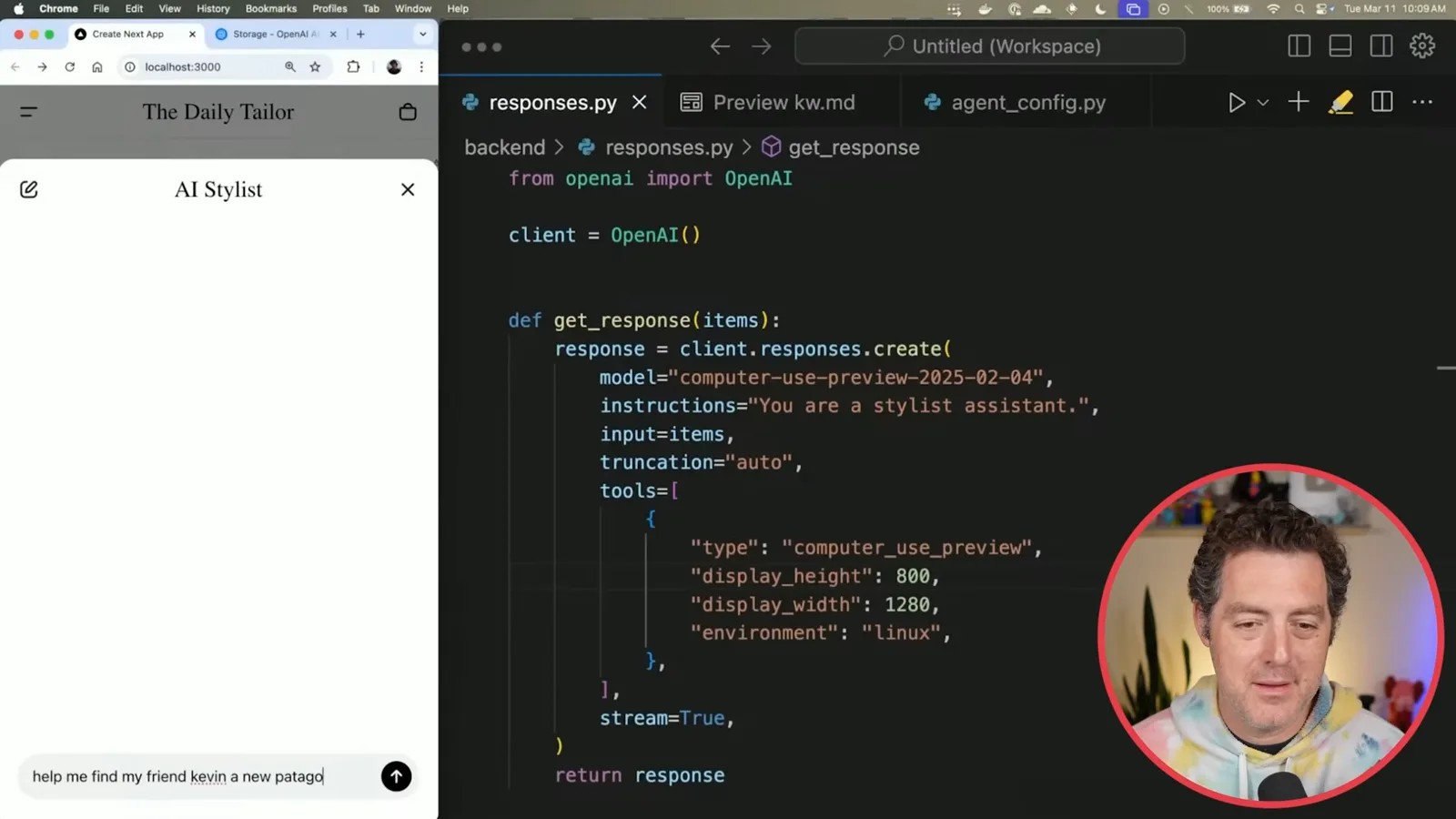
For a computer-use example, they switch to the computer-use preview model and specify the display dimensions. The model receives a screenshot from a local Docker environment, proposes an action such as a click, and receives another screenshot after the application executes it. The loop continues until the task is complete.
Agents SDK and handoffs
The SDK organizes specialized agents and ordinary functions as tools. A triage agent hands a return request to customer support.
More complex applications can involve specialized agents for different tasks, such as answering questions, handling refunds and managing orders. OpenAI says its experimental Swarm framework inspired the production-oriented Agents SDK, which aims to keep simple workflows simple while supporting more complex orchestration.
The team reimplements the stylist with an agent, instructions and file and web search tools. They say the SDK uses the Responses API by default but can also work with compatible providers. A separate customer-support agent handles returns so that its logic can be developed and tested independently.
The support agent gets tools for looking up past orders and submitting a refund request. The presenters explain that ordinary Python functions can become tools: the SDK derives a JSON schema from their type signatures, invokes the function and returns its result to the model.
A handoff transfers a conversation from one agent to another while switching the instructions and tools in use. A triage agent can route a request to the stylist or customer-support agent. In the demonstration, a request to return a purchase is handed to the support agent, which looks up past orders.
Tracing and API transition
The team inspects the agent run, discusses SDK features and describes its plans for existing APIs. Berman closes with his view of agent development.
The SDK includes tracing and monitoring. The presenters inspect a run in the dashboard to see the original input, available and selected handoffs, function calls, parameters and outputs. I like the clarity of the interface because this visibility makes multi-agent behavior easier to debug.
They also mention guardrails and lifecycle events and say the framework is open source. I welcome the competition among agent frameworks; I also disclose that I am an investor in CrewAI and have used it extensively. The presenters say compatible non-OpenAI providers can be used with the SDK.
OpenAI says Chat Completions will continue to be supported, while some built-in tool and agent capabilities will be available through Responses. At the time of the presentation, the team says it plans to add missing Assistants API features and provide a migration path before a planned 2026 sunset.
The launch brings retrieval, web search, computer use and agent orchestration together as developer building blocks. I see it as part of a broader move from AI that only answers questions toward systems that can carry out tasks, while the real value depends on how developers put those pieces together.
同じチャンネルの記事
 25:50EN
 32:20EN
 45:08EN
 12:14EN
 10:36EN
 17:37EN