Why Humanoid Robots Can Move Beyond Human Limits

Matthew Berman explains why joints that rotate beyond human ranges could help robots work in factories.

MBMatthew BermanIntervenant · Forward Future
Chaîne
Matthew Berman
Publié
11 janv. 2026
Vidéo
1:36
Lecture
1 min
Diapositives
1
Original
anglais
Ouvrir sur YouTube
En faisant défiler, la vidéo se réduit en bas à droite et continue. Les sous-titres suivent votre langue de lecture.
Langue de lectureDisponible en 2 langues
Cet article n’est pas encore disponible en français ; il s’affiche dans l’original en anglais.
RÉSUMÉ

En 30 secondes

Matthew Berman uses Boston Dynamics’ Atlas as an example of a humanoid robot designed with movement beyond human limits. He argues that faster repositioning and heavy lifting could be valuable in factories, while describing these benefits as potential applications.

  1. 1Beyond human movementBerman points to rotating hands, legs and torso as examples of mobility that differs from human anatomy.
  2. 2Factory efficiencyHe argues that faster repositioning could save time during repetitive industrial work.
  3. 3Future deploymentBerman expects heavy lifting and humanoid mobility to change factory work.

À retenir

  1. A humanoid robot need not copy every limitation of human anatomy.
  2. Rotating joints can give a robot more options for repositioning.
  3. Berman expects these capabilities to matter in industrial work.
TEXTE INTÉGRAL

Lire le texte remanié, chapitre par chapitre

Transcription seule
01

Designing beyond human anatomy

Berman describes humanoid robots with joints that can rotate beyond normal human ranges. He discusses why those capabilities could matter in factories.

The human hand is remarkable, but a robot does not have to inherit every limitation of human anatomy. Boston Dynamics takes a humanoid form and gives it capabilities such as hands that can rotate fully, legs that move in unfamiliar directions and a torso that can turn around.
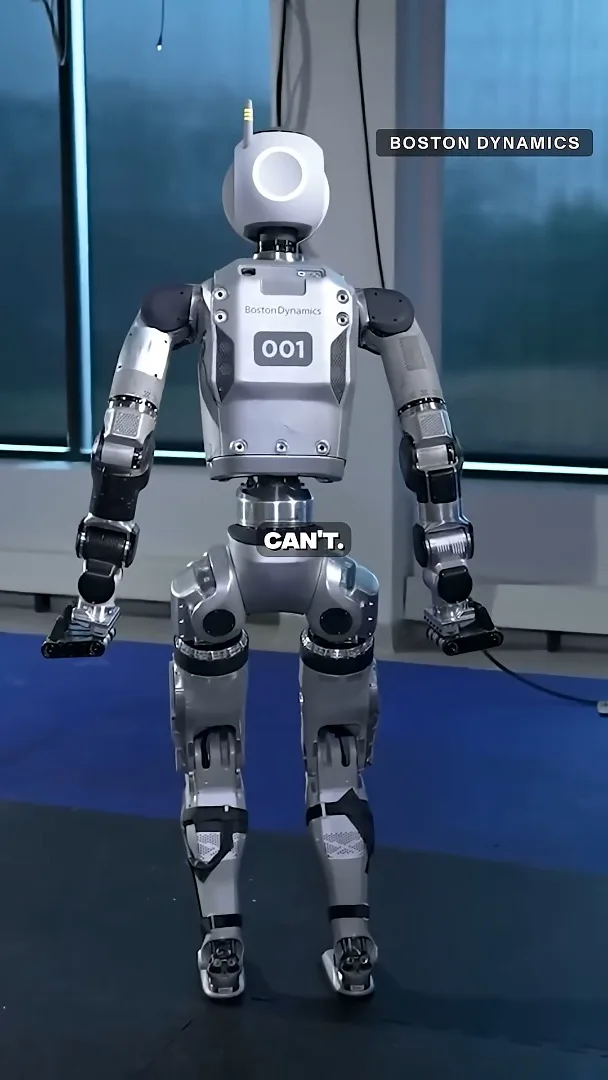
A Boston Dynamics humanoid robot
DIAPOSITIVE 1 / 1A Boston Dynamics humanoid robotThe video shows the robot’s body and joint layout while discussing movement beyond human ranges.

I think that flexibility could matter in a factory, where repeated movements add up. If a robot can reposition more quickly than a person, it could save time during a task. The benefit depends on the actual operation and the robot’s performance in that environment.

Boston Dynamics has a long history of robotics demonstrations, from its four-legged machines to Atlas. I expect newer humanoid robots capable of moving heavy objects to change factory work as they are deployed. How would it feel to work alongside one?

Sur la même chaîne

6 diapositives25:50EN
MBMatthew Berman· 24 oct. 2026Kimi K3.1 Pro Tested: Strong 3D Demos, Uneven Results and Competitive PricingMatthew Berman · Forward FutureMatthew Berman tests the open-weight model on coding, 3D rendering and visual explanations, then compares benchmark results and prices.Open-weight modelsBenchmarksAI cost & performance+1
2 diapositives32:20EN
MBMatthew Berman· 23 oct. 2026Who Is Local AI For? The Costs, Trade-offs and a Hybrid FutureMatthew Berman · Forward FutureMatthew Berman weighs data control and independence against hardware cost, setup complexity and inference speed.Local inferenceOpen-weight modelsAI cost & performance+1
45:08EN
MBMatthew Berman· 21 oct. 2026Sam Altman on AI Discovery, Consciousness, Compute and a Human-Centered FutureMatthew Berman, Sam Altman · Forward FutureIn a conversation with Matthew Berman, Altman discusses scientific progress, personal assistants, recursive self-improvement and the importance of human agency.AI for sciencePersonal agentsConsciousness+2
0:32EN
MBMatthew Berman· 21 oct. 2026Sam Altman on the Continuing Demand for Software WorkSam Altman, Matthew Berman · OpenAIIn a short interview excerpt, Altman says demand for software may be larger than expected even as AI changes how it is made.Future of WorkSoftware engineeringAgents de code
5 diapositives12:14EN
MBMatthew Berman· 14 oct. 2026Gemini 4 Argon Tested: 3D Demos, a Spreadsheet Prototype and Benchmark ResultsMatthew Berman · Forward FutureMatthew Berman tests Google’s model on games and visual projects, then compares reported coding and agent benchmarks.GeminiBenchmarksAgents de code+1
5 diapositives10:36EN
MBMatthew Berman· 13 oct. 2026Meta Muse Wonder Tested: Strong Benchmarks, Mixed Demos and Quota FrictionMatthew Berman · Forward FutureMatthew Berman tests Meta’s models on browser demos and reviews their published benchmark scores, availability and cost.Modèles et entraînementBenchmarksAI cost & performance+1