Why Humanoid Robots Can Move Beyond Human Limits

Matthew Berman explains why joints that rotate beyond human ranges could help robots work in factories.

MBMatthew BermanPonente · Forward Future
Canal
Matthew Berman
Publicado
11 ene 2026
Vídeo
1:36
Lectura
1 min
Diapositivas
1
Original
inglés
Abrir en YouTube
Al desplazarte, el vídeo se reduce a la esquina inferior derecha y sigue reproduciéndose. Los subtítulos siguen tu idioma de lectura.
Idioma de lecturaDisponible en 2 idiomas
Este artículo aún no está en español, así que se muestra el original en inglés.
RESUMEN

En 30 segundos

Matthew Berman uses Boston Dynamics’ Atlas as an example of a humanoid robot designed with movement beyond human limits. He argues that faster repositioning and heavy lifting could be valuable in factories, while describing these benefits as potential applications.

  1. 1Beyond human movementBerman points to rotating hands, legs and torso as examples of mobility that differs from human anatomy.
  2. 2Factory efficiencyHe argues that faster repositioning could save time during repetitive industrial work.
  3. 3Future deploymentBerman expects heavy lifting and humanoid mobility to change factory work.

Conclusiones

  1. A humanoid robot need not copy every limitation of human anatomy.
  2. Rotating joints can give a robot more options for repositioning.
  3. Berman expects these capabilities to matter in industrial work.
TEXTO COMPLETO

Lee el texto editado por capítulos

Solo la transcripción
01

Designing beyond human anatomy

Berman describes humanoid robots with joints that can rotate beyond normal human ranges. He discusses why those capabilities could matter in factories.

The human hand is remarkable, but a robot does not have to inherit every limitation of human anatomy. Boston Dynamics takes a humanoid form and gives it capabilities such as hands that can rotate fully, legs that move in unfamiliar directions and a torso that can turn around.
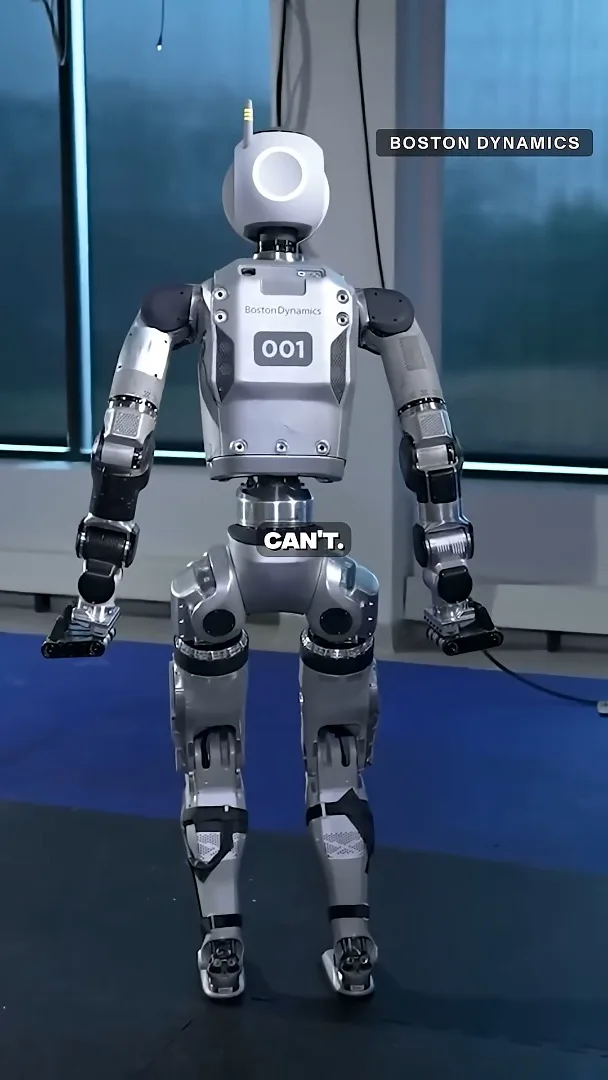
A Boston Dynamics humanoid robot
DIAPOSITIVA 1 / 1A Boston Dynamics humanoid robotThe video shows the robot’s body and joint layout while discussing movement beyond human ranges.

I think that flexibility could matter in a factory, where repeated movements add up. If a robot can reposition more quickly than a person, it could save time during a task. The benefit depends on the actual operation and the robot’s performance in that environment.

Boston Dynamics has a long history of robotics demonstrations, from its four-legged machines to Atlas. I expect newer humanoid robots capable of moving heavy objects to change factory work as they are deployed. How would it feel to work alongside one?

Más de este canal

6 diapositivas25:50EN
MBMatthew Berman· 24 oct 2026Kimi K3.1 Pro Tested: Strong 3D Demos, Uneven Results and Competitive PricingMatthew Berman · Forward FutureMatthew Berman tests the open-weight model on coding, 3D rendering and visual explanations, then compares benchmark results and prices.Open-weight modelsBenchmarksAI cost & performance+1
2 diapositivas32:20EN
MBMatthew Berman· 23 oct 2026Who Is Local AI For? The Costs, Trade-offs and a Hybrid FutureMatthew Berman · Forward FutureMatthew Berman weighs data control and independence against hardware cost, setup complexity and inference speed.Local inferenceOpen-weight modelsAI cost & performance+1
45:08EN
MBMatthew Berman· 21 oct 2026Sam Altman on AI Discovery, Consciousness, Compute and a Human-Centered FutureMatthew Berman, Sam Altman · Forward FutureIn a conversation with Matthew Berman, Altman discusses scientific progress, personal assistants, recursive self-improvement and the importance of human agency.AI for sciencePersonal agentsConsciousness+2
5 diapositivas12:14EN
MBMatthew Berman· 14 oct 2026Gemini 4 Argon Tested: 3D Demos, a Spreadsheet Prototype and Benchmark ResultsMatthew Berman · Forward FutureMatthew Berman tests Google’s model on games and visual projects, then compares reported coding and agent benchmarks.GeminiBenchmarksAgentes de programación+1
5 diapositivas10:36EN
MBMatthew Berman· 13 oct 2026Meta Muse Wonder Tested: Strong Benchmarks, Mixed Demos and Quota FrictionMatthew Berman · Forward FutureMatthew Berman tests Meta’s models on browser demos and reviews their published benchmark scores, availability and cost.Modelos y entrenamientoBenchmarksAI cost & performance+1
2 diapositivas17:37EN
MBMatthew Berman· 10 oct 2026AI Coding, Game Mashups and the Value of Human TasteMatthew Berman · Forward FutureMatthew Berman explains decompilation and game mashups, then argues that iterative AI coding changes software and creativity.Agentes de programaciónSoftware engineeringCreativity+1