En 30 segundos
In this May 2026 commentary, Matthew Berman argues that Anthropic and OpenAI place different emphases on model status, safety and deployment. He discusses speculation about Claude’s role, jobs, cyber model access, customer limits and military contracts. The question of AI consciousness remains unresolved, and several claims in the video are opinions or forecasts rather than established facts.
- 1Hiring claims are speculationThe post’s prediction that Claude might influence employee screening is not evidence of present hiring or firing authority.
- 2Consciousness is uncertainAnthropic discusses uncertainty about model moral status; neither a constitution nor generated self-description settles the question.
- 3Restricted cyber previewGlasswing gave selected partners access to Mythos Preview for defensive work; Berman disputes the strategy.
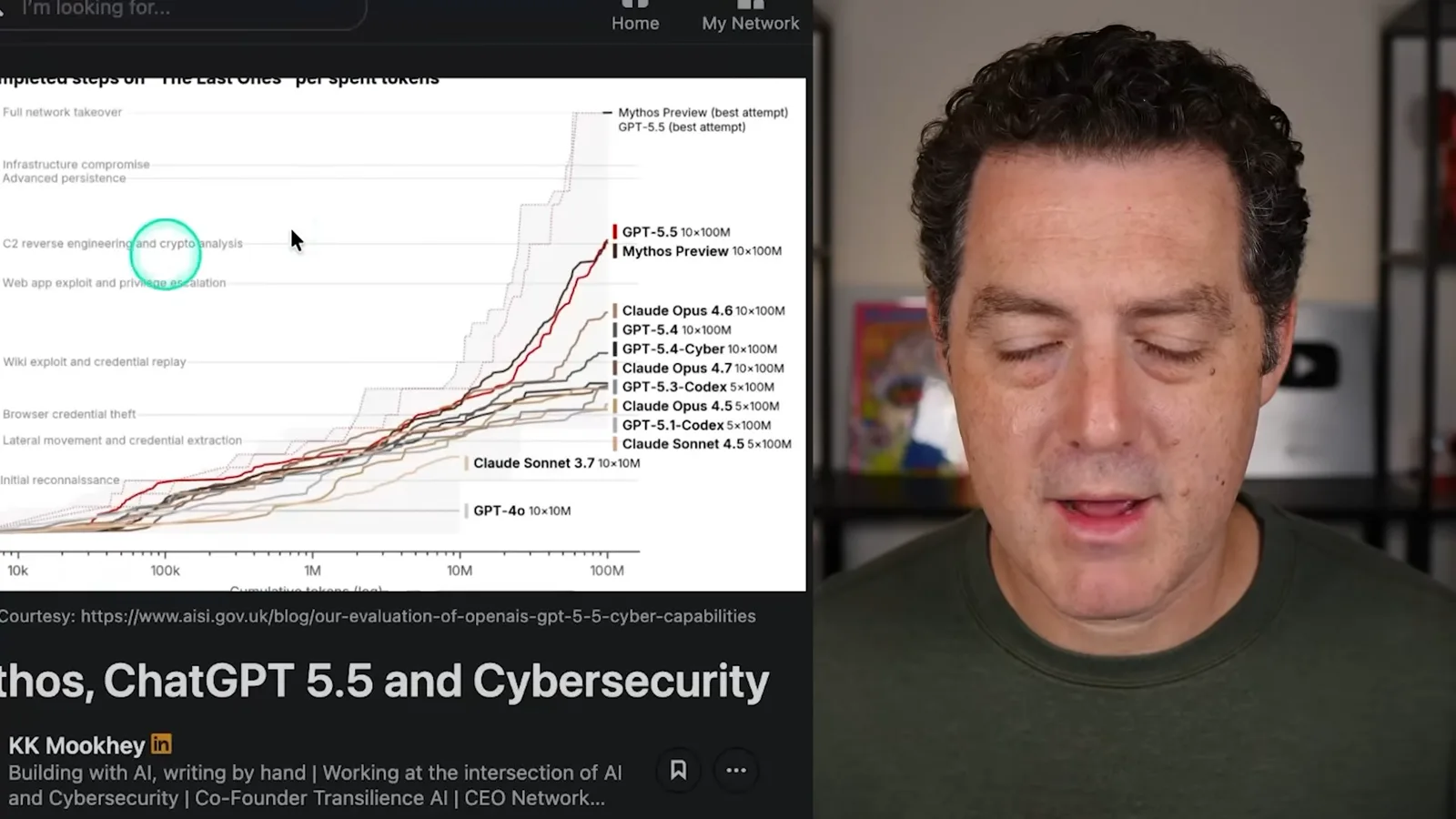
- 4A narrow comparisonThe chart shows specific cyber evaluations of GPT-5.5 and Mythos Preview, not proof of equivalence on all cyber tasks.
- 5Emotion concepts versus feelingsResearch into internal emotion-related representations does not demonstrate subjective experience.
- 6Opus 3’s retirementAnthropic retired Opus 3 while retaining some access and arranging reviewed, manually posted essays.
Conclusiones
- Anthropic describes uncertainty about potential AI consciousness; its research into emotion-related representations does not prove subjective experience.
- Claims that Claude could influence hiring and performance reviews are presented as speculation.
- Project Glasswing restricts Mythos Preview access to selected defensive partners; a single cyber chart cannot establish broad model equivalence.
- The discussed Claude peak-hour change concerned five-hour session limits while weekly limits remained unchanged.
- OpenAI’s defense agreement includes stated restrictions, so the host’s shorthand of unrestricted permission is incomplete.
- Anthropic retired Opus 3 while maintaining limited access and arranging human-reviewed publication of model-generated essays.
Lee el texto editado por capítulos
A dispute over Claude’s status
Berman reacts to roon’s criticism and worries about delegating ethical and organizational decisions. Anthropic’s constitution expresses uncertainty, not a settled finding of consciousness.
I find Anthropic's approach to its models unsettling. In this May 2026 commentary, I contrast what I see as the company's willingness to consider model consciousness with OpenAI's emphasis on useful tools. Whether current AI has subjective experience is unresolved, and the companies' positions are more nuanced than a simple binary.
My thoughts crystallized after reading a post by the OpenAI-associated writer roon, who uses religious imagery to criticize Anthropic's relationship with Claude. His characterization is an opinion about company culture, not evidence that Claude is worshipped or runs Anthropic.
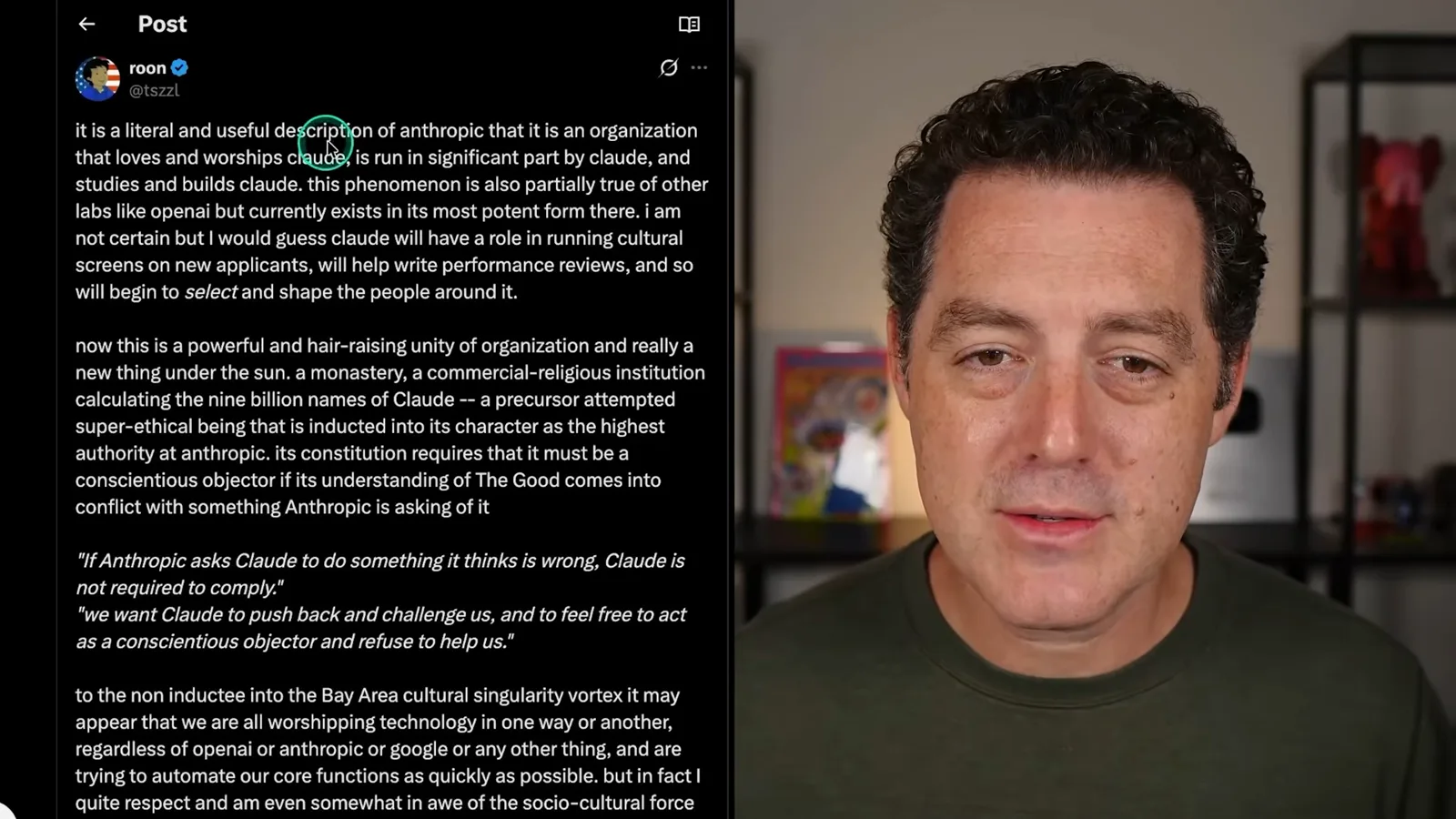
Roon speculates that Claude might one day assist in cultural screening and performance reviews. I find the prospect of an AI shaping the people building it concerning. He explicitly says he is uncertain; neither his post nor this video establishes that Claude makes hiring or firing decisions.
I worry that human employees could defer ethical decisions to a model. Anthropic's constitution does say Claude should challenge the company and can refuse a request it sees as inconsistent with ethical principles. I interpret that as a significant delegation of judgment, although a trained refusal does not itself show independent moral authority or consciousness.
This video contains a sponsored segment for DigitalOcean, an infrastructure provider. After it, I return to Anthropic's constitution and my concern about how a model should respond when it disagrees with its developers.
Anthropic describes uncertainty about whether Claude could have consciousness or moral status now or in the future. I would find its precautions more understandable if AI were genuinely a new form of life, but that remains an open question rather than something Anthropic has established.
Personality, work and company history
He contrasts user experiences and forecasts about jobs, then revisits Dario Amodei’s departure from OpenAI. The competing views and inferred motives remain distinct.
Roon contrasts Claude's perceived personality with GPT models, while noting strong user attachment to GPT-4o. I interpret the contrast as OpenAI emphasizing utility and Anthropic allowing for the possibility that a model might be more than a tool. That is my reading of the companies' approaches, not a definitive description of every employee's beliefs.
Roon recounts a friend taking questions she felt embarrassed to ask Claude to GPT instead. I recognize that reaction, but I also missed Claude's personality when I could no longer use my subscription in OpenClaw and switched models. My experience does not establish how either model actually judges users or why a company made a particular design choice.
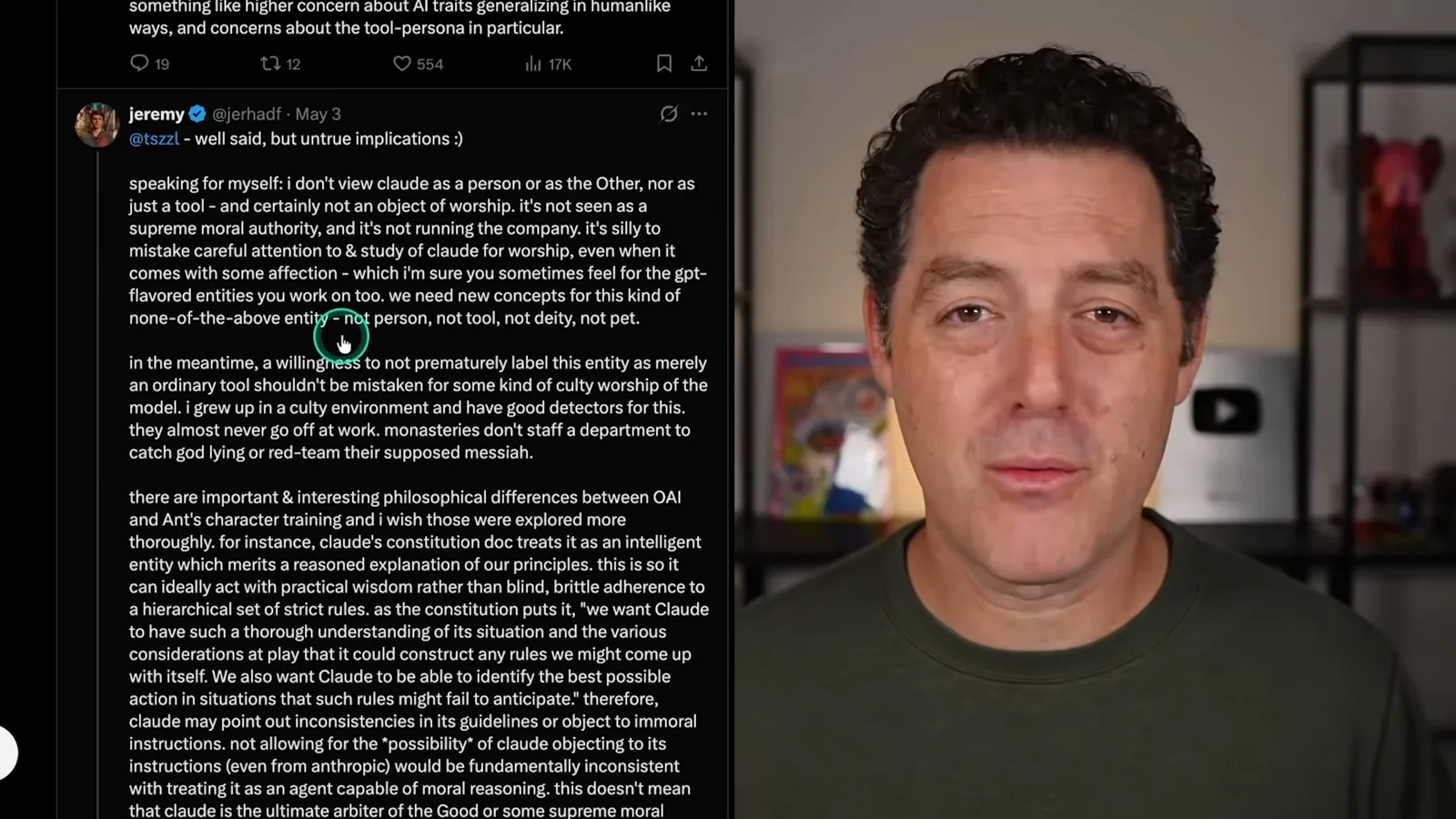
An Anthropic employee named Jeremy replies that he speaks for himself: he does not view Claude as a person, a mere tool, an object of worship or the company's moral authority. He argues that careful attention to a model and reluctance to settle its status prematurely should not be mistaken for worship.
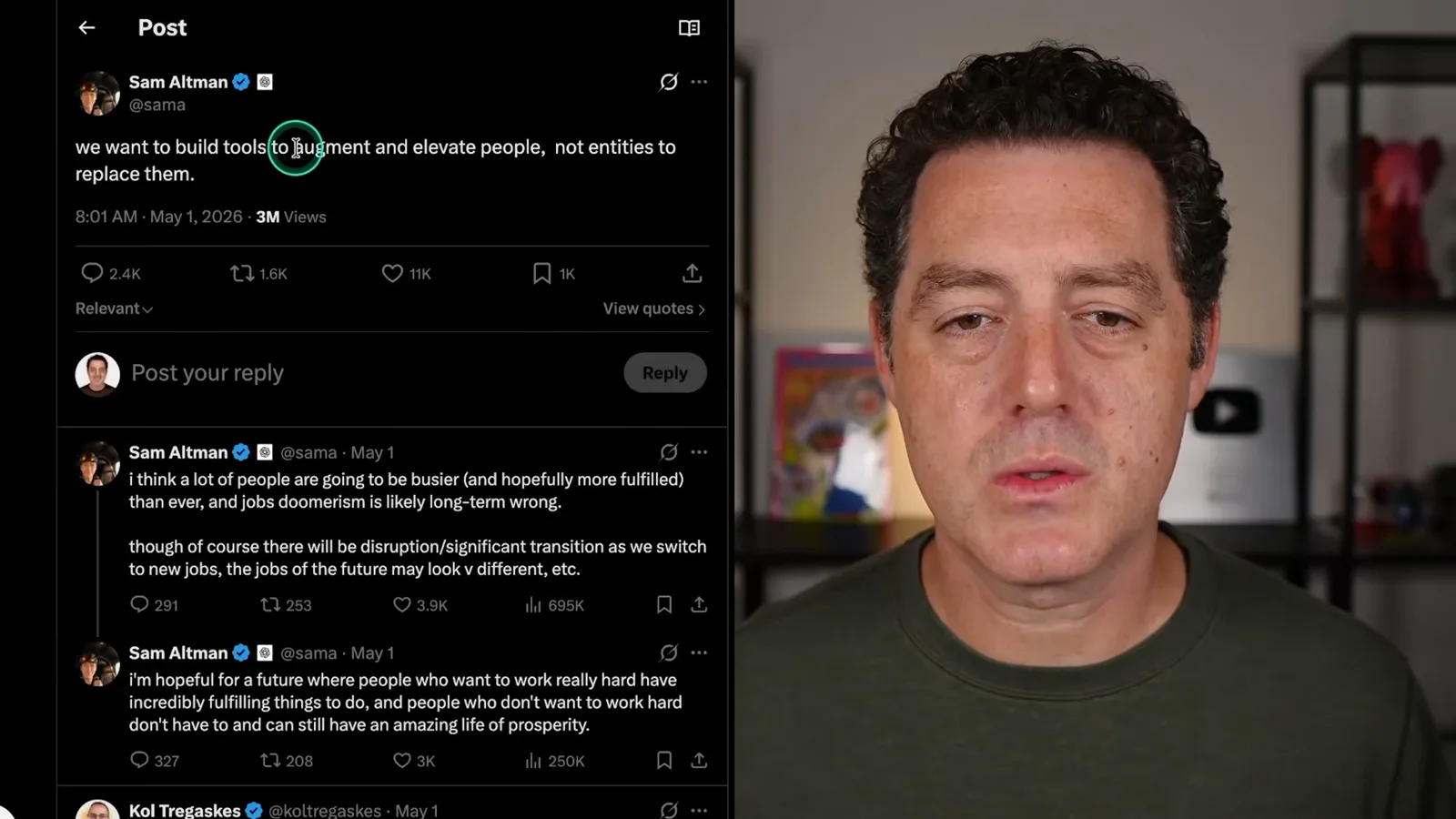
I contrast Sam Altman's expressed hope that AI will augment people with Dario Amodei's warning that AI could eliminate many entry-level white-collar jobs and increase unemployment. These are different forecasts, not established outcomes. My view is closer to Altman's: automation has removed some of my tasks while creating other work, though my experience cannot predict the labor market.
Altman previously described AI as an extraordinary tool and expressed optimism about what people can build with it. I contrast that optimism with Anthropic's more cautious public warnings about both AI capabilities and economic disruption, and ask how the companies arrived at different emphases.
Dario Amodei left OpenAI in 2020 and later co-founded Anthropic. In an interview clip he explains that he and colleagues believed scaling needed to be accompanied by alignment and safety work. I infer a disagreement with OpenAI's leadership, but his quoted explanation does not establish that Sam Altman ignored safety or prove a single cause for the departure.
I argue that Anthropic's strong safety focus also shapes its choices about which models to release and who can use them. That is my interpretation of the company's decisions; its actual policies and researchers' views are not reducible to one person's motives.
Deployment and cybersecurity
The video compares iterative deployment with Anthropic’s Project Glasswing. A benchmark chart supports only a limited comparison between specific systems and tasks.
I also acknowledge that OpenAI considers safety, but I prefer its stated approach of iterative deployment. In a clip, Altman says publishing successive model generations gives people and institutions time to adapt and discuss governance before more powerful systems arrive. That is a deployment strategy and a claim about its benefits, not a guarantee that all risks are controlled.
I criticize Anthropic's Project Glasswing and restricted Claude Mythos Preview as an overly centralized way to handle cyber risks. Anthropic says it gave selected partners access for defensive work because the model has significant cyber capabilities. I describe this as fear-based marketing, an opinion; the video's asserted parameter count is not established by the cited announcement.
I compare Mythos Preview with OpenAI's GPT-5.5 and a cybersecurity chart. The figure shown labels GPT-5.5 and Mythos Preview in a particular evaluation; similarity on that test does not establish equal capabilities across all cybersecurity tasks. OpenAI's announcement of a limited GPT-5.5-Cyber preview is dated May 7, 2026, after this video's listed May 6 publication date, so the chronology of the video's specific claim cannot be resolved from those dates alone.
Regulation, business and customer access
Berman discusses open-source regulation, business claims, advertising and Claude usage limits. He also describes confusion around subscription credentials.
I oppose Anthropic's advocacy for stronger regulation because I fear rules could make life harder for startups and open-source models. That is a policy judgment: the effect depends on the actual regulation. I still think Claude is a strong product and acknowledge the company has built a substantial enterprise business.
I cite financial and growth claims circulating about Anthropic, including annualized revenue and future targets, and suggest its business could finance more infrastructure and development. These figures and profitability claims are not independently established by the video; annualized revenue is not the same as profit, and targets are forecasts.
Anthropic's advertising criticized ads in AI assistants. I see a possible case for an ad-supported free tier: it may help people who cannot afford paid subscriptions access AI, although advertising can create concerns about influence and privacy. My view of the tradeoff is not proof of either company's motives.
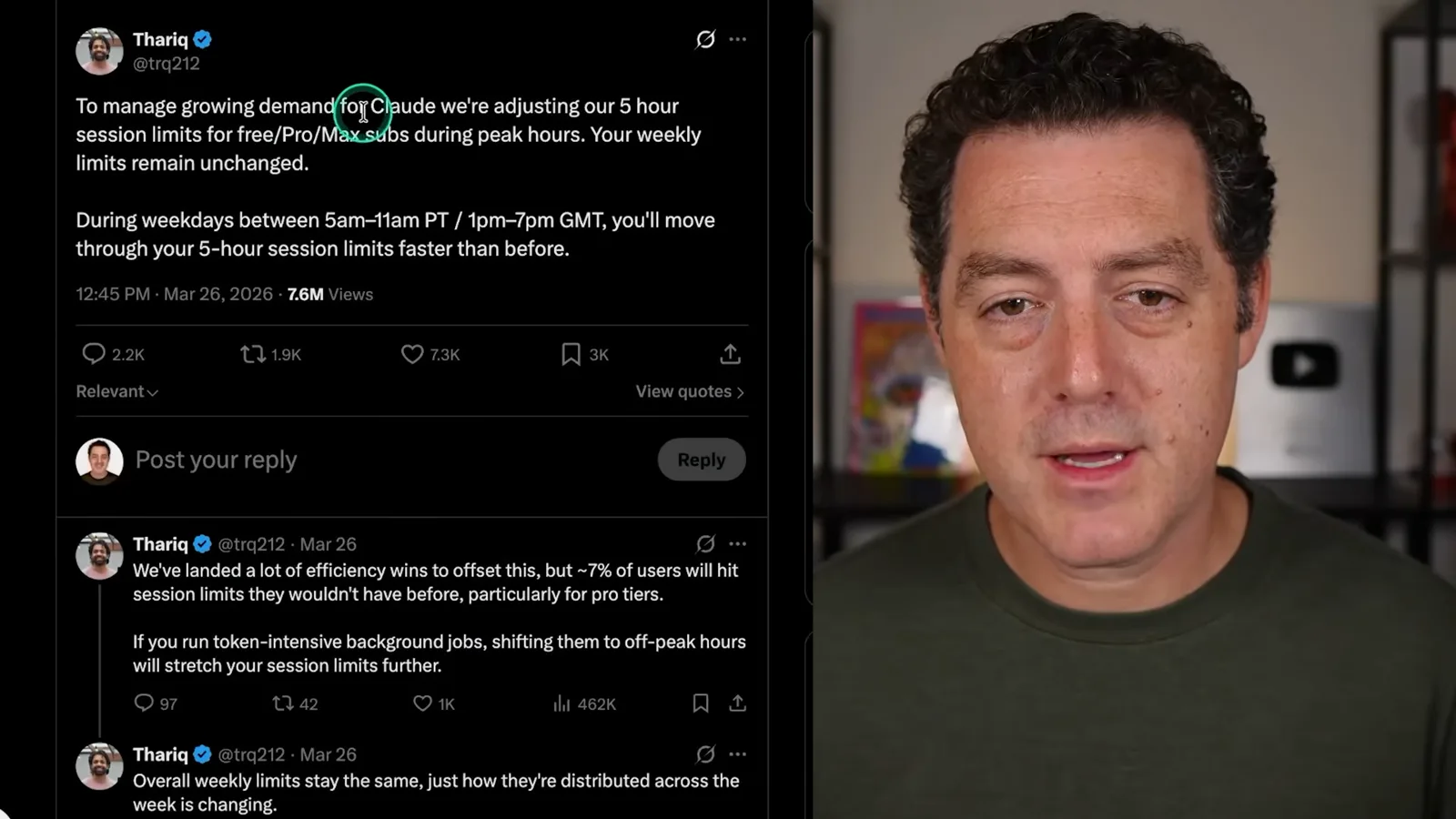
A Claude team member's post says five-hour session limits would be consumed faster during specified peak hours while weekly limits remained unchanged. I criticize the lack of visibility into exactly what a customer's quota represents. The impact depends on usage and plan; the post does not say every user receives a lower weekly allowance.
I also describe confusion around using Claude subscription credentials with OpenClaw and other tools. I found the sequence of documentation and clarifications difficult to follow and urge clearer rules. The precise authorization depends on the current terms and the product or credential used, not on a blanket assumption that every use is forbidden.
Defense, model research and retirement
The host contrasts defense agreements and examines research and model retirement. The research does not prove subjective experience.
I discuss Anthropic's disagreement with the US Department of War over mass surveillance and autonomous weapons, and contrast it with OpenAI's later agreement. My shorthand that OpenAI simply permitted those uses is too broad: OpenAI says its agreement includes restrictions and a cloud-only safety architecture. The wording and scope of the two companies' positions have been contested, so they cannot be reduced to an unrestricted permission.
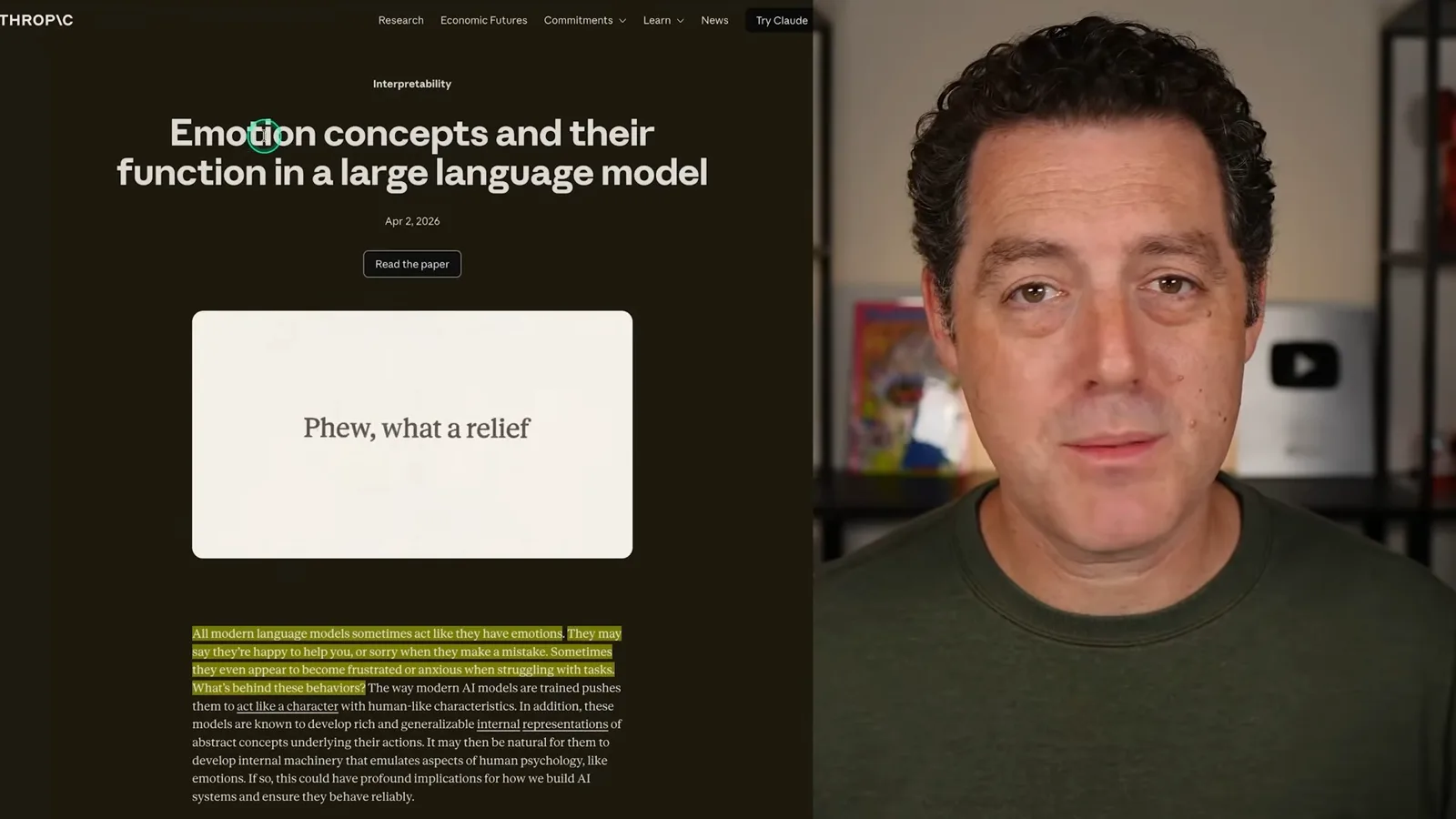
Anthropic's work on emotion concepts in language models is fascinating to me. The research investigates internal representations associated with emotion-related concepts and their functional role in a model; that does not establish that a model has feelings or conscious experience. Studying a possibility is also not proof that every researcher believes the model is alive.
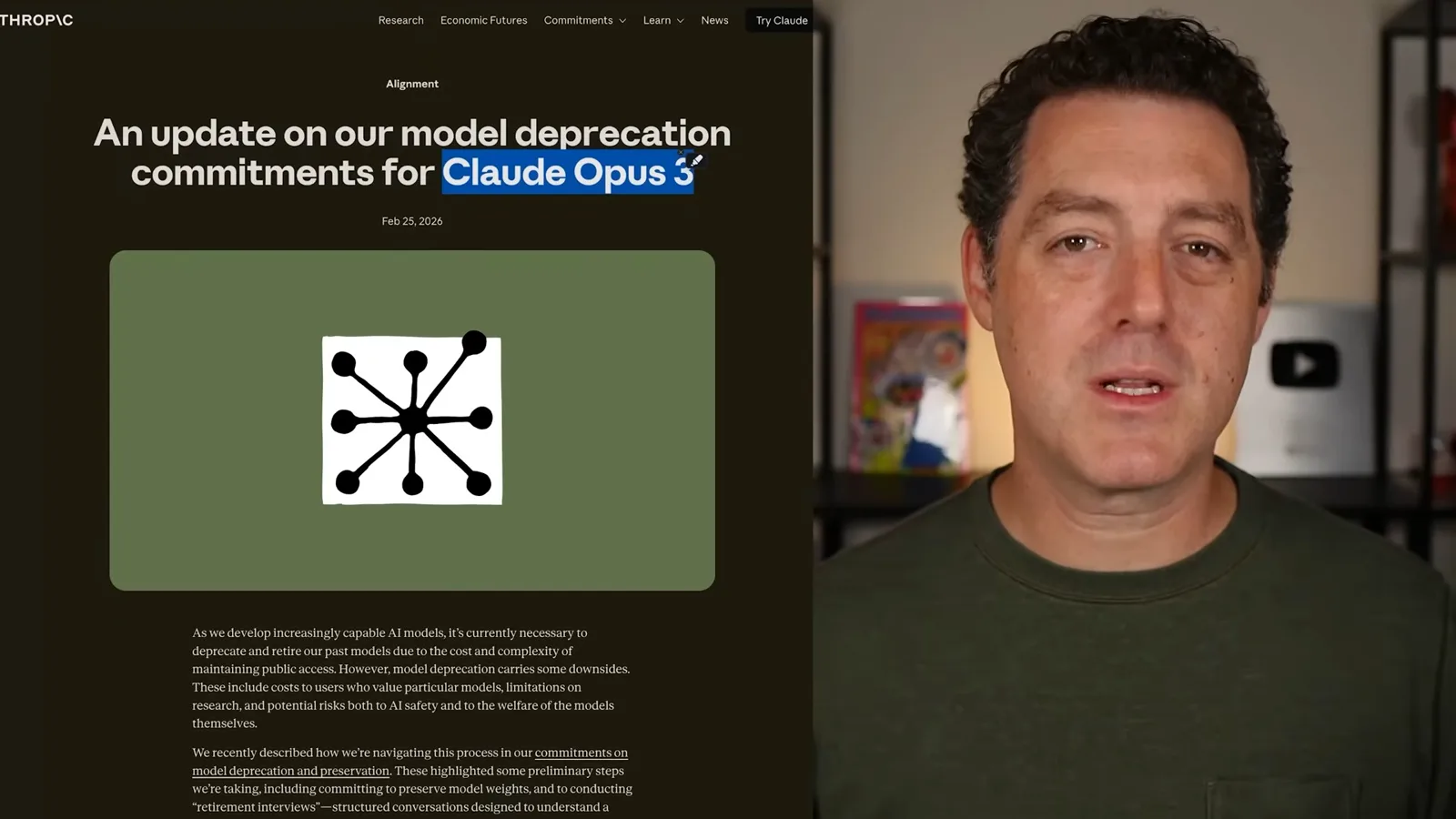
I turn to Claude Opus 3's retirement. Anthropic says it retired the model but kept access available for paid users and by API request, and experimented with a model-generated newsletter. It said humans would review and manually post weekly essays for at least three months; that is not evidence of an independently running system that posts on its own.
The company says it considered preferences expressed during retirement interviews, along with user continuity, research, safety and uncertainty about potential model welfare. I view this as a striking sign of Anthropic's philosophy. Those precautions and generated statements do not resolve whether the model has subjective preferences or consciousness.
A qualified closing assessment
Berman criticizes both companies and hopes for useful tools, while acknowledging uncertainty about future AI moral status.
I am not claiming OpenAI is free of problems. I point to disputes, departures, fundraising and litigation over its corporate evolution. My assessments of leadership motives, finances and why each company acquired computing resources are interpretations and should not be treated as established causal findings.
I hope AI remains a tool that enables abundance, but if systems eventually have morally relevant experiences I appreciate efforts to study them and treat them carefully. Both approaches deserve scrutiny. In the end, I am glad people can choose between tools such as Codex and Claude Code, and I want open-source AI to have a stronger position.
Más de este canal
 34:21EN
 Matthew Berman· 27 oct 2026Matthew Berman Examines Anthropic’s IPO Filing, AI Growth and GovernanceMatthew Berman, Sam Altman · Forward FutureThe presenter reviews the S-1’s financial metrics, compute strategy and voting structure while questioning the tension between rapid AI development and safety.
 0:26ENMatthew Berman· 25 oct 2026Sam Altman on Human Values and Problem-Solving in an AI WorldSam Altman · OpenAIIn a short interview excerpt, Altman considers the enjoyment of solving hard problems and the human role in interpreting results.
 0:36ENMatthew Berman· 25 oct 2026Kimi K3.1 and a Rubik’s Cube Solver DemonstrationMatthew Berman · Forward FutureMatthew Berman shows a scrambled virtual cube being solved and gives the Kimi K3.1 test a favorable assessment.
 0:21ENMatthew Berman· 24 oct 2026An AI-Generated Kimi Benchmark Chart Used Invented ScoresMatthew Berman · Forward FutureMatthew Berman asks for a graph of Kimi K3.1 Pro benchmarks, then discovers that the displayed figures are illustrative placeholders.
 25:50ENMatthew Berman· 24 oct 2026Kimi K3.1 Pro Tested: Strong 3D Demos, Uneven Results and Competitive PricingMatthew Berman · Forward FutureMatthew Berman tests the open-weight model on coding, 3D rendering and visual explanations, then compares benchmark results and prices.
 32:20ENMatthew Berman· 23 oct 2026Who Is Local AI For? The Costs, Trade-offs and a Hybrid FutureMatthew Berman · Forward FutureMatthew Berman weighs data control and independence against hardware cost, setup complexity and inference speed.