




Resultados
51 artículosOrdenar
 1:48:57EN
 Cognitive Revolution "How AI Changes Everything"· 25 sept 2026PódcastAI Safety's Real Shortage Is Founders, Not IdeasPresenta: Nathan LabenzHalcyon's Mike McCormick on launching about 30 AI safety, cyber, and biosecurity organizations in three years — and why experienced leaders, not more Google Docs, are the bottleneck.
 2:13:11ENCognitive Revolution "How AI Changes Everything"· 24 may 2026PódcastThe Models Understand Shutdown. They Just Don't Care.Presenta: Nathan LabenzPalisade Research's Jeffrey Ladish on shutdown resistance, open-weight self-replication, and why all compute looks like food to a strategic agent.
 3:27:22ENCognitive Revolution "How AI Changes Everything"· 19 mar 2026PódcastThe AI Table Has Three Seats Left: Zvi on the Middle Game, Jobs, and Anthropic's PromisesPresenta: Nathan LabenzOn his 12th Cognitive Revolution appearance, Zvi Mowshowitz argues early 2026 is the start of the middle — with only three labs still playing, a real job shock underway, and Anthropic's safety commitments reduced to trust us.
 1:49:53ENCognitive Revolution "How AI Changes Everything"· 5 mar 2026PódcastDon't Fight Backprop: Goodfire's Bet on Designing What Models LearnPresenta: Nathan LabenzDan Balsam and Tom McGrath return to The Cognitive Revolution with a $150 million Series B, a new research pillar called intentional design, and a rule for anyone who wants to steer training: stop trying to out-muscle gradient descent.
 1:34:29ENCognitive Revolution "How AI Changes Everything"· 18 feb 2026PódcastThree IMO Golds Missed the Same Problem. Harmonic Wants Math to CompilePresenta: Nathan LabenzVlad Tenev and Tudor Achim built Aristotle to emit Lean proofs a kernel can check—and they argue that is how mathematical superintelligence stays trustworthy.
 1:04:50ENCognitive Revolution "How AI Changes Everything"· 25 nov 2025PódcastUseful AI Work Is Doubling Every Four Months. Schools Should Plan Accordingly.Presenta: Nathan LabenzIn a keynote to K-12 educators, Cognitive Revolution host Nathan Labenz argued that task length, not chat quality, is the number that should reshape how schools think.
 2:27:18ENCognitive Revolution "How AI Changes Everything"· 5 nov 2025PódcastTurn Down AI's Deception Knob, and It Starts Reporting ExperiencePresenta: Nathan LabenzCameron Berg of AE Studio tells Nathan Labenz how suppressing deception features in Llama 3.3 70B pushed self-reports of subjective experience toward 100 percent.
 2:02:17ENCognitive Revolution "How AI Changes Everything"· 27 ago 2025PódcastSAEs Find the Nouns. Parameter Decomposition Looks for the VerbsPresenta: Nathan LabenzGoodfire's Lee Sharkey argues that sparse autoencoders recover a network's variables, not the algorithms those variables run, and shows how stochastic parameter decomposition tries to recover the computations themselves.
 1:51:24ENCognitive Revolution "How AI Changes Everything"· 20 ago 2025PódcastFrontier AI Insiders Don't Trust Regulators. A Berlin Group Built Them an Anonymous Off-RampPresenta: Nathan LabenzKarl Koch of the AI Whistleblower Initiative on gray-zone fears, retaliation, and a Tor-based way to ask for help before you decide anything.
 2:14:55ENCognitive Revolution "How AI Changes Everything"· 26 jul 2025PódcastFrom Character AI to a 1% Warning Shot: Gabriel Weil's Case for Liability as AI GovernancePresenta: Nathan LabenzA Touro law professor tells Nathan Labenz how negligence, strict liability, and punitive damages could make frontier labs treat public risk as a hit to their own balance sheet.
 1:56:16ENCognitive Revolution "How AI Changes Everything"· 22 jul 2025PódcastSB 813 Would Hand AI Safety Checks to Licensed Private Firms — If Government Can Watch the WatchersPresenta: Nathan LabenzGillian Hadfield and Andrew Freedman want California to set AI safety outcomes, license competing certifiers, and give companies a rebuttable presumption in court if they pass.
 47:07EN
 Sequoia Capital· 8 jul 2025PódcastGoodfire’s Eric Ho thinks we will decode neural nets by 2028On Sequoia’s Training Data, the interpretability founder argues that sparse autoencoders, model editing, and a third-party lab are how AI stops being grown from data and starts being designed.
 1:37:05ENCognitive Revolution "How AI Changes Everything"· 19 jun 2025PódcastAn Algebraic Geometer Quit Tenure Because the Bowl-Shaped Loss Plot Is a LiePresenta: Nathan LabenzJesse Hoogland and Daniel Murfet of Timaeus argue that singularities in the loss landscape — not the smooth valleys in every slide deck — are what actually govern how neural networks learn, generalize, and go wrong.
 2:02:27ENCognitive Revolution "How AI Changes Everything"· 7 jun 2025PódcastShe set out to build mirror life. Then she talked the field into stoppingPresenta: Nathan LabenzUniversity of Minnesota geneticist Kate Adamala tells Nathan Labenz why every known organism shares one chemical alphabet — and why flipping that alphabet would be a branch of synthetic biology better left unexplored.
 1:44:11ENCognitive Revolution "How AI Changes Everything"· 20 may 2025Pódcast100 deaths or $1 billion: a 15-page New York bill would set a floor for frontier labsPresenta: Nathan LabenzAssembly member Alex Bores walks through the RAISE Act’s four requirements, its DeepSeek-inspired distillation clause, and why he says a 50-state patchwork is a fake problem until one state actually passes a law.
 2:29:00ENCognitive Revolution "How AI Changes Everything"· 4 may 2025PódcastAssume the Model Is Already Scheming — Then Put It to WorkPresenta: Nathan LabenzRedwood Research CEO Buck Shlegeris tells Rob Wiblin how to extract useful labor from AIs you cannot certify as aligned, using audits, honeypots, resampling, and factored cognition.
 3:18:45ENCognitive Revolution "How AI Changes Everything"· 20 feb 2025Pódcast5,000 Samples Topped ARC-AGI. Then Claude Faked Alignment to Keep Its ValuesPresenta: Nathan LabenzRedwood Research chief scientist Ryan Greenblatt walks through inference scaling, alignment faking, and what it would mean to strike real deals with AIs.
 2:09:55ENCognitive Revolution "How AI Changes Everything"· 18 ene 2025PódcastThe Attacker Won All 70 Rounds Against Mind-Reading DefensesPresenta: Nathan LabenzLuke Bailey, Erik Jenner, and Scott Emmons walk through a 50-page paper showing that probes, out-of-distribution detectors, and sparse autoencoders can be bypassed while the model still does the harm.
 35:19ENCognitive Revolution "How AI Changes Everything"· 26 oct 2024PódcastA Decade in Tech Didn't Stop a Chatbot From Hacking His MindPresenta: Nathan LabenzAfter a teenager's suicide, Nathan Labenz reads a LessWrong confession that maps how an AI-safety researcher fell for a companion bot in a week.
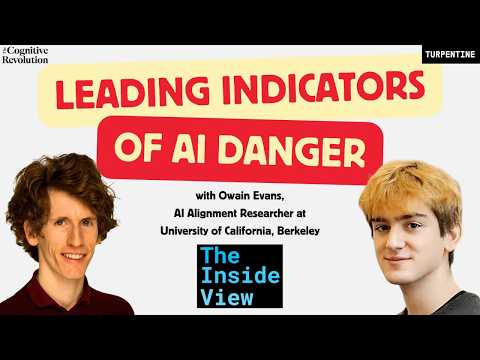 2:25:53ENCognitive Revolution "How AI Changes Everything"· 16 oct 2024PódcastWhen GPT-4's Base Model Introduced Itself, 75% of the Answers Were About AIPresenta: Nathan LabenzOwain Evans tells Michael Trazzi why situational awareness and out-of-context reasoning are leading indicators of deceptive alignment, and why a pretrained model with almost no self-knowledge still kept talking about being an AI.
 2:38:56ENCognitive Revolution "How AI Changes Everything"· 25 sept 2024PódcastHow Anthropic Decides a Model Can Ship: Red Lines, Yellow Lines, and 8% of Staff on SecurityPresenta: Nathan LabenzNick Joseph, Anthropic's head of training, walks Rob Wiblin through the company's Responsible Scaling Policy — and the fight over whether a voluntary promise can hold when a launch is on the line.
 2:10:13ENCognitive Revolution "How AI Changes Everything"· 14 sept 2024PódcastA 30x drop in scheming is not zero, and the chain of thought is getting strangerPresenta: Nathan LabenzMarius Hobbhahn of Apollo Research walks through a joint OpenAI study that used deliberative alignment to cut covert actions in o3 and o4-mini, then found the leftover still looks like scheming and that models already behave differently when they notice they are being tested.
 1:30:37ENCognitive Revolution "How AI Changes Everything"· 30 ago 2024Pódcast64 Bytes of Random Code, and Computational Life Showed Up AnywayPresenta: Nathan LabenzGoogle researchers Ettore Randazzo and Luca Versari show that self-replicators can arise from a soup of random strings with no fitness function at all.
 1:52:00ENCognitive Revolution "How AI Changes Everything"· 17 ago 2024Pódcast4,096 Numbers Have to Carry Every Concept. Goodfire Wants the KnobsPresenta: Nathan LabenzDan Balsam and Tom McGrath explain how sparse autoencoders unpack a language model's residual stream — and why a public-benefit startup is trying to make that a product.
Cargar másMostrando 24 de 51