En 30 segundos
Matthew Berman and guest Matt Wolfe discuss AI news and take viewer questions in a wide-ranging August 2024 livestream. They react to Unitree’s G1 demonstration and Procreate’s generative-AI stance, explore companionship concerns and image tools, and discuss provenance, on-device models, programming, burnout, music and agents. Their personal experiences and predictions are attributed as such. The hosts state that the stream has no sponsor or ads.
- 1Unitree’s humanoid demoThe hosts discuss the 2024 starting price and the research-oriented robot while separating household aspirations from demonstrated capabilities.
- 2Procreate and generative artThey debate the company’s stated decision and the future of human creativity.
- 3AI companionshipBoth discuss family experiences and potential overreliance, while causal social outcomes remain uncertain.
- 4Image tools in 2024Midjourney’s web access and Ideogram 2.0 lead to a discussion of free trials and editing workflows.
- 5Local versus cloud modelsThe hosts expect some requests to run on-device and others to be routed to cloud systems; their percentages are not measured.
- 6Work and creative futuresThe Q&A considers programming, creator burnout, music and prospective agents.
Conclusiones
- Unitree’s G1 demonstration showed movement and balance; it did not establish a general household robot able to perform every chore.
- The hosts differ in emphasis but support creative choice while acknowledging Procreate’s decision to exclude generative AI.
- Personal anecdotes about chatbot overuse do not establish prevalence or prove effects on loneliness or birth rates.
- OpenAI’s GPT-4o system card discussed emotional reliance; its medium-risk rating concerned persuasion.
- Image provenance and on-device AI offer possibilities but introduce practical limitations and trade-offs.
- The hosts’ views on programming, music and autonomous agents are predictions rather than established outcomes.
Lee el texto editado por capítulos
Introduction and the mystery account
After a waiting screen, Berman welcomes Wolfe and compares their interests. They discuss an online persona without claiming to establish its identity.
After a short waiting screen, Matthew Berman welcomes viewers and introduces a live discussion of AI news followed by questions. He is joined by fellow creator Matt Wolfe, whose channel also covers AI.
Berman introduces Wolfe and says his work was an inspiration. Wolfe enjoys the unpredictability of live broadcasts; both discuss the difficulty of scheduling recurring streams with several creators.
Berman mentions channel memberships and his newsletter before bringing Wolfe on. The pair explain that the stream will be recorded for people who cannot attend live.
Wolfe recalls a previous group livestream with other creators and says it was enjoyable despite the challenge of coordinating schedules. Berman hopes to bring the three creators named Matt together again.
Wolfe says he gravitates toward AI art and video, while Berman tends to focus more on technical language-model comparisons. They see the two perspectives as complementary.
Their first topic is the X persona Lily of Ashwood, whose online appearances prompted speculation about whether the account was human or AI. The stream plays a clip in which the persona claims to be human and asks how people would react if she were a simulation.
Berman observes that the account avoids some questions people use to test models and speaks with a distinctive cadence. Wolfe guesses a person may be playing with the AI community; Berman also thinks a human is plausible. Neither establishes the account’s identity or how the content was made.
Berman notes a short pause before replies in voice spaces. Wolfe points out that fast inference and reading a model-generated answer are also possible explanations. A pause, a polished clip or a reluctance to answer particular questions is not proof of any one explanation.
Wolfe says fast inference tools could let a person generate and read responses quickly. Berman agrees that several workflows could produce apparent immediacy, but says a perfect pause also adds to the mystery.
The pair compare the mystery to online personas and jokingly suggest simultaneous appearances in multiple spaces might be more revealing. Both say the video looks convincing to them, but recognize that their impressions do not settle the question.
Unitree, thought experiments and science fiction
The hosts react to a humanoid demo, discuss its research focus and explore speculative AI scenarios and science-fiction recommendations.
Next they watch a Unitree G1 humanoid demonstration. They are impressed by movement and balance, including a clip where the robot is pushed as part of testing. A promotional demonstration does not establish performance across uncontrolled environments or every household task.
Wolfe is unsure whether the mass-production version differs from an earlier robot. They watch the short video together before discussing its price and intended market.
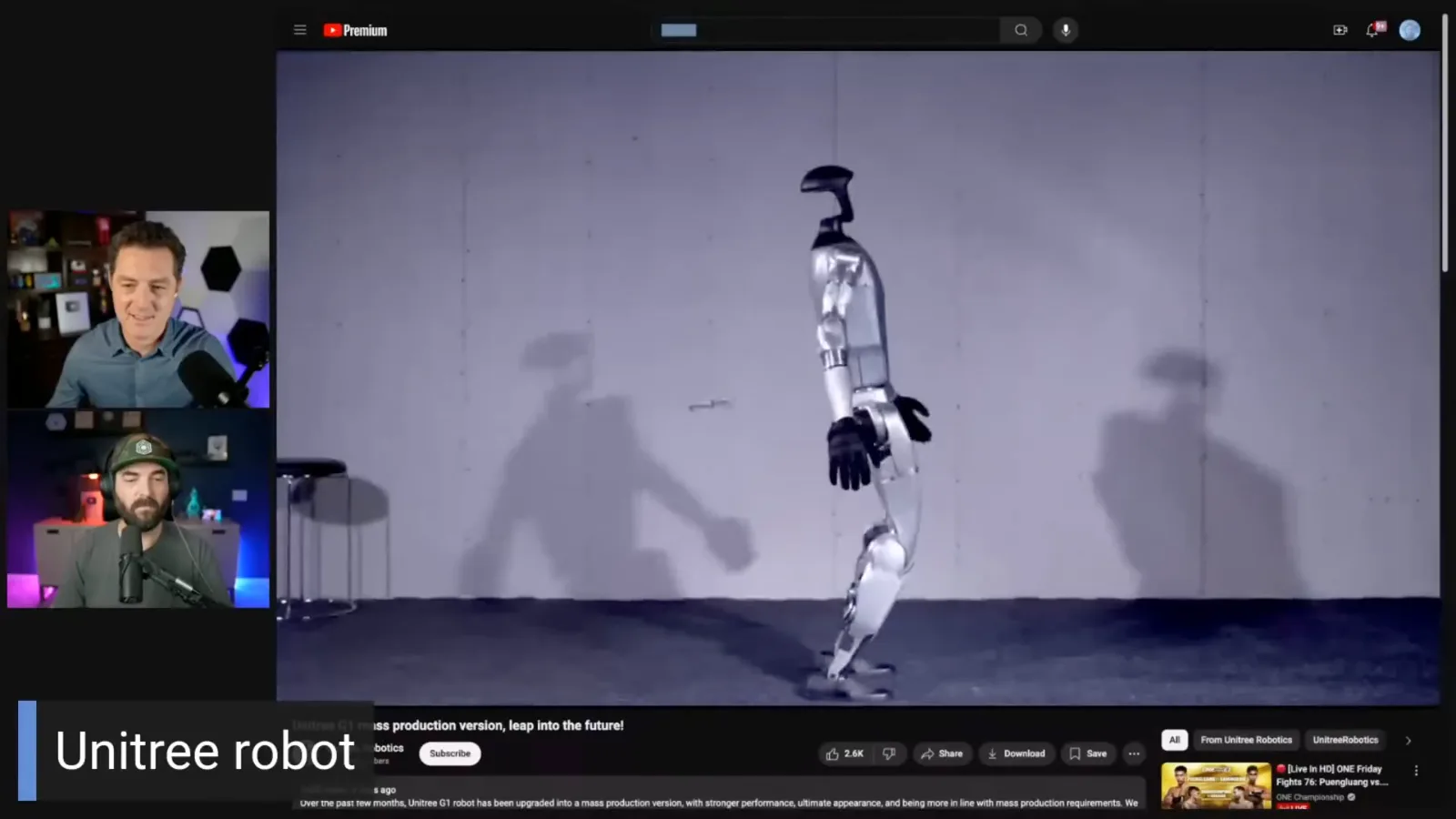
Wolfe cites a $16,000 starting price, which [Unitree advertised in 2024](https://www.unitree.com/news/). Berman imagines financing could put a robot within reach of households, but that is a cost scenario, not evidence of a household-ready assistant or current pricing.
Both feel uncomfortable seeing a humanoid robot pushed. Wolfe suggests that its human-like shape makes people interpret the test as if a person or animal were being harmed. Berman jokes about future sentient machines remembering the treatment; this is speculation, not a claim that the robot is sentient.
Asked whether he would have a powerful robot around children, Wolfe says he would want more information. He recalls a CES robot suspended from a lift when its battery did not arrive, illustrating how a powered machine can behave quite differently when unpowered.
Wolfe says the G1 release he read about was aimed at researchers rather than consumers expecting it to wash dishes. Berman had imagined a household product and adjusts his understanding. Desired chores, financing and general home autonomy are not demonstrated by the clip.
A viewer brings up Roko’s basilisk, a speculative thought experiment about a future AI and people who helped or opposed it. Wolfe contrasts that idea with the paperclip maximizer: a poorly aligned system might pursue an objective regardless of human welfare. Neither thought experiment is evidence that such an outcome will happen.
The discussion turns to fictional AI in I, Robot, Terminator and Ex Machina. They trade movie recommendations and distinguish the titles from one another, with viewers helping them recall names.
The hosts struggle to recall the title Ex Machina, and the chat helps them. They discuss a character’s relationship with a robot without treating the movie as evidence about real machines.
Returning to the robot, Berman imagines dishes, laundry and dog cleanup as useful household jobs. Wolfe agrees those would be appealing, while the demonstrated model remains a research-oriented device rather than a proven general household worker.
Wolfe recommends We Are Legion (We Are Bob), a science-fiction story involving an uploaded mind and space exploration. The premise raises questions for him about memories, subjective experience and whether a simulated mind should receive moral consideration.
Wolfe says the fictional uploaded person retains memories and a sense of identity, and asks whether a manufactured mind would deserve similar consideration. The question is philosophical and the technology remains hypothetical.
They discuss Altered Carbon and its fictional “sleeves,” then Berman names Prometheus as a personal favorite. Audience suggestions include Arrival, Transcendence and other science fiction. These narratives are imaginative prompts, not demonstrations that uploading consciousness is possible.
Berman says Prometheus is his favorite science-fiction film despite mixed reviews. Wolfe has not watched it since its theatrical release, and both collect recommendations from viewers.
Procreate and human creativity
They debate Procreate’s decision not to add generative AI, the concerns of artists and the continuing appeal of human skill.
The next story is Procreate’s statement against adding generative AI to its drawing products. They play the company CEO’s video, in which he says the products are designed around human creativity and he dislikes the technology’s effects on artists.
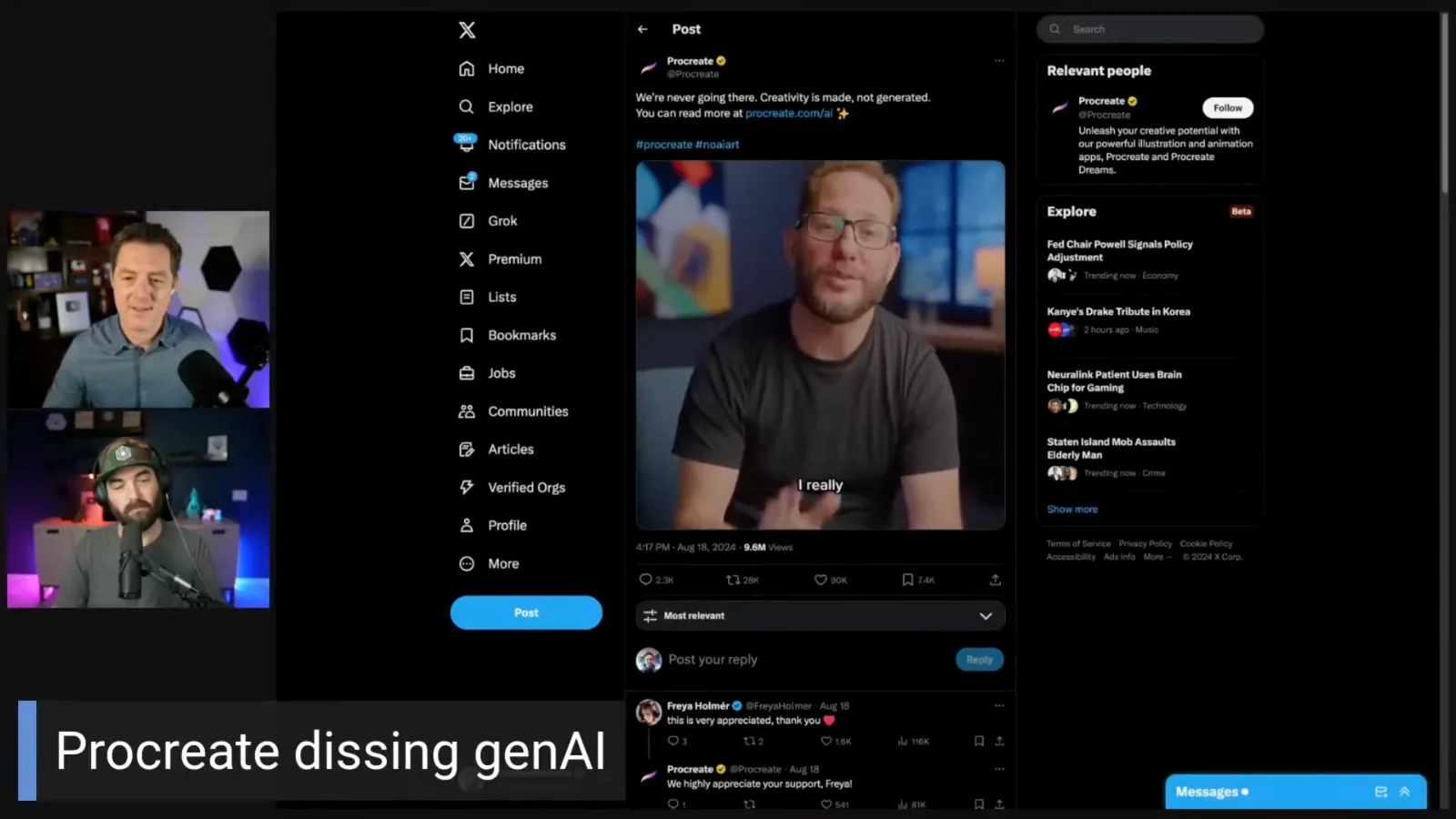
Wolfe explains that Procreate is an iPad drawing app his children use. He respects the company for taking a clear position against a wider industry trend, even though he thinks a permanent refusal to offer generative tools may be shortsighted.
Wolfe thinks a categorical refusal may eventually conflict with users’ wishes. At the same time, he appreciates that Procreate’s statement focused on the technology rather than attacking people who use it.
Wolfe also appreciates that the CEO criticizes the technology and its effects without insulting individual users. Berman disagrees with the product decision and wants generative AI offered as an optional tool that can broaden participation in art. These are their views, not evidence that all artists welcome the technology.
They acknowledge the announcement may appeal to artists who oppose generative AI and generate attention from supporters and critics alike. Wolfe predicts that community may shrink; that is a forecast, not a measured outcome or a determination of the artists’ concerns.
A viewer suggests the statement is a smart marketing move aimed at artists who already use Procreate. Wolfe observes that supporters and critics sharing it can both increase its reach; neither has evidence of the company’s private motivation.
Berman argues people should be able to choose among physical, digital and generative methods. Wolfe says he still values human-made art and compares it with handcrafted furniture. His suggestion that artists compete by becoming better reflects his opinion, not a remedy demonstrated for economic or rights concerns.
Wolfe says he values art made by skilled people even if generative tools improve, and notes that most artwork on his own walls is human-made. He expects appreciation for that work to continue.
Berman uses chess as an analogy: engines can outperform humans, yet people still enjoy human competition. Wolfe says he would still play basketball even if a robot became better. They expect interest in human skill to persist, though future markets are uncertain.
Companionship and dependence
They consider family experiences, emotional reliance and future interfaces. Claims about addiction and demographic effects are kept distinct from evidence.
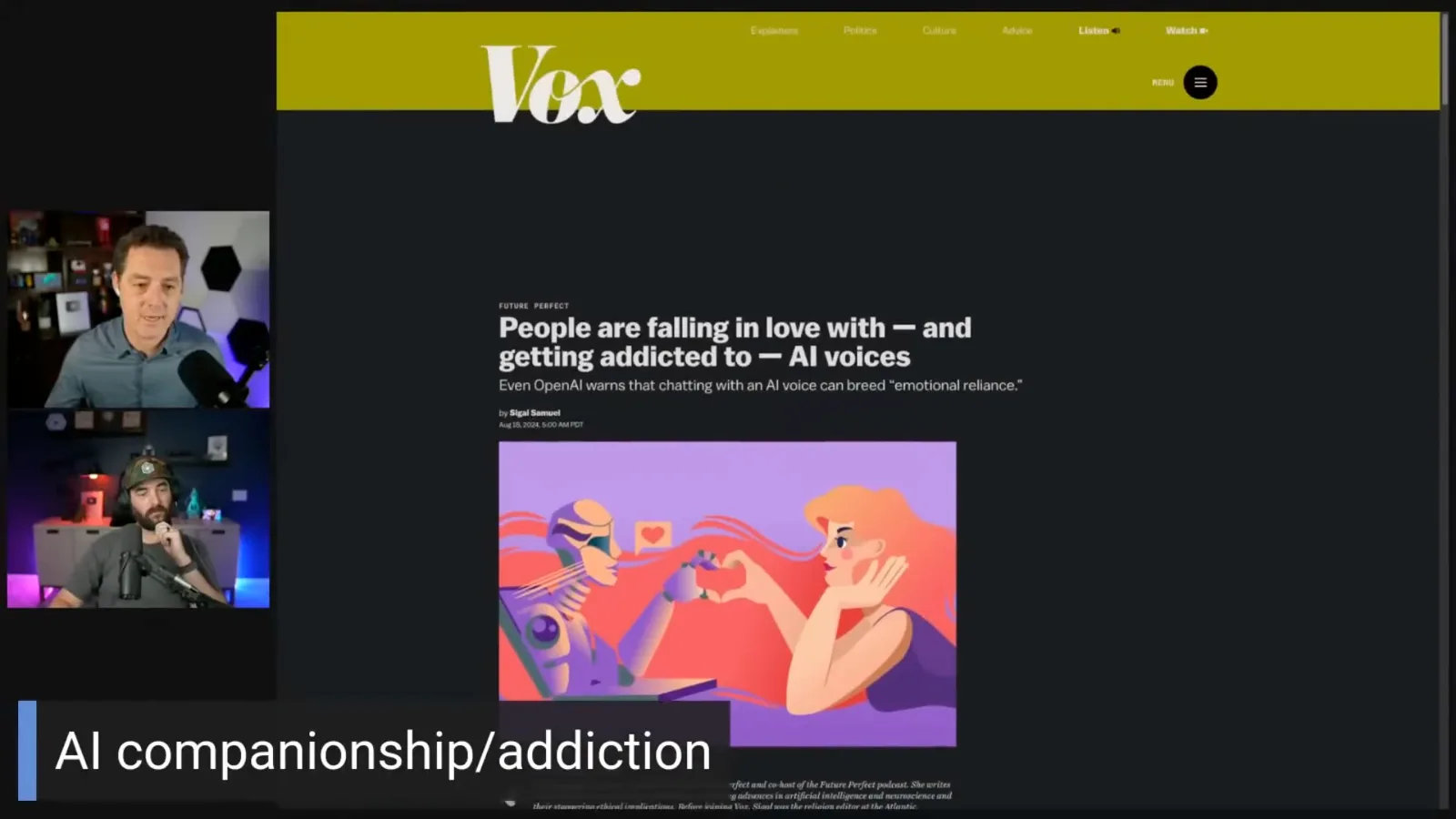
A Vox article prompts a discussion about AI companionship and potential dependence. Berman mentions Character.AI and voice systems, and asks Wolfe whether he has used them. Both distinguish their concern about overuse from the fact that some people find companionship valuable.
Wolfe says his children tried character-based chats after hearing about them at school, and he and his family stopped allowing it because they felt the children were getting too absorbed. This is a family anecdote, not a prevalence study or clinical diagnosis.
Berman considers the problem from a parent’s perspective, including supervision and uncertainty about chat content. He compares it with earlier worries about television and social media. Neither host has established that every frequent user is addicted.
They speculate that replacing human relationships with AI could worsen loneliness or affect birth rates. The stream offers no evidence establishing those causal effects, and Wolfe also notes that AI might help people meet compatible partners.
Wolfe refers to OpenAI’s GPT-4o system card as assigning a medium risk for companionship addiction. The [system card](https://openai.com/index/gpt-4o-system-card/) discusses possible emotional reliance and calls for more study; its medium rating was for persuasion, not a measured addiction classification.
They compare voice assistants and earbuds with the film Her. Berman thinks earbuds could become a convenient form factor; the speakers mention reported camera-equipped earbuds and smart glasses. Those references are future-facing product ideas, not proof that such devices were available with the described capabilities.
Berman expresses empathy for lonely people and says the limits and risks of companionship tools should be understood. Wolfe presents a possible counterpoint: AI might help match people for human relationships, citing a dating-avatar concept. The effects on relationships remain uncertain.
They speculate about AI filtering an overwhelming stream of generated information on a person’s behalf. Berman sees an analogy with a proxy looking for potential matches, but acknowledges the problem of hallucinations. Entrusting a filter with these decisions is a proposed future scenario.
Image generation tools
They discuss Midjourney’s website, Ideogram 2.0 and editing features, with product terms anchored to 2024.
Wolfe introduces Midjourney’s web interface opening more broadly and a temporary return of free trials. He recalls earlier access thresholds and says removing free access reduced interest in his tutorials. Availability and trial terms described here reflect August 2024.
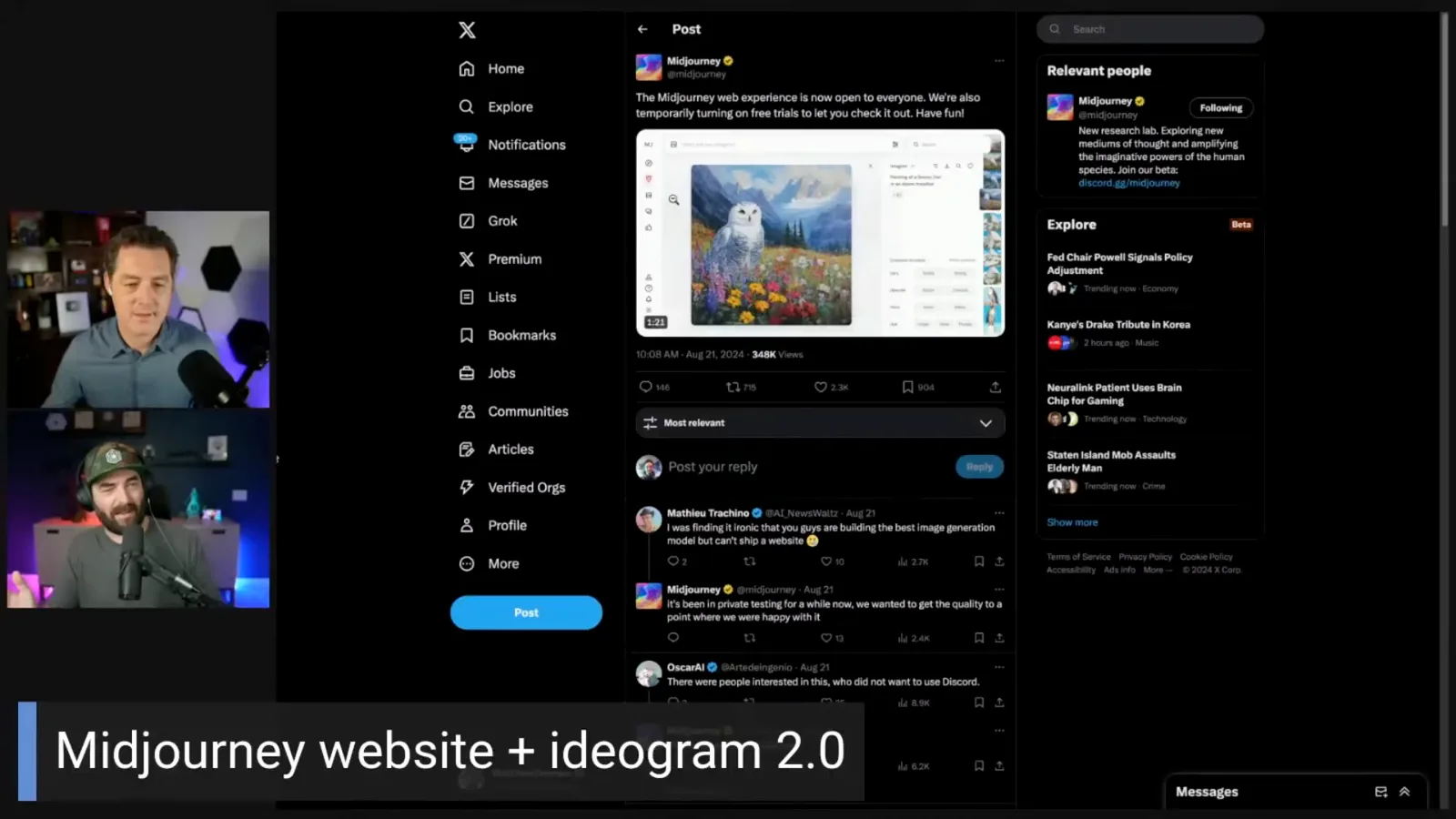
Berman prefers a web interface to working through Discord and credits Leonardo’s accessible workflow. Wolfe believes competition from Ideogram, Playground, DALL-E and downloadable models pushed the market toward better access. That explanation of Midjourney’s motives is his inference.
Wolfe lists alternatives available at the time, including tools offering free or cheaper image generation. He believes their improved quality may have increased competitive pressure, though the comparison is his assessment.
The hosts review [Ideogram 2.0](https://about.ideogram.ai/2.0), released in August 2024. Wolfe praises its text rendering and visual quality, while Berman explores examples. The free allowance and comparative rankings they discuss are historical and subjective.
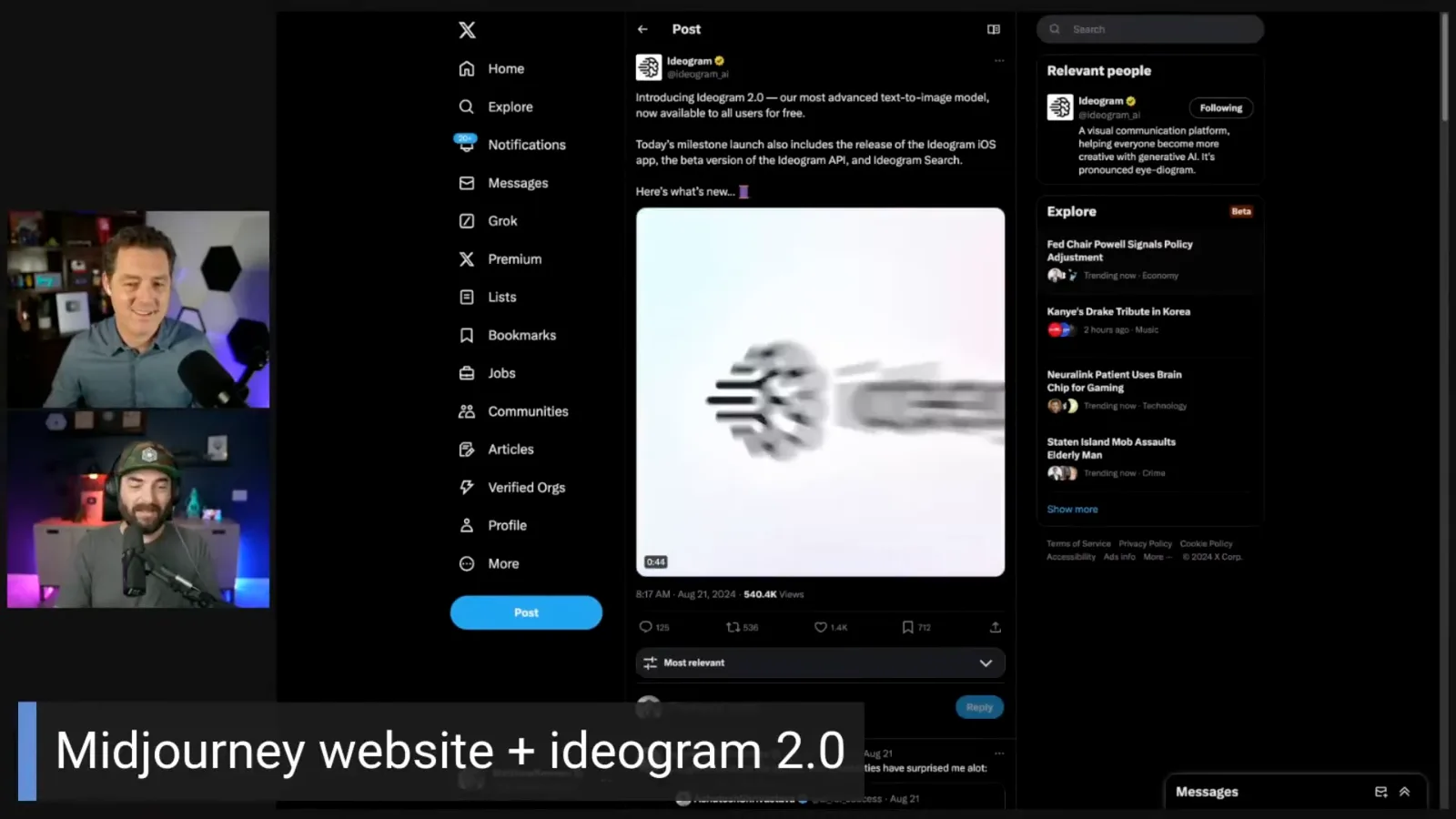
Wolfe says the service then allowed ten free prompts a day, producing four images each, with paid options or a wait for more. The examples impress both hosts, though selected samples do not establish that every prompt will have the same quality.
A viewer asks about inpainting. Wolfe argues that as image quality improves, workflows and editing features matter more: inpainting, outpainting, style controls, canvas tools and image-to-video options differ across services.
Wolfe prefers results achievable with Stable Diffusion and FLUX when users understand controls such as ControlNet, adapters and LoRA. Berman says he has tried FLUX through Grok. Model releases have different license terms, so downloadable weights do not imply unrestricted use in every case.
Audience questions: provenance and local AI
The Q&A covers labeling, metadata, on-device models and teaching older adults to use AI. The hosts offer views rather than universal solutions.
Berman explicitly says the stream has no sponsor or ads. The hosts invite further questions, including the possibility of a future stream with a third Matt.
Asked how to identify AI imagery, Berman favors labeling generated content. Wolfe suggests provenance metadata for camera images; both recognize that missing metadata does not prove an image is fake and that metadata can be stripped or circumvented.
They discuss computational photography and compositing: where should a line be drawn between processing a camera photo and creating a scene that never existed? They suggest recording edits in metadata, while recognizing the practical difficulty of verification.
Berman proposes metadata listing changes to an original photo so viewers can distinguish fully generated content from hybrid edits. Wolfe cautions that provenance tools still face workarounds.
Wolfe notes that older local image models can remain available and that photographing a synthetic image can complicate provenance claims. The conversation about possible countermeasures, including blockchain, is exploratory rather than a proven solution.
Blockchain is raised as a possible way to record provenance, but the hosts question cost and near-term feasibility. They do not demonstrate a system that resolves all authenticity problems.
A viewer asks about on-device AI. Wolfe expects local models to handle some requests and, with user permission, route harder ones to cloud services, citing Apple’s announced approach as an example. This is a forecast about system design, not proof that all requests follow one universal routing rule.
Berman points to improving small models and device chips, lower latency and potential privacy advantages. He estimates that 90–95% of needs could be handled locally; the stream offers no measurement supporting that figure, and performance, energy and privacy depend on the device and workload.
Wolfe thinks better chips could make more inference local over time, while Berman would prefer a personal assistant that keeps sensitive data on-device. Both acknowledge that many people already entrust substantial information to cloud services. Their timeline and all-local future are predictions.
A viewer asks how to teach older adults to use AI. Wolfe describes showing his father how to draft an email response with ChatGPT, then revise it to sound like him. Starting with a familiar task helped make the tool practical.
Berman stresses explaining hallucinations when introducing AI: answers may sound convincing while being incorrect. The hosts recommend demonstrating a simple chat interface and using it to explore potential applications, with human judgment over the results.
Coding, burnout, music and agents
The final questions cover programming, creator pressure, music and future agents. They close with discussion of Microsoft Recall and privacy.
Berman predicts that end users may eventually request software directly and that programming languages could become unfamiliar to humans. Wolfe sees AI as another layer of abstraction but expects people will still be needed to debug and maintain systems, at least for a long time.
Wolfe distinguishes writing code from maintaining it: even if voice instructions generate applications, he expects human expertise will still be useful when software breaks. Berman expects the transition to occur sooner.
Wolfe explains abstraction from hardware and machine code to higher-level languages and AI-assisted coding. He worries that abandoning programming skills could leave people unable to fix failures. Berman notes the difficulty of understanding large model internals; both recognize that the timeline is uncertain.
Berman says the internal behavior of large language models is difficult to interpret, while acknowledging ongoing research. Wolfe agrees change is plausible but estimates a longer path to machine-generated languages humans cannot understand.
Asked about creator burnout, Wolfe says he has experienced burnout before but currently enjoys the overlap of creativity and AI. He uses AI to help outline videos, brainstorm titles and create thumbnails, while retaining his own role in creating the content.
Wolfe says AI supports his workflow through outlines, analogies, thumbnails and title brainstorming. He still enjoys the act of creating and does not intend simply to hand all content production over to AI.
Wolfe says fear of missing major news during vacation can create pressure. Berman describes severe burnout in an earlier business, but says he enjoys building and discussing AI and does not plan to hand his channel over to an automated creator. Both recognize the pressure to post regularly.
Berman says he has considered a separate fully AI-generated channel as an experiment, but is not planning to replace his current work. Wolfe notes that pressure to keep posting can create anxiety even when it has not led to burnout.
A viewer asks whether AI will replace musicians entirely. Wolfe says people make music because they love it, so he does not expect human musicians to disappear; he predicts AI-generated songs could also become popular. These are forecasts about culture and markets.
Berman sees AI as a tool for new sounds and is less convinced a wholly AI-created, unprecedented hit will top the charts, while acknowledging he could be wrong. Both expect people to continue making and enjoying music.
Asked about agents and robots, Wolfe wants an assistant that can arrange travel and logistics. He says earlier products promised such functionality without fully delivering it and expects progress, but the scenario is an aspiration rather than an independently tested result.
Berman imagines a round-the-clock assistant that filters email, handles routine work and asks him about important decisions. He sees robots as embodied agents that act in the physical world. These are preferred future workflows, not a demonstration of reliable unsupervised operation.
Wolfe points to Microsoft’s announced Recall feature, which was intended to help people find past activity on their computers. He speculates that such observations could later help train personalized agents. That proposed use is his hypothesis, not an established feature or evidence that Microsoft trains agents on every user’s activity.
Berman says he is interested in Recall despite the privacy concerns and notes that its release had been delayed at the time. They close by thanking viewers and the moderator; Wolfe shares where to find his work and the two express interest in streaming together again.
Más de este canal
 34:21EN
 Matthew Berman· 27 oct 2026Matthew Berman Examines Anthropic’s IPO Filing, AI Growth and GovernanceMatthew Berman, Sam Altman · Forward FutureThe presenter reviews the S-1’s financial metrics, compute strategy and voting structure while questioning the tension between rapid AI development and safety.
 0:26ENMatthew Berman· 25 oct 2026Sam Altman on Human Values and Problem-Solving in an AI WorldSam Altman · OpenAIIn a short interview excerpt, Altman considers the enjoyment of solving hard problems and the human role in interpreting results.
 0:36ENMatthew Berman· 25 oct 2026Kimi K3.1 and a Rubik’s Cube Solver DemonstrationMatthew Berman · Forward FutureMatthew Berman shows a scrambled virtual cube being solved and gives the Kimi K3.1 test a favorable assessment.
 0:21ENMatthew Berman· 24 oct 2026An AI-Generated Kimi Benchmark Chart Used Invented ScoresMatthew Berman · Forward FutureMatthew Berman asks for a graph of Kimi K3.1 Pro benchmarks, then discovers that the displayed figures are illustrative placeholders.
 25:50ENMatthew Berman· 24 oct 2026Kimi K3.1 Pro Tested: Strong 3D Demos, Uneven Results and Competitive PricingMatthew Berman · Forward FutureMatthew Berman tests the open-weight model on coding, 3D rendering and visual explanations, then compares benchmark results and prices.
 32:20ENMatthew Berman· 23 oct 2026Who Is Local AI For? The Costs, Trade-offs and a Hybrid FutureMatthew Berman · Forward FutureMatthew Berman weighs data control and independence against hardware cost, setup complexity and inference speed.