En 30 segundos
In March 2023, Matthew Berman reviews the Future of Life Institute’s open letter, its proposed six-month pause and associated safety measures. He supports the idea but questions how a global pause could be enforced and how the incentives affect OpenAI and its competitors.
- 1The requested pauseThe letter called for a public and verifiable pause on training systems more powerful than GPT-4, with a government moratorium as a proposed fallback.
- 2Misinformation risksBerman uses an AI-generated image of the pope to illustrate how convincing fabricated media can spread.
- 3Task exposure is not job lossA study estimated the share of workers whose tasks might be affected; it did not predict the timing or number of job losses.
- 4Coordination problemBerman questions how independent labs and governments could implement and verify a global pause.
Conclusiones
- The letter called for at least six months without training systems more powerful than GPT-4, not a halt to all AI research.
- Its authors identified misinformation, labor disruption and potential loss of control as risks to consider.
- The employment paper estimates potential exposure of tasks, not the number of jobs that will disappear.
- Berman supports a pause while questioning international coordination, verification and companies’ incentives.
Lee el texto editado por capítulos
The letter and its risks
Berman introduces the March 2023 letter and its narrow request. He reviews its warnings about misinformation, jobs and advanced AI.
In March 2023, an open letter brought together AI researchers and technology figures to call for a pause in training AI systems more powerful than GPT-4. I want to examine the reasons, the signatories, the implications for OpenAI and whether a pause could actually be enforced. This is a discussion of the proposal and the competitive landscape as they appeared in 2023.
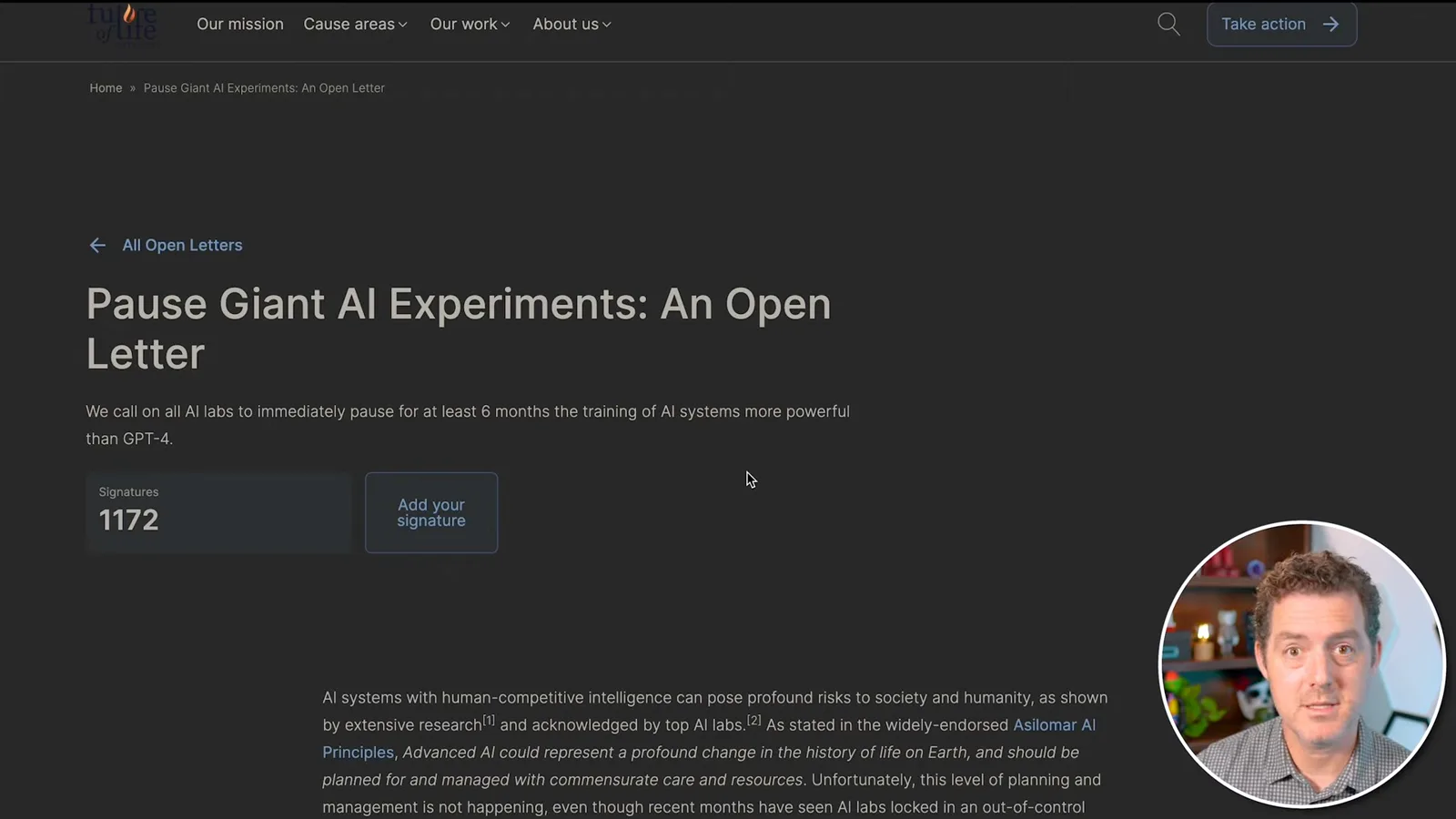
The [Future of Life Institute letter](https://futureoflife.org/open-letter/pause-giant-ai-experiments/), published March 22, calls for a public, verifiable pause of at least six months on training systems more powerful than GPT-4. The page showed 1,172 signatures when I recorded this video. The proposal uses OpenAI’s model as a threshold, though it addresses all AI labs and does not call for stopping all AI research.
The letter argues that AI systems with human-competitive capabilities may pose profound risks and that labs are racing to deploy increasingly powerful systems without enough planning. I find the concern compelling: once a powerful technology spreads, bringing it back under control may be very difficult. The letter’s claims about future systems and loss of control are warnings, not established outcomes.
The authors ask whether machines should flood information channels with propaganda and falsehoods. AI-generated images can illustrate the problem: the viral image of the pope in a puffer jacket looked plausible to many people. Extend that to fabricated video, images and text attributed to real people, and misinformation could become much harder to manage.
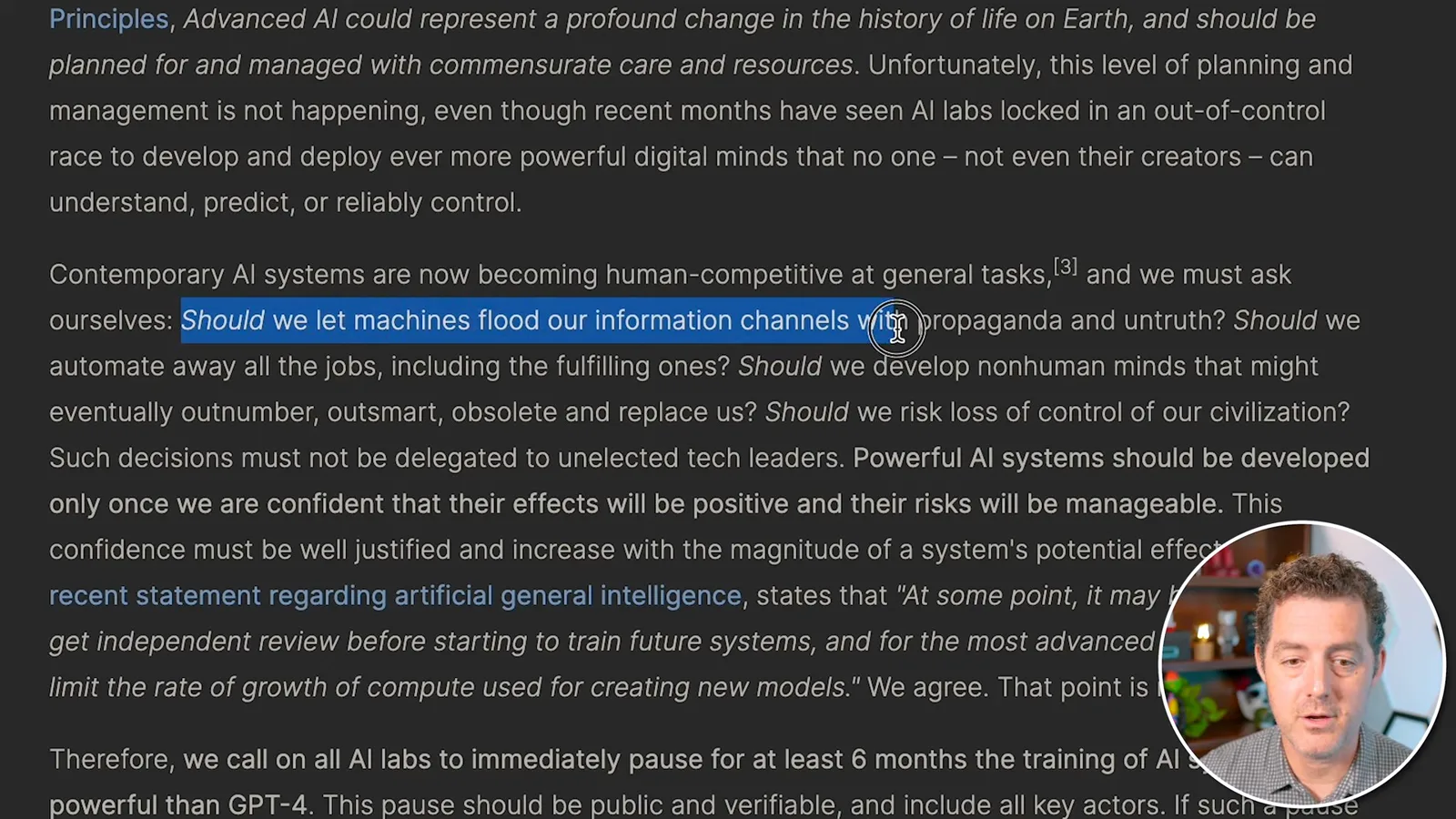
The letter also asks whether jobs, including fulfilling jobs, should be automated away, and raises the possibility that future nonhuman systems might outsmart or replace people. Those are questions and speculative risks, not evidence that existing AI has achieved general intelligence or that these outcomes are inevitable. Its authors argue that powerful systems should advance only when their effects and risks are adequately understood.
The proposed pause and signatories
The letter calls for verification, shared safety protocols and possible government intervention. Berman reviews prominent signatories and an Altman interview clip.
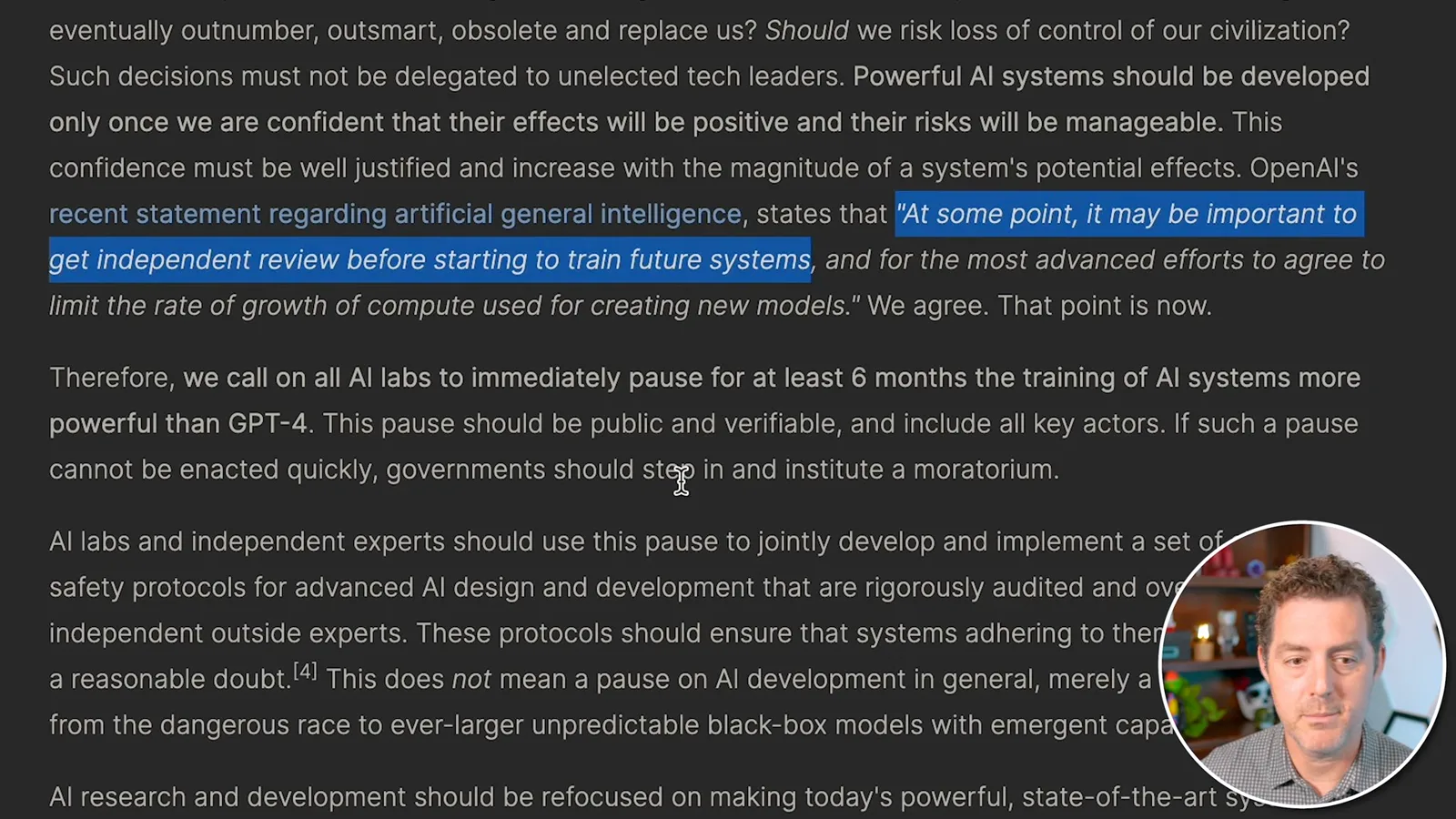
The requested pause would cover training above the GPT-4 threshold, involve key actors and be publicly verifiable. If voluntary action could not happen quickly, the letter asks governments to institute a moratorium. I doubt governments would respond quickly enough, so I am skeptical that this fallback is a straightforward solution.
The authors propose that AI labs and independent experts use the pause to develop shared safety protocols with independent oversight, while working with policymakers on governance. They explicitly do not call for a halt to AI development in general: existing systems could be made safer, more transparent and more reliable. I support taking time to establish meaningful safeguards.
The signatories I discuss include Yoshua Bengio, Stuart Russell, Elon Musk, Steve Wozniak, Andrew Yang and Max Tegmark, as well as figures from technology companies. The list shown in the video was a snapshot, and signatures can change. I note that OpenAI CEO Sam Altman was not among the names I saw then; absence from that snapshot does not establish why someone did not sign.
In an interview clip, Altman says he is concerned about disinformation and economic shocks at a scale society may not be prepared for. I also point to his 2015 essay on machine intelligence. There is disagreement in the field about both the nature of AI risks and the right response, so concern should not be mistaken for unanimous support for a pause.
Jobs and competitive incentives
Berman discusses a study of task exposure and considers how a GPT-4 threshold could affect competition. He distinguishes his own interpretation from what the research established.
I turn to an [OpenAI and University of Pennsylvania study](https://arxiv.org/abs/2303.10130): its authors estimated that about 80% of the US workforce could have at least 10% of work tasks affected by language models, while about 19% could see at least half their tasks affected. They evaluated potential task exposure, including tasks that software could help complete faster; the percentages do not predict job losses or a timeline for adoption.
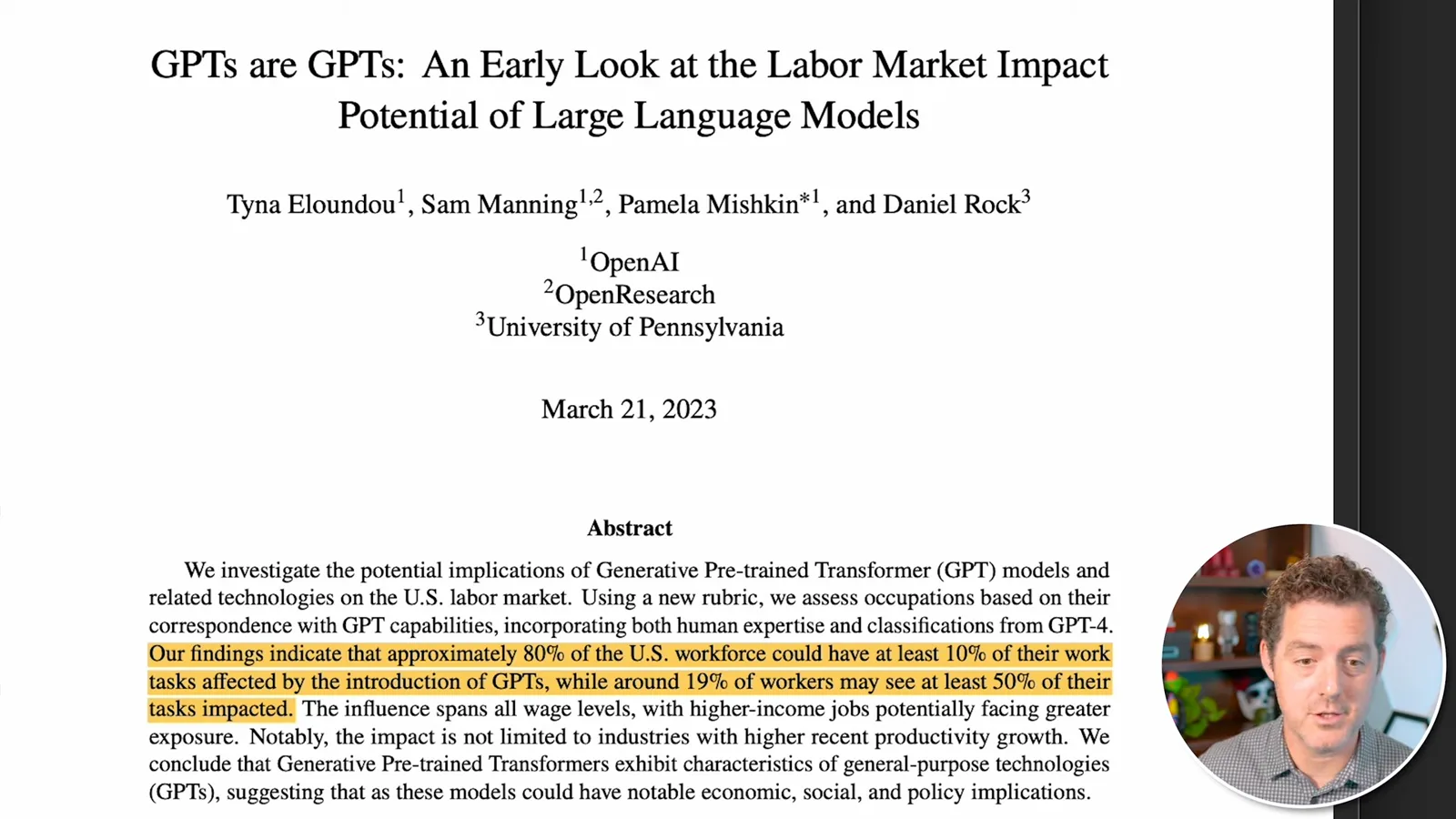
I worry particularly about knowledge work, including work like my own at a computer. Exposure does not mean that every exposed job will disappear, and the paper does not claim immediate replacement. Still, potential changes to many tasks make the labor-market question worth discussing.
I viewed OpenAI as a leader at the time because it had GPT-4, and I thought a threshold defined around that model could give competitors room to catch up while constraining OpenAI’s next training run. That is my competitive assessment, not a finding that GPT-4 was best at every task or that OpenAI would have to stop all future development.
From OpenAI’s perspective, a pause could feel like letting rivals close the gap. I can understand why that might reduce its incentive to sign, although I do not know the company’s motives. I still favor a pause long enough to consider safeguards and the implications of rapid development.
Can a pause be enforced?
Berman questions whether companies and governments could coordinate and verify a pause. He closes by asking viewers to consider fairness and incentives.
The practical difficulty is global coordination: independent companies in many countries would need to agree on the threshold and make their pause verifiable. I do not know whether that can be achieved, and I am doubtful that governments could impose a moratorium quickly enough. The letter itself is a proposal, not evidence that such a worldwide pause was enacted.
I hope OpenAI joins the discussion and that the industry takes time to consider where the AI race could lead. I ask whether a six-month pause is fair to OpenAI, what incentives other companies have to sign, and whether Sam Altman might sign. Those questions remain part of the debate, not settled answers.
Más de este canal
 34:21EN
 Matthew Berman· 27 oct 2026Matthew Berman Examines Anthropic’s IPO Filing, AI Growth and GovernanceMatthew Berman, Sam Altman · Forward FutureThe presenter reviews the S-1’s financial metrics, compute strategy and voting structure while questioning the tension between rapid AI development and safety.
 0:26ENMatthew Berman· 25 oct 2026Sam Altman on Human Values and Problem-Solving in an AI WorldSam Altman · OpenAIIn a short interview excerpt, Altman considers the enjoyment of solving hard problems and the human role in interpreting results.
 0:36ENMatthew Berman· 25 oct 2026Kimi K3.1 and a Rubik’s Cube Solver DemonstrationMatthew Berman · Forward FutureMatthew Berman shows a scrambled virtual cube being solved and gives the Kimi K3.1 test a favorable assessment.
 0:21ENMatthew Berman· 24 oct 2026An AI-Generated Kimi Benchmark Chart Used Invented ScoresMatthew Berman · Forward FutureMatthew Berman asks for a graph of Kimi K3.1 Pro benchmarks, then discovers that the displayed figures are illustrative placeholders.
 25:50ENMatthew Berman· 24 oct 2026Kimi K3.1 Pro Tested: Strong 3D Demos, Uneven Results and Competitive PricingMatthew Berman · Forward FutureMatthew Berman tests the open-weight model on coding, 3D rendering and visual explanations, then compares benchmark results and prices.
 32:20ENMatthew Berman· 23 oct 2026Who Is Local AI For? The Costs, Trade-offs and a Hybrid FutureMatthew Berman · Forward FutureMatthew Berman weighs data control and independence against hardware cost, setup complexity and inference speed.