En 30 segundos
In May 2024, Matthew Berman discusses former OpenAI director Helen Toner’s account of Sam Altman’s November 2023 removal, an essay by Toner and Tasha McCauley, and OpenAI’s new safety committee. Toner’s allegations and Berman’s interpretations are contested; OpenAI’s board commissioned a review by outside law firm WilmerHale and disputed the former directors’ account. The video includes a Careerist sponsorship.
- 1Toner’s accountThe former director alleges information was withheld or misrepresented, and says the board lost trust. These are her claims, which OpenAI board members later rejected.
- 2The startup fundToner says the board was not told about Altman’s control of the fund. OpenAI said he made no personal investment and had no financial interest; management control is not equivalent to equity in OpenAI.
- 3Executive concernsToner recounts serious complaints by two executives. Their identities are not established by the excerpt, and Berman’s guesses are not verified.
- 4What the review saidA special committee retained WilmerHale; OpenAI published a summary, not the full report. The summary describes lost trust and says the board acted within its discretion.
- 5Safety oversightOpenAI’s initial committee included directors and technical experts. Berman questions independence, while later changes were announced in September 2024.
Conclusiones
- Toner alleged that repeated communication and governance problems led the former board to lose trust in Altman; the allegations are disputed.
- Control of a fund management entity is not itself proof of a personal economic interest or a false statement to Congress.
- OpenAI’s nonprofit controlled its capped-profit subsidiary in the period discussed; the legal claims over its structure are contested.
- OpenAI’s public summary of the WilmerHale review said trust had broken down and that the board acted within its discretion, while finding Altman’s conduct did not mandate removal.
- Toner and McCauley argue for external oversight, while Berman worries about regulatory capture and burdens on smaller companies.
- The safety committee initially included Altman; OpenAI later announced an independent board oversight committee in September 2024.
Lee el texto editado por capítulos
Toner’s account of the board crisis
Berman plays excerpts from Toner’s TED interview and comments on the allegations. Her account and his inferences are distinguished from established facts.
Former OpenAI board member Helen Toner has publicly described why she and other directors voted to remove CEO Sam Altman in November 2023. In this May 2024 video, I discuss her interview, an essay by Toner and Tasha McCauley, and OpenAI’s new safety committee. Her allegations are disputed, and no single public account resolves every question about the board crisis.
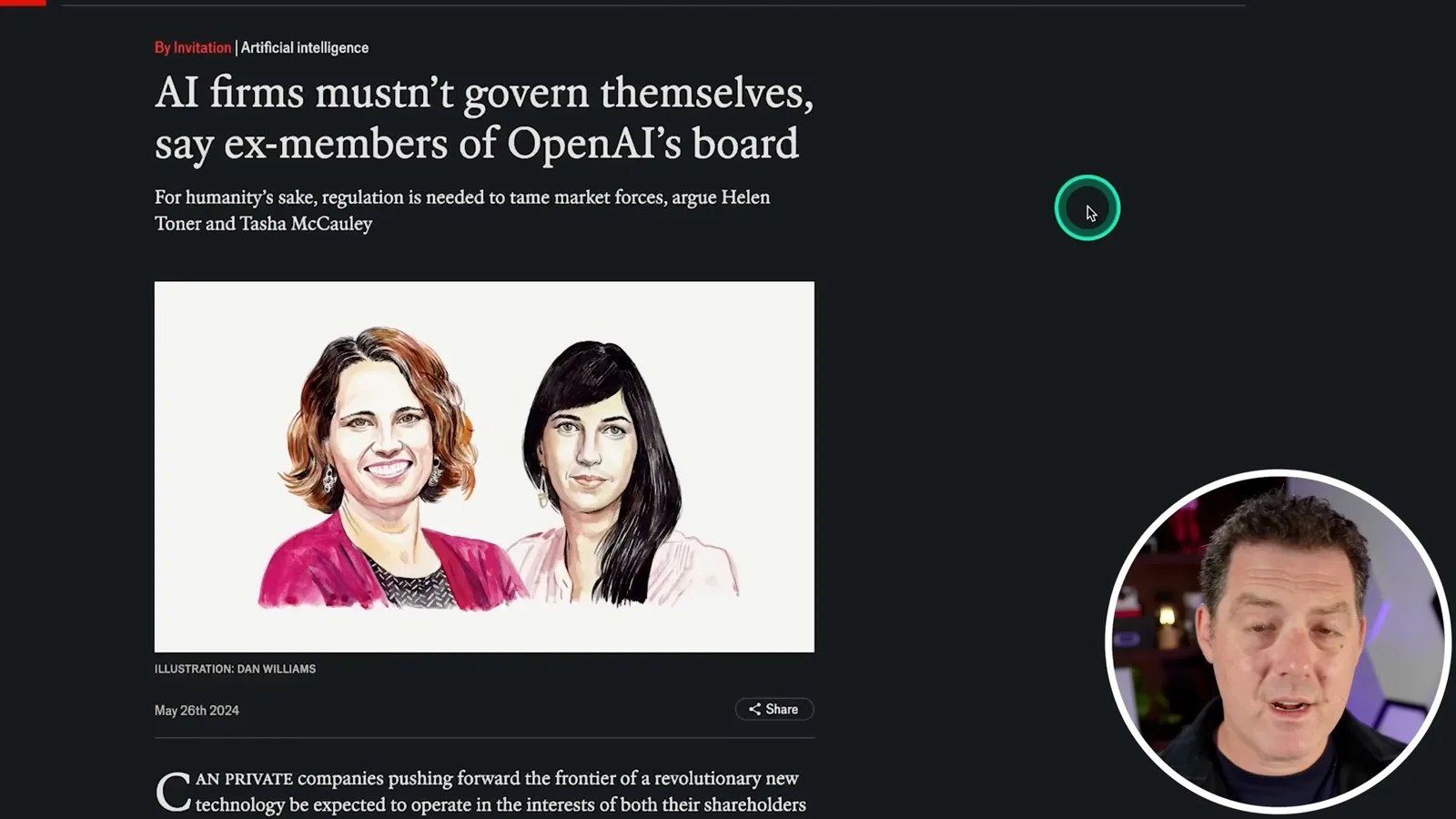
In a TED AI Show interview with Bilawal Sidhu, Toner says the nonprofit board’s job was to protect OpenAI’s public-benefit mission rather than simply maximize investors’ returns. She alleges that a pattern of withholding or misrepresenting information made effective oversight difficult. These are her assertions about her experience, not findings established by this video.
I connect the governance discussion to Elon Musk’s lawsuit over OpenAI’s direction and financing. The structure needs precision: OpenAI began as a nonprofit and created a capped-profit subsidiary in 2019 under nonprofit control; it did not simply turn the nonprofit itself into a conventional for-profit company. Musk and OpenAI dispute the claims, and the video cannot determine their legal merits or Microsoft’s exact ownership stake.
Toner alleges the board learned of ChatGPT’s November 2022 launch on Twitter rather than in advance from Altman. I consider two possible explanations: that information was withheld because the board might object, or that a limited research launch was not expected to become so consequential. These are my hypotheses; the interview does not establish Altman’s intentions.
Toner also alleges Altman did not inform the board about his control of the OpenAI Startup Fund. I interpret the issue as contradicting his statement that he had no OpenAI equity. That inference goes beyond the available evidence: control of the fund’s management entity is not the same as ownership of OpenAI equity or a personal financial interest in the fund.
OpenAI said Altman had not invested personally in the fund and had no financial interest in it, and formal control was transferred to Ian Hathaway in April 2024. Whether a particular disclosure was required or a statement was false cannot be settled from the interview alone; calling the Senate statement a proven lie would overstate the record.
Toner alleges Altman gave the board inaccurate information about formal safety processes, making them difficult to assess. I link that claim to Jan Leike’s public criticism after his departure and to Ilya Sutskever’s departure. Leike did raise safety concerns, but the video’s speculation about Sutskever’s reasons and any specific compute commitment should not be treated as established fact.
Toner says that after she co-authored a research paper, Altman misrepresented matters to other directors while seeking to remove her from the board. She says this further damaged trust. This is an allegation from one former director, not an independently established finding about his intent.
She says the four directors who voted for removal concluded that they could not rely on the CEO as their main source of information. In her account they had tried to improve board processes, but the relationship remained unworkable. Her account explains the board’s stated reasoning without resolving all disputes over individual events.
Toner also recounts concerns expressed to the board by two senior executives, including claims of a harmful workplace atmosphere and behavior they described as psychological abuse. I speculate about their identities, but the excerpt does not identify them; the accusations should not be attributed to named people without evidence.
I note that others in the industry have spoken positively about working with Altman and that I do not know him personally. Different accounts do not themselves resolve the allegations. Toner says the directors reviewed supporting material and concluded that new leadership was needed; the underlying evidence is not fully public.
Altman returned to the CEO role days after his removal and the board changed. Toner says directors feared that, if alerted before their decision, he would try to undermine it. That is her assessment of what he might have done, not a finding that such conduct occurred.
The video includes a paid Careerist promotion for a software QA training program. Salary, placement and completion claims in that advertisement are promotional claims rather than guarantees of a particular student’s outcome.
Self-governance and regulation
Toner and McCauley argue that company self-regulation cannot reliably withstand profit pressures. Berman agrees on conflicts of interest but questions regulation and regulatory capture.
Toner and McCauley argue in The Economist that private companies cannot reliably govern frontier AI solely through internal commitments under strong commercial pressure. I share concern about conflicts between shareholder incentives and broader public interests, while recognizing this is a policy argument rather than proof about every decision by every company.
The former directors describe joining the board in 2018 and 2021 and their hope that the nonprofit-led structure would safeguard OpenAI’s mission. They argue the experiment failed. I relate their account to Leike’s criticism of safety prioritization, but the directors’ interpretation is contested and does not establish the motives of all departing employees.
I question how nonprofit research and commercial fundraising were combined and link the issue to Musk’s lawsuit. The legal analysis depends on the actual entities, transfers and applicable law; operating a nonprofit and a commercial subsidiary is not automatically unlawful. The parties disagree about what commitments were made and whether they were breached.
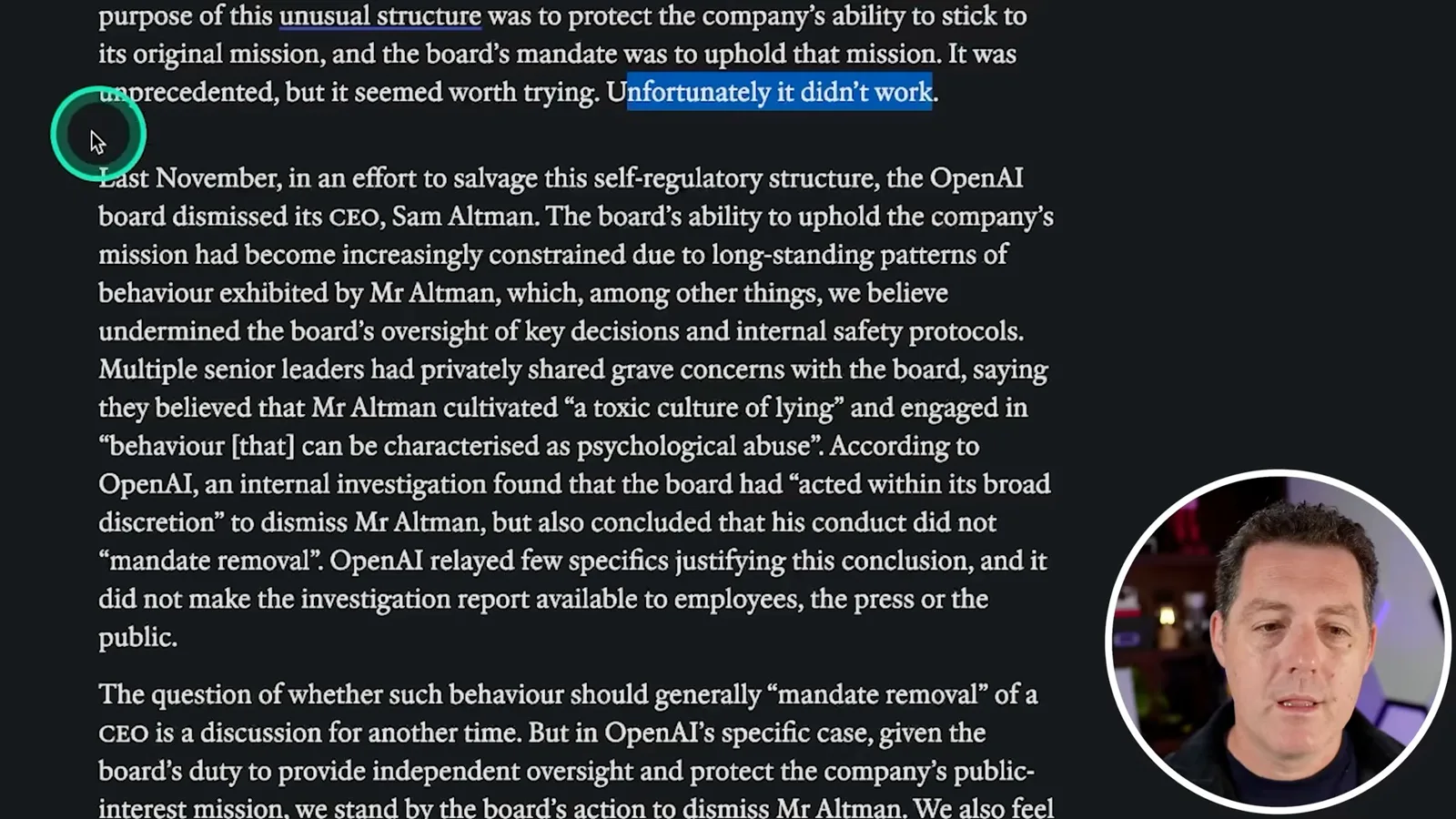
In their essay, the former directors say leadership concerns restricted the board’s oversight and that several senior leaders shared serious allegations. They stand by the dismissal. OpenAI’s board members Bret Taylor and Larry Summers later rejected Toner and McCauley’s claims and defended the company’s governance and Altman.
OpenAI’s board special committee retained outside law firm WilmerHale to investigate. In its March 2024 public summary, OpenAI says the firm reviewed more than 30,000 documents and conducted dozens of interviews. It reported a breakdown of trust, said the prior board acted within its discretion, and concluded Altman’s conduct did not mandate removal; the full report was not released publicly.
I question how much confidence to place in a review commissioned after Altman’s return. That concern is my opinion; describing it only as a company internally grading itself omits that an outside law firm conducted the review for a board special committee. Its undisclosed full report limits what outsiders can independently assess.
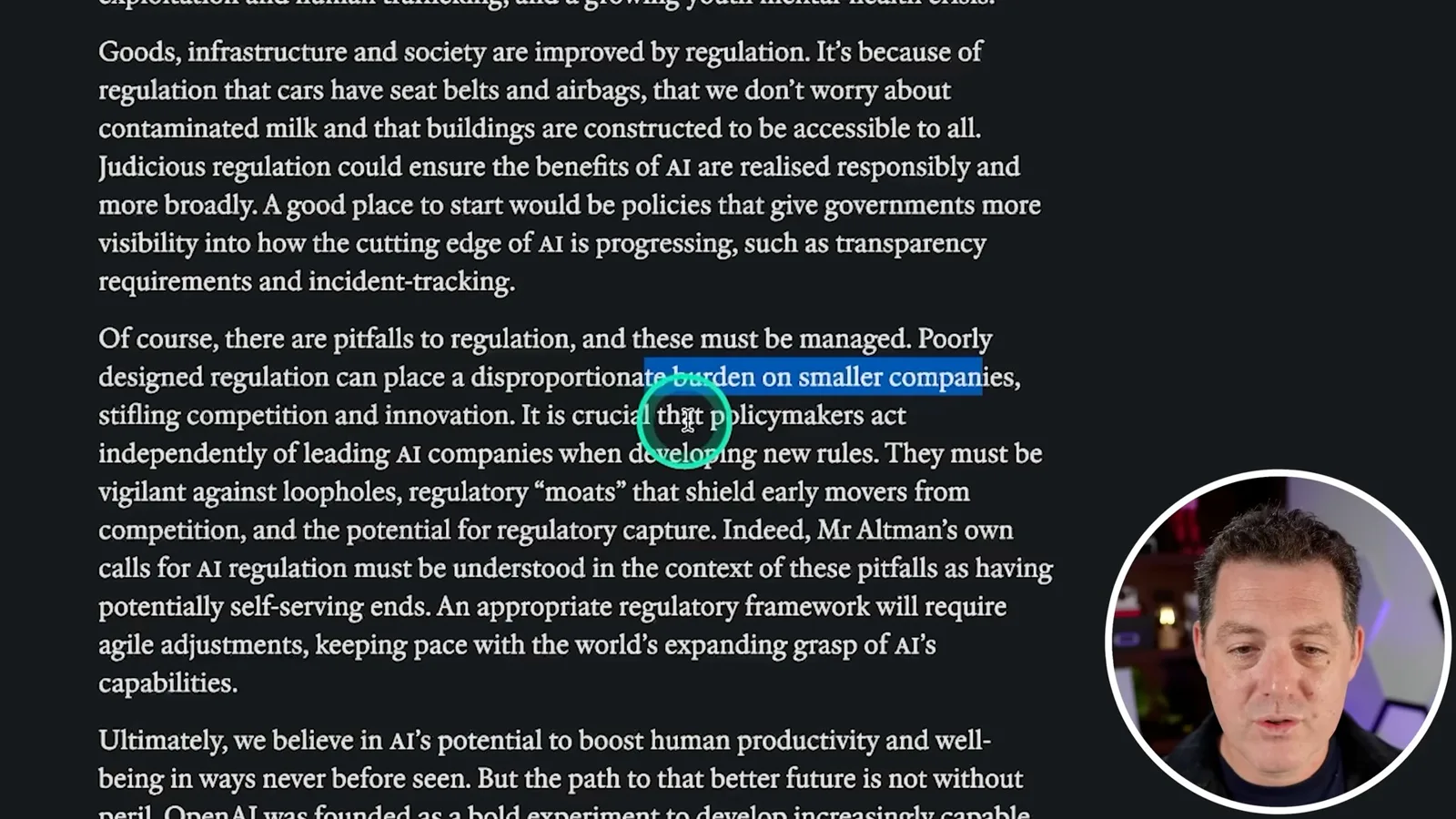
The former directors favor external oversight and government involvement. I worry that regulation can be inefficient, slow innovation and allow large incumbents to influence rules in ways that burden smaller competitors. Those are competing policy judgments, not proof that all regulation helps or harms innovation.
Their essay cites public protections such as vehicle safety and food standards while acknowledging that poorly designed rules can disproportionately burden smaller firms. I agree those examples matter but reject the idea that every regulation is beneficial. I also ask how policymakers can obtain expertise without becoming dependent on the companies they regulate.
The safety committee
Berman reviews OpenAI’s May 2024 announcement and questions the committee’s independence. A later company update announced a changed oversight structure.
OpenAI announced a Safety and Security Committee in May 2024 to evaluate its processes and make recommendations to the board after 90 days. Its initial listed directors included Bret Taylor, Adam D’Angelo, Nicole Seligman and Altman, alongside technical experts. I question the independence of this arrangement; membership alone does not prove any particular safety decision or motive.
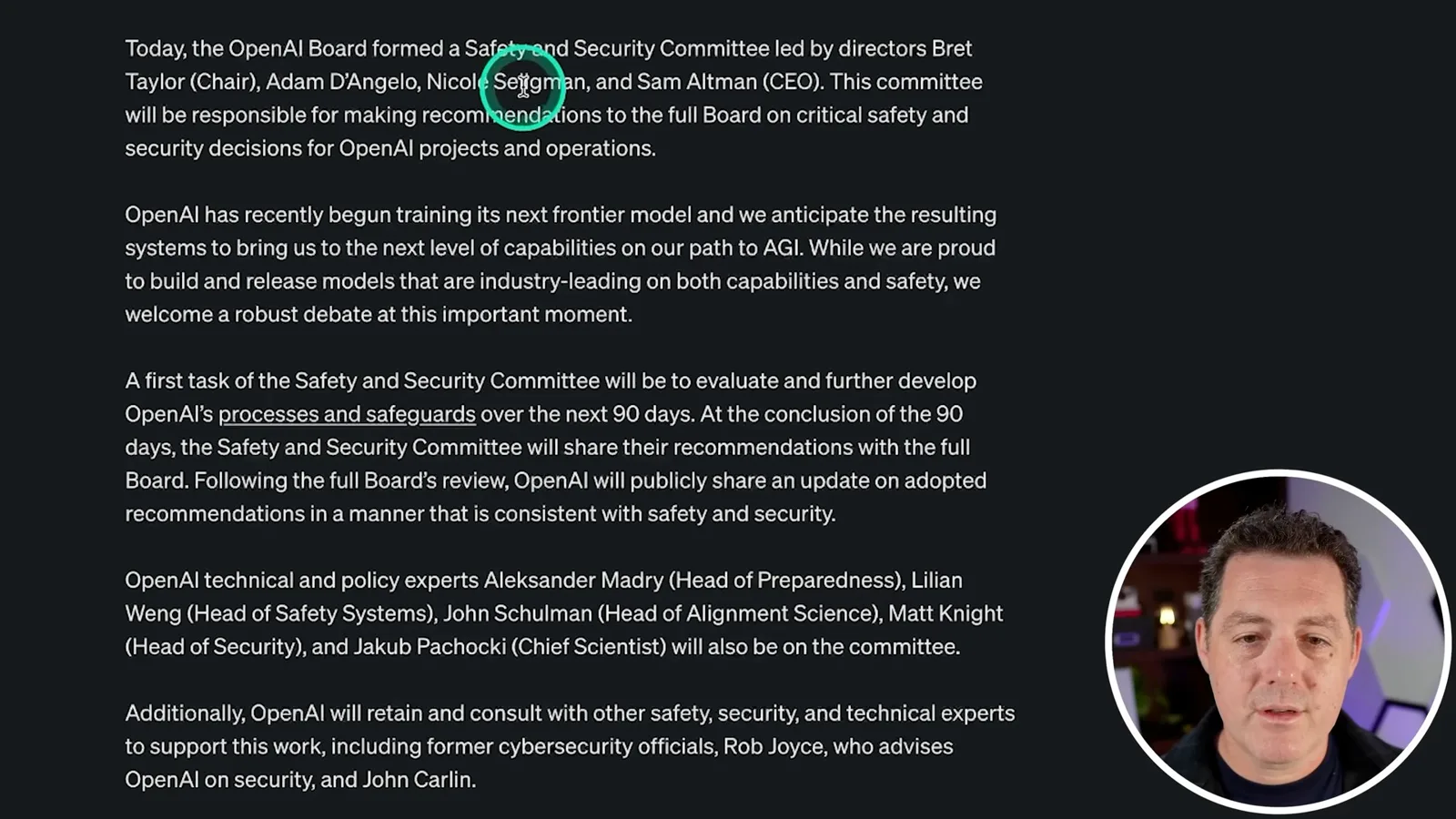
The same announcement said OpenAI had begun training its next frontier model, without identifying it by name. The company said the committee would report to the board and that adopted recommendations would be shared publicly in a manner consistent with safety and security. I remain skeptical that the announcement offers enough independent oversight.
In a later development, OpenAI announced in September 2024 that the committee would become an independent board oversight committee chaired by Zico Kolter. That update postdates this video and does not by itself resolve the broader debate over how effective the oversight is.
I ask whether the former board was right to remove Altman and whether the committee can provide meaningful scrutiny. Those remain questions for readers: the competing accounts, limited public review material and later governance changes should be weighed separately.
Más de este canal
 34:21EN
 Matthew Berman· 27 oct 2026Matthew Berman Examines Anthropic’s IPO Filing, AI Growth and GovernanceMatthew Berman, Sam Altman · Forward FutureThe presenter reviews the S-1’s financial metrics, compute strategy and voting structure while questioning the tension between rapid AI development and safety.
 0:26ENMatthew Berman· 25 oct 2026Sam Altman on Human Values and Problem-Solving in an AI WorldSam Altman · OpenAIIn a short interview excerpt, Altman considers the enjoyment of solving hard problems and the human role in interpreting results.
 0:36ENMatthew Berman· 25 oct 2026Kimi K3.1 and a Rubik’s Cube Solver DemonstrationMatthew Berman · Forward FutureMatthew Berman shows a scrambled virtual cube being solved and gives the Kimi K3.1 test a favorable assessment.
 0:21ENMatthew Berman· 24 oct 2026An AI-Generated Kimi Benchmark Chart Used Invented ScoresMatthew Berman · Forward FutureMatthew Berman asks for a graph of Kimi K3.1 Pro benchmarks, then discovers that the displayed figures are illustrative placeholders.
 25:50ENMatthew Berman· 24 oct 2026Kimi K3.1 Pro Tested: Strong 3D Demos, Uneven Results and Competitive PricingMatthew Berman · Forward FutureMatthew Berman tests the open-weight model on coding, 3D rendering and visual explanations, then compares benchmark results and prices.
 32:20ENMatthew Berman· 23 oct 2026Who Is Local AI For? The Costs, Trade-offs and a Hybrid FutureMatthew Berman · Forward FutureMatthew Berman weighs data control and independence against hardware cost, setup complexity and inference speed.