En 30 segundos
In May 2026, Matthew Berman reacts to Andrej Karpathy’s announcement that he is joining Anthropic. Berman sees the move as a possible sign of pessimism about AI and worries that a few labs are absorbing independent voices; Karpathy’s announcement itself does not establish that he shares the beliefs Berman attributes to him. Berman also examines survey data, political polarization, media incentives and Eric Schmidt’s reception at a commencement. He concludes that optimism about AI should coexist with criticism of companies and their decisions.
- 1A consequential career moveKarpathy announced that he was joining Anthropic to return to research, while saying he intended to resume his educational work in time. Berman interprets the decision as a signal about the industry, although its motives remain speculative.
- 2Independent voices and a few large labsBerman felt a similar loss when OpenClaw creator Peter Steinberger joined OpenAI. He worries that a small number of companies are absorbing people with diverse perspectives.
- 3Public concern about AIBerman cites Pew Research data showing that half of US adults were more concerned than excited about AI’s increasing role in daily life.
- 4A communication problem at commencementA clip of former Google CEO Eric Schmidt addressing graduates illustrates Berman’s argument that the industry must frame AI around people and their agency.
- 5Balancing optimism and criticismBerman says negative videos can attract attention, but he wants to highlight benefits and still criticize companies where their decisions warrant it.
Conclusiones
- Karpathy said he was excited to return to frontier research and planned to resume education work in time; his announcement did not explain his views on every Anthropic position.
- Berman worries that the concentration of researchers in a few large labs narrows the range of independent perspectives.
- A 2025 Pew survey found half of US adults more concerned than excited about increased AI use in daily life.
- Berman argues that fearful narratives can attract attention while leaving too little room for AI’s potential benefits.
- He sees a need to criticize AI companies when warranted while communicating a future in which people have agency.
Lee el texto editado por capítulos
Karpathy’s move and a perceived shift
Berman introduces Karpathy’s Anthropic announcement and explains why the news surprised him. He speculates about what the choice might mean for the researcher’s worldview.
Andrej Karpathy’s announcement that he had joined Anthropic shook me. He is an influential AI researcher, an OpenAI co-founder and a former Tesla AI leader, but also an unusually effective educator who can make complex ideas accessible. His job update attracted enormous attention, and I found myself asking why the decision felt so consequential.
Karpathy said the next few years at the frontier of large language models would be formative, and that he was excited to return to research and development. He also said he remained passionate about education and planned to resume that work in time. I see Anthropic attracting exceptional people, and I wonder what its culture offers them.
My immediate interpretation was that joining a company can look like an endorsement of its worldview. I associate Anthropic with warnings about AI risk and job disruption, and I worry that pessimism is becoming dominant. That is my reading of the move, though: Karpathy’s announcement did not say that he agreed with all of the positions I attribute to the company.
I felt a loss at the thought of an independent researcher and teacher becoming part of a large lab. I also found myself wondering whether Karpathy shares a darker view of the future. Those are questions and inferences, not things his announcement established.
The concentration of AI talent
He compares the move with Peter Steinberger joining OpenAI and describes his concern about independent researchers joining a few large companies. His comparisons between lab cultures and possible motives are his own interpretations.
I had a similar initial reaction when Peter Steinberger, the creator of OpenClaw, joined OpenAI. An independent builder had created something innovative and open source, and I worried that a piece of that independence would be lost. I see a handful of large companies absorbing a great deal of the talent and oxygen in the field.
The move also struck me because Karpathy helped found OpenAI and had worked at Tesla. I interpreted his choice of Anthropic as a comment on the competing labs and their cultures, though choosing one employer does not tell us why he chose it or what he thinks of the others. I am struck by Anthropic’s ability to attract and retain talent.
I describe Anthropic’s public message as comparatively pessimistic, OpenAI’s as emphasizing tools and eventual abundance despite a difficult transition, and Elon Musk’s as explicitly optimistic about abundance. These are broad characterizations of different messages, not a complete account of what everyone at each organization believes.
A researcher with options may be drawn by the mission, the people or a technical problem. Karpathy may have seen something in Anthropic’s research that excited him; he may have other reasons altogether. I cannot know his financial situation, private motivations or agreement with individual predictions from the hiring announcement.
Public concern and polarized narratives
Berman discusses polling on AI, political debate and the incentives of social media and news. He argues that negative coverage can crowd out discussion of potential benefits.
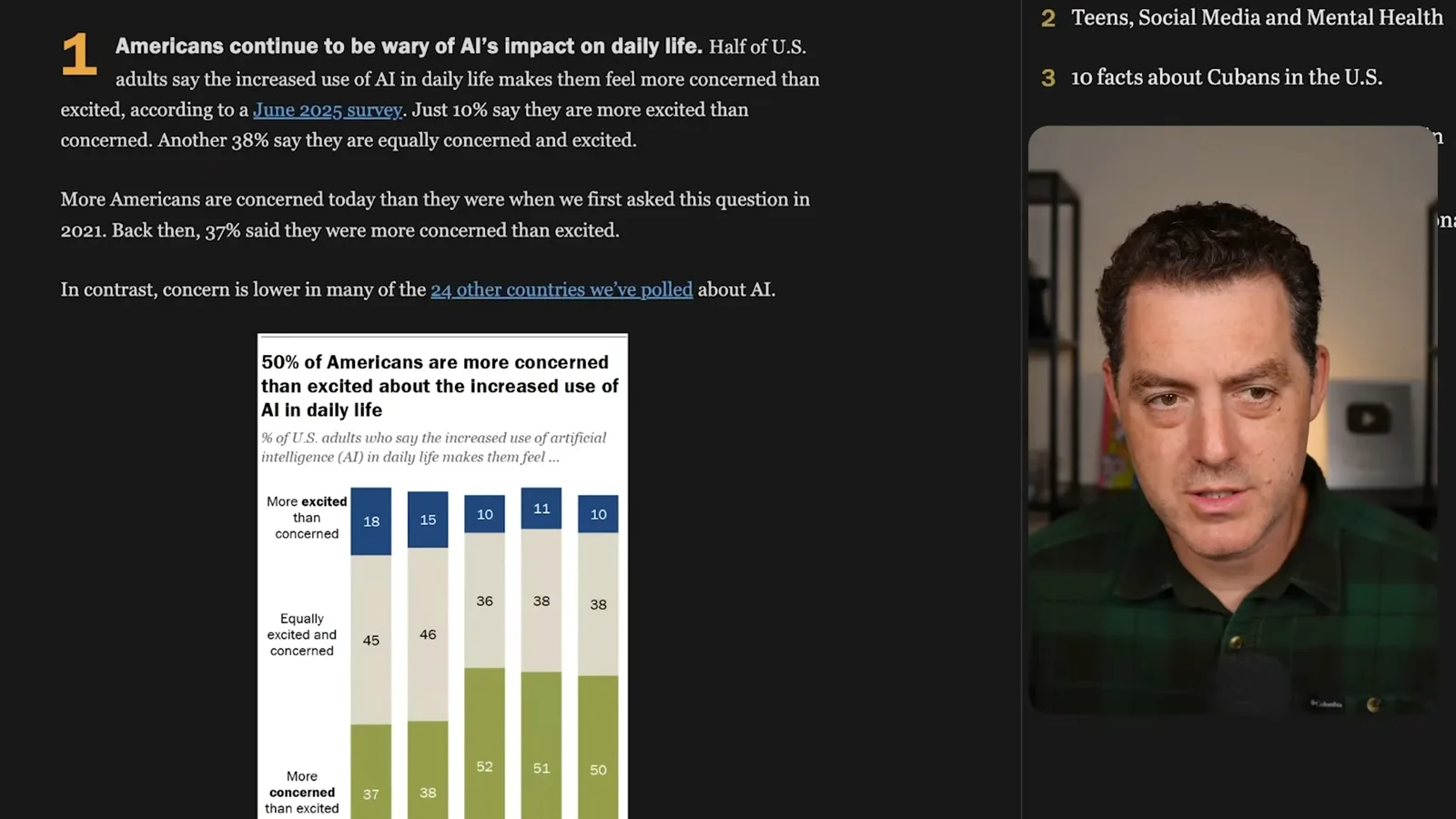
The larger concern for me is the public narrative. A 2025 Pew Research Center survey found that 50% of US adults were more concerned than excited about the increased use of AI in daily life. Concern had risen over time; ChatGPT itself launched in November 2022. The survey also included people who felt equally concerned and excited, as well as people who were more excited.
AI has also become a political subject. I see polarized reactions in debates involving Bernie Sanders and Alexandria Ocasio-Cortez, and in the Trump administration’s dispute with Anthropic. I worry that discussion becomes a choice between declaring AI entirely good and treating it as entirely bad, leaving little space for nuance.
I have historically been very optimistic about AI, perhaps enough that some viewers saw me as naive. My team discussed that feedback, and I think it had merit: if I am enthusiastic about everything, my opinion carries less weight. I have tried to be critical when criticism is warranted, even as I remain concerned about the prevalence of pessimistic narratives.
I see a connection to incentives on social media. Platforms and news organizations compete for attention, and fear or anger can be powerful ways to hold it. I point to a New Mexico jury’s finding concerning Meta and harm to children as one example in a broader discussion about engagement; it is not proof that every outlet or algorithm works the same way.
Politicians and media outlets can focus on frightening claims about AI, from jobs to the resources used by data centers. Those concerns are real subjects for scrutiny, but I do not think the whole picture is either disaster or sunshine. If people hear only reasons for fear, they may miss technologies that could do substantial good.
I worry that public fear could support policies that slow AI development while other countries continue. That is a geopolitical prediction, not a guarantee about what any country will do. The AI industry also bears responsibility for public distrust and does itself few favors in how it communicates.
Speaking to graduates about AI
An Eric Schmidt commencement clip and a response from Lulu Cheng Meservey prompt a discussion about putting people at the center of the AI story. Berman also recognizes that AI companies contribute to public skepticism.
One example is former Google CEO Eric Schmidt’s commencement speech, which drew audible interruptions. In the clip, Schmidt acknowledges fear and argues that AI will affect work across fields. He suggests graduates could assemble AI agents to help tackle problems they could not solve alone, and urges them to find a way to say yes.
Communications professional Lulu Cheng Meservey criticized the framing, arguing that the graduates should have been presented as protagonists rather than accessories to an AI-shaped future. I agree that the industry talks about a race to AGI using a term even insiders define differently. Telling graduates to help build something they fear could replace them is not, in my view, a compelling story.
A creator’s dilemma and a hopeful conclusion
Berman reflects on the attention rewarded by criticism and the feedback he has received for excessive optimism. He returns to Karpathy’s move and hopes to balance optimism with accountability.
There is a personal tension here as well. Videos criticizing a company’s pricing, developer treatment or transparency can perform very well; it is tempting to keep making negative videos about Google or Anthropic. Yet positive developments deserve attention too, and my overall outlook remains optimistic.
Viewers have told me I hype things up and rarely say anything negative. I took that seriously. As someone who has built startups, I know how difficult it is to put your work into the world and have people mock it, but that does not mean companies and their decisions should escape criticism.
I return to Karpathy because I had taken his move as an endorsement of the pessimistic positions I associate with Anthropic, including severe job loss and opposition to open source. That leap is my interpretation, not a statement by Karpathy. Another possibility is that his arrival brings a different perspective to the company.
I want to remain optimistic while criticizing bad decisions and listening to feedback when I get the balance wrong. I hope Anthropic becomes more positive with Karpathy on the team. For an example of the kind of pessimistic argument I am responding to, I point viewers to another discussion of an Anthropic essay about competition with China.
Más de este canal
 34:21EN
 Matthew Berman· 27 oct 2026Matthew Berman Examines Anthropic’s IPO Filing, AI Growth and GovernanceMatthew Berman, Sam Altman · Forward FutureThe presenter reviews the S-1’s financial metrics, compute strategy and voting structure while questioning the tension between rapid AI development and safety.
 0:26ENMatthew Berman· 25 oct 2026Sam Altman on Human Values and Problem-Solving in an AI WorldSam Altman · OpenAIIn a short interview excerpt, Altman considers the enjoyment of solving hard problems and the human role in interpreting results.
 0:36ENMatthew Berman· 25 oct 2026Kimi K3.1 and a Rubik’s Cube Solver DemonstrationMatthew Berman · Forward FutureMatthew Berman shows a scrambled virtual cube being solved and gives the Kimi K3.1 test a favorable assessment.
 0:21ENMatthew Berman· 24 oct 2026An AI-Generated Kimi Benchmark Chart Used Invented ScoresMatthew Berman · Forward FutureMatthew Berman asks for a graph of Kimi K3.1 Pro benchmarks, then discovers that the displayed figures are illustrative placeholders.
 25:50ENMatthew Berman· 24 oct 2026Kimi K3.1 Pro Tested: Strong 3D Demos, Uneven Results and Competitive PricingMatthew Berman · Forward FutureMatthew Berman tests the open-weight model on coding, 3D rendering and visual explanations, then compares benchmark results and prices.
 32:20ENMatthew Berman· 23 oct 2026Who Is Local AI For? The Costs, Trade-offs and a Hybrid FutureMatthew Berman · Forward FutureMatthew Berman weighs data control and independence against hardware cost, setup complexity and inference speed.