En 30 segundos
In this short December 2025 video, Matthew Berman presents OpenAI’s launch figures for GPT-5.2 and examples of spreadsheets, software and image understanding. The comparisons are from OpenAI’s selected tests and demonstrations rather than an independent assessment. He also reviews launch-era API prices and ChatGPT rollout plans. The GDPval comparison shown is with GPT-5, despite his description as a comparison with GPT-5.1.
- 1Knowledge-work comparisonOpenAI’s GDPval table reports 70.9% wins or ties for GPT-5.2 Thinking versus 38.8% for GPT-5.
- 2Coding and mathThe launch chart lists 55.6% on SWE-bench Pro and 100% on AIME 2025 for GPT-5.2 Thinking.
- 3Abstract reasoningOpenAI reports 52.9% on ARC-AGI-2 Verified for GPT-5.2 Thinking, compared with 17.6% for GPT-5.1 Thinking.
- 4Historical API pricingThe launch chart lists $1.75 per million input tokens and $14 per million output tokens for standard GPT-5.2.
Conclusiones
- OpenAI reported GPT-5.2 Thinking at 70.9% wins or ties on GDPval versus 38.8% for GPT-5, not GPT-5.1.
- The launch table reported 55.6% on SWE-bench Pro and 100% on AIME 2025 for GPT-5.2 Thinking under its stated conditions.
- OpenAI reported 52.9% on ARC-AGI-2 Verified for GPT-5.2 Thinking versus 17.6% for GPT-5.1 Thinking.
- The spreadsheet, software and motherboard examples are selected demonstrations and do not establish universal performance.
- At launch, standard GPT-5.2 API input and output prices shown were higher than those for GPT-5.1.
Lee el texto editado por capítulos
OpenAI’s benchmark claims
Berman highlights launch results for knowledge work, coding, mathematics and abstract reasoning. The displayed GDPval baseline is GPT-5, despite his reference to GPT-5.1.
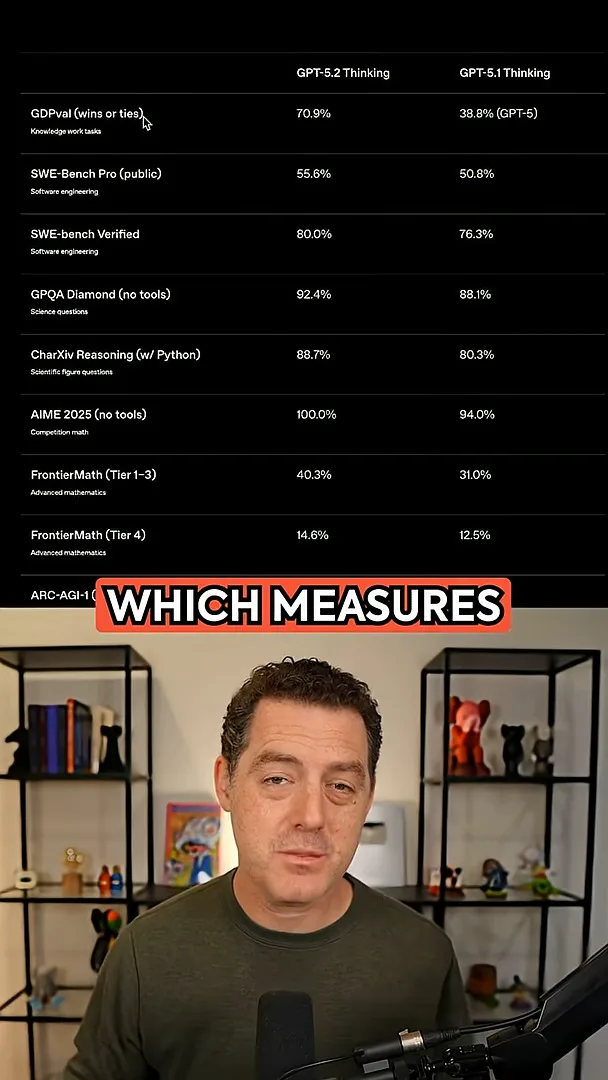
In December 2025, Matthew Berman reviews OpenAI’s introduction of GPT-5.2, highlighting its reported benchmark improvements. The launch chart shows GPT-5.2 Thinking winning or tying human professionals on 70.9% of GDPval tasks versus 38.8% for GPT-5; Berman describes the baseline as GPT-5.1, but the displayed table identifies GPT-5.
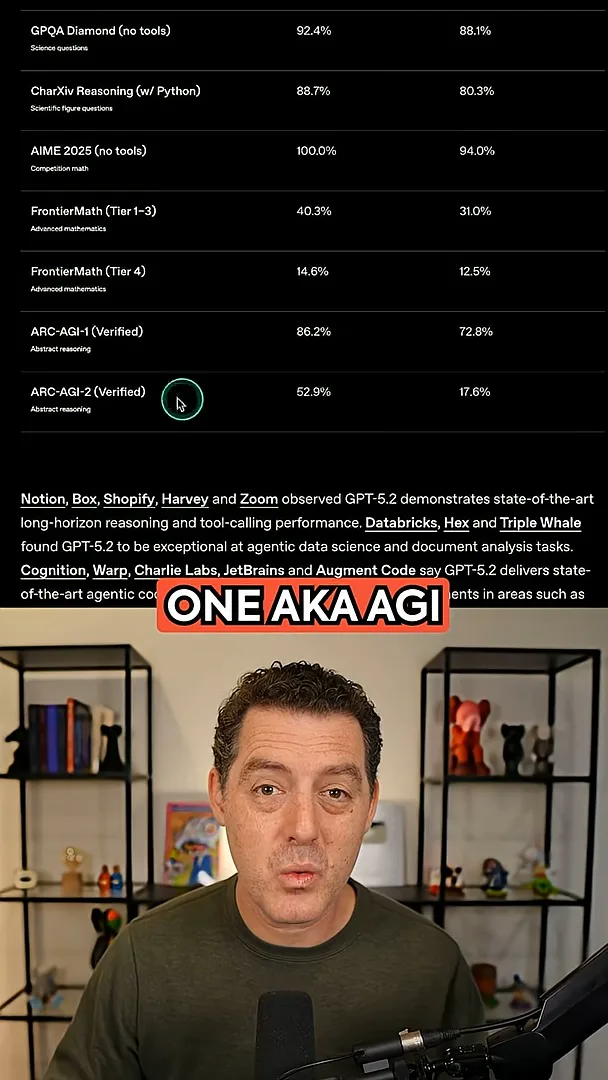
OpenAI’s table reports GPT-5.2 Thinking at 55.6% on SWE-bench Pro versus 50.8% for GPT-5.1 Thinking, and 100% versus 94% on AIME 2025 without tools. On ARC-AGI-2 Verified, the reported scores are 52.9% and 17.6% respectively. These are provider-reported research evaluations under specified conditions, not proof of general intelligence or a universal ranking.
Selected demos and pricing
The video shows spreadsheets, a project-management example, an ocean-wave simulation and motherboard labels. Berman closes with the initial rollout and API prices.
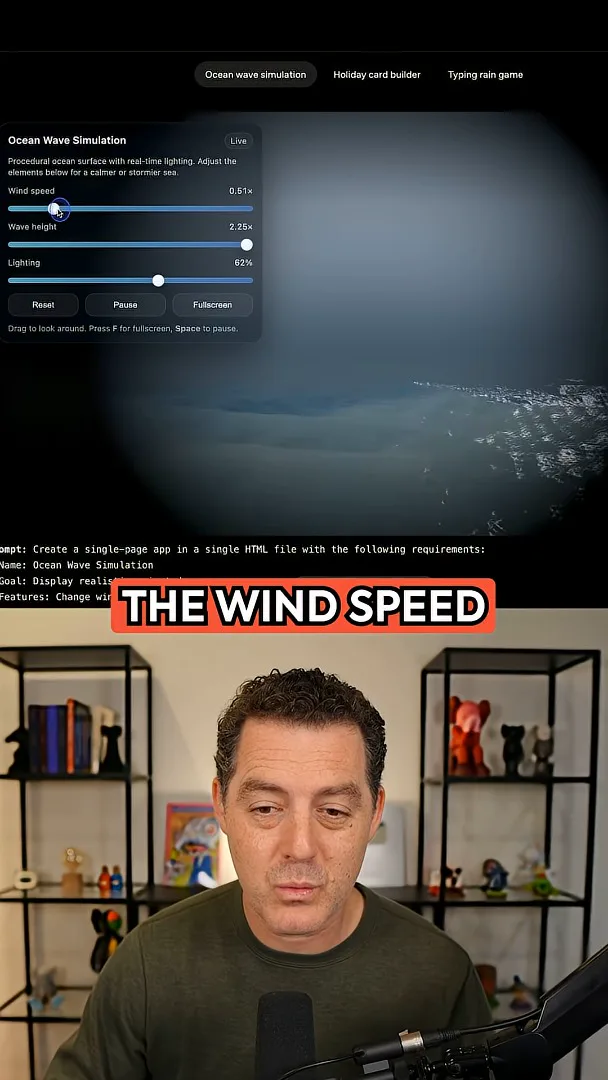
Berman compares selected examples of a spreadsheet and a project-management output, saying the newer model produces a more polished result. He then shows an ocean-wave simulation with controls for wind speed, wave height and lighting. These examples illustrate outputs shown at launch rather than a systematic comparison of every task.
For image understanding, he shows a motherboard-labeling comparison and says GPT-5.2 identifies more components with more precise markings. The video presents this as one visual example, not an independently verified error rate across images.
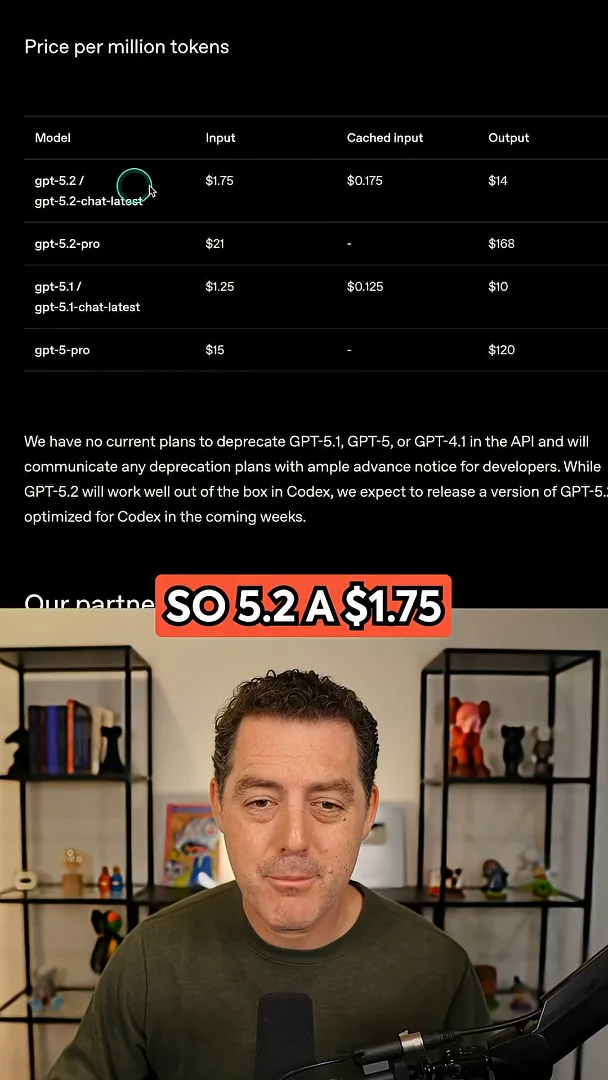
Berman says GPT-5.2 Instant, Thinking and Pro began rolling out to paid ChatGPT plans at launch. The displayed API table lists standard GPT-5.2 at $1.75 per million input tokens and $14 per million output tokens, compared with $1.25 and $10 for GPT-5.1. These are launch-era prices and rollout details.
Más de este canal
 34:21EN
 Matthew Berman· 27 oct 2026Matthew Berman Examines Anthropic’s IPO Filing, AI Growth and GovernanceMatthew Berman, Sam Altman · Forward FutureThe presenter reviews the S-1’s financial metrics, compute strategy and voting structure while questioning the tension between rapid AI development and safety.
 0:26ENMatthew Berman· 25 oct 2026Sam Altman on Human Values and Problem-Solving in an AI WorldSam Altman · OpenAIIn a short interview excerpt, Altman considers the enjoyment of solving hard problems and the human role in interpreting results.
 0:36ENMatthew Berman· 25 oct 2026Kimi K3.1 and a Rubik’s Cube Solver DemonstrationMatthew Berman · Forward FutureMatthew Berman shows a scrambled virtual cube being solved and gives the Kimi K3.1 test a favorable assessment.
 0:21ENMatthew Berman· 24 oct 2026An AI-Generated Kimi Benchmark Chart Used Invented ScoresMatthew Berman · Forward FutureMatthew Berman asks for a graph of Kimi K3.1 Pro benchmarks, then discovers that the displayed figures are illustrative placeholders.
 25:50ENMatthew Berman· 24 oct 2026Kimi K3.1 Pro Tested: Strong 3D Demos, Uneven Results and Competitive PricingMatthew Berman · Forward FutureMatthew Berman tests the open-weight model on coding, 3D rendering and visual explanations, then compares benchmark results and prices.
 32:20ENMatthew Berman· 23 oct 2026Who Is Local AI For? The Costs, Trade-offs and a Hybrid FutureMatthew Berman · Forward FutureMatthew Berman weighs data control and independence against hardware cost, setup complexity and inference speed.