In 30 seconds
In this July 2023 roundup, Matthew Berman discusses generative video, reported AI projects at Apple and OpenAI, a study of changes in GPT model behavior, Hugging Face funding reports, Stripe’s internal tool, Petals and Llama 2. The episode includes his own predictions and interpretations alongside the reports available at the time.
- 1AI-generated entertainmentBerman discusses a Fable Studio demonstration imitating a South Park-style production while questioning its storytelling.
- 2Model behavior over timeHe discusses a 2023 study comparing selected GPT-3.5 and GPT-4 tasks; the results do not establish his proposed cause.
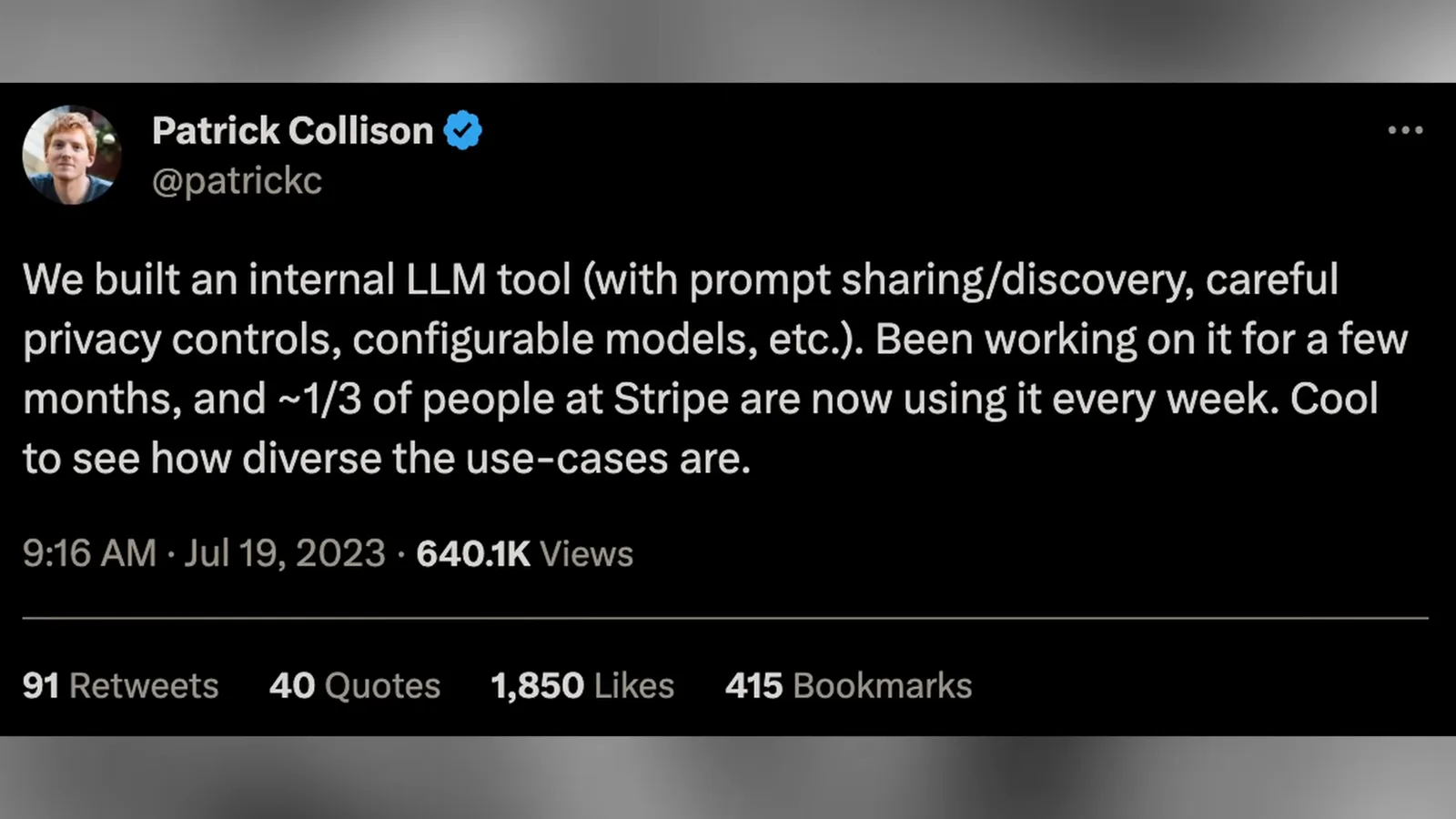
- 3Stripe’s internal toolBerman cites Patrick Collison on prompt sharing, privacy controls and employee adoption at the time.
- 4Llama 2 launchThe roundup describes the 7B, 13B and 70B base and chat models and their commercial license.
Takeaways
- Generative-video examples prompted both excitement about new tools and concern about creative work.
- The GPT comparison covered selected tasks and dates; Berman’s causal explanation is his interpretation.
- Internal AI tools raise questions about privacy controls and configurable models.
- Petals explores distributed model inference across participating devices.
- Llama 2 launched in multiple base and chat sizes under a license with specific terms.
Read the edited text by chapter
AI video and entertainment
Berman reviews generated-video examples and a Fable Studio animation demonstration, alongside concerns about writers and storytelling.
In a July 2023 news roundup, Matthew Berman discusses AI-generated entertainment, reports about Apple and OpenAI, company uses of language models and Meta’s Llama 2 release. His examples, estimates and predictions describe the news as he understood it at the time.
Berman opens with the writers’ strike and concerns about AI replacing creative work. He shows several AI-video examples, including work using WarpFusion and Runway Gen-2, and is impressed by their visual consistency compared with earlier short clips.
He predicts that content production could move closer to individual viewers, allowing highly personalized stories. At the same time, he says he has not yet seen AI reliably reproduce the emotion, suspense and empathy needed for compelling storytelling.
He highlights a Fable Studio paper and a demonstration that imitates South Park-style animation using AI for visuals, voices and story. He is impressed by the production but remains skeptical that the example achieves gripping storytelling. He plans a separate discussion of the paper.
Apple and changing GPT behavior
He discusses reports about Apple’s Ajax effort and a study comparing selected GPT model behaviors over time.
Turning to Apple, Berman discusses reports of an internally tested AI effort code-named Ajax. He speculates that deep integration with Apple’s ecosystem could encourage adoption. His comments are a 2023 prediction, not confirmation of a product roadmap or user count.
Berman discusses a Stanford and UC Berkeley study comparing March and June 2023 versions of GPT-3.5 and GPT-4 on selected tasks. He says results changed across math, sensitive questions, code generation and visual reasoning, with some improvements and some declines.
He attributes perceived declines to a tradeoff between safety measures and model quality. That is his interpretation; the comparisons shown do not by themselves establish that safety changes caused the differences or that every capability declined.
He points to changes in the rate of answers to a sensitive question and to lower scores on the code-generation measure shown in the video. These are results for particular prompts and evaluation methods in a historical comparison, not a general measure of current model quality.
Privacy, financing and internal tools
The roundup covers reported image-recognition concerns, Hugging Face funding and Stripe’s internal language-model tool.
Berman recounts reporting that OpenAI delayed broader image-recognition features over privacy and security concerns, including face identification. He also describes Be My Eyes, where volunteers help blind people interpret their surroundings, and the potential for AI assistance alongside concerns about misinterpreting people’s faces.
On financing, he recounts a report that Hugging Face was raising $200 million at a $4 billion valuation. He explicitly says the round was still in progress when he recorded, so it should be read as a report at that time rather than a completed transaction.
Berman cites Stripe CEO Patrick Collison’s description of an internal language-model tool with prompt sharing, privacy controls and configurable models. Collison said roughly one-third of Stripe employees were using it weekly. Berman speculates about the underlying provider and sees a business opportunity in privacy-aware internal tools.
Distributed inference and Llama 2
Berman explains Petals and recaps Llama 2 model sizes and commercial licensing.
He then describes Petals, a project for distributed inference in which different devices contribute portions of a large model. He compares the distribution idea to torrents and notes support for Llama 2; his suggestion that this could form an exceptionally powerful network is a prediction, not a measured result.
Finally, he recaps Meta’s Llama 2 launch: base and chat variants in 7B, 13B and 70B sizes, and a reported increase in training data over the first Llama. He notes that a 34B model was not released at that time.
Berman highlights commercial use under the Llama 2 license and mentions its 700-million-user threshold. That threshold is not a substitute for the full license terms. He expects many fine-tuned versions to appear and points to his separate testing video.
More from this channel
 14:45EN
 Matthew Berman· Oct 29, 2026Matthew Berman Examines Google’s Gemini 4 Carbon AnnouncementMatthew Berman · Forward FutureMatthew Berman reviews Google’s reported benchmark results, staged rollout and pricing for Gemini 4 Carbon, while noting he has not yet used the model.
 21:11ENMatthew Berman· Oct 28, 2026Matthew Berman tests DeepSeek V4.1 Flash: coding, vision and local appsMatthew Berman · Forward FutureA hands-on tour of visual coding, image reasoning, local applications and provider economics reveals both impressive results and visible flaws.
 34:21ENMatthew Berman· Oct 27, 2026Matthew Berman Examines Anthropic’s IPO Filing, AI Growth and GovernanceMatthew Berman, Sam Altman · Forward FutureThe presenter reviews the S-1’s financial metrics, compute strategy and voting structure while questioning the tension between rapid AI development and safety.
 0:26ENMatthew Berman· Oct 25, 2026Sam Altman on Human Values and Problem-Solving in an AI WorldSam Altman · OpenAIIn a short interview excerpt, Altman considers the enjoyment of solving hard problems and the human role in interpreting results.
 0:36ENMatthew Berman· Oct 25, 2026Kimi K3.1 and a Rubik’s Cube Solver DemonstrationMatthew Berman · Forward FutureMatthew Berman shows a scrambled virtual cube being solved and gives the Kimi K3.1 test a favorable assessment.
 0:21ENMatthew Berman· Oct 24, 2026An AI-Generated Kimi Benchmark Chart Used Invented ScoresMatthew Berman · Forward FutureMatthew Berman asks for a graph of Kimi K3.1 Pro benchmarks, then discovers that the displayed figures are illustrative placeholders.