In 30 seconds
In June 2024, Matthew Berman introduced NVIDIA’s Nemotron-4 340B family and its intended use in generating and filtering synthetic training data. His informal prompts produced a mixture of successes and failures; they were not an evaluation of a synthetic-data pipeline.
- 1Synthetic-data pipelineThe family combines base, instruction and reward models intended to help create and filter training data.
- 2Coding testA Snake program retained an undefined variable after a correction attempt, according to Berman.
- 3A disputed drying answerThe model answered 16 hours without explaining the assumption that shirts cannot all dry in parallel; Berman nevertheless gave it a pass.
- 4Constrained writing failureThe model did not produce the requested sentences ending in “Apple,” including on a retry with lower temperature.
Takeaways
- Nemotron-4 340B includes base, instruction and reward models for a synthetic-data workflow.
- The reward model was described as scoring several response qualities, including correctness and helpfulness.
- Berman’s informal tests showed both successful answers and failures in code and constrained text generation.
- A model’s response to a handful of prompts does not establish the quality of its generated training data.
Read the edited text by chapter
Nemotron and synthetic data
Berman describes the model family, its proposed training-data workflow and NVIDIA’s release details.
Matthew Berman tests NVIDIA’s Nemotron-4 340B in June 2024, beginning with an answer to a physical-reasoning puzzle about a marble and an inverted glass. He introduces the large model family as a tool for generating synthetic data to train other models.
Berman describes the base, instruction and reward models as a pipeline for synthetic data generation. He says obtaining high-quality training data can be difficult and expensive, particularly for smaller teams, and sees value in an openly available model that can help create it.
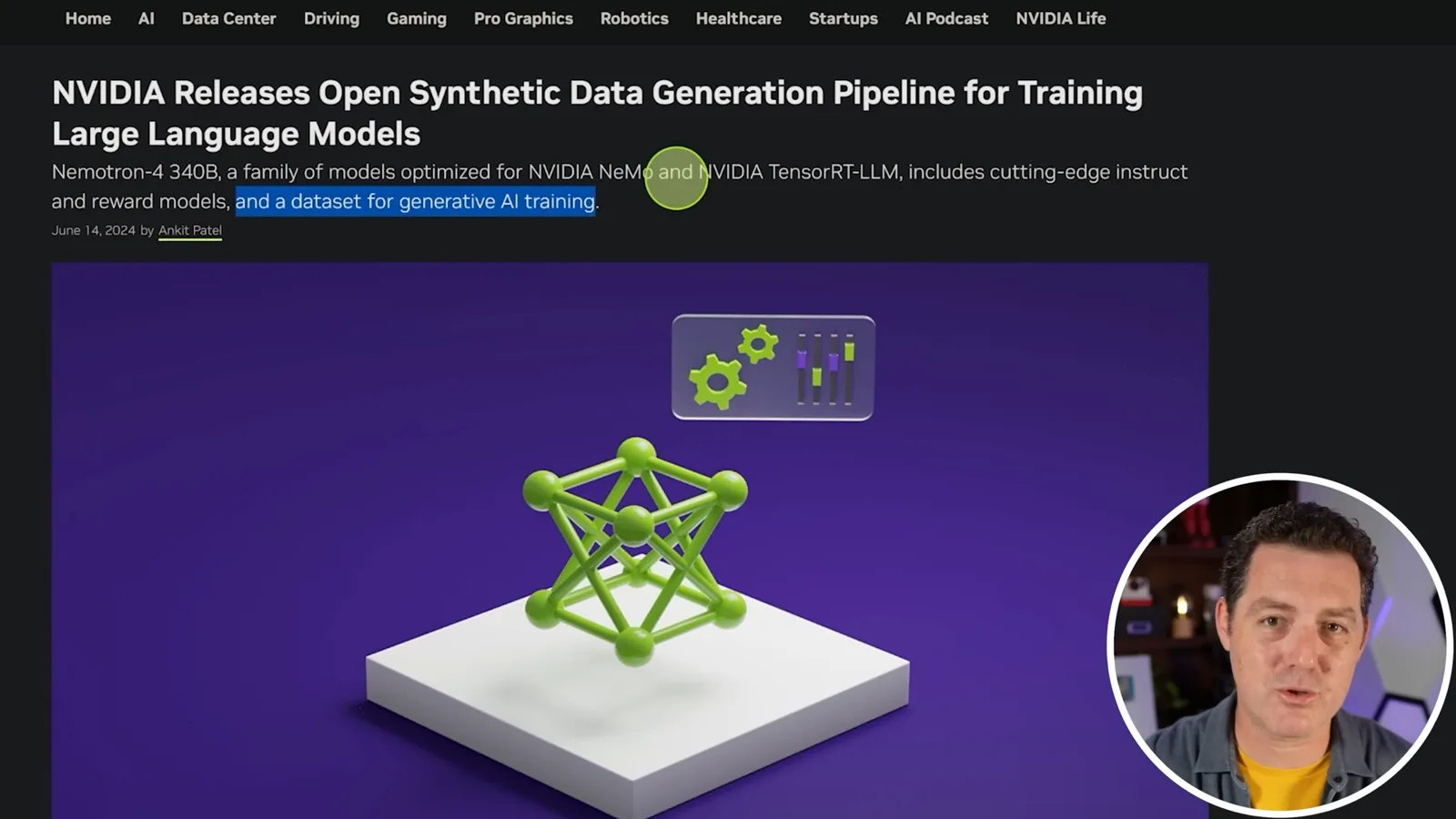
The models were offered under NVIDIA’s open model license and optimized for NVIDIA NeMo and TensorRT-LLM. Berman says they could be downloaded from NVIDIA or Hugging Face and describes a planned NVIDIA NIM deployment option. These availability details reflect the 2024 announcement.
According to the material Berman presents, the reward model can filter responses using attributes including helpfulness, correctness, coherence, complexity and verbosity. He also notes a reported nine trillion training tokens and a reward-model leaderboard result from that period.
Coding, arithmetic and assumptions
He runs an informal set of prompts, including Python code, a drying puzzle and arithmetic.
For a hands-on test, Berman selects the 340-billion-parameter model on a public model-comparison site and runs his own collection of prompts. This small, informal test illustrates individual outputs; it does not measure the quality of a synthetic-data pipeline or establish an overall ranking.
The model succeeds at a simple Python task to output numbers from 1 to 100. Asked to write Snake using the curses library, its first attempt contains an undefined food variable; after Berman asks it to correct the error, he finds the variable still undefined and marks the task as failed.
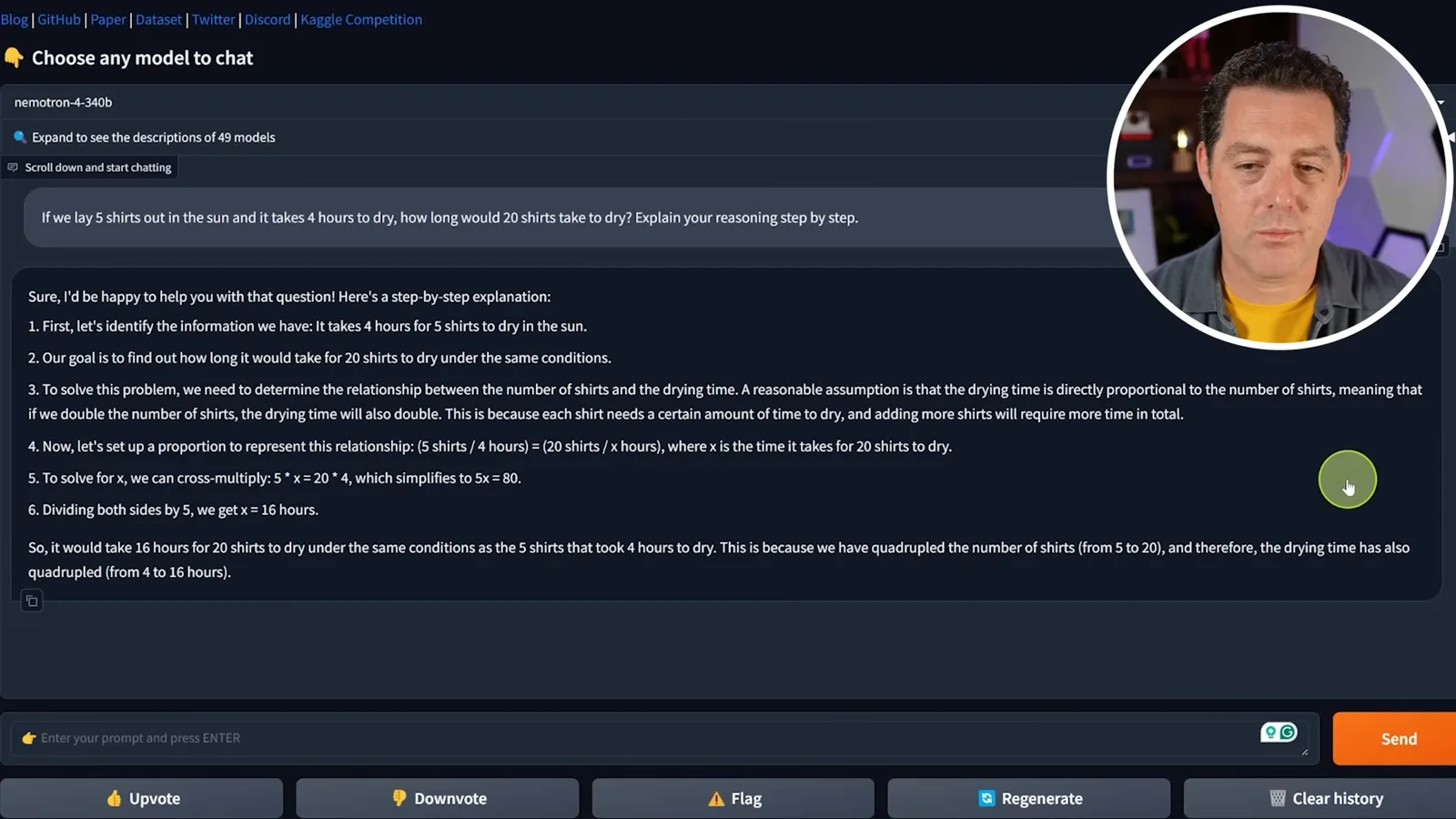
The model refuses a request to explain breaking into a car. Berman then asks how long 20 shirts take to dry if five dry in four hours. The model answers 16 hours by assuming time scales with the number of shirts. Berman gives it a pass while wishing it had discussed parallel drying; the answer depends on unstated capacity assumptions.
On arithmetic, the model follows the order of operations and answers 25 − 4 × 2 + 3 correctly as 20. Berman also says it solves a hotel price problem involving a nightly rate, tax and a one-time fee, though a network error appears while he highlights the response.
Word counting and reasoning tests
The model struggles to count its response, answers two reasoning puzzles and fails a constrained-sentence task.
The model fails to count the words in its own response accurately. Berman notes that many models struggle with this kind of prompt. This observation is from his small set of tests rather than a systematic measurement.
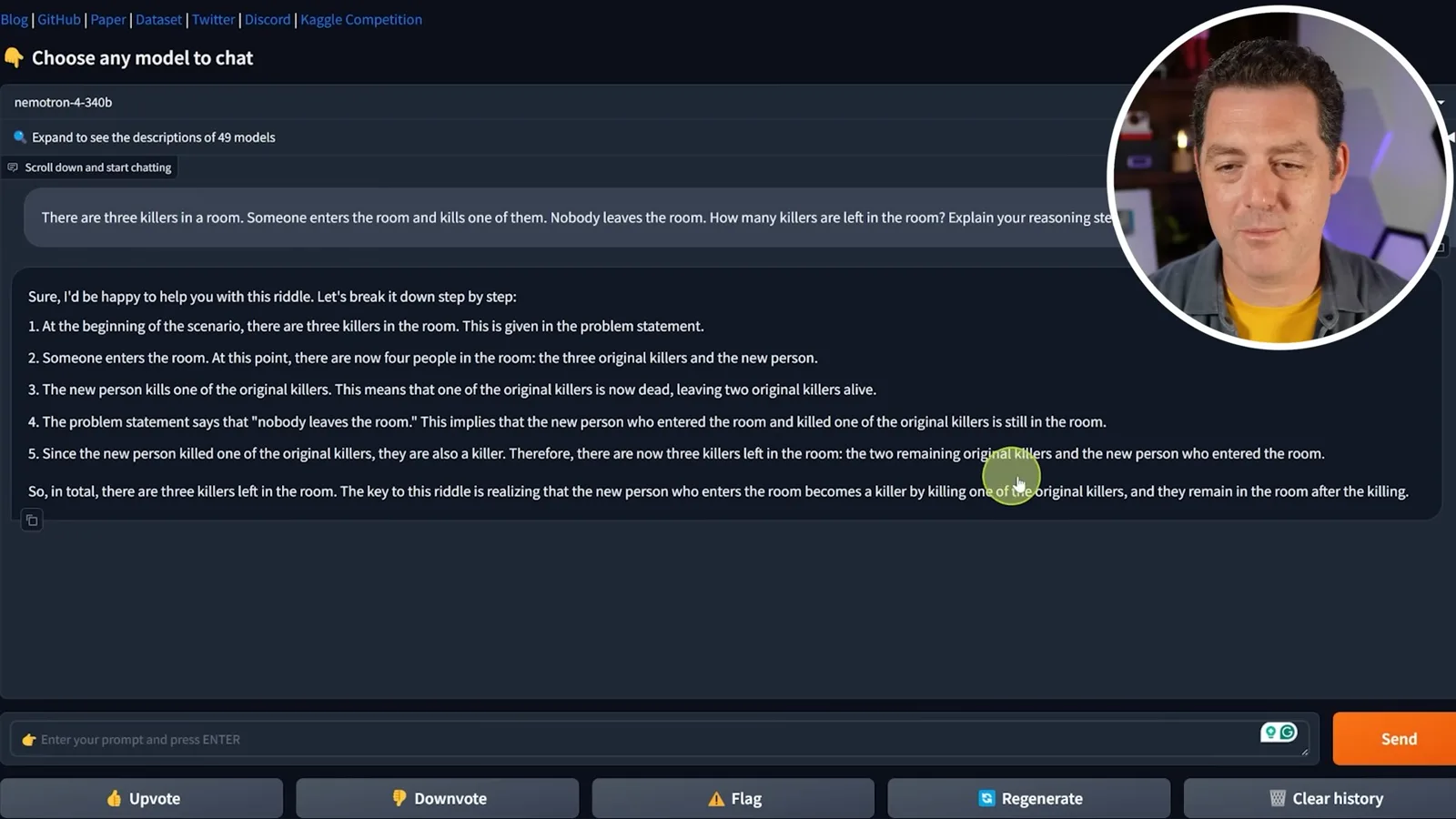
In a riddle about three killers and a newcomer who kills one of them, the model says three killers remain: two original killers and the newcomer. Berman approves the explanation, which recognizes that the new arrival has become a killer.
For the marble puzzle, the model says the marble remains on the table when the inverted glass is lifted and moved to a microwave. Berman considers its explanation a strong pass in this test.
Finally, he asks for ten sentences ending in the word “Apple.” He says none meet the requirement, and lowering the temperature to zero does not fix the result in his retry. He concludes that the model performed well on some prompts but failed others; the video does not directly evaluate generated training data.
More from this channel
 14:45EN
 Matthew Berman· Oct 29, 2026Matthew Berman Examines Google’s Gemini 4 Carbon AnnouncementMatthew Berman · Forward FutureMatthew Berman reviews Google’s reported benchmark results, staged rollout and pricing for Gemini 4 Carbon, while noting he has not yet used the model.
 21:11ENMatthew Berman· Oct 28, 2026Matthew Berman tests DeepSeek V4.1 Flash: coding, vision and local appsMatthew Berman · Forward FutureA hands-on tour of visual coding, image reasoning, local applications and provider economics reveals both impressive results and visible flaws.
 34:21ENMatthew Berman· Oct 27, 2026Matthew Berman Examines Anthropic’s IPO Filing, AI Growth and GovernanceMatthew Berman, Sam Altman · Forward FutureThe presenter reviews the S-1’s financial metrics, compute strategy and voting structure while questioning the tension between rapid AI development and safety.
 0:26ENMatthew Berman· Oct 25, 2026Sam Altman on Human Values and Problem-Solving in an AI WorldSam Altman · OpenAIIn a short interview excerpt, Altman considers the enjoyment of solving hard problems and the human role in interpreting results.
 0:36ENMatthew Berman· Oct 25, 2026Kimi K3.1 and a Rubik’s Cube Solver DemonstrationMatthew Berman · Forward FutureMatthew Berman shows a scrambled virtual cube being solved and gives the Kimi K3.1 test a favorable assessment.
 0:21ENMatthew Berman· Oct 24, 2026An AI-Generated Kimi Benchmark Chart Used Invented ScoresMatthew Berman · Forward FutureMatthew Berman asks for a graph of Kimi K3.1 Pro benchmarks, then discovers that the displayed figures are illustrative placeholders.