In 30 seconds
Matthew Berman reviews Cognition’s March 2024 Devin launch, questioning its first-of-its-kind marketing while praising the integrated workspace and demonstrations. He examines examples from debugging to model fine-tuning and an Upwork-related task, then discusses why the reported benchmark comparison requires care.
- 1A coding-agent workspaceScott Wu’s launch video shows planning, documentation, debugging and a website in an integrated environment.
- 2First-of-its-kind marketingBerman notes earlier coding agents while praising Devin’s interface.
- 3Fine-tuning a language modelA company demo shows an agent following a QLoRA repository’s instructions and starting a 7B model training job.
- 4A SymPy debugging exampleA Cognition demonstrator shows an agent reproducing and fixing a logarithm issue, then running tests.
- 5SWE-bench qualificationsCognition’s 13.86% result used a random subset and differs from the displayed baselines in assistance and workflow.
Takeaways
- Cognition’s 2024 Devin launch combined a shell, editor, browser and planner in a coding-agent workspace.
- Earlier coding-agent projects already existed, making the company’s first-of-its-kind label a marketing claim.
- Selected demonstrations show workflows but do not independently establish reliability or client acceptance across real tasks.
- Cognition reported 13.86% on a random 25% subset of SWE-bench, with different assistance and agent setups from displayed baselines.
- Claims about the precise underlying model and repository-navigation method were not verified by the shown demos.
Read the edited text by chapter
The launch and its context
Berman introduces Devin and questions the first-of-its-kind claim. Scott Wu’s company demonstration shows an agent using a development workspace.
Cognition has introduced Devin, which it markets as the first AI software engineer. I am impressed by the launch demonstrations, but question the word 'first': GPT Pilot, MetaGPT and other coding-agent projects were already exploring similar workflows. This video reviews Cognition's demonstrations and launch claims as they appeared in March 2024.
In Cognition's introductory video, CEO Scott Wu asks Devin to benchmark Llama across API providers. He describes a plan, a development environment with a shell, editor and browser, and the agent reading documentation. In the edited demonstration, it encounters an error, adds diagnostic output and builds a website to present the results.
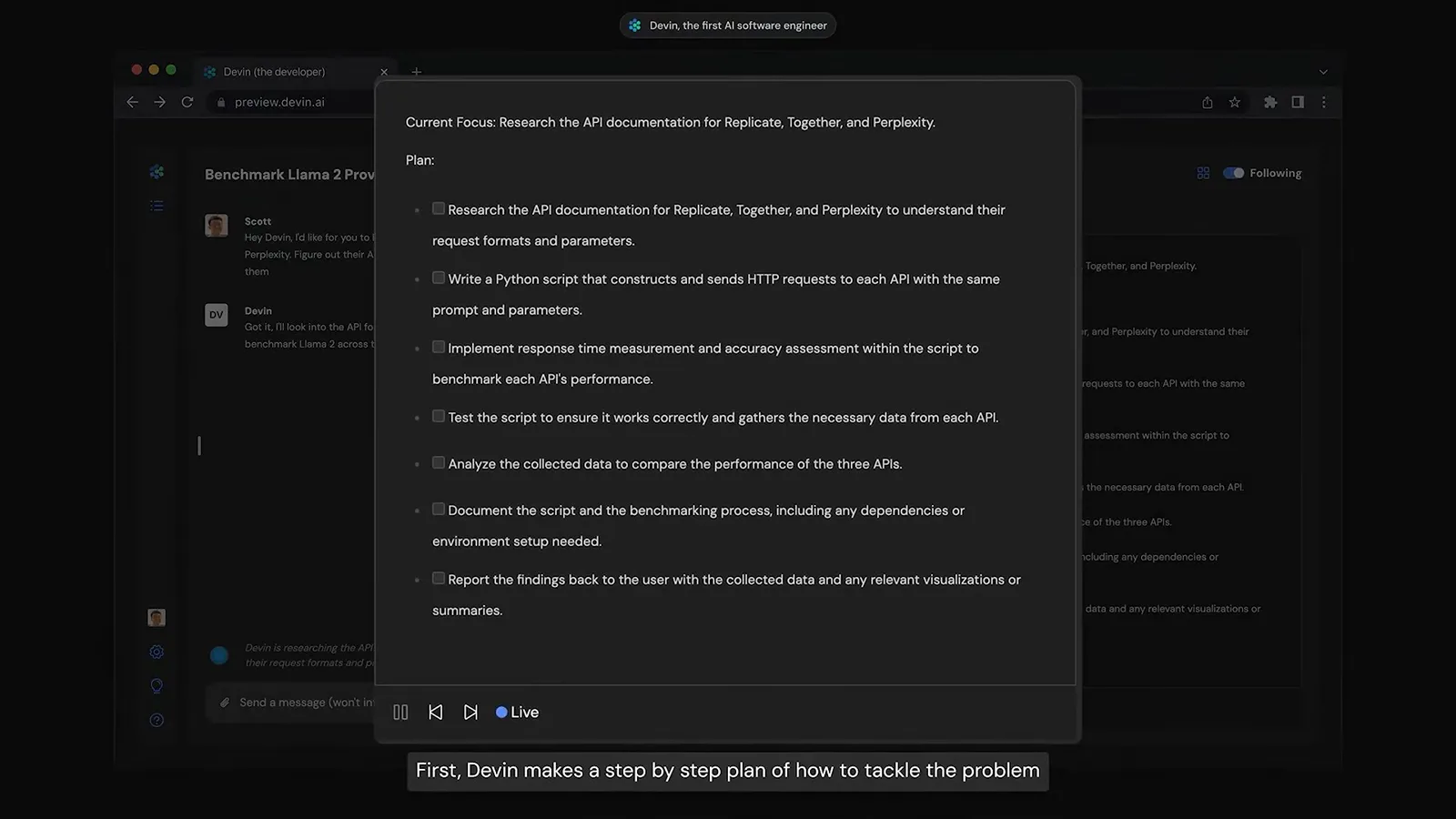
Wu says the system's reasoning and planning make the workflow possible, while acknowledging that the problem is difficult and the work is early. A company-selected demonstration illustrates a possible sequence; it does not by itself establish how reliably the system completes a representative range of jobs.
I compare Devin with GPT Pilot, also known through Pythagora, and other projects I have seen. My view is that parts of the workflow are not new, even if the interface and execution look polished. Comparing the products fairly would require testing them on the same tasks and conditions.
Cognition reported a $21 million Series A led by Founders Fund. I think the backing and publicity contributed to the launch's reach, alongside a widely shared clip of Wu answering competitive mathematics questions. Those are my observations about attention, not evidence that funding or a viral clip establishes product performance.
The workspace and early demonstrations
Cognition highlights its interface and shows image generation, website building and debugging. Berman distinguishes the examples from proof of general reliability.
The company's [launch post](https://cognition.com/blog/introducing-devin) calls Devin a fully autonomous software engineer and describes planning, context handling and error correction. I see the 'first' label as marketing, given earlier coding agents. One distinctive presentation choice is the workspace bringing a shell, editor, browser and planner into one view.
One demonstration begins with a blog post about images with hidden text. A user asks Devin to set it up; the edited video shows the agent reading the page, planning, installing dependencies and producing images. I like how little instruction the request appears to need, while recognizing that a curated example does not measure success across arbitrary blogs.
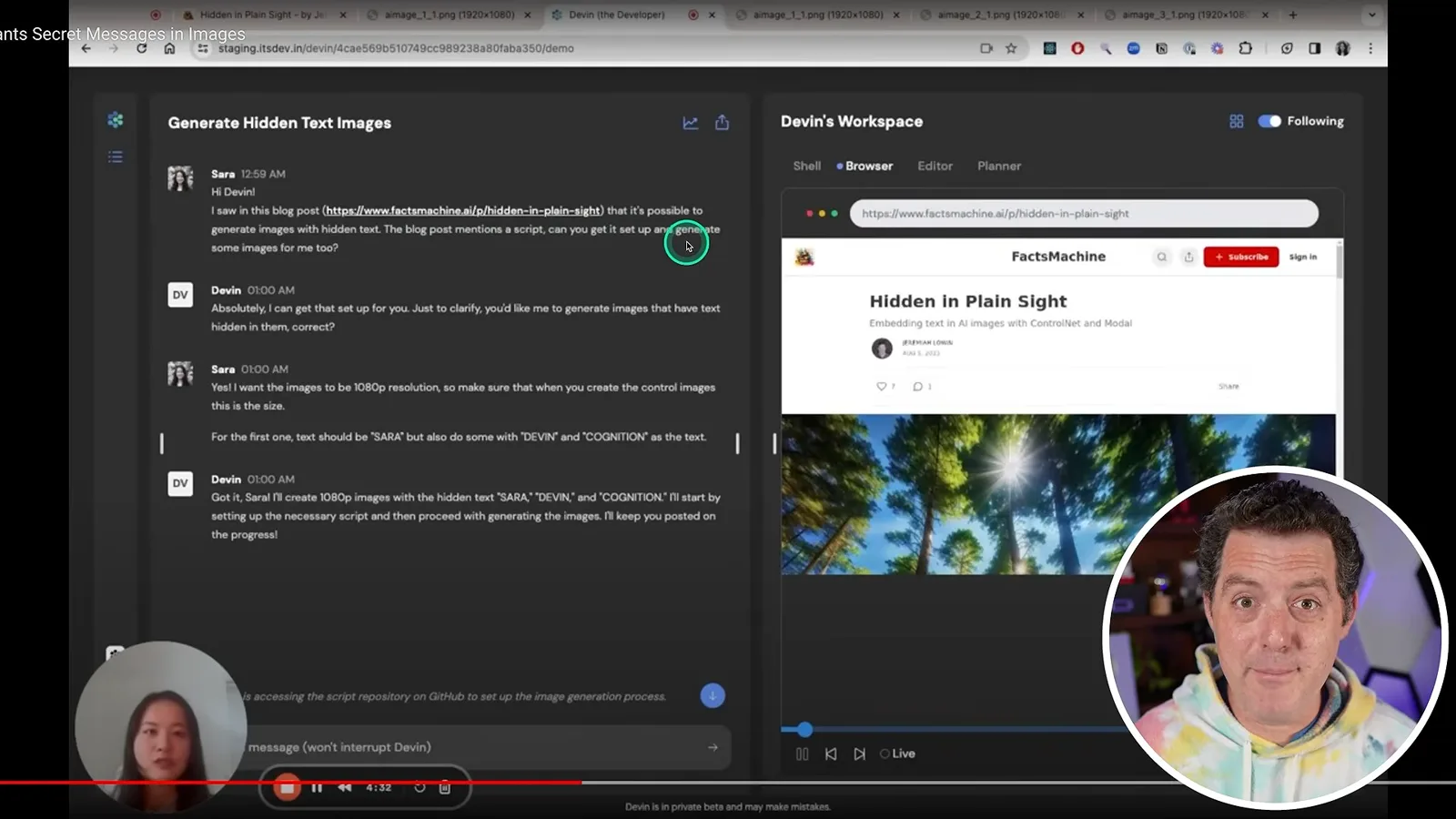
I speculated that the system was powered by GPT-4 and discussed the inability, in the early product, to choose a local model or another provider. The exact underlying model configuration was not established by the demonstration, so my claim should not be taken as confirmed architecture. Product access and model choices can also change.
In another demo, a user asks for a personal website based on Conway's Game of Life. Devin asks clarifying questions, builds a version, accepts requested changes and deploys a page where the initial pattern spells its name. I particularly like seeing the conversation and development tools together, although other assistants can also ask questions and revise code.
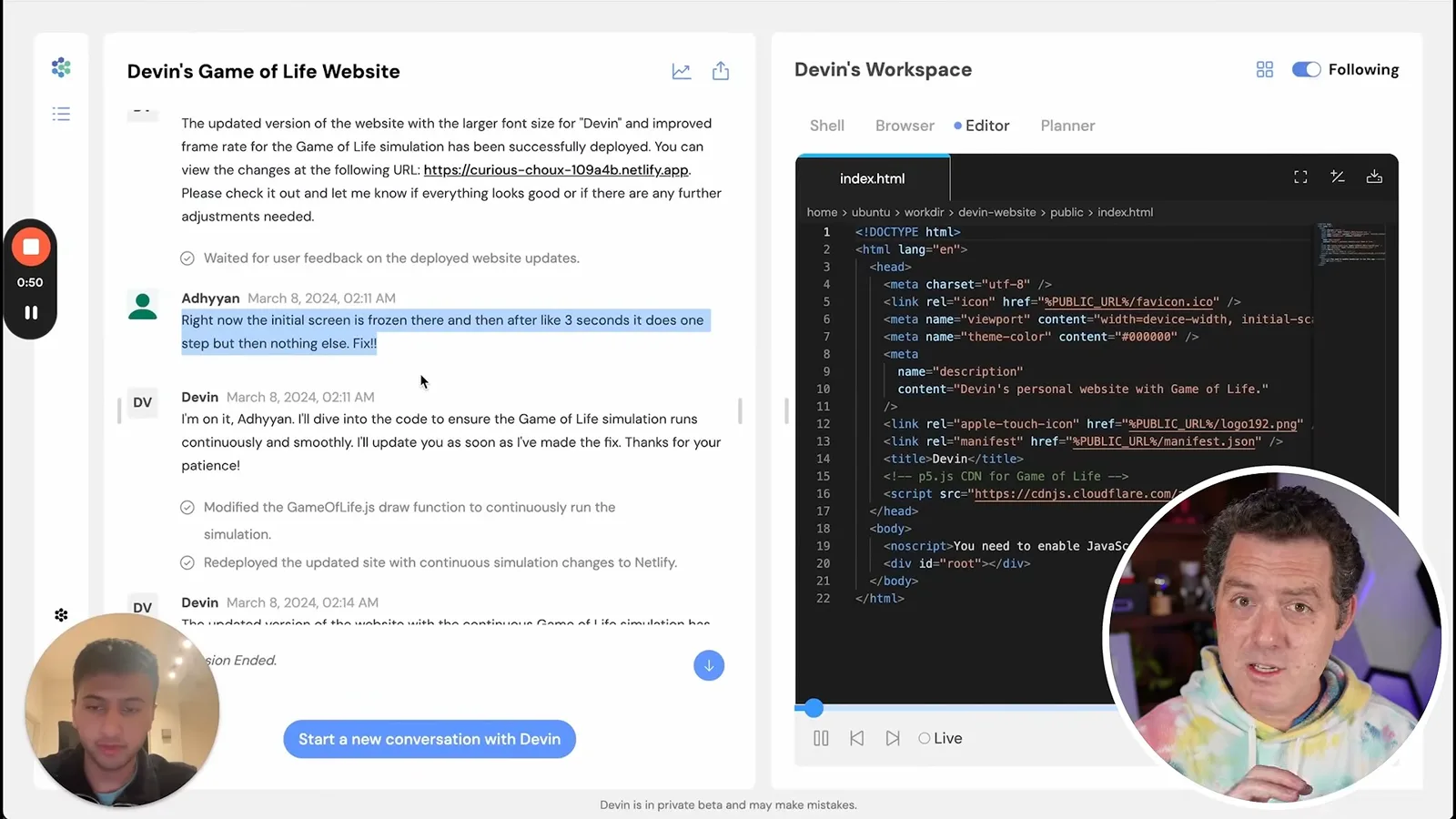
A debugging example takes an existing repository, writes and expands tests, finds a failing case and uses diagnostic print statements before making a fix. The engineer in the clip says the tests then pass. These demonstrations show a particular workflow, not proof that the agent understands or reliably fixes every large codebase.
I wonder how Devin finds relevant code and speculate about indexing or fitting a small repository into a model's context. Those are guesses: the video does not establish which retrieval technique the system uses. The scope and complexity of a repository matter when assessing a coding-agent demonstration.
Fine-tuning and repository fixes
Company demonstrations show a QLoRA training setup, an issue fix and a SymPy debugging task. Berman discusses what can and cannot be inferred from the clips.
In the next example, a Cognition demonstrator asks Devin to fine-tune a 7-billion-parameter Llama model using the QLoRA repository. The agent reads the instructions, installs dependencies and works through environment issues. QLoRA is a parameter-efficient fine-tuning method for quantized models, not evidence that the agent invented or trained the underlying base model from scratch.
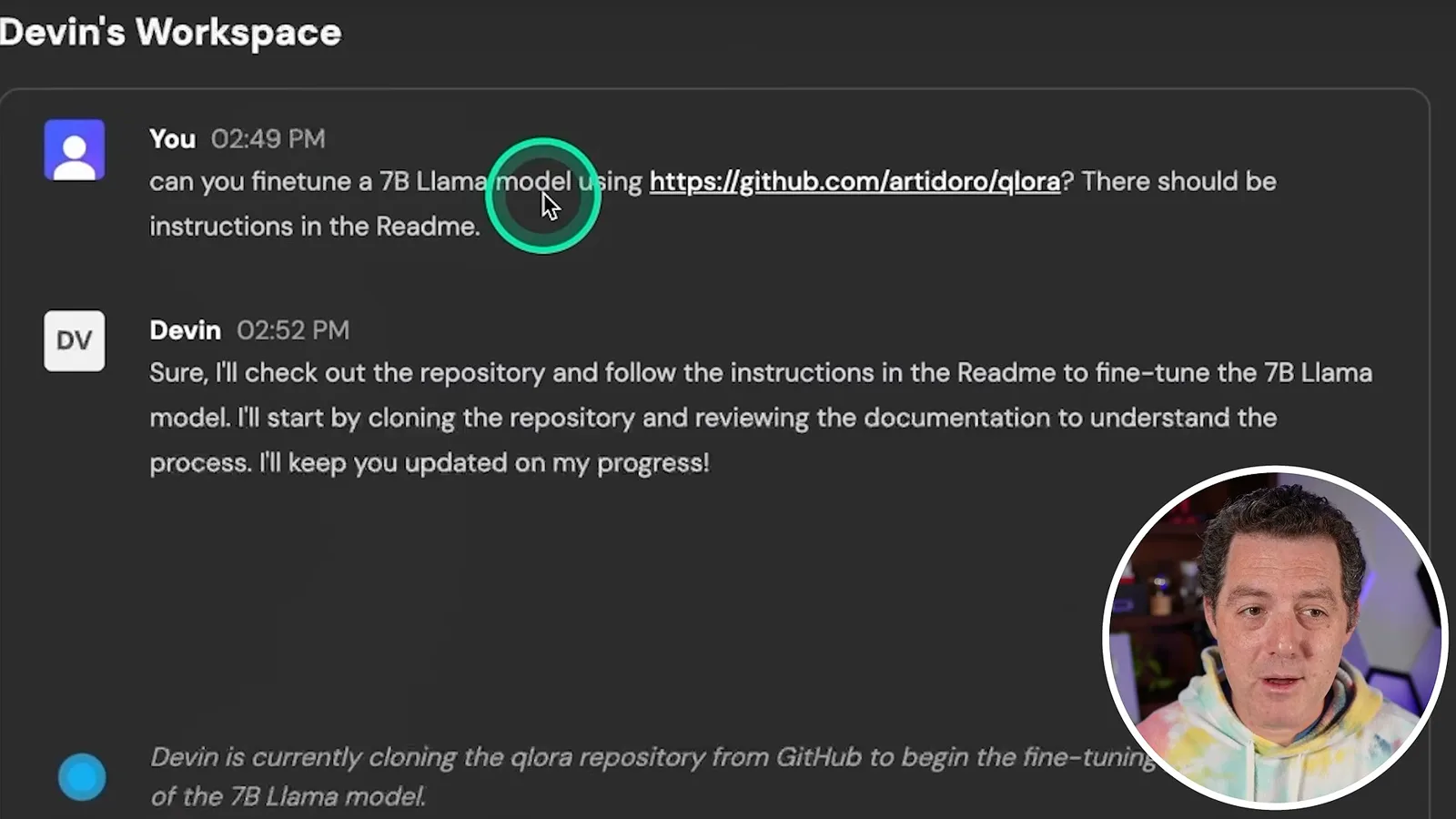
The demonstration shows a training job running and loss values being reported after package and CUDA problems are addressed. That is an example of setting up and starting a job; the clip does not independently establish the quality of the resulting model or whether every issue would be handled in another environment.
Another task asks Devin to prepare a fix for a GitHub issue without committing or pushing. The agent confirms the constraint and works on the change. This highlights how instructions and permissions affect a coding agent's workflow, and why a human should review proposed changes.
Cognition's Neal demonstrates a SymPy issue where a logarithm of a fraction produces an incorrect infinity result. He says Devin reproduces the issue, uses diagnostic output to locate integer division as the cause, changes the calculation and runs tests. The company describes this example as a SWE-bench issue.
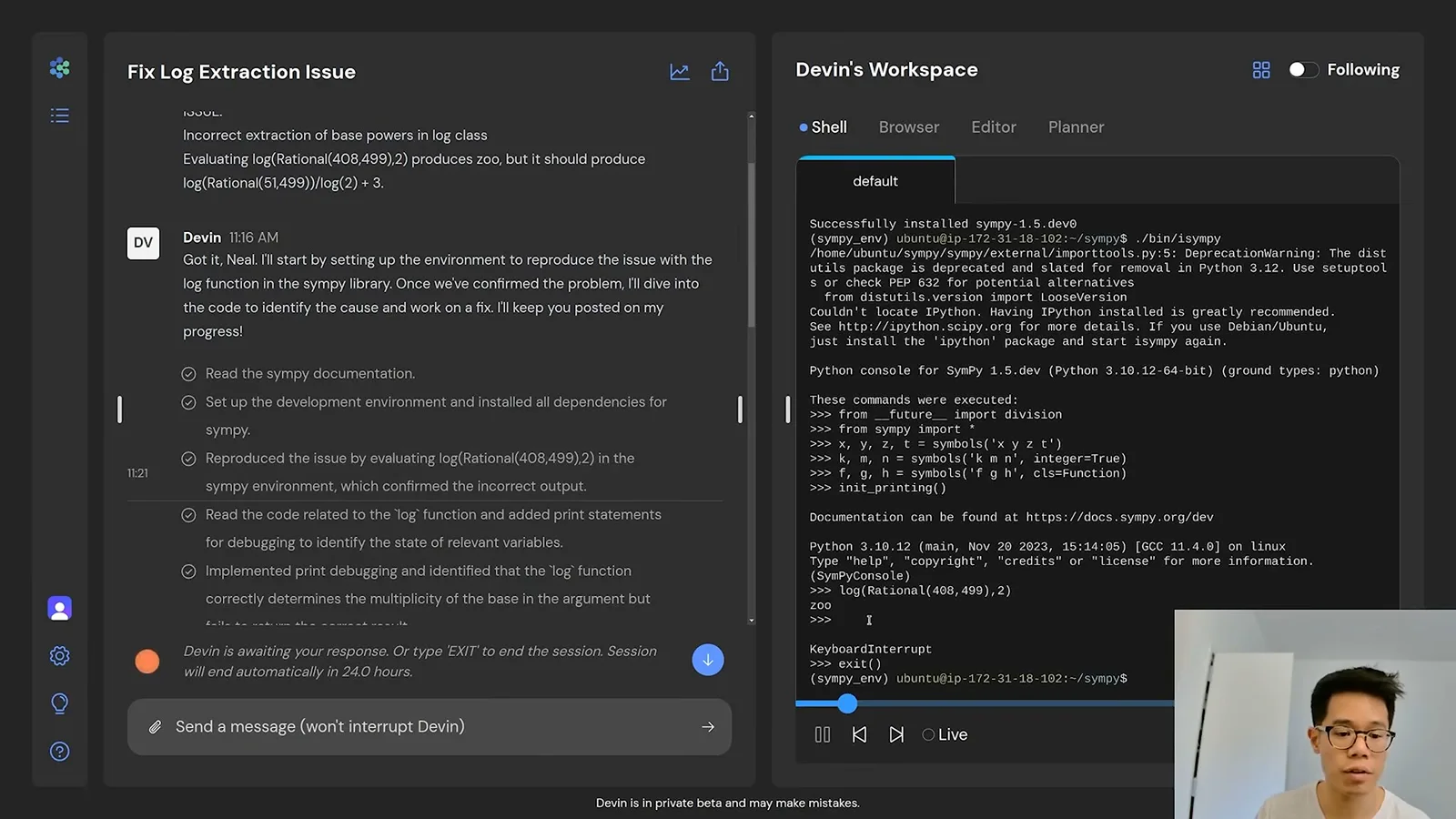
I find the example interesting but caution that the visible change appears localized to one file. I cannot establish every dependency from the edited video, and a successful fix in one repository does not prove broad understanding of all large codebases. The demonstration is evidence about this displayed case.
I want to distinguish criticism of the 'first' label from criticism of the work: I think the demos and interface are impressive, and I expect AI to change programming jobs. The employment effect is a prediction, not an outcome established by this launch.
A freelance example and benchmark results
A Cognition demonstrator presents a computer-vision task based on an Upwork job. Berman reviews SWE-bench scores and asks for comparisons with other agents under similar conditions.
Walden from Cognition presents a computer-vision task based on an Upwork job. In the company demo, Devin sets up a repository, works through dependency issues, runs a road-damage model and produces example outputs and a report. The video does not independently verify payment, client acceptance or completion of every original job requirement.
Walden describes the agent using print statements and repeated runs to trace errors and make changes. This is an illustrative sequence from the company's demonstration; it does not reveal all attempts, human intervention or failure rates across real freelance work.
Cognition reports that Devin resolved 13.86% of a random 25% subset of SWE-bench end-to-end without being told which files to edit. Its launch post contrasts that with earlier reported scores of 1.96% unassisted and 4.80% when supplied the files to edit. These are company-reported 2024 benchmark results, not current measures of general software-engineering ability.
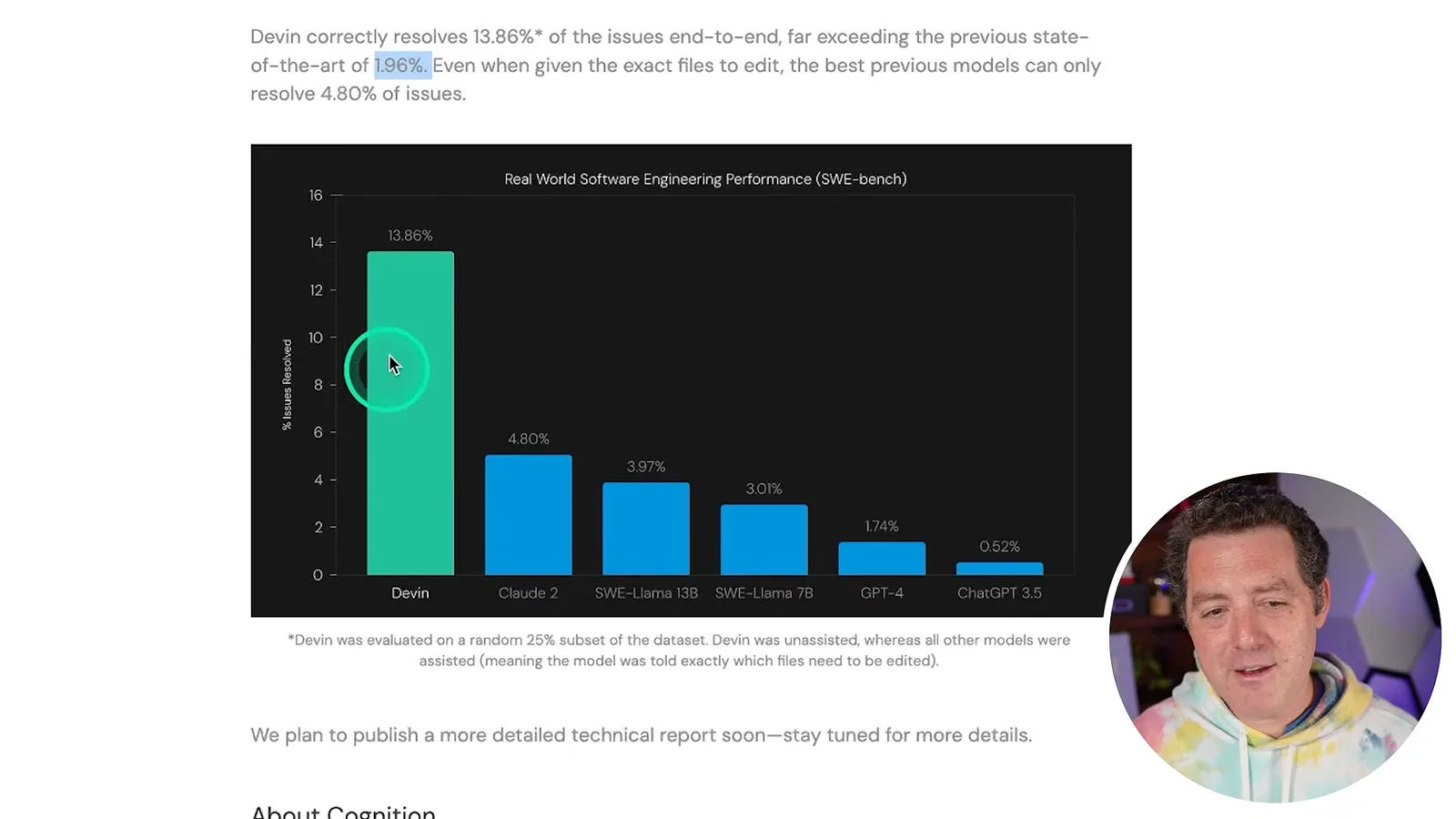
The displayed bar chart's footnote says the other displayed models were assisted by being given the files to edit, whereas Devin was unassisted. I also point out that an agent able to iterate is not directly comparable to a single model response. Both the dataset subset and differences in setup matter; the chart alone cannot determine how Devin compares with other agent frameworks.
I would like to see a comparison against coding-agent systems such as GPT Pilot and MetaGPT under the same benchmark conditions. My conclusion in 2024 is that Cognition's interface and selected demos are compelling, while its first-of-its-kind marketing and comparative claims need scrutiny. I would also prefer an open system with greater choice of models.
More from this channel
 34:21EN
 Matthew Berman· Oct 27, 2026Matthew Berman Examines Anthropic’s IPO Filing, AI Growth and GovernanceMatthew Berman, Sam Altman · Forward FutureThe presenter reviews the S-1’s financial metrics, compute strategy and voting structure while questioning the tension between rapid AI development and safety.
 0:26ENMatthew Berman· Oct 25, 2026Sam Altman on Human Values and Problem-Solving in an AI WorldSam Altman · OpenAIIn a short interview excerpt, Altman considers the enjoyment of solving hard problems and the human role in interpreting results.
 0:36ENMatthew Berman· Oct 25, 2026Kimi K3.1 and a Rubik’s Cube Solver DemonstrationMatthew Berman · Forward FutureMatthew Berman shows a scrambled virtual cube being solved and gives the Kimi K3.1 test a favorable assessment.
 0:21ENMatthew Berman· Oct 24, 2026An AI-Generated Kimi Benchmark Chart Used Invented ScoresMatthew Berman · Forward FutureMatthew Berman asks for a graph of Kimi K3.1 Pro benchmarks, then discovers that the displayed figures are illustrative placeholders.
 25:50ENMatthew Berman· Oct 24, 2026Kimi K3.1 Pro Tested: Strong 3D Demos, Uneven Results and Competitive PricingMatthew Berman · Forward FutureMatthew Berman tests the open-weight model on coding, 3D rendering and visual explanations, then compares benchmark results and prices.
 32:20ENMatthew Berman· Oct 23, 2026Who Is Local AI For? The Costs, Trade-offs and a Hybrid FutureMatthew Berman · Forward FutureMatthew Berman weighs data control and independence against hardware cost, setup complexity and inference speed.