In 30 seconds
In December 2025, Matthew Berman argues for national coordination of AI regulation, drawing on President Trump’s statement and adviser David Sacks’s explanation. He contrasts AI with California vehicle-emissions standards and discusses startups, copyright, child safety, data centers and censorship. The subsequent executive order directed federal action against certain state laws and recommended legislation; it did not automatically nullify all state AI regulation. The video contains a paid Lindy sponsorship.
- 1A national rulebookBerman endorses a federal approach and fears conflicting state requirements will burden small companies.
- 2Interstate commerceSacks argues that AI spans multiple states. Whether a state law is preempted requires a more specific legal analysis.
- 3The California car analogyBerman weighs local air-quality benefits against the costs of different emissions standards.
- 4Discrimination and censorshipBerman presents Sacks’s partisan assertions while questioning the claimed cause of a Google image-generation error.
- 5Four areas of concernSacks discusses child safety, communities, creators and censorship; Berman challenges his partisan framing.
Takeaways
- Berman supports a national AI framework because he fears inconsistent state rules could impose disproportionate costs on startups.
- Interstate commerce does not by itself settle whether a specific state law is preempted.
- The automobile analogy highlights both local regulatory benefits and potential compliance costs.
- Sacks’s claims about discrimination, child safety and local control are arguments about proposed policy, not definitive legal rulings.
- The December 11, 2025 order initiated federal actions and legislative recommendations; it did not eliminate all state AI laws.
- The video includes a paid Lindy promotion.
Read the edited text by chapter
The proposal and the jurisdictional argument
Berman reads Trump’s call for a single rulebook and explains Sacks’s interstate-commerce rationale. He argues that different state requirements could hurt startups.
President Trump has called for one national rulebook for AI and said he would issue an executive order that week. I agree that a patchwork of state rules could burden startups. This video, published December 9, 2025, examines the argument as it stood before that order was issued.
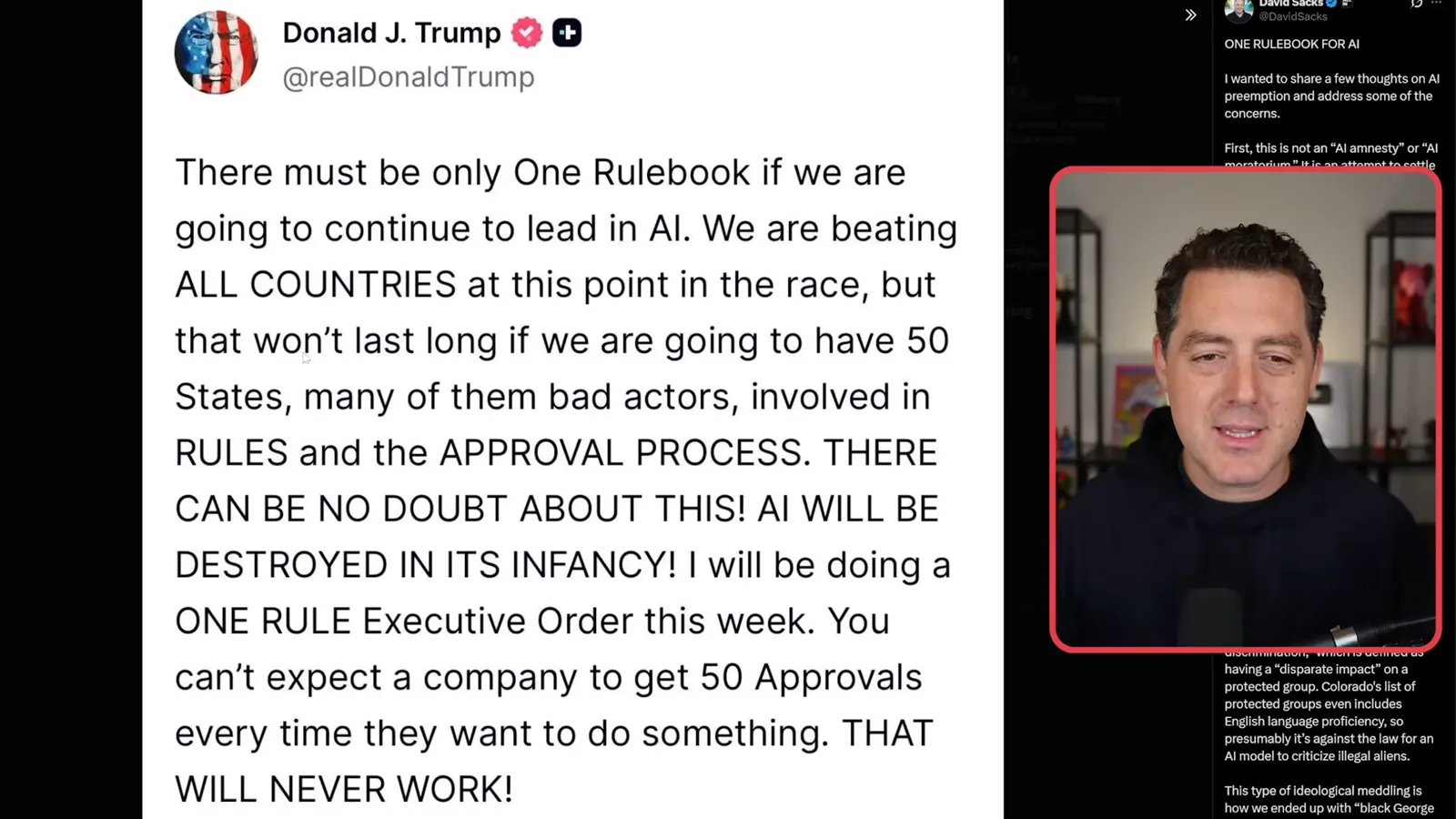
Trump warned that requiring companies to obtain approvals from 50 states would undermine AI. His AI and crypto adviser David Sacks expanded on the jurisdictional argument. Sacks framed the proposal as neither an amnesty nor a moratorium: the issue, in his telling, is whether federal or state governments should set the rules.
Several states have already passed or considered AI measures. Sacks argues that a model developed in one state, trained in another, run in a third and delivered over national networks is interstate commerce. I find the cross-border nature of AI persuasive. Whether any particular state law is preempted, however, depends on the relevant federal law and constitutional analysis; interstate activity alone does not automatically eliminate state authority.
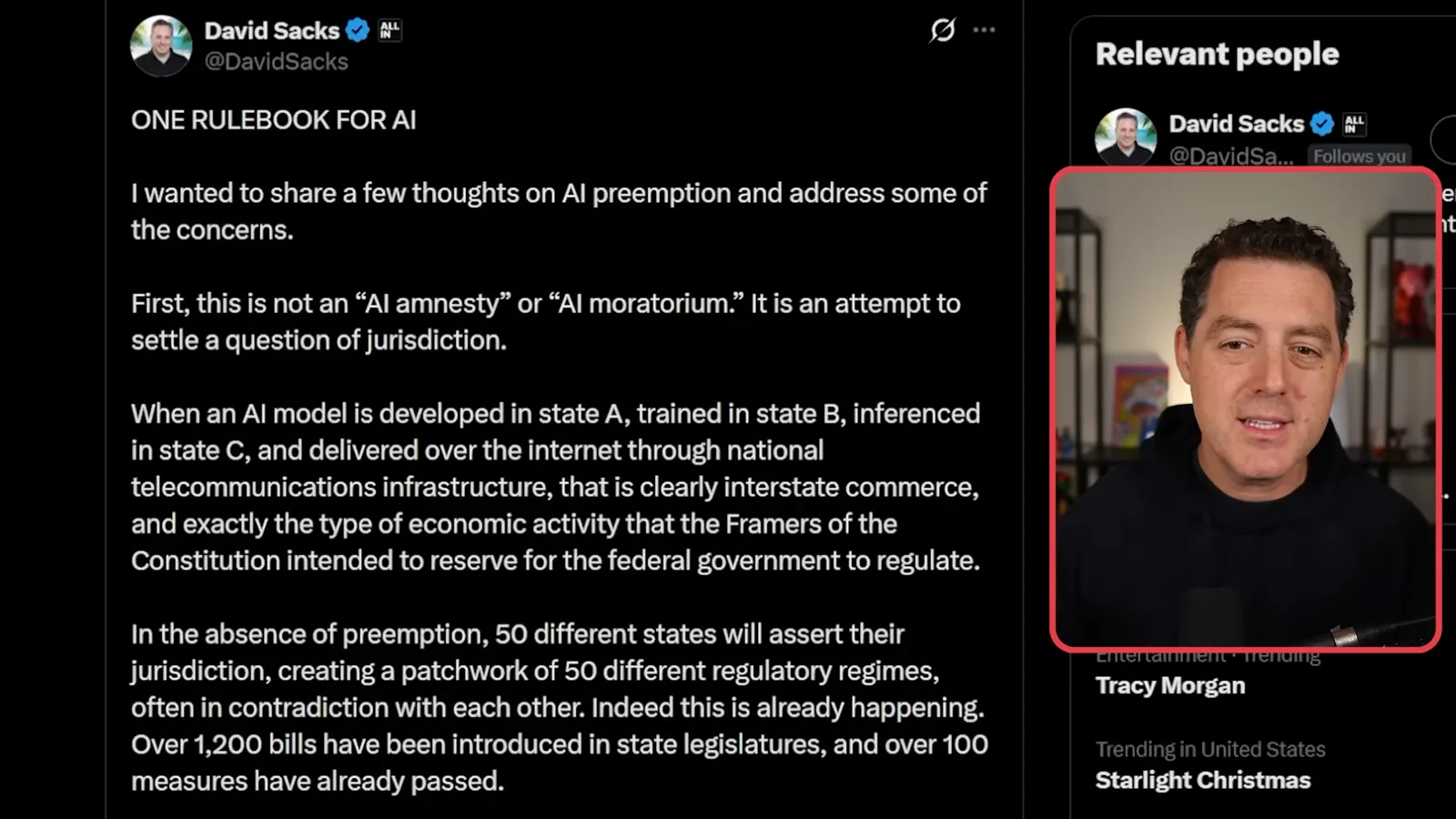
I worry that 50 differing regimes would make it very difficult for small companies to compete with well-funded firms such as Google, Meta, OpenAI and Anthropic. Imagine a five-person startup having to build different model versions and pay for lawyers to comply with rules in California, Florida, Texas and New York. That is a potential cost scenario, not evidence that existing laws require 50 versions.
Competition and sponsor
Berman contrasts US state regulation with his view of China. A paid Lindy promotion follows.
I also worry about competition with China, contrasting its centralized government with a fragmented US approach. I do not want China's system here, but I think uncoordinated state regulation would be the wrong response. The claim that a single leader can instantly redirect the entire economy is my simplified characterization, not an account of every decision in China.
The video includes a paid sponsorship from Lindy, an AI-agent platform. I describe examples such as a social-media spam monitor, an application QA agent and personal CRM management, and say the service is intended to make agent-building accessible without coding. These are promotional claims, not independently verified performance results.
California’s automobile analogy
Berman discusses state AI bill counts and compares AI regulation with vehicle emissions standards. He weighs local benefits and compliance costs.
Returning to Sacks's post, he says more than 1,200 AI bills had been introduced in state legislatures and more than 100 measures passed. I take those figures as evidence of a growing patchwork. They are his count, not a finding that all those proposals became law or that all enacted measures conflict.
The automobile industry offers a useful comparison. I grew up in Los Angeles and remember severe smog in the 1990s. California adopted stricter vehicle pollution requirements, and I remember the skies eventually clearing. That personal recollection does not establish that one measure alone caused the improvement or that it happened suddenly.
This example also makes a case for state authority: a car emits pollution where it is driven, and California had an acute local problem. But automakers faced added cost and logistics to meet different standards. I argue that companies eventually had an incentive to sell vehicles meeting California requirements more broadly; my account simplifies a complex history of federal and state standards and market choices.
AI, by contrast, may be developed in one place, trained and run elsewhere, and delivered worldwide. I think that makes national coordination more appropriate. That is a policy and legal argument, not a determination that states have no power over any AI-related activity.
For cars, emissions offer a measurable risk, even if states weigh pollution and costs differently. AI risks are less clearly defined and can cross borders: a system made or used in California could affect people elsewhere. We know some risks, but not necessarily all of them.
Discrimination, Europe and regulatory capture
Sacks’s examples lead to a discussion of partisan priorities and Google’s image generation. Berman criticizes European regulation and warns that excessive rules can favor large firms.
Different states may prioritize censorship, bias or discrimination differently. Sacks cites Colorado, California and Illinois and argues that rules on algorithmic discrimination could impose ideological constraints. His suggestion that Colorado's law would prohibit an AI model from criticizing undocumented immigrants is his interpretation, not an established legal conclusion; the laws differ in scope and application.
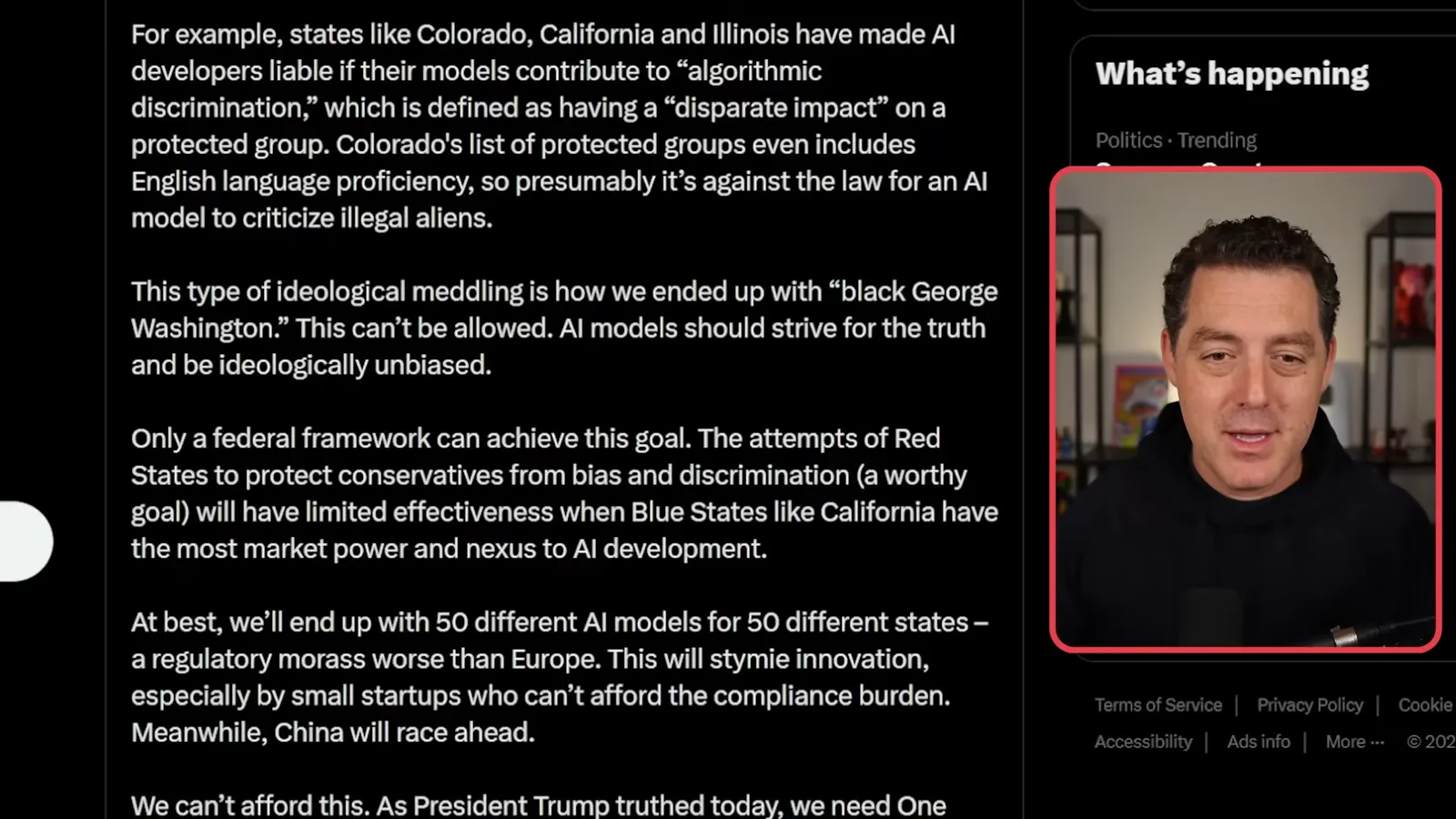
Sacks connects ideological intervention with a Google-generated image of a Black George Washington. I am not sure that his proposed cause explains the result. He argues only a federal framework can avoid divergent models and compliance obligations; those predicted outcomes should not be treated as demonstrated consequences of state law.
I see Europe as an example of regulation making innovation difficult, although others argue for its benefits. Cookie banners frustrate me and I associate them with GDPR; in practice European cookie rules also involve the ePrivacy framework, and consent and exemptions depend on the technology and circumstances. My broader judgment about European stagnation is an opinion, not evidence that regulation alone caused it.
I fear excessive compliance burdens could let large firms capture the market because startups lack the people and money to keep up. That can happen under federal rules too, not just state rules. Whether a particular proposal has that effect requires evidence about its design and actual costs.
Child safety, communities, creators and censorship
Berman reviews Sacks’s four concerns and questions his partisan account of censorship. He closes on the proposed executive order.
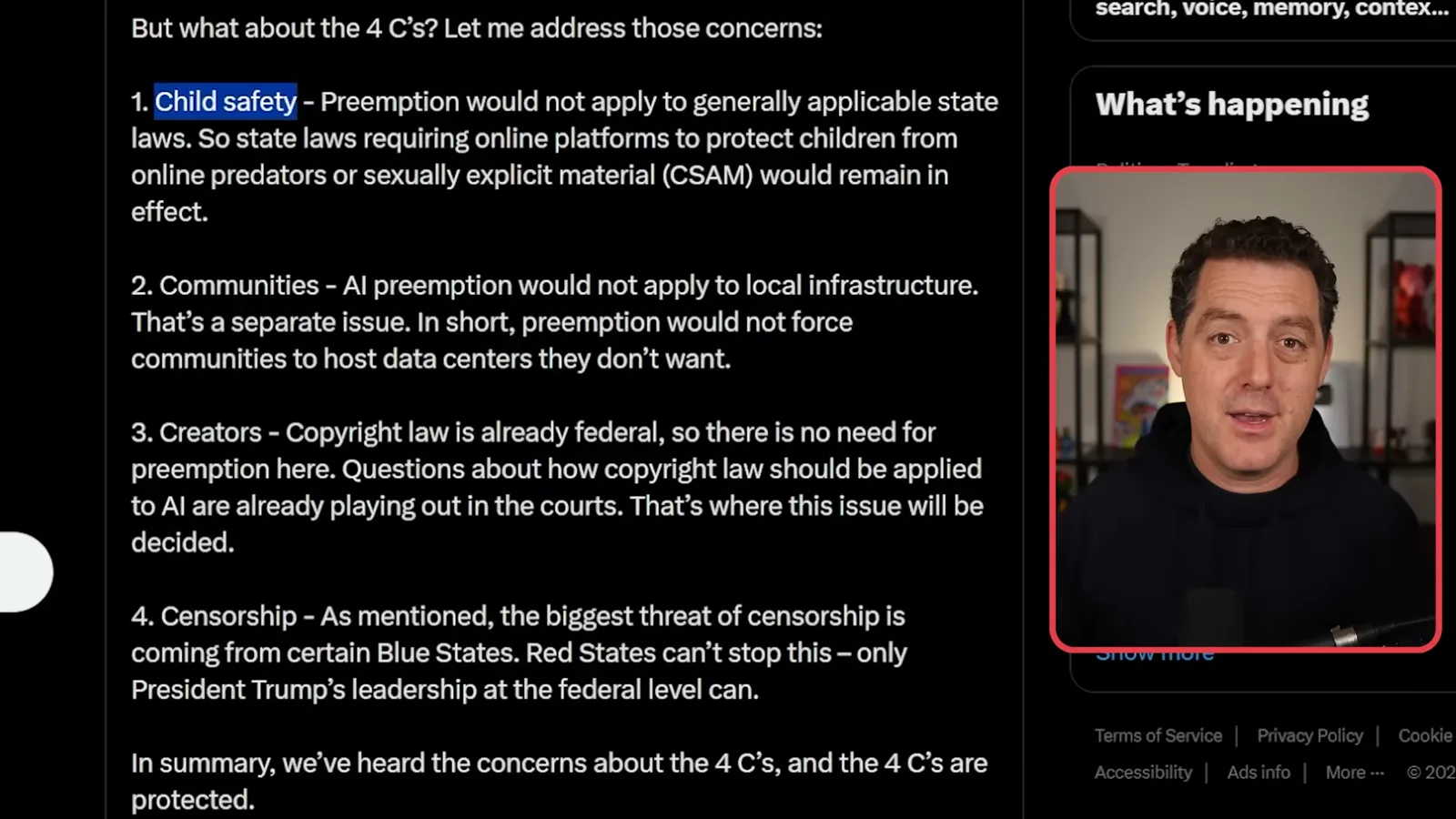
Sacks addresses child safety first, saying generally applicable state protections against online predators and sexually explicit material would remain. That is his proposed approach; the actual legal effect depends on the final text and applicable law, not his assurance alone.
On communities, Sacks says AI preemption would not force localities to host unwanted data centers. I note opposition to data centers, including concerns about electricity costs. On creators, he says copyright is already federal and the application of copyright to AI is being contested in court; those cases do not all have one settled outcome.
On censorship, Sacks argues that the greatest threat comes from some Democratic-led states and that federal leadership is needed. I regard that as a partisan claim: censorship is concerning, but I doubt it comes from only one side. He adds a fifth C, competitiveness, arguing that inconsistent rules would impede the US AI race.
At the time of recording, Trump said an executive order was coming that week. On December 11, 2025, he signed [an order](https://www.whitehouse.gov/presidential-actions/2025/12/eliminating-state-law-obstruction-of-national-artificial-intelligence-policy/) directing federal agencies to identify and challenge certain state AI laws and develop legislative recommendations. It did not itself erase every state AI law. In March 2026 the White House published a [legislative framework](https://www.whitehouse.gov/releases/2026/03/president-donald-j-trump-unveils-national-ai-legislative-framework/); a recommendation is not itself an enacted statute.
More from this channel
 34:21EN
 Matthew Berman· Oct 27, 2026Matthew Berman Examines Anthropic’s IPO Filing, AI Growth and GovernanceMatthew Berman, Sam Altman · Forward FutureThe presenter reviews the S-1’s financial metrics, compute strategy and voting structure while questioning the tension between rapid AI development and safety.
 0:26ENMatthew Berman· Oct 25, 2026Sam Altman on Human Values and Problem-Solving in an AI WorldSam Altman · OpenAIIn a short interview excerpt, Altman considers the enjoyment of solving hard problems and the human role in interpreting results.
 0:36ENMatthew Berman· Oct 25, 2026Kimi K3.1 and a Rubik’s Cube Solver DemonstrationMatthew Berman · Forward FutureMatthew Berman shows a scrambled virtual cube being solved and gives the Kimi K3.1 test a favorable assessment.
 0:21ENMatthew Berman· Oct 24, 2026An AI-Generated Kimi Benchmark Chart Used Invented ScoresMatthew Berman · Forward FutureMatthew Berman asks for a graph of Kimi K3.1 Pro benchmarks, then discovers that the displayed figures are illustrative placeholders.
 25:50ENMatthew Berman· Oct 24, 2026Kimi K3.1 Pro Tested: Strong 3D Demos, Uneven Results and Competitive PricingMatthew Berman · Forward FutureMatthew Berman tests the open-weight model on coding, 3D rendering and visual explanations, then compares benchmark results and prices.
 32:20ENMatthew Berman· Oct 23, 2026Who Is Local AI For? The Costs, Trade-offs and a Hybrid FutureMatthew Berman · Forward FutureMatthew Berman weighs data control and independence against hardware cost, setup complexity and inference speed.