In 30 seconds
Matthew Berman reacts to Boston Dynamics’ April 2024 unveiling of an all-electric Atlas following the retirement of its hydraulic predecessor. He discusses its movement, the appeal of humanoid form, the company’s existing Spot platform and the infrastructure needed to deploy robots at work. The demonstration shows a prototype, not proof of commercial readiness or general autonomy. Boston Dynamics said it would test applications with a small group of customers, beginning with Hyundai, over the following years.
- 1Electric Atlas follows hydraulic AtlasBoston Dynamics retired its hydraulic research platform and introduced an all-electric successor designed for future real-world applications.
- 2Movement in the first demonstrationBerman is impressed by the robot’s unusual joint rotation and ability to rise from the floor, shown in a controlled demonstration.
- 3Why humanoid form?Berman points to human-oriented environments and the availability of human video data as possible advantages, while their effectiveness requires testing.
- 4A testing partnership with HyundaiThe company said Hyundai would be an early testing ground and that selected customer applications would be developed over the coming years.
- 5The deployment ecosystemBoston Dynamics describes the need for IT, safety, workflows and support alongside hardware, citing over 1,500 Spot deployments at the time.
- 6Software and facility modelsThe company discusses simulation, model-predictive control, reinforcement learning, computer vision and facility data; Berman speculates about competing approaches.
Takeaways
- The new Atlas shown in 2024 uses electric actuation, succeeding Boston Dynamics’ retired hydraulic research robot.
- The unveiling shows the prototype standing from the floor and moving its joints beyond human ranges; it does not demonstrate a complete industrial task.
- Boston Dynamics planned to test and refine applications with Hyundai and other selected partners over several years.
- A practical deployment needs workflows, safety, connectivity, operational support and facility data as well as the robot itself.
- Berman’s comparison of control strategies among robot companies is an interpretation, not a verified description of their complete systems.
Read the edited text by chapter
A new electric Atlas
Berman introduces the electric prototype and plays its unveiling. He contrasts it with the retired hydraulic Atlas and reflects on its design.
Boston Dynamics retired its hydraulic Atlas research robot and unveiled a new all-electric version in April 2024. The brief demonstration is striking: Atlas rises from the floor through unusual joint rotations and walks away. I am impressed by the movement and futuristic appearance, but the footage shows a controlled prototype demonstration, not a complete industrial deployment.
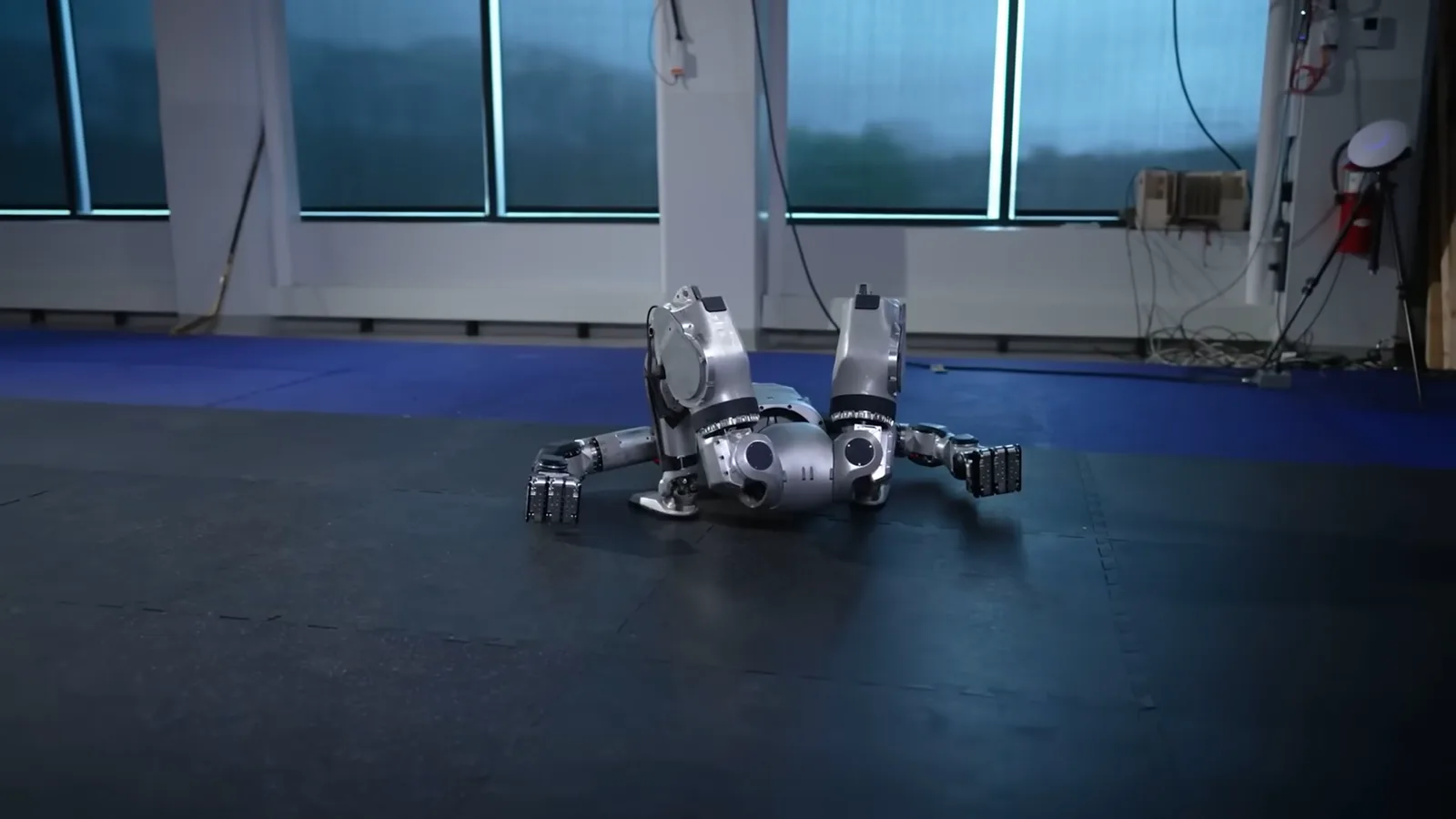
The speed, movement and head design make this one of the most interesting-looking robots I have seen. Appearance may matter if humanoid robots eventually enter homes, although that is a future possibility rather than a demonstrated use for this machine. Boston Dynamics describes the new platform as all-electric, in contrast to the hydraulic actuation of the retired Atlas.
I have followed Boston Dynamics’ videos for years, and the progression of Atlas is remarkable. Earlier research demonstrations included dynamic movement and parkour. The company says the electric platform builds on that history while aiming at real-world applications; it does not claim that the 2024 prototype is already generally available for commercial work.
Spot and the humanoid form
He compares the growing robotics field with the commercial Spot platform. He suggests reasons robots may adopt human-like forms.
The robotics landscape now includes many companies, including 1X and Figure. Boston Dynamics already has a commercial quadruped, Spot, used for tasks such as inspection in industrial or hazardous environments. Its existing deployments should not be confused with completed deployments of the new Atlas.
Why build humanoid robots? I see two possible reasons. Much of the built environment and many workflows are designed around human bodies, while the abundance of videos of people may provide useful training data. Neither factor alone guarantees that a humanoid can safely replace a person or that human video transfers directly to robot skills.
Hyundai testing and manipulation
Boston Dynamics plans to begin testing Atlas applications with Hyundai. Berman discusses the robot’s movement and planned gripper variations.
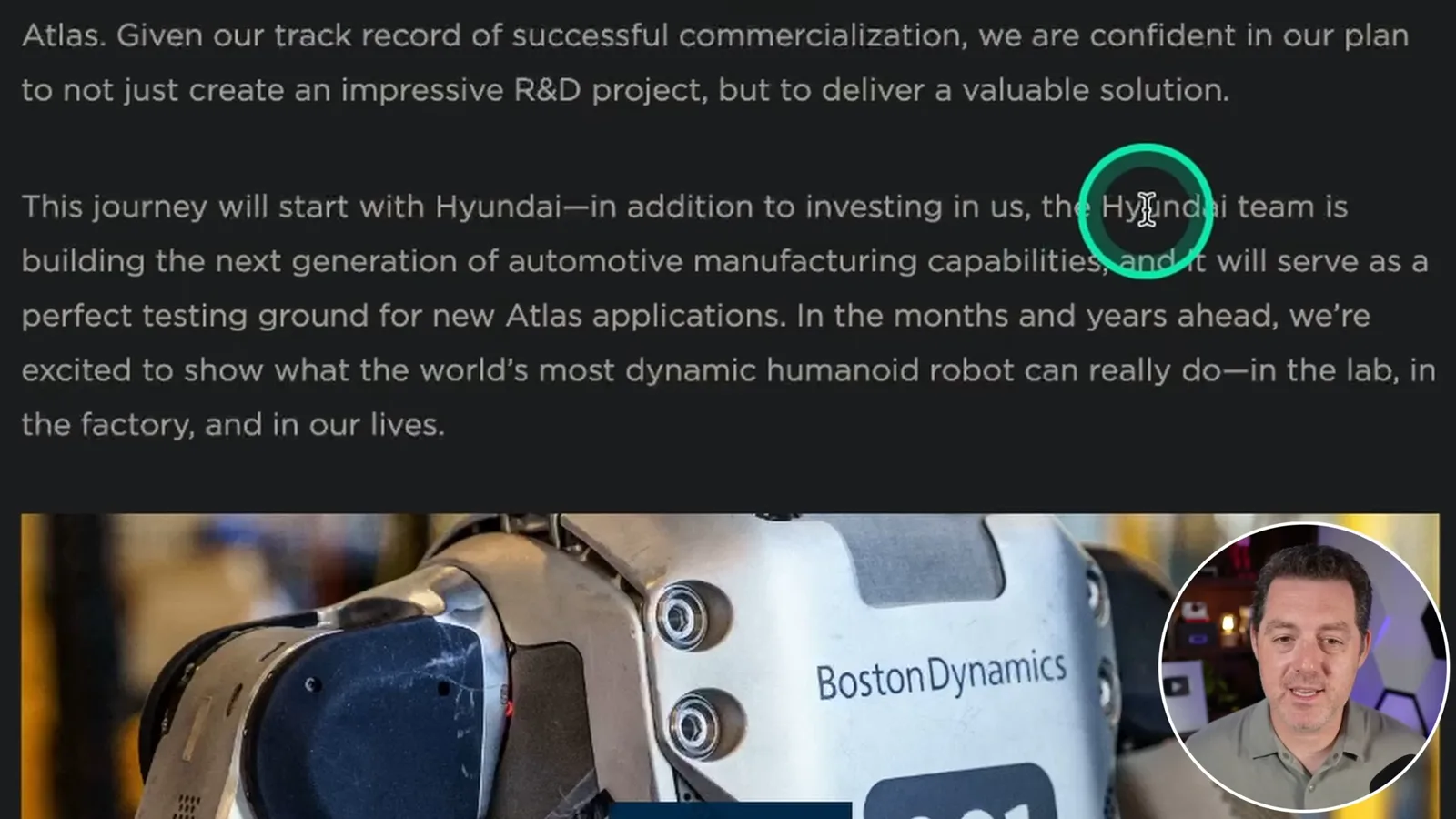
Boston Dynamics says the journey will begin with Hyundai, its investor and a potential automotive-manufacturing testing ground. Its [2024 announcement](https://bostondynamics.com/blog/electric-new-era-for-atlas/) says it plans to test and refine Atlas applications with a small group of customers over the following years. This is a commercialization plan, not evidence that the newly unveiled robot was already ready for broad sale.
I find Atlas’ motion exceptionally impressive, particularly the way it gets up from a flat position. Boston Dynamics says the electric version is intended to be stronger and have a broader range of motion than previous generations. Those are company claims about the platform; the brief launch video does not establish comparative performance across every humanoid robot.
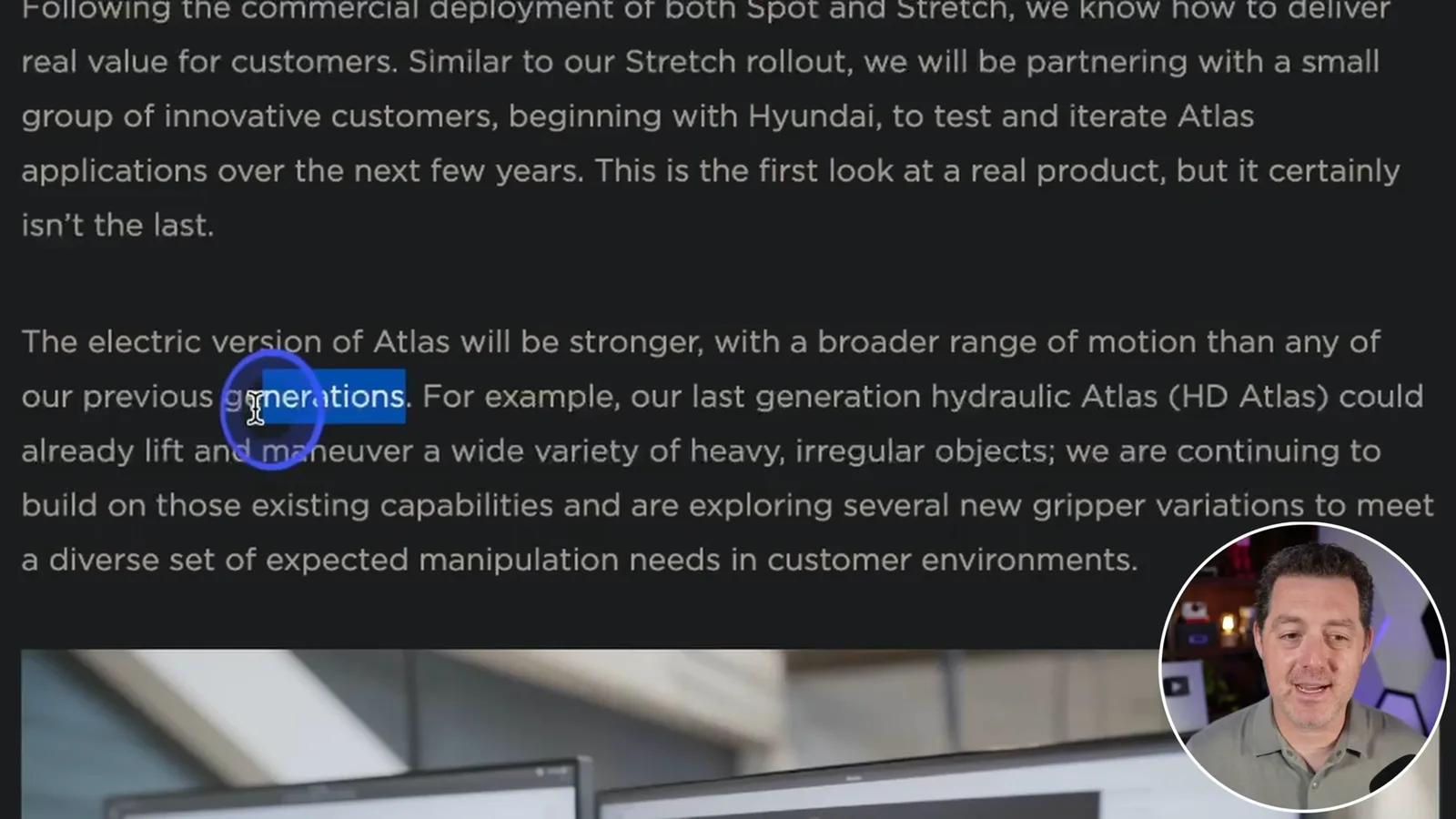
The company says its previous hydraulic Atlas could manipulate heavy, irregular objects and that it is exploring new gripper variations for customer needs. I compare that with Spot’s configurable attachments: different jobs may call for different tools. The specific commercial manipulation abilities of the new Atlas still have to be tested.
The deployment ecosystem and software
Hardware must be supported by infrastructure, safety and operational processes. Berman discusses facility models, simulation and machine learning.
A capable robot is only part of a commercial solution. Boston Dynamics points to IT infrastructure, connectivity, employee buy-in, workflows, safety standards and operational processes. At the time of its announcement, the company cited more than 1,500 Spot deployments as experience helping organizations work with mobile robots.
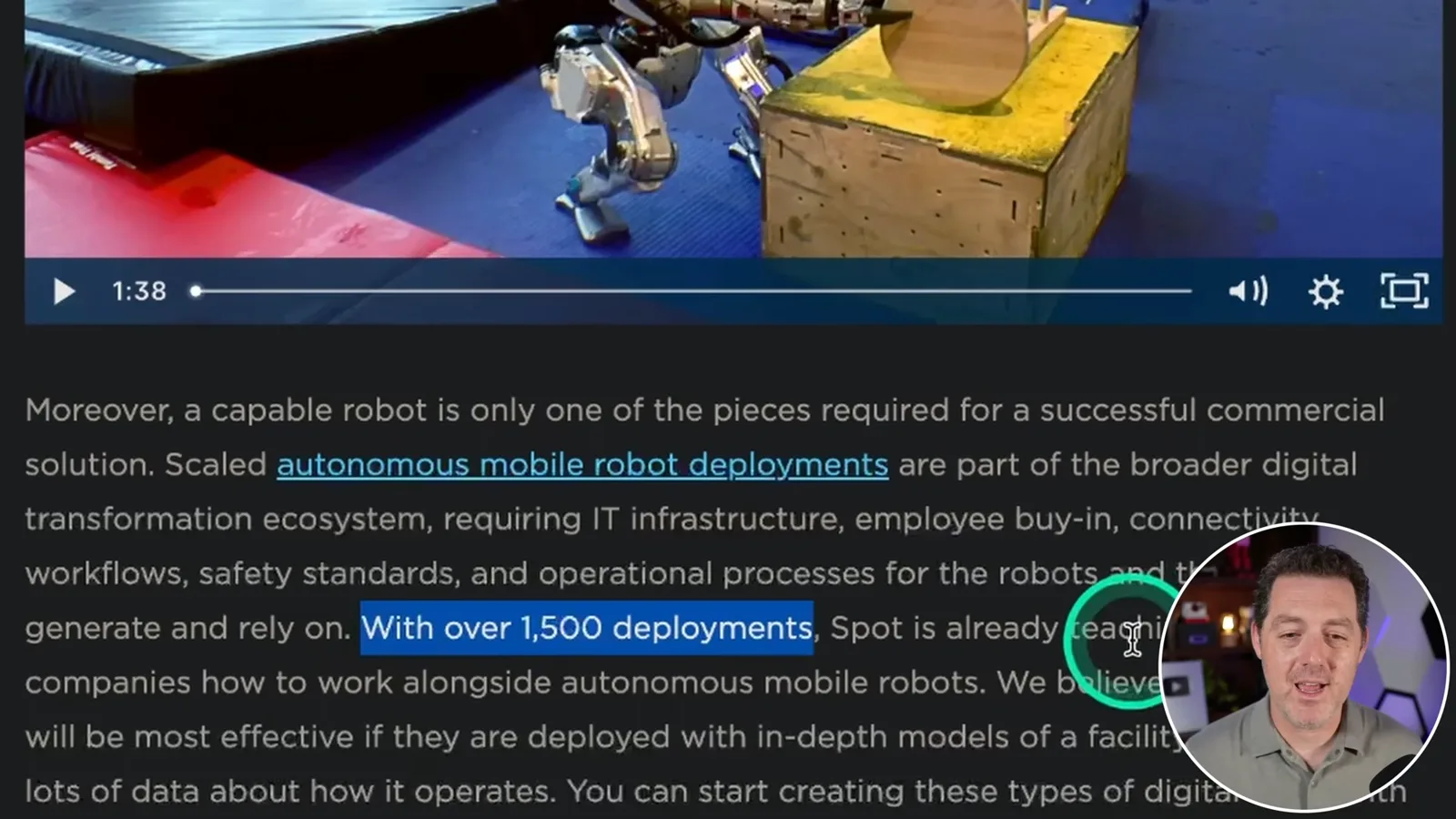
Boston Dynamics argues that detailed facility models and operational data can help humanoids work effectively, and says Spot can help create digital twins. I wonder how that compares with the end-to-end neural approaches discussed by Tesla and Figure. That is my reading of limited public information, not proof that their robots lack maps or other supporting systems.
The company also describes experience with simulation and model-predictive control, plus reinforcement learning and computer vision. I wonder whether it will build everything itself or use tools from companies such as NVIDIA. Its Orbit software provides centralized fleet and site-data management; the 2024 announcement said it was available for Spot, with Stretch and Atlas integration planned.
Mobility beyond human limits
The company explains why it builds legged robots and why Atlas need not share human joint limits. Berman returns to the demonstration.
Boston Dynamics traces Atlas back through PETMAN and the hydraulic robot’s parkour research. It says legged machines can balance and move dynamically across difficult or unfamiliar terrain, and that a humanoid shape fits environments designed for people. The shape, however, does not require the robot to copy the limits of human joints.
That design choice is clear in the launch clip: Atlas rotates its legs and pushes itself up in a way a person cannot. I find the approach exciting and want to see more demonstrations. This is a mobility demonstration, not proof of autonomous performance across factory tasks; the video closes by replaying the clip.
The video description also promotes Pinecone, a vector database service, but does not specify the terms of that promotion. The rest of the presentation focuses on Boston Dynamics’ public announcement and Berman’s reaction.
More from this channel
 34:21EN
 Matthew Berman· Oct 27, 2026Matthew Berman Examines Anthropic’s IPO Filing, AI Growth and GovernanceMatthew Berman, Sam Altman · Forward FutureThe presenter reviews the S-1’s financial metrics, compute strategy and voting structure while questioning the tension between rapid AI development and safety.
 0:26ENMatthew Berman· Oct 25, 2026Sam Altman on Human Values and Problem-Solving in an AI WorldSam Altman · OpenAIIn a short interview excerpt, Altman considers the enjoyment of solving hard problems and the human role in interpreting results.
 0:36ENMatthew Berman· Oct 25, 2026Kimi K3.1 and a Rubik’s Cube Solver DemonstrationMatthew Berman · Forward FutureMatthew Berman shows a scrambled virtual cube being solved and gives the Kimi K3.1 test a favorable assessment.
 0:21ENMatthew Berman· Oct 24, 2026An AI-Generated Kimi Benchmark Chart Used Invented ScoresMatthew Berman · Forward FutureMatthew Berman asks for a graph of Kimi K3.1 Pro benchmarks, then discovers that the displayed figures are illustrative placeholders.
 25:50ENMatthew Berman· Oct 24, 2026Kimi K3.1 Pro Tested: Strong 3D Demos, Uneven Results and Competitive PricingMatthew Berman · Forward FutureMatthew Berman tests the open-weight model on coding, 3D rendering and visual explanations, then compares benchmark results and prices.
 32:20ENMatthew Berman· Oct 23, 2026Who Is Local AI For? The Costs, Trade-offs and a Hybrid FutureMatthew Berman · Forward FutureMatthew Berman weighs data control and independence against hardware cost, setup complexity and inference speed.