In 30 seconds
Matthew Berman argues that OpenAI’s January 2026 announcements form a coordinated push to expand access and monetize users. He compares revenue and compute growth, discusses a low-cost tier and advertising, and considers bundling and competition from Google. His account includes hypothetical economics and a reading of OpenAI’s motives; the article identifies where these differ from verified announcements and adds relevant later context.
- 1Compute and revenueOpenAI reported rising compute capacity alongside rising revenue run rates. The correlation alone does not prove that compute is the only limit on growth.
- 2A cheaper tierGo expanded beyond its earlier India launch, with an announced US price of $8 monthly in January 2026. Its margins were not disclosed.
- 3Advertising arrivesOpenAI announced an ad test for eligible US Free and Go users, promising separation from responses and privacy from advertisers.
- 4A hypothetical ad businessBerman’s billion-user math uses assumed user numbers and monetization rates rather than observed ChatGPT ad revenue.
- 5Google’s distributionBerman sees Google’s existing users, products and revenue as major advantages in AI competition.
Takeaways
- OpenAI reported more than $20 billion in annualized revenue run rate, not $20 billion in profit or necessarily in full-year revenue.
- ChatGPT Go was introduced as a lower-cost subscription; its profitability is not disclosed.
- OpenAI planned labeled ads for eligible Free and Go users, with privacy and answer-independence commitments.
- A billion-user ad-revenue calculation is an illustration built on assumptions, not a measured outcome.
- Personalization, bundling and distribution could shape competition, but Berman’s claims about their future effects are hypotheses.
Read the edited text by chapter
Revenue and compute
Berman describes OpenAI’s growth flywheel and compares reported compute capacity with annualized revenue. He examines an outside estimate of losses and its uncertainties.
OpenAI made three announcements in the same week: revenue figures, an $8 ChatGPT subscription and plans to introduce ads. I think they fit together as a strategy to expand the market while creating new ways to monetize it. The video was recorded in January 2026, so its prices, product features and forecasts describe that moment.
CFO Sarah Friar described a flywheel: compute enables research and stronger models, better products drive adoption, and adoption brings revenue that can fund more compute. [OpenAI's announcement](https://openai.com/index/a-business-that-scales-with-the-value-of-intelligence/) said both weekly and daily active users were reaching highs; I referred to weekly and monthly users in the video.
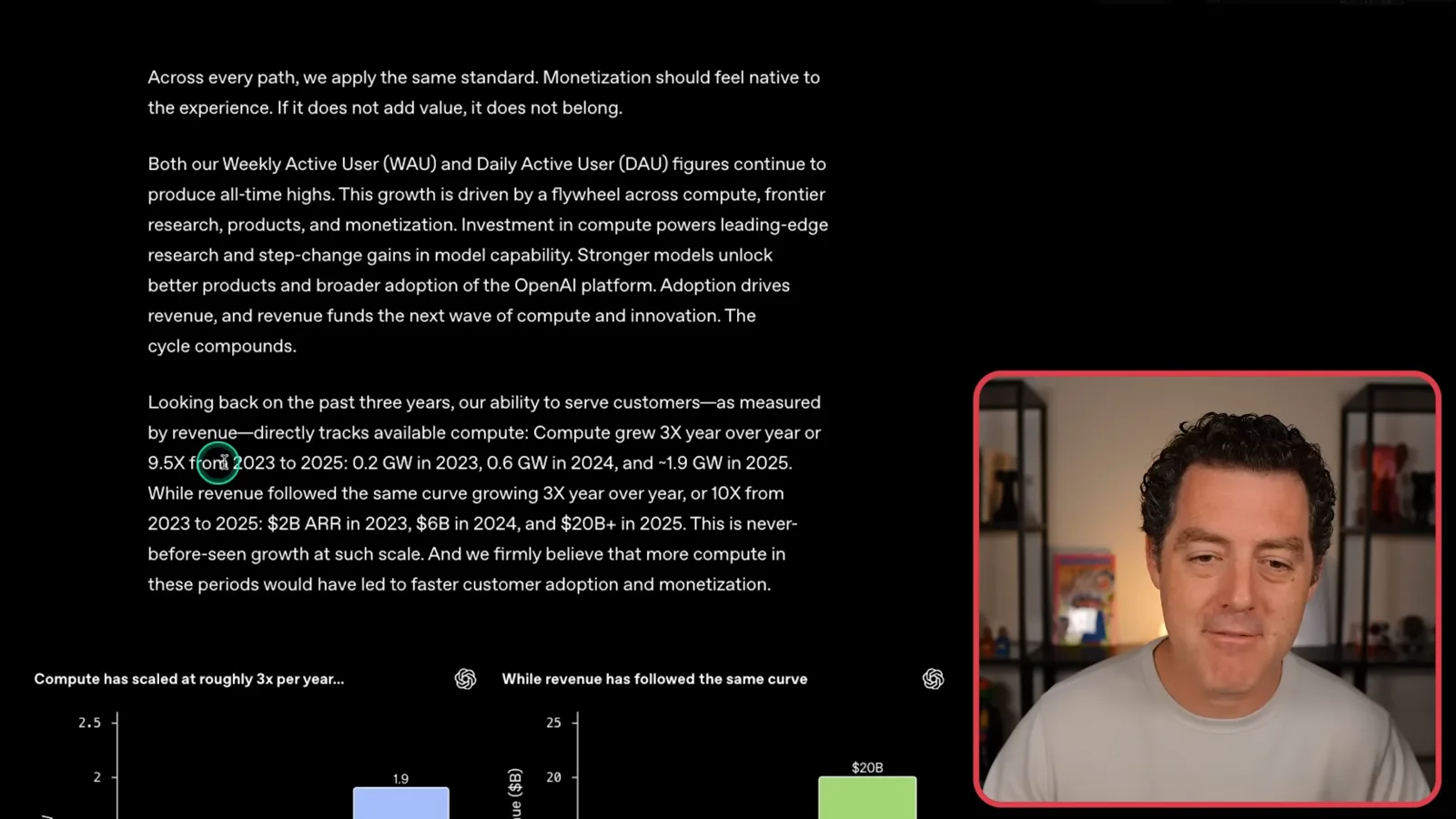
OpenAI reported compute capacity of 0.2 gigawatts in 2023, 0.6 in 2024 and about 1.9 in 2025, alongside annualized revenue run rates of $2 billion, $6 billion and more than $20 billion. Those are run rates, not full-year revenue or profit. I see a close relationship between compute and revenue, though three observations do not establish that GPUs are the only constraint on growth.
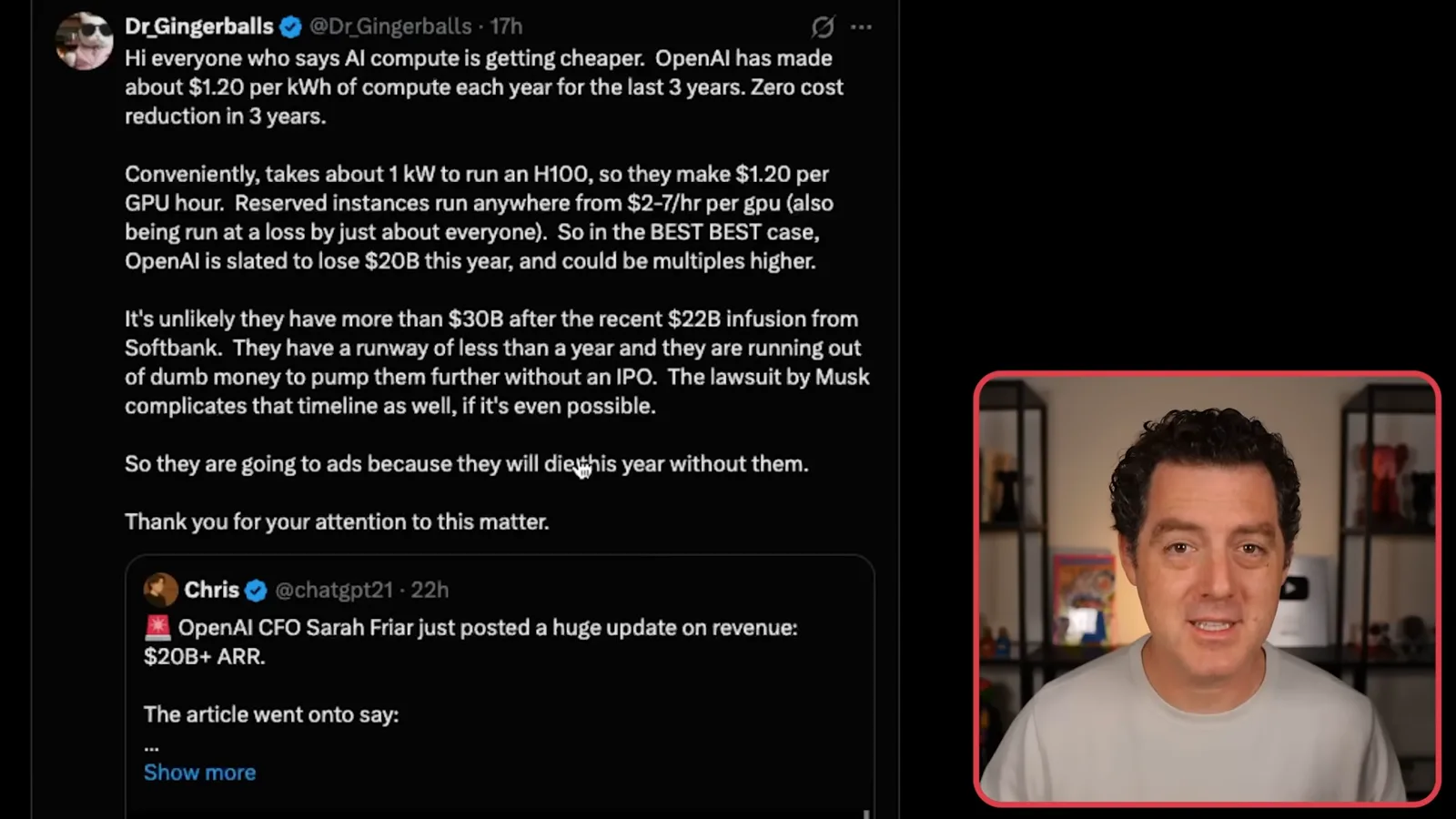
OpenAI did not disclose profitability in that post. A commentator estimated revenue per unit of compute capacity and compared it with the rental cost of an H100, suggesting a possible $20 billion loss. That is a speculative calculation: capacity, utilization, chip mix, costs and other expenses are not fully known, and revenue per kilowatt-hour is not itself a measure of operating cost.
One projection discussed in the video put future revenue around $100 billion within three years. Continued growth, new products, enterprise adoption and a possible consumer device could contribute, but a forecast is not a result. I also look at Anthropic for context: the reported rise in its revenue run rate shows a fast-growing competitor, not proof of its exact revenue mix.
Revenue mix and ChatGPT Go
He contrasts OpenAI with Anthropic and discusses business adoption data. A lower-cost subscription may expand the addressable market.
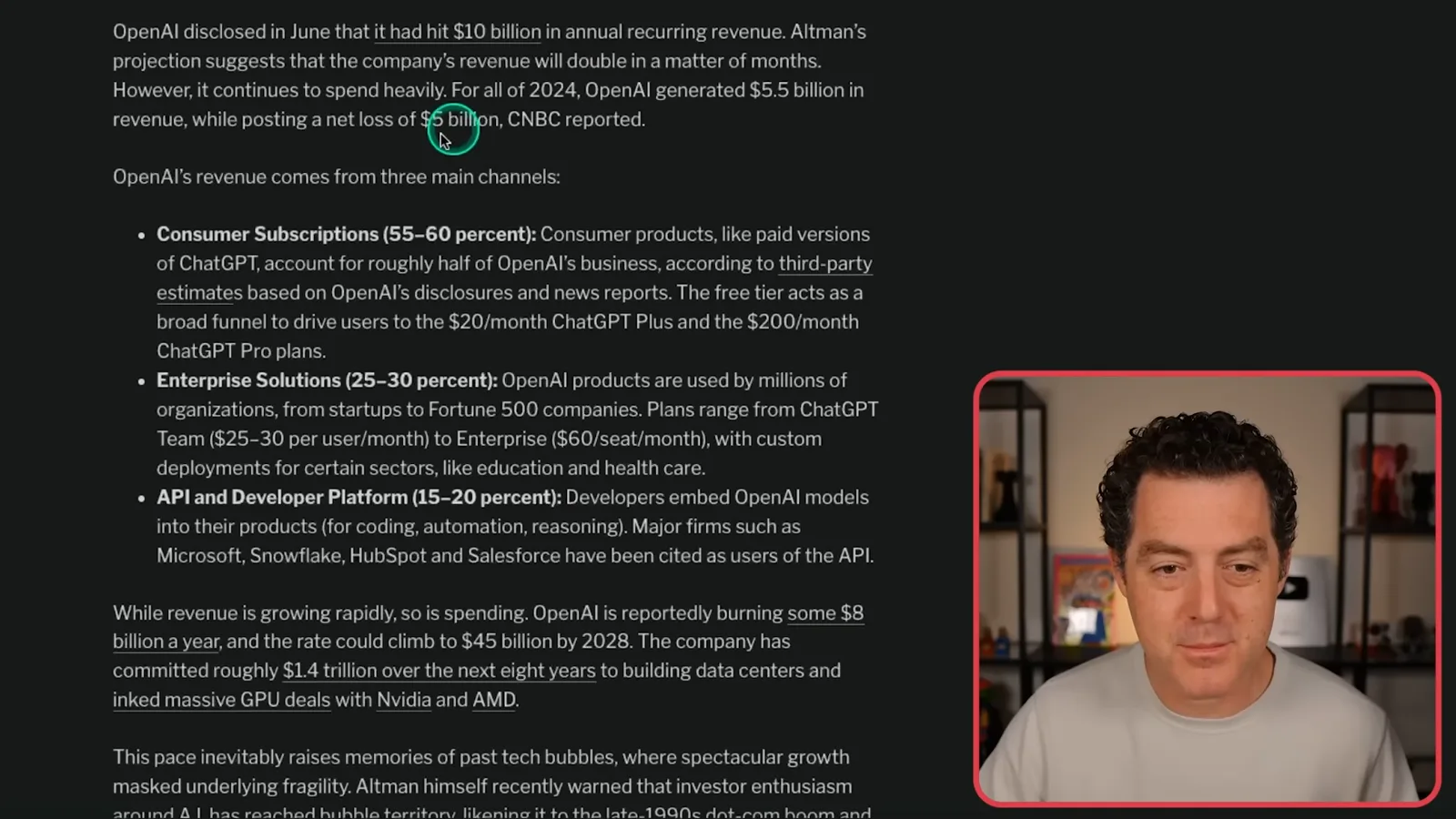
I associate Anthropic's strength with coding and API use, including integrations in tools such as Cursor and Claude Code. My contrast is that OpenAI has a large subscription business. An outside estimate displayed in the video assigns 55–60% of OpenAI revenue to consumer subscriptions, 25–30% to enterprise and 15–20% to APIs; these are estimates, not verified company disclosures.
A Ramp report on AI adoption among its customers places OpenAI ahead in the chart I show. That is useful evidence about that sample of business spending, but it does not establish universal market share. The next part of the strategy, in my view, is getting more people onto a paid tier they can afford.
[ChatGPT Go](https://openai.com/index/introducing-chatgpt-go/) began in India in August 2025 and was being expanded globally in January 2026, with a US price of $8 per month and localized pricing elsewhere. I think it addresses customers for whom the $20 plan is too expensive. The price and features described here are historical and may have changed.
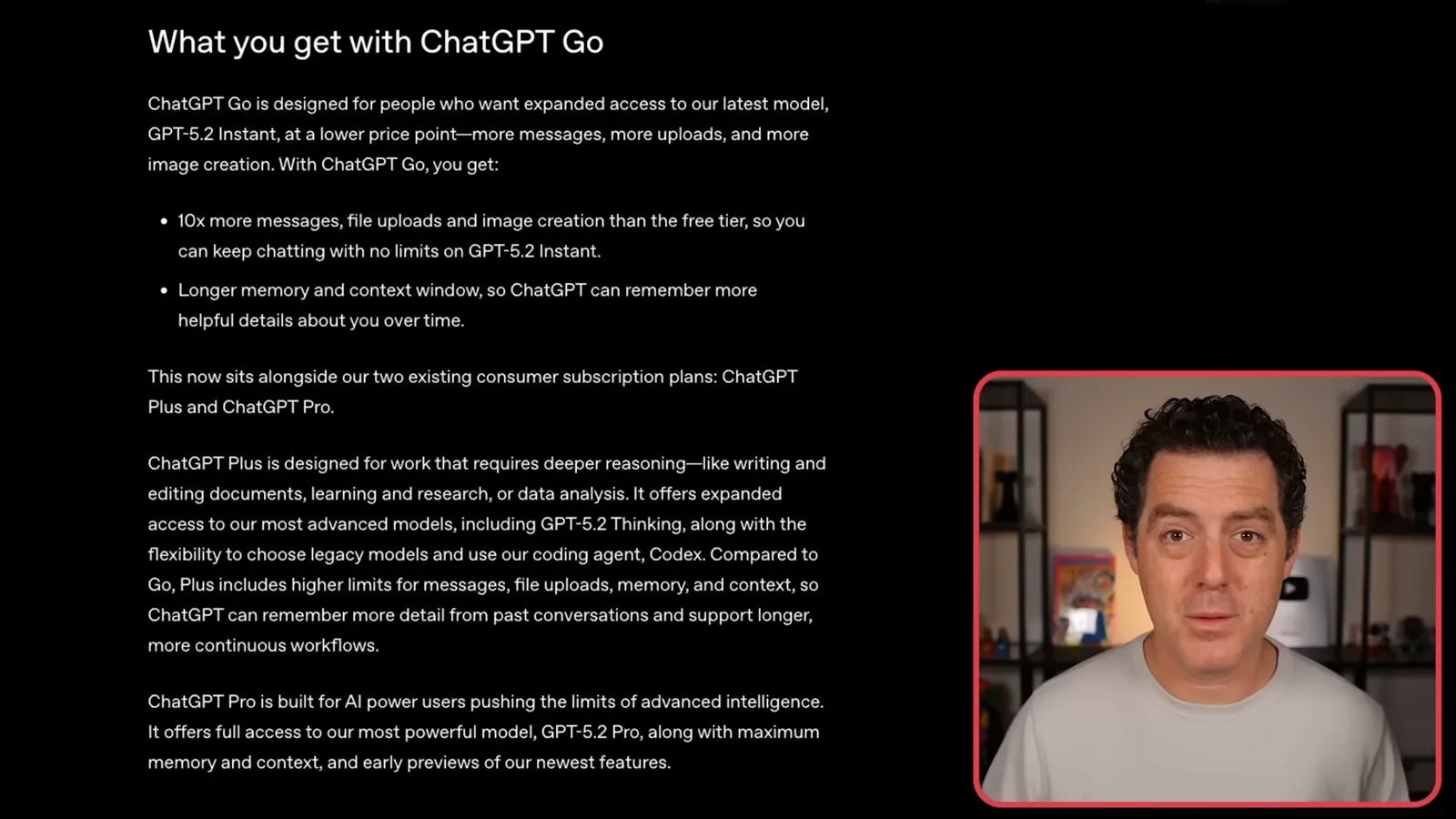
At that time OpenAI described Go as offering ten times the free-tier allowance for messages, uploads and image generation, with access to GPT-5.2 Instant. I interpret the emphasis on a faster model as a way to serve a wider audience more efficiently. The company did not disclose that model's size or the plan's per-user costs, so its margins cannot be inferred from the announcement.
I suspect Go might function as a loss leader: attract users at a low price now and earn more from them later. Some subscribers will use very little and others much more, and I do not know the mix. Whether the plan actually loses money is unverified; the larger point is my hypothesis about market capture, not a disclosed financial result.
Retention and bundling
Berman discusses personalization, training data, hardware and the possibility of bundling products for businesses.
An AI assistant can become harder to leave as it remembers preferences and becomes more useful to an individual. Familiarity at home might also influence what employees want at work. I see potential for cheaper inference and hardware partnerships to improve economics over time, although the [Cerebras partnership](https://openai.com/index/cerebras-partnership/) is an announced deployment plan, not proof of a particular cost saving.
I argue that usage can provide useful feedback and data for future models, but my claim that all user data is used for training was too broad. OpenAI says business, Enterprise and Education data is not used to train models by default, and consumer users have controls over training. The [company's data guidance](https://help.openai.com/en/articles/8554407-gpts-in-chatgpt) describes those distinctions.
Personalization may also matter if OpenAI launches a consumer device: a person already familiar with ChatGPT could consider carrying that relationship into new hardware. That is a possible future buying decision, not an announced device design or a demonstrated outcome. I think consumer familiarity might also help OpenAI reach enterprise knowledge workers beyond coding.
Bundling means selling products together for one price. I use Microsoft Teams and Slack to illustrate how an established supplier can distribute an additional product through an existing customer base. I prefer Slack, but the product comparison and my claim that bundling explains the growth gap are opinions; the chart alone does not establish a cause or a legal finding.
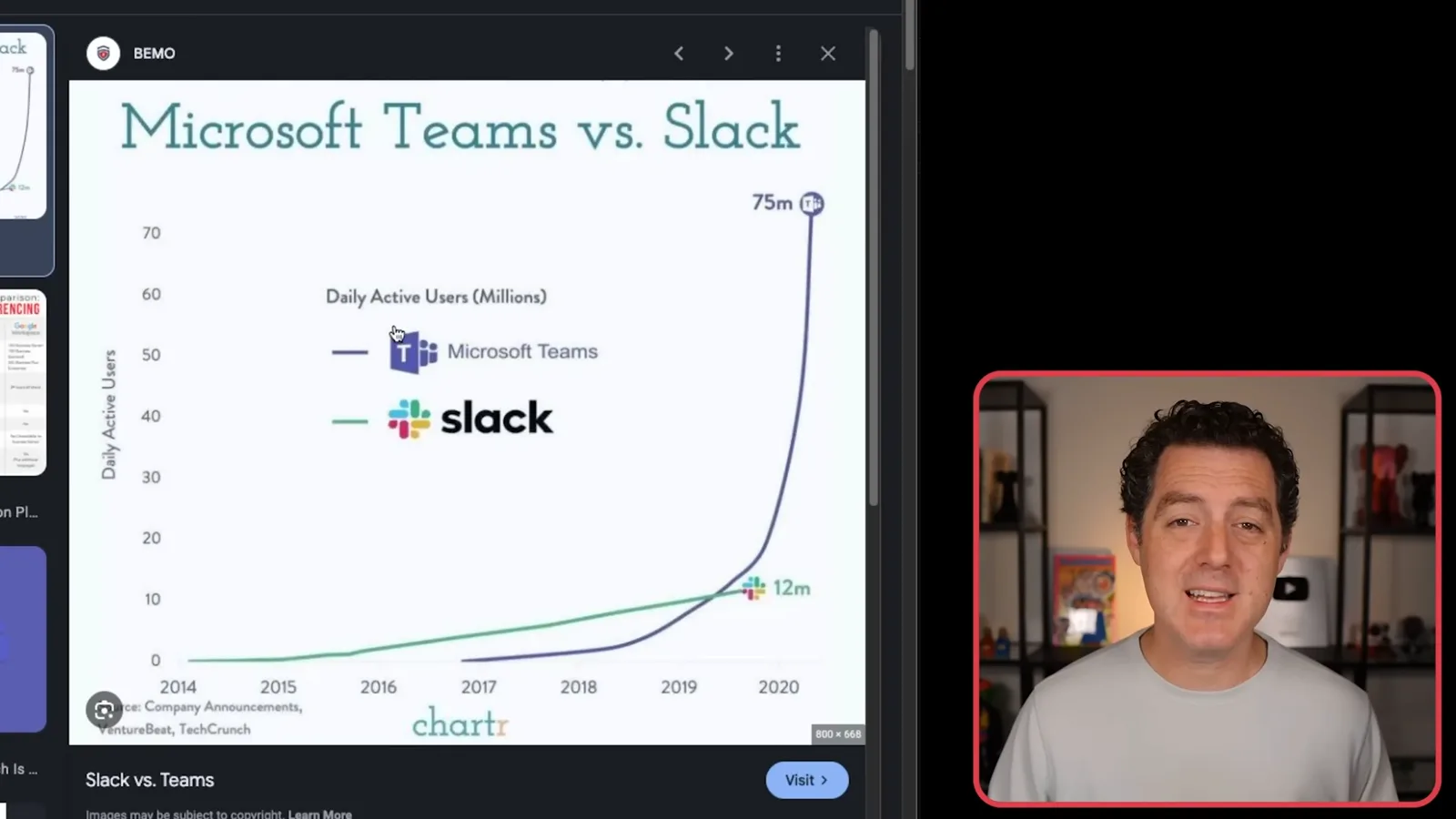
My hypothesis is that OpenAI could similarly offer businesses a package combining ChatGPT with future devices or coding services. Existing subscribers might find a discounted bundle easier to buy than separate offerings from rivals. This is a possible strategy, not a disclosed OpenAI offer.
Advertising and the revenue scenario
OpenAI’s announced ad plans lead to a discussion of communications, personalization and a hypothetical billion-user business.
The third announcement was advertising. In January, [OpenAI said](https://openai.com/index/our-approach-to-advertising-and-expanding-access/) it planned to test ads for adults in the US on the Free and Go tiers, including the paid Go plan; Plus, Pro, Business and Enterprise were to remain ad-free. The initial test actually began on February 9, after this video, according to [OpenAI's pilot announcement](https://openai.com/index/testing-ads-in-chatgpt/).
OpenAI said ads would be clearly labeled and separate from answers, that ads would not influence responses, and that advertisers would not receive users' conversations. Its illustrated example places a hot-sauce ad below a recipe answer. These are the company's stated design and privacy commitments, not independent proof that every implementation will work perfectly.
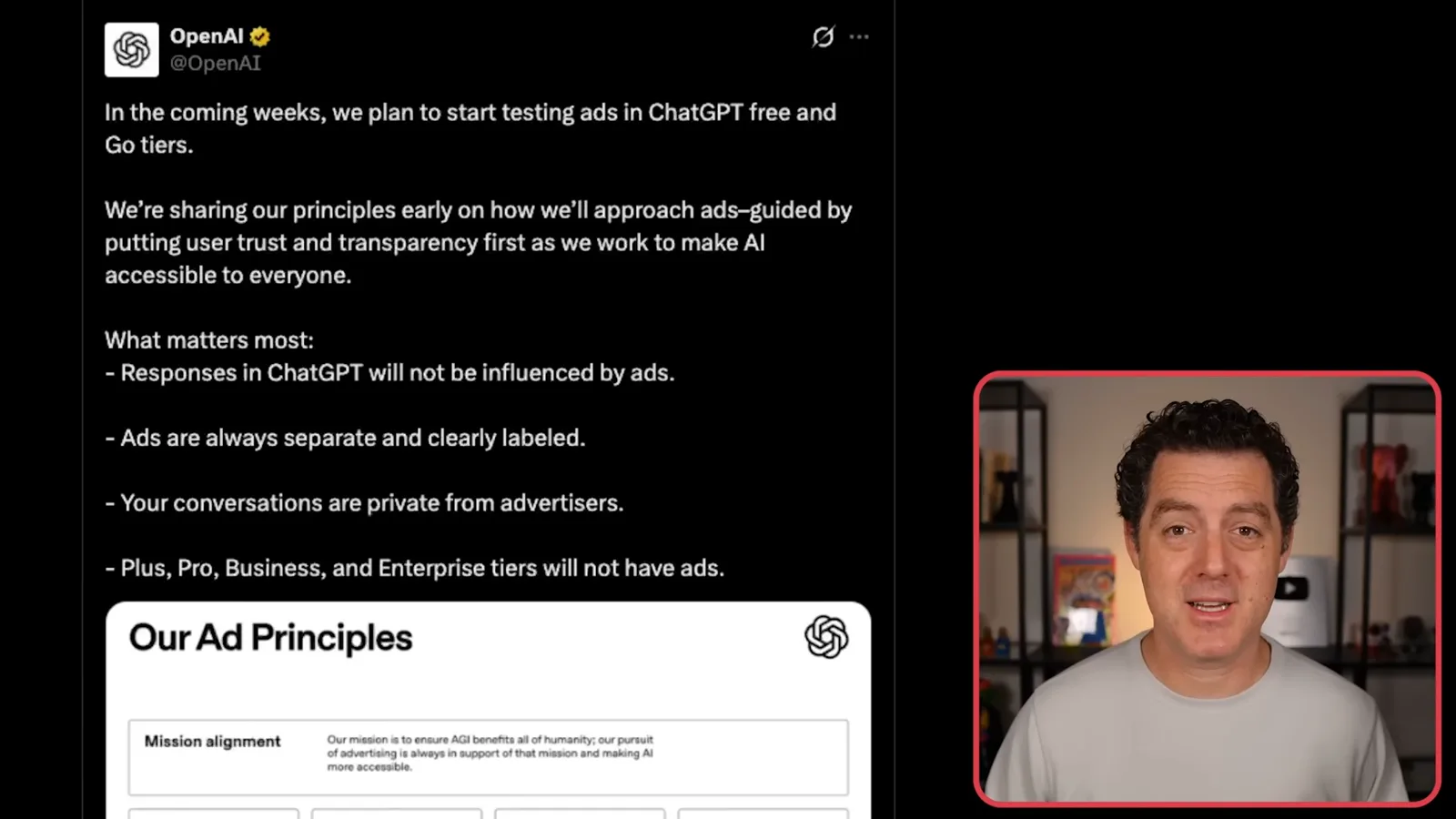
I think announcing strong growth and a cheaper plan alongside advertising was a smart communications move. Had ads appeared alone, analysts might have interpreted them as a sign of financial distress; with the other news, they can be presented as part of expansion. That reading of the timing and motives is mine, and revenue growth alone does not establish profitability.
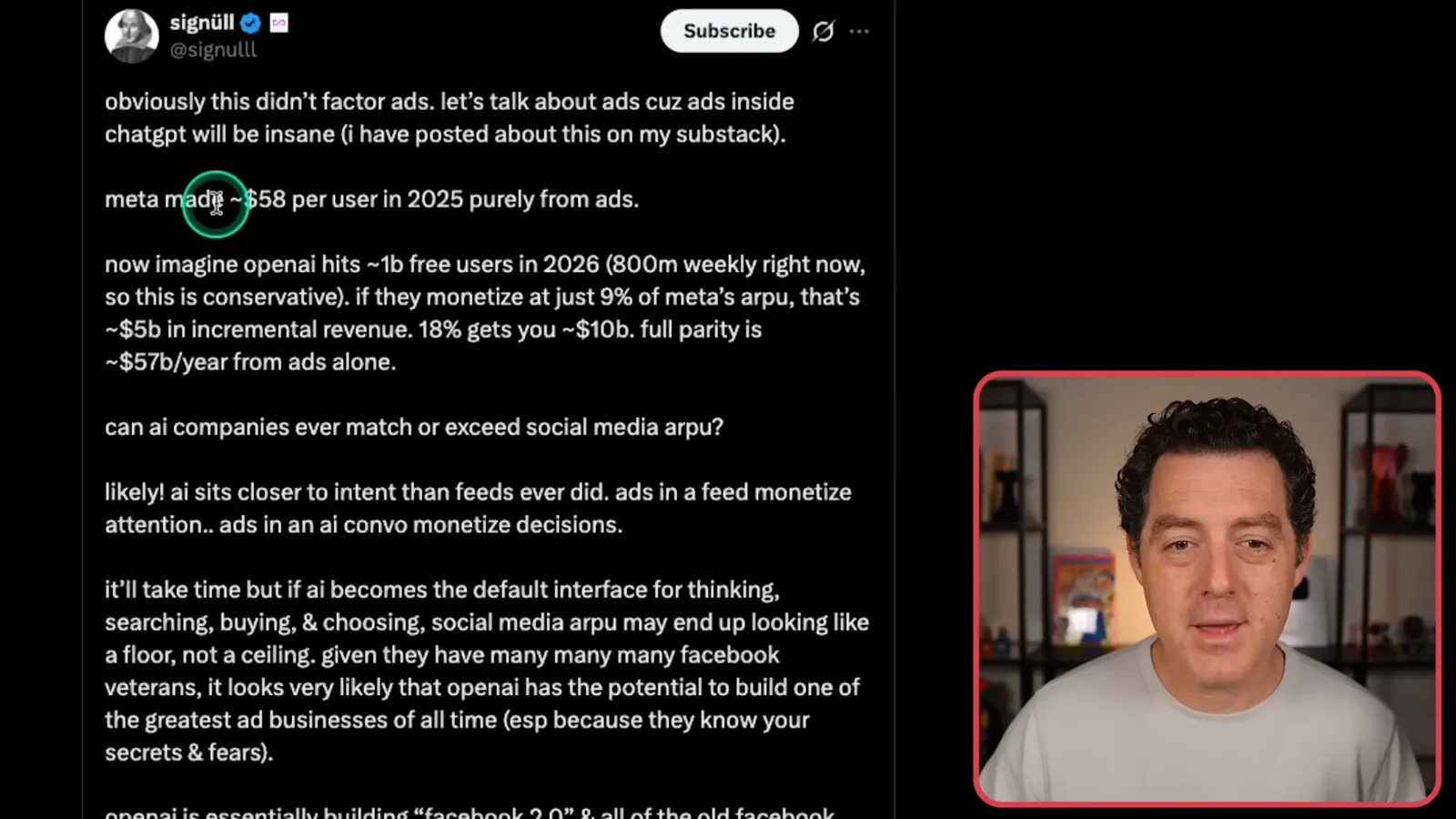
To illustrate the potential, I use a hypothetical one billion free users and a claimed $58 annual ad revenue per Meta user. At 9% of that benchmark the arithmetic is about $5.2 billion; 18% is about $10.4 billion, and full parity is about $58 billion. These are scenarios, not OpenAI revenue forecasts or evidence that ChatGPT can achieve Meta's rate. The 800 million weekly users I cite are not a count of free users, and the Meta comparison depends on its definition and period.
A hybrid subscription and advertising model could raise revenue per Go user beyond the subscription fee. I believe proximity to purchase intent and relevant personalization could make ads valuable. OpenAI's pilot described user controls for ad personalization and said ads could use the current conversation; relevance, revenue and the privacy trade-offs remain questions for the actual implementation.
Personally, I would pay to avoid ads, but many people cannot afford the higher subscription price or even $8 a month. A free, ad-supported option may widen access for them. The choice also raises the question of whether the product remains useful and trustworthy when advertisements are present.
Competition with Google
Berman recaps his strategy thesis and identifies Google’s users, products and resources as competitive advantages.
My overall interpretation is that revenue growth, a lower-priced tier and ads are mutually reinforcing: OpenAI can attract more users and add monetization channels. I call the timing clever, but my view that nobody would question the company's finances is an opinion, not evidence of profitability. In a later [August 2026 update](https://openai.com/index/expanding-access-to-ai-with-chatgpt-ads/), OpenAI reported a $1 billion annualized ads run rate; that figure is not a full year of realized advertising revenue.
Google is the competitor I would watch most closely. It has Android, a vast existing search audience, Gemini and diversified businesses, and it can distribute AI through products such as Workspace. Those advantages make bundling a meaningful competitive threat, although my description of Google's resources as effectively unlimited is rhetorical.
This is my breakdown of the three announcements and the competitive context. I credit Theo's video with inspiring this analysis and invite viewers to follow the conversation. The video also mentions my own newsletter.
More from this channel
 34:21EN
 Matthew Berman· Oct 27, 2026Matthew Berman Examines Anthropic’s IPO Filing, AI Growth and GovernanceMatthew Berman, Sam Altman · Forward FutureThe presenter reviews the S-1’s financial metrics, compute strategy and voting structure while questioning the tension between rapid AI development and safety.
 0:26ENMatthew Berman· Oct 25, 2026Sam Altman on Human Values and Problem-Solving in an AI WorldSam Altman · OpenAIIn a short interview excerpt, Altman considers the enjoyment of solving hard problems and the human role in interpreting results.
 0:36ENMatthew Berman· Oct 25, 2026Kimi K3.1 and a Rubik’s Cube Solver DemonstrationMatthew Berman · Forward FutureMatthew Berman shows a scrambled virtual cube being solved and gives the Kimi K3.1 test a favorable assessment.
 0:21ENMatthew Berman· Oct 24, 2026An AI-Generated Kimi Benchmark Chart Used Invented ScoresMatthew Berman · Forward FutureMatthew Berman asks for a graph of Kimi K3.1 Pro benchmarks, then discovers that the displayed figures are illustrative placeholders.
 25:50ENMatthew Berman· Oct 24, 2026Kimi K3.1 Pro Tested: Strong 3D Demos, Uneven Results and Competitive PricingMatthew Berman · Forward FutureMatthew Berman tests the open-weight model on coding, 3D rendering and visual explanations, then compares benchmark results and prices.
 32:20ENMatthew Berman· Oct 23, 2026Who Is Local AI For? The Costs, Trade-offs and a Hybrid FutureMatthew Berman · Forward FutureMatthew Berman weighs data control and independence against hardware cost, setup complexity and inference speed.