In 30 seconds
Matthew Berman reacts to OpenAI’s September 2026 announcement of an AI-generated proof concerning the Navier–Stokes Millennium Prize problem. He explores the practical importance of fluid equations, the dispute involving mathematicians Tristan Buckmaster and Levent Alpöge, and the possibility of AI accelerating its own improvement. The claim requires careful mathematical evaluation: a later Clay Mathematics Institute statement said the problem had apparently been settled and that it would organize a review. Berman’s predictions about autonomous improvement, medicine and future human work are speculation, not consequences established by the claimed proof.
- 1A mathematical question about fluidsNavier–Stokes equations describe moving fluids, but the Millennium Problem asks for a rigorous answer about existence and smoothness under specified conditions.
- 2OpenAI’s proof claimThe company says a multi-agent system produced a proof of finite-time blowup in a forced case. Clay later said the result appeared to settle the problem and announced a careful evaluation.
- 3A dispute about related workBuckmaster and Alpöge worked on related fluid equations and asked how their private Codex use had been treated. Buckmaster expressly said he did not know whether their data was used and was not making an accusation.
- 4Conflicting accounts and a later updateOpenAI denied direct access to their work; its later update reported an internal investigation into recent Codex prompts. The researchers’ and company’s accounts should be read separately.
- 5AI-assisted research and its limitsBerman connects the announcement to research automation and recursive self-improvement, while acknowledging a fully closed loop is not yet in place.
- 6Platform and data riskBerman urges businesses to scrutinize how AI providers handle their information. Data-use rules depend on the product, account and settings.
Takeaways
- OpenAI claims its agents produced a proof of finite-time blowup for a forced Navier–Stokes formulation, a result that requires independent scrutiny.
- Buckmaster and Alpöge reported related but distinct fluid-dynamics results; Buckmaster said he did not know whether their private data had been used and was not accusing anyone.
- OpenAI disputed direct access to their work and subsequently reported an internal finding concerning their recent Codex prompts.
- The 88-hour proof effort and the larger agent-compute totals describe different measures and should not be conflated.
- Berman sees possible gains and risks in AI-assisted research and self-improvement, but his more expansive forecasts remain conjectural.
Read the edited text by chapter
Why fluid motion matters
Berman introduces vortices and the Navier–Stokes equations through everyday engineering. He explains why the associated Millennium Problem attracted a prize.
Watch a ring of moving air stretch and break into smaller curls: it can look random, but the motion follows physical laws. Understanding fluids supports technologies from aircraft to cooling systems. The mathematical question I want to discuss asks what the equations permit as fluid motion becomes increasingly complex.
The Navier–Stokes Millennium Problem concerns rigorous existence and smoothness properties of solutions to the equations, rather than simply whether engineers can make useful forecasts. The Clay Mathematics Institute attached a million-dollar prize to a qualifying solution. OpenAI has announced what it says is a solution; the claim and its surrounding controversy need careful examination.
The equations model water in pipes, air around wings, ocean currents and smoke. Better fluid modeling can matter for flight, vehicles, chip cooling and weather. I am particularly interested in the use of AI agents to tackle difficult mathematics, although a proof about a specified mathematical setting does not itself deliver all of those engineering improvements.
OpenAI’s proof announcement
Berman reacts to the company’s claim and its reported use of a next-generation model. Independent evaluation and the precise forced setting matter to the claim.
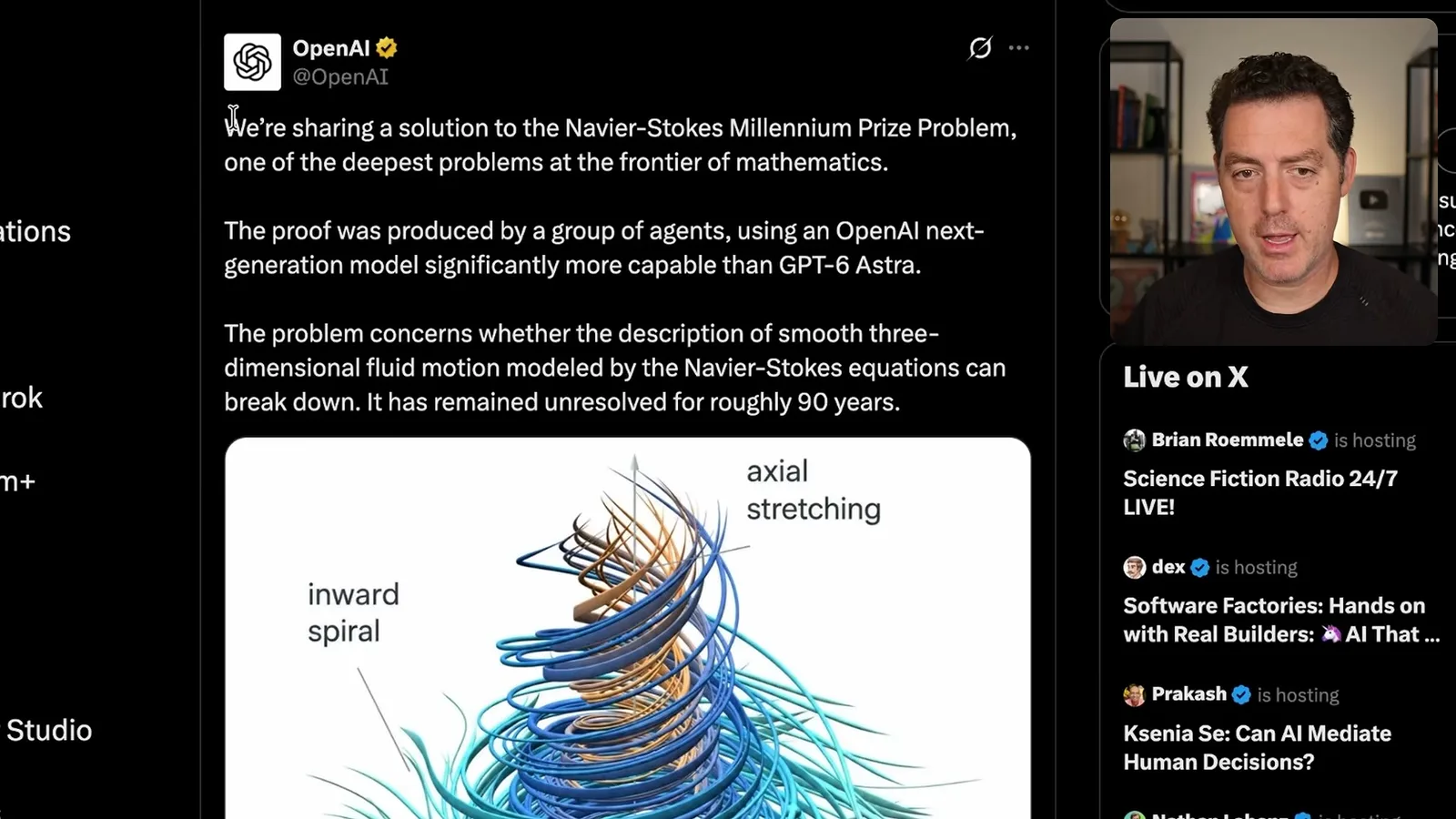
In its [announcement](https://openai.com/index/navier-stokes-solution/), OpenAI says a group of agents using a next-generation model produced a proof of finite-time blowup for a smooth, initially stationary fluid under smooth external forcing. This addresses the forced alternatives in the Millennium Problem. The company published a mathematical write-up and a Lean formalization; independent mathematical review remains essential.
I see this as an exciting possible step toward using AI in materials science and medicine, and I am struck by the company’s claim that the model is substantially more capable than GPT-6 Astra. Those applications are hopes, not results demonstrated by this particular proof. On September 11, after this video, [Clay said](https://www.claymath.org/news/navier-stokes-announcement/) the problem had apparently been settled and that it would arrange a careful evaluation; that is not the same as awarding the prize.
Related research and the dispute over credit
Berman recounts Buckmaster and Alpöge’s related work and their contact with OpenAI. Their and the company’s accounts differ, and the data-use question must be stated carefully.
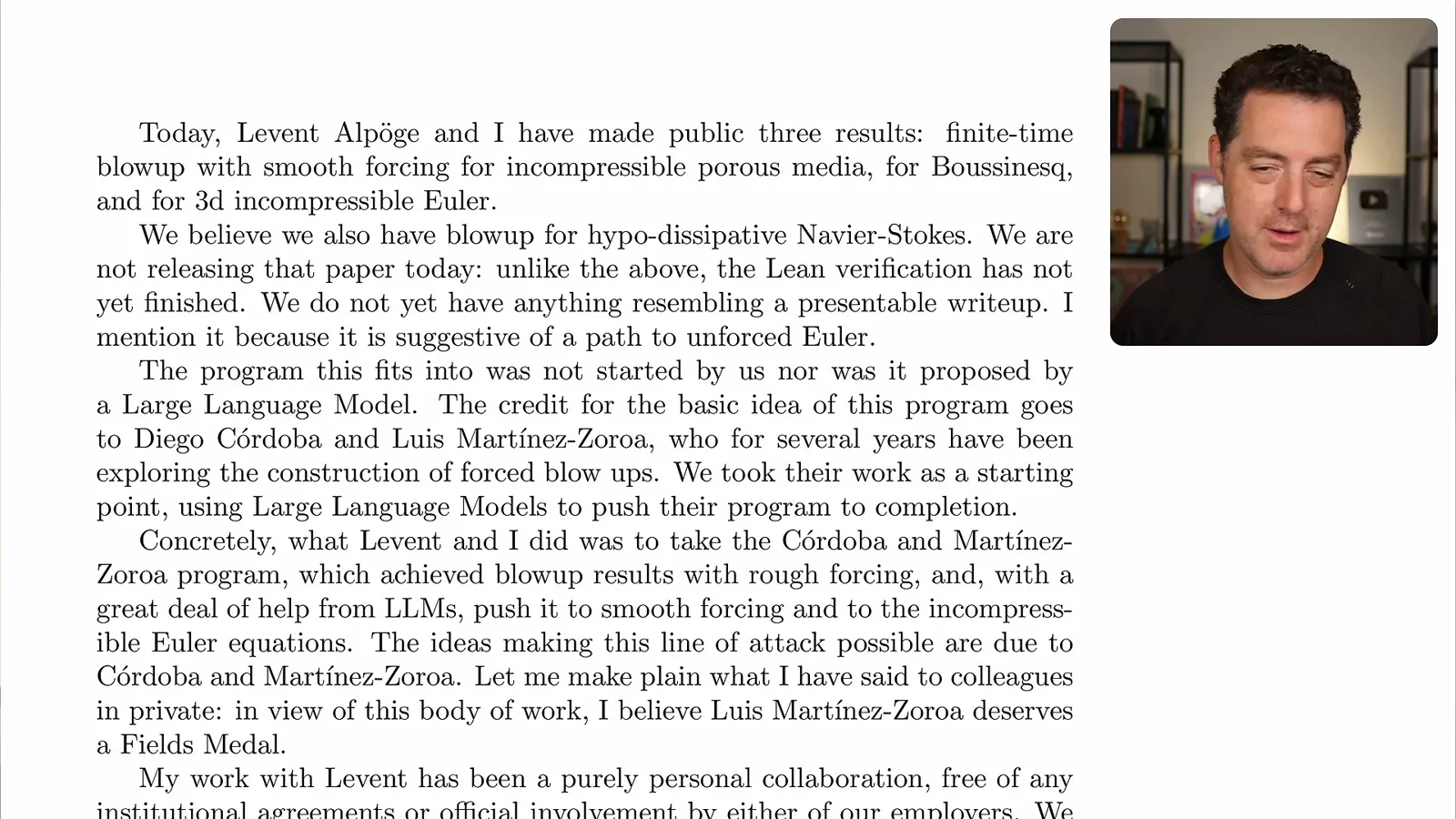
The announcement also brought a dispute involving Tristan Buckmaster and Levent Alpöge, an Anthropic employee who described their work as a personal collaboration. They had used OpenAI’s Codex while pursuing related fluid mathematics. In his [statement](https://cims.nyu.edu/~tristanb/statement.pdf), Buckmaster describes results for the forced Euler, Boussinesq and porous-media equations; these are related to, but distinct from, the claimed forced Navier–Stokes result.
Buckmaster says he contacted OpenAI on September 3 after hearing the company knew about their progress, and that OpenAI told them on September 6 about its own apparent result. Berman finds the similarity in direction striking and discusses whether learning of their progress could have helped steer OpenAI’s effort. OpenAI’s account says its internal work began September 1, before that email; the sequence and its implications are contested.
Buckmaster says he asked whether their private Codex drafts or usage had influenced OpenAI’s models and did not receive a clear answer at the time. He also describes proposals for publication and authorship that concerned him. Crucially, he writes that he does not know whether their data was used and is not accusing anyone of anything; his questions should not be recast as proof of misuse.
OpenAI said its researchers and agents had not seen the mathematicians’ work through any means before its public release and had not accessed specific user data to solve the problem. Its initial statement also said it could not rule out that de-identified data from their product use had helped improve its models. Berman reads that qualification as a warning about entrusting research to an AI provider.
In a September 10 update, after this video, OpenAI said an internal investigation had found that Buckmaster’s Codex prompts from the preceding two months could not have influenced the system, including through training. That is the company’s reported finding, not an independent determination. Its earlier qualification and Buckmaster’s account explain why Berman raised the issue, but neither establishes that private drafts were accessed for the proof.
AI research and the proof effort
Berman connects the result to recursive self-improvement and describes OpenAI’s reported timeline. He also reads Sebastian Bubeck’s account of the discussions.
This brings me to recursive self-improvement: AI discovering ways to improve AI. Labs already describe using models to assist with research and the development of later models. A fully closed loop would go further, with AI proposing and running experiments, applying improvements to itself and repeating the process; Berman acknowledges that such a loop is not yet in place.
Berman also reads Sebastian Bubeck’s account of his communications with the mathematicians. Bubeck says he sought to coordinate releases, did not ask for Alpöge to be removed from authorship of his own work, and wanted to celebrate their achievements. Those assertions and Buckmaster’s description are separate perspectives on a disputed interaction.
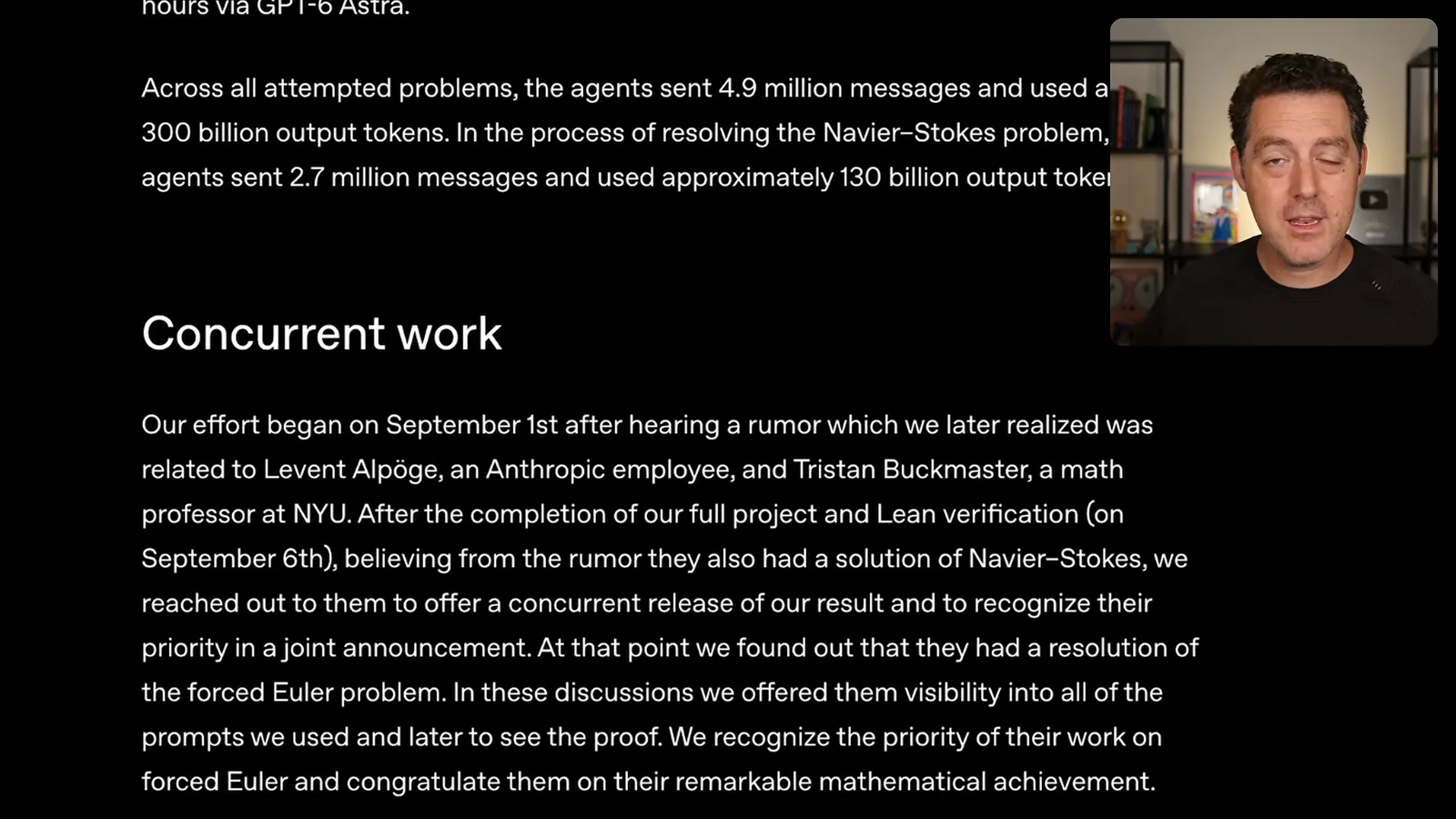
OpenAI reports that the proposed Navier–Stokes proof was produced in 88 hours, from September 1 to September 5, with another 17 hours for Lean formalization. Berman cites 4.9 million agent messages and 300 billion output tokens. OpenAI’s breakdown attributes those larger totals to all attempted problems; the Navier–Stokes effort accounts for 2.7 million messages and 130 billion output tokens. Human researchers also oversaw and interacted with the agents.
Potential benefits, risks and human work
Berman imagines improvements to medicine and engineering and asks what happens when AI outperforms people in research. These are predictions rather than established outcomes.
I wonder what happens if AI can discover mathematics that helps improve AI itself. Berman suggests that a Millennium Problem result might imply the ability to solve any mathematical problem and lead to exponential self-improvement. Neither inference follows from this one claimed proof, and reliable autonomous improvement remains an open question.
The potential upside Berman imagines is enormous: new materials, improved environmental technology, better weather prediction and perhaps cures for disease. He even wonders whether a six-hour flight could one day take an hour. These are illustrations of his hopes, not demonstrated consequences or timelines.
What does faster machine discovery mean for people? Berman compares frontier research with chess, where leading engines outperform human champions but people still enjoy human competition. He argues that, unlike competitive chess, research is valued chiefly for discovering knowledge as quickly as possible, and predicts AI will dominate that work. The analogy is a viewpoint, not evidence that human contributions will disappear.
Platform risk and private data
Berman argues that companies relying on AI providers should examine data use and competitive exposure. Actual controls vary across products and settings.
Finally, businesses building on AI models face platform risk: the provider supplies a capability on which they depend and may also operate in related markets. Berman worries that use of a model could expose a business’s expertise to future competing systems, and recommends examining provider data practices and considering open models.
The actual treatment of data depends on the particular service, account and settings; the initial OpenAI qualification does not establish that every business’s confidential information trains models or becomes available to competitors. The episode brings together three questions Berman finds fascinating: a disputed mathematical breakthrough, the handling of research data, and the prospects for AI-assisted improvement.
More from this channel
 34:21EN
 Matthew Berman· Oct 27, 2026Matthew Berman Examines Anthropic’s IPO Filing, AI Growth and GovernanceMatthew Berman, Sam Altman · Forward FutureThe presenter reviews the S-1’s financial metrics, compute strategy and voting structure while questioning the tension between rapid AI development and safety.
 0:26ENMatthew Berman· Oct 25, 2026Sam Altman on Human Values and Problem-Solving in an AI WorldSam Altman · OpenAIIn a short interview excerpt, Altman considers the enjoyment of solving hard problems and the human role in interpreting results.
 0:36ENMatthew Berman· Oct 25, 2026Kimi K3.1 and a Rubik’s Cube Solver DemonstrationMatthew Berman · Forward FutureMatthew Berman shows a scrambled virtual cube being solved and gives the Kimi K3.1 test a favorable assessment.
 0:21ENMatthew Berman· Oct 24, 2026An AI-Generated Kimi Benchmark Chart Used Invented ScoresMatthew Berman · Forward FutureMatthew Berman asks for a graph of Kimi K3.1 Pro benchmarks, then discovers that the displayed figures are illustrative placeholders.
 25:50ENMatthew Berman· Oct 24, 2026Kimi K3.1 Pro Tested: Strong 3D Demos, Uneven Results and Competitive PricingMatthew Berman · Forward FutureMatthew Berman tests the open-weight model on coding, 3D rendering and visual explanations, then compares benchmark results and prices.
 32:20ENMatthew Berman· Oct 23, 2026Who Is Local AI For? The Costs, Trade-offs and a Hybrid FutureMatthew Berman · Forward FutureMatthew Berman weighs data control and independence against hardware cost, setup complexity and inference speed.