In 30 seconds
In April 2026 Matthew Berman criticizes Anthropic’s communication around Claude Code subscriptions, usage limits and third-party tools, and compares its capacity strategy with competitors. Anthropic described the pricing-page change as a test involving about 2% of new signups, not a blanket removal for existing Pro users. Berman’s claims about company motives, unit economics and capacity rankings are interpretations, while his comparison of a clipped interview with a bankruptcy prediction overstates what the clip says. He discloses receiving tokens from Cursor, which he says does not sponsor his videos.
- 1A limited signup testAnthropic said a pricing-page experiment affected roughly 2% of new signups and did not affect existing Pro and Max subscribers.
- 2Compute investment riskAmodei’s clip describes a hypothetical spending decision and the risk of a growth forecast falling short.
- 3Third-party accessAnthropic announced that some third-party tools would draw on extra usage or API access rather than included subscription usage.
- 4Unverified unit economicsBerman’s assertion that every token is sold at a loss is not established by evidence in the video.
- 5AWS capacity agreementThe agreement is for up to five gigawatts over time, with staged capacity coming online.
- 6Cursor relationshipThe April announcement concerned a partnership and acquisition option; Cursor later joined SpaceX.
Takeaways
- The Claude Code pricing-page change was described as a test for about 2% of new signups, not a removal from every existing Pro account.
- Anthropic changed how subscriptions covered some third-party tools; current terms and plan limits may differ from the historical discussion.
- A subscription allowance is subject to plan terms and is not necessarily a fixed, unrestricted stock of purchased tokens.
- The interview excerpt discusses hypothetical overcommitment risk rather than directly predicting OpenAI bankruptcy.
- The AWS agreement covers up to five gigawatts over time; future contracted capacity is not all immediately online.
- SpaceX’s April arrangement gave it an option to acquire Cursor; the acquisition was completed later.
- Berman discloses that Cursor provides him tokens but says it does not sponsor his videos.
Read the edited text by chapter
Pricing-page test and the compute flywheel
Berman raises concerns about Claude Code access and describes Anthropic’s coding business. He argues that compute capacity and demand are out of balance.
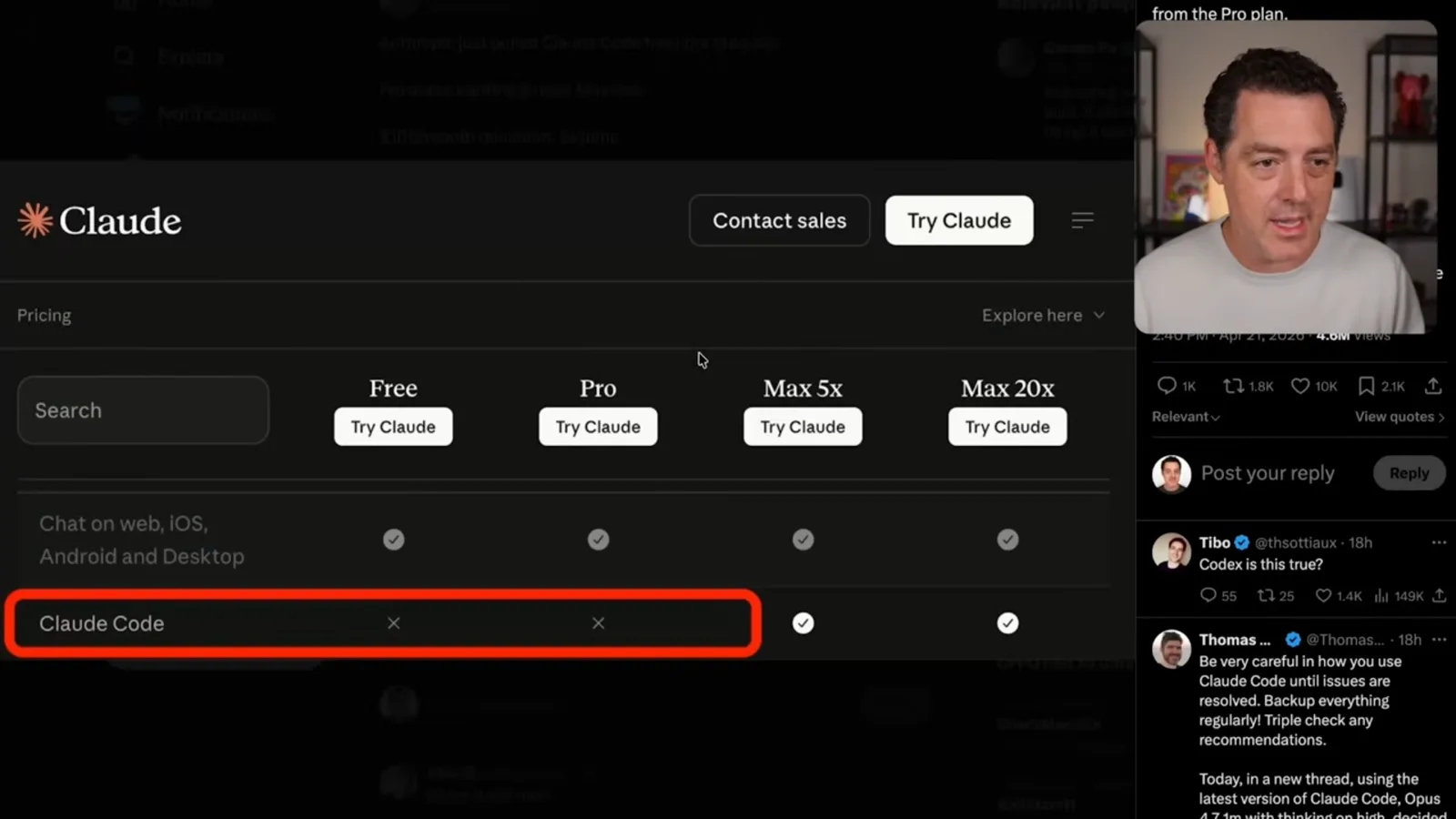
I am frustrated by Anthropic’s changing subscription limits and communication, even though I use and like its models. A pricing page appeared to remove Claude Code from lower tiers. Anthropic subsequently described this as a test affecting roughly 2% of new signups, not a general removal from all existing Pro accounts; I saw the Pro listing return during the video.
I first saw a claim that Pro users would need the $100-a-month Max plan to keep Claude Code. The pricing page did briefly show Claude Code crossed out on lower tiers in my view, but the later explanation limits the incident to a small signup test. The apparent price jump should not be treated as a change imposed on all existing subscribers.
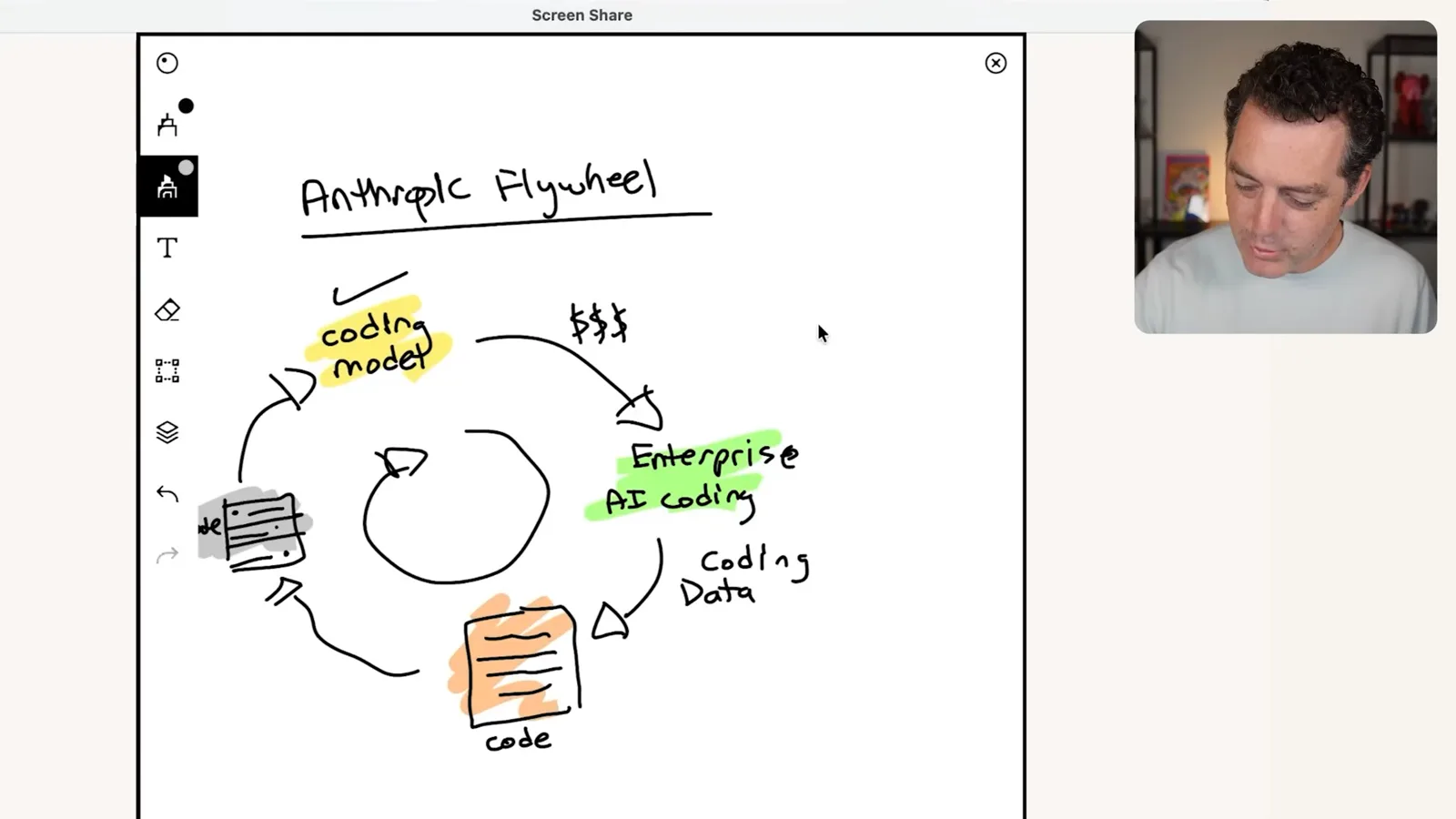
I describe Anthropic’s focus on coding and enterprise as a business flywheel: capable coding models attract customers, revenue supports compute, and improvements in tooling help develop future models. Whether and how customer data is used depends on applicable settings and agreements; the existence of customer use alone does not prove all their code trains the next model.
The flywheel starts with a strong coding model that draws enterprise customers. I suggest that commercial activity, code and improved AI-assisted development can feed the next generation of models. That is my proposed mechanism; customer data access and training permissions depend on the specific terms and settings.
In my diagram, compute connects revenue and the ability to serve and train models. I believe Anthropic underestimated demand and is now capacity constrained. That is my interpretation of public signals, not a verified accounting of its capacity, internal forecasts or the specific cause of every policy change.
Amodei’s investment dilemma
An interview clip explores the risk of overcommitting to long-term compute. Berman offers his own assessment of competitive positioning.
I play a clip from Dario Amodei’s interview with Dwarkesh Patel. Amodei describes the dilemma of committing to expensive data-center capacity years ahead: if projected revenue growth falls short, an extreme commitment could threaten a company’s finances. In the excerpt he gives a hypothetical about his own purchasing decision, not a direct prediction that OpenAI will go bankrupt.
The interview turns on a timing problem: data centers can take one or two years to build or reserve, so a company must choose capacity before it knows what revenue will be. Amodei says even very fast growth has limits and that a forecast can be wrong by a year or more.
Amodei’s example extrapolates tenfold annual growth to very large revenue and asks what would happen if he contracted for enormous compute and the forecast missed. He says his company must accept some risk of unmet demand as well as the risk of overcommitting. The numbers are hypothetical scenarios, not actual contracted spending.
In his hypothetical, Amodei starts with $10 billion in annualized revenue and extrapolates tenfold growth to $100 billion and then $1 trillion. He says a five-year commitment sized to the latter could be disastrous if revenue fell short. These are illustrative projections, not a statement that those revenues or commitments occurred.
Amodei says responsible investment means examining the spreadsheet and the risks, not simply choosing the smallest absolute investment. He questions whether some other companies fully understand their commitments, but the excerpt does not identify a specific company as destined to fail.
I argue that Anthropic erred by not acquiring enough capacity and that OpenAI could attract customers it cannot serve. That is my competitive assessment, not independently verified evidence that every departing user goes to OpenAI or that either company’s investment strategy has definitively won.
I speculate that Anthropic expected efficiency improvements to offset demand, but that growing use of agentic coding outpaced supply. I personally run many agents in parallel. My explanation is plausible as a concern about capacity, but the companies’ actual utilization and unit economics are not established by my account.
Third-party agents and subscription limits
He traces confusing communications, peak-hour limits and a change affecting third-party tools. He challenges how the company communicated with subscribers.
I say demand also grew for personal agent tools such as OpenClaw and Hermes. I prefer Opus for my OpenClaw workflows because of its tool use and interaction style, though that is a personal assessment rather than a universal benchmark. Changes to the use of subscriptions in third-party tools became a source of confusion for me.
I describe mixed messages about Claude subscriptions, OAuth, the Claude Agent SDK and third-party harnesses. A company employee said local experimentation with the SDK could continue and recommended API keys for businesses. I found the boundaries unclear; a social-media discussion is not a substitute for the actual terms governing a particular use.
The employee’s explanation distinguishes experimentation from building a business, but I say my personal OpenClaw workflows did not fit neatly into my understanding of the rules. I wanted clear documentation about whether wrappers and third-party harnesses were included. That is a complaint about my interpretation of historical communications, not a legal conclusion.
For a personal user, I say the distinction between a local experiment and a third-party product remains difficult to apply. I want an explanation that tells me which tools my subscription can actually support before I build my routine around them.
I look at historical status dashboards and cite approximately 98.8% for Claude.ai and around 99% for other Anthropic services, compared with higher figures displayed for several OpenAI services. These are snapshots with service-specific definitions and time windows, not independently normalized availability comparisons or proof of the cause of downtime.
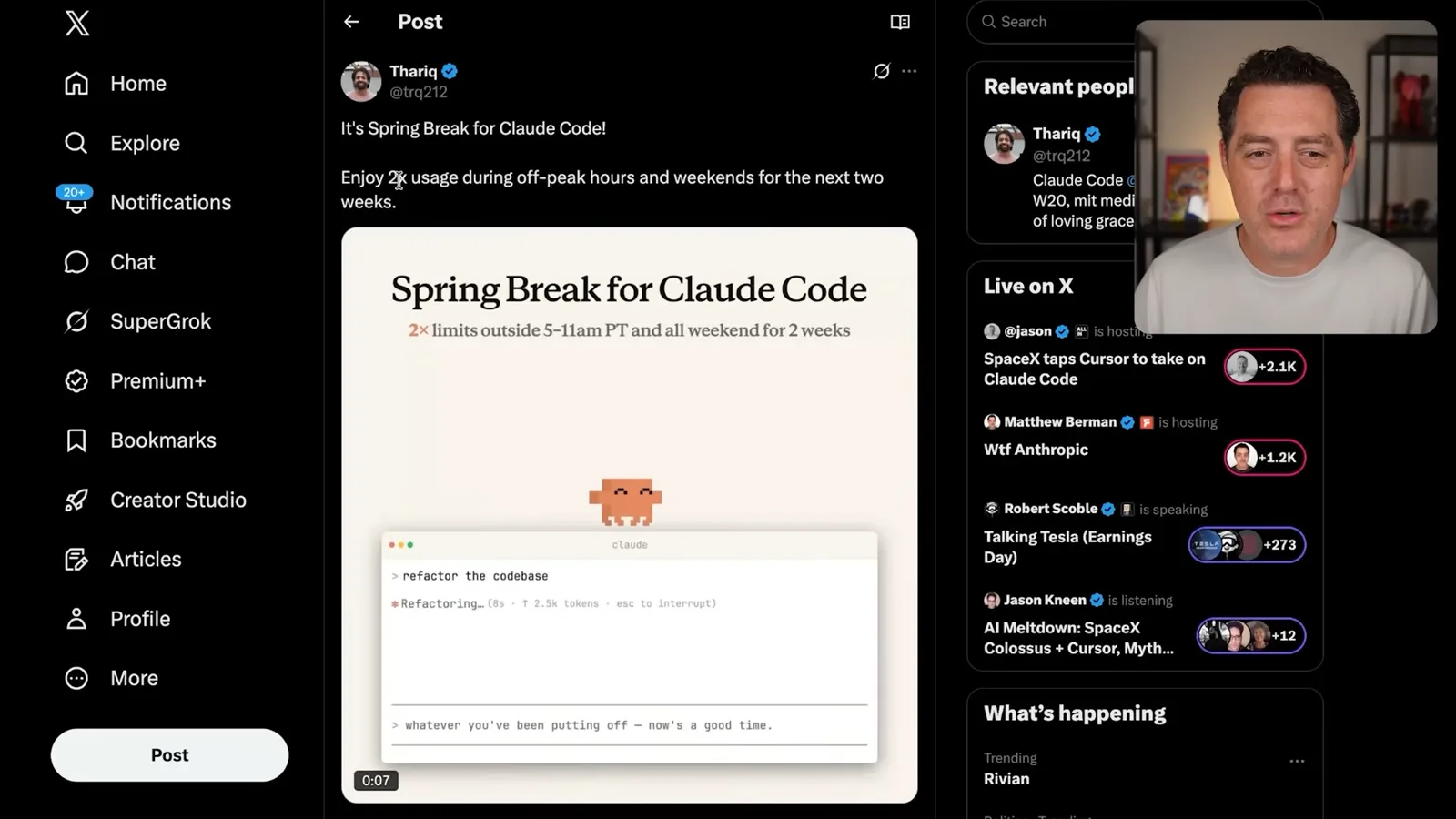
In March 2026 Anthropic offered a temporary twofold off-peak usage promotion. I moved some background work to late-night hours and found my session quota lasted longer. This is an example of using incentives to shift demand, based on my own experience.
The off-peak promotion encouraged users to move workloads away from the busiest hours, showing how time-based incentives can stretch a constrained service. I found it useful for background work, but my own experience does not measure how much capacity it freed for other customers.
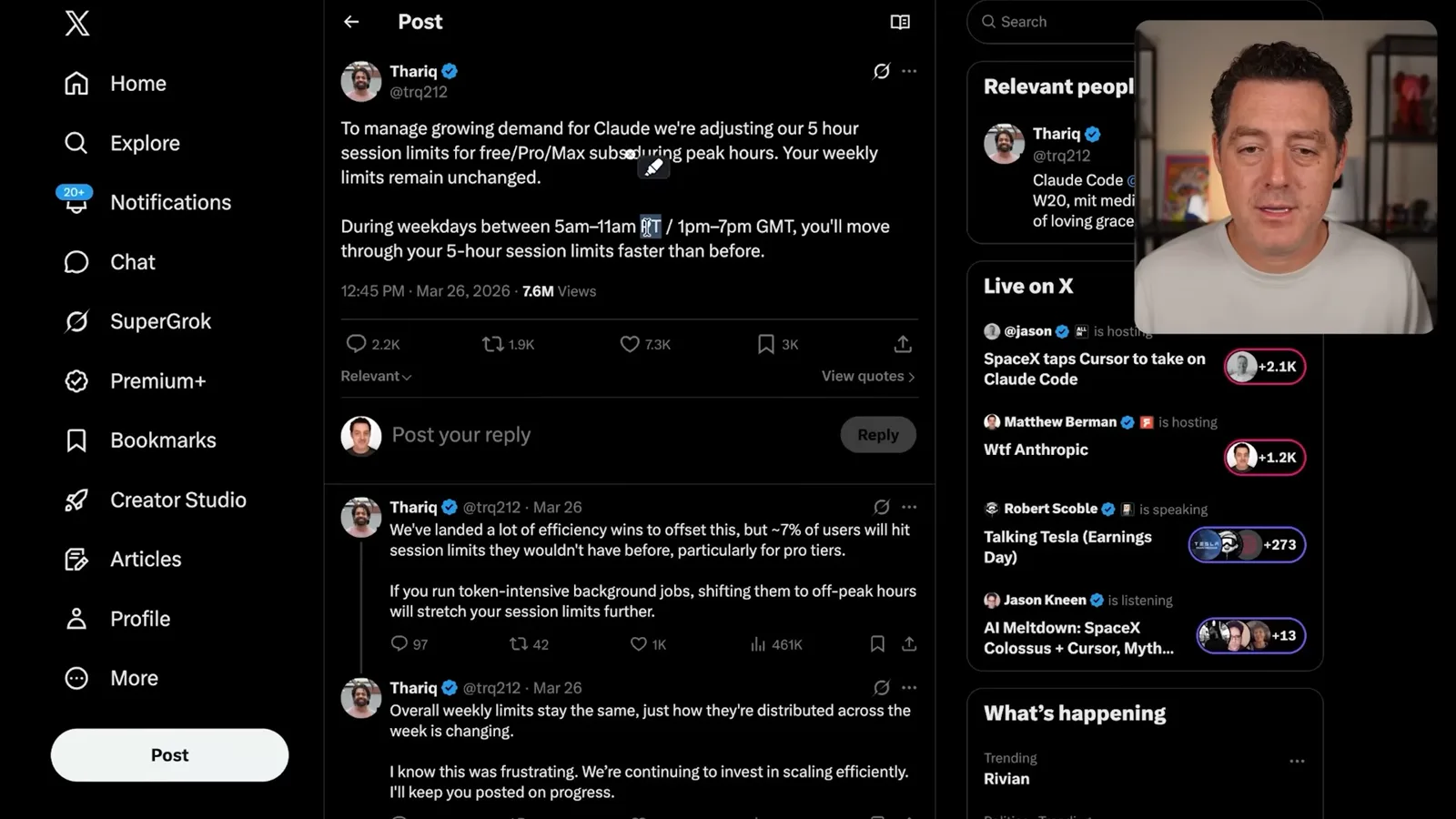
Anthropic later announced changes to five-hour limits during weekday peak hours while saying weekly limits would remain unchanged. It estimated roughly 7% of users would encounter a session limit they otherwise would not have hit. I wanted a clearer explanation of how much faster the limits would be consumed.
I speculate that the affected 7% were primarily users of tools like OpenClaw and characterize the change as punishment. The cited estimate does not identify that group, so it cannot establish that all affected users used third-party agents or that the policy was intended to punish them.
On April 3 Anthropic announced that, beginning the next day, subscription usage would no longer cover third-party tools such as OpenClaw. It described alternatives including extra usage or an API key. I object to the short notice and the lack of clarity I perceived about SDK-based local tools.
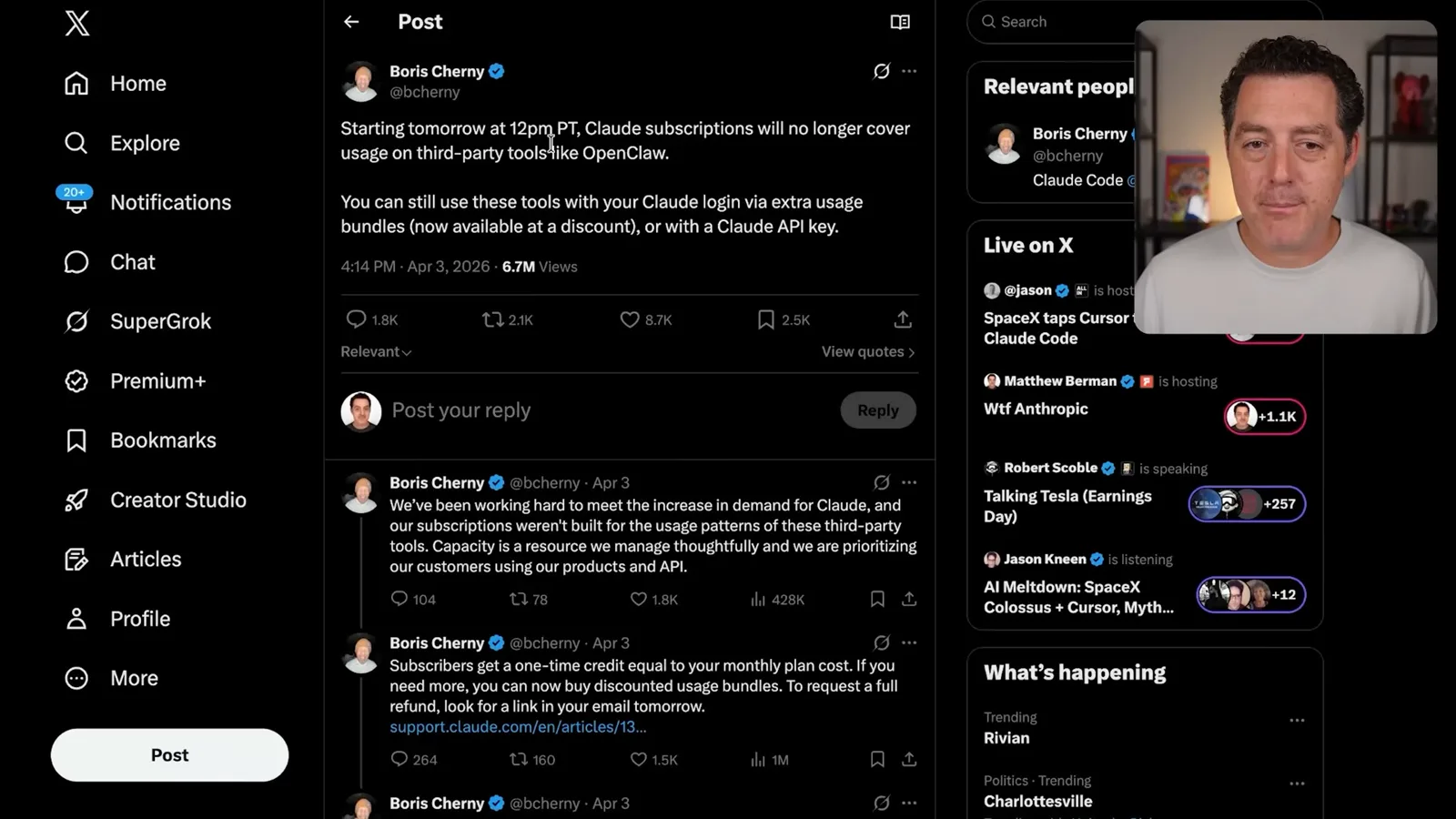
I argue that subscribers should be able to use their allowance as they choose. Subscription plans, however, are governed by their terms and variable usage limits; a monthly subscription is not necessarily ownership of a fixed, unrestricted quantity of tokens. My view is a product-policy preference, not a statement of contractual entitlement.
I compare subscription economics to a car wash where customers use different amounts, and speculate that heavy agent users made earlier assumptions untenable. Anthropic said usage patterns had changed; it did not disclose the full unit economics or confirm my proposed calculation.
The announcement described a one-time credit equal to a monthly plan cost and discounted extra-usage options. I say subsequent statements about locally wrapped Claude tools still did not answer my questions. These were historical communications; users should consult the provider’s current documentation for current terms.
I am not opposed to an API as an option, but I object to being given little time to adjust an established workflow. My larger point is that access to models can be as consequential as model quality when people organize work around a subscription.
The signup test and competitive responses
Berman compares OpenAI’s responses with Anthropic’s clarification that a small test affected new signups. He also discusses product advertising and public reactions.
I contrast this with OpenAI’s April announcement of a Codex usage-limit reset to mark three million weekly users and a plan to repeat resets at milestones. I like that OpenAI supported the OpenClaw ecosystem and hired its creator Peter Steinberger. These are examples of product and communication choices at the time, not a guarantee of future limits.
I also contrast OpenAI’s relationship with OpenClaw creator Peter Steinberger and its support for Codex use in that ecosystem with my uncertainty over Claude. I prefer Opus for parts of my own workflow; that preference does not establish a general performance ranking or a permanent policy.
I return to the pricing-page test: the version I saw omitted Claude Code from Free and Pro. I argue even limited access can help users discover a product and later upgrade. Anthropic’s growth head Amol Avasare said the test concerned about 2% of new prosumer signups and did not affect existing Pro and Max subscribers.
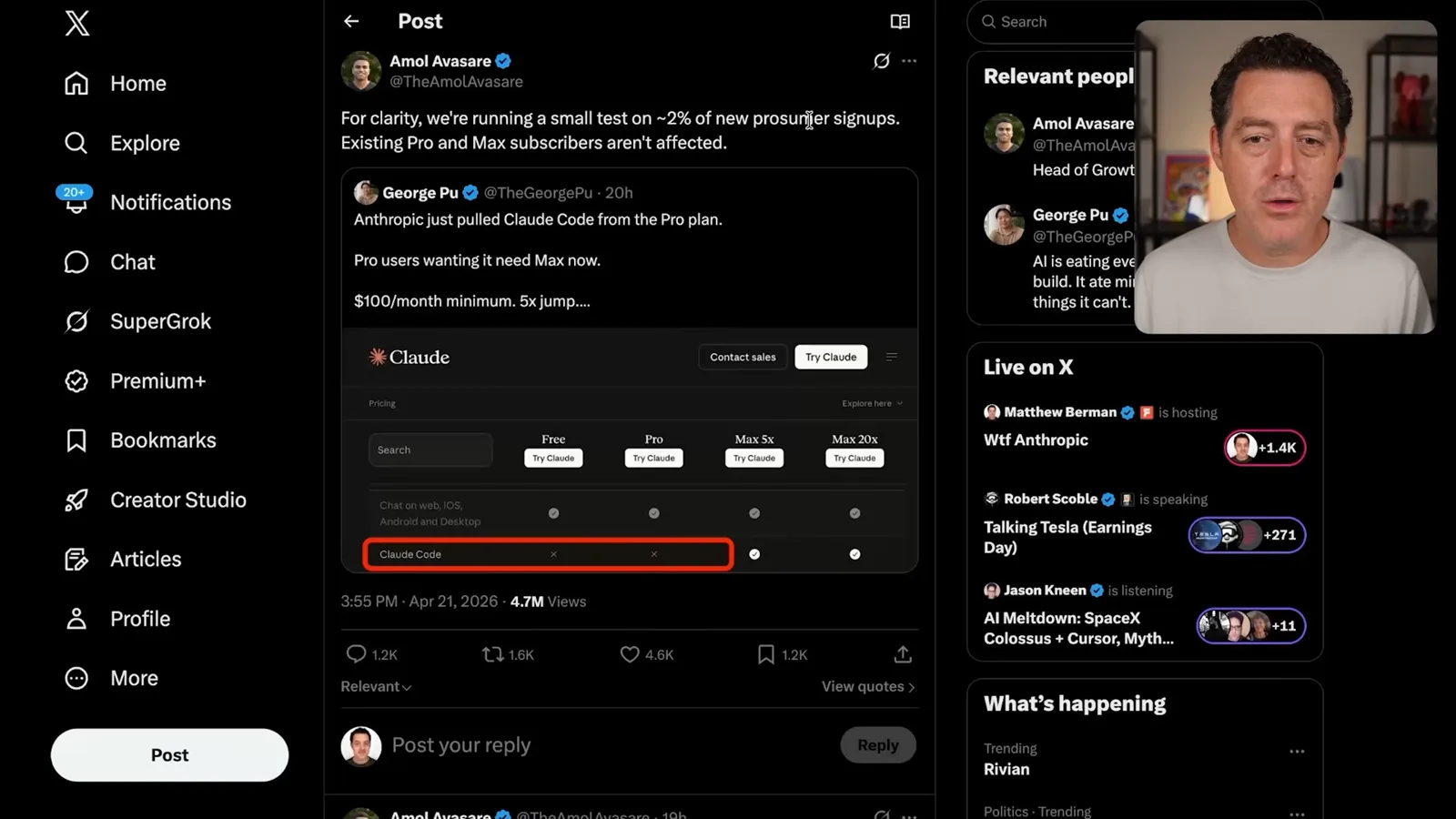
Avasare said subscriptions originally designed for different patterns now face long-running agents and heavier use. I think a clear price or allowance adjustment would be preferable to restricting particular tools. My inference that the company assumed subscribers would not use their allotted quota is not established by his statement.
Anthropic said it was exploring options and would give existing subscribers notice if changes affected them. I contrast that promise with the short notice for the third-party-tool change. This is a comparison of the communications I experienced, not proof that every future change will lack notice.
I show OpenAI staff responding that Codex would remain available on Free and Plus plans and that the company would communicate major changes. I see the posts as competitive positioning. Availability, quotas and pricing are historical statements from April 2026 and may change.
I also discuss advertising in ChatGPT’s free and lower-cost tiers, and reconsider whether subsidizing access could help people who cannot pay for higher subscriptions. I contrast that with Anthropic’s anti-advertising campaign. My account of each company’s intentions is interpretation, not an independently proven description of its strategy.
My view of the advertising debate changes as I think about affordability. I suggest advertising could subsidize access for people who cannot pay for expensive plans, while acknowledging that people object to advertisements and that the companies have taken different public positions.
I see a cultural contrast in how broadly the companies want to distribute their models, and I question Anthropic’s selective approach. These are my impressions and predictions; the companies’ releases and access policies cannot by themselves prove their underlying intentions.
I read Sam Altman’s posts about drinks and possible model releases, interpreting a salute emoji as a hint of a coming GPT release. The post is not a definitive product announcement, and the release date and model identity should not be inferred from the emoji alone.
I show critics including Jeremy Howard and Theo questioning the test and its presentation. Their observations and allegations are their own; anecdotal signup experiences do not by themselves establish that Anthropic’s stated test percentage was false or that the company acted dishonestly.
Tokenization, costs and compute
He reviews Opus 4.7 usage characteristics and speculates about unit economics. An external compute chart has important limits.
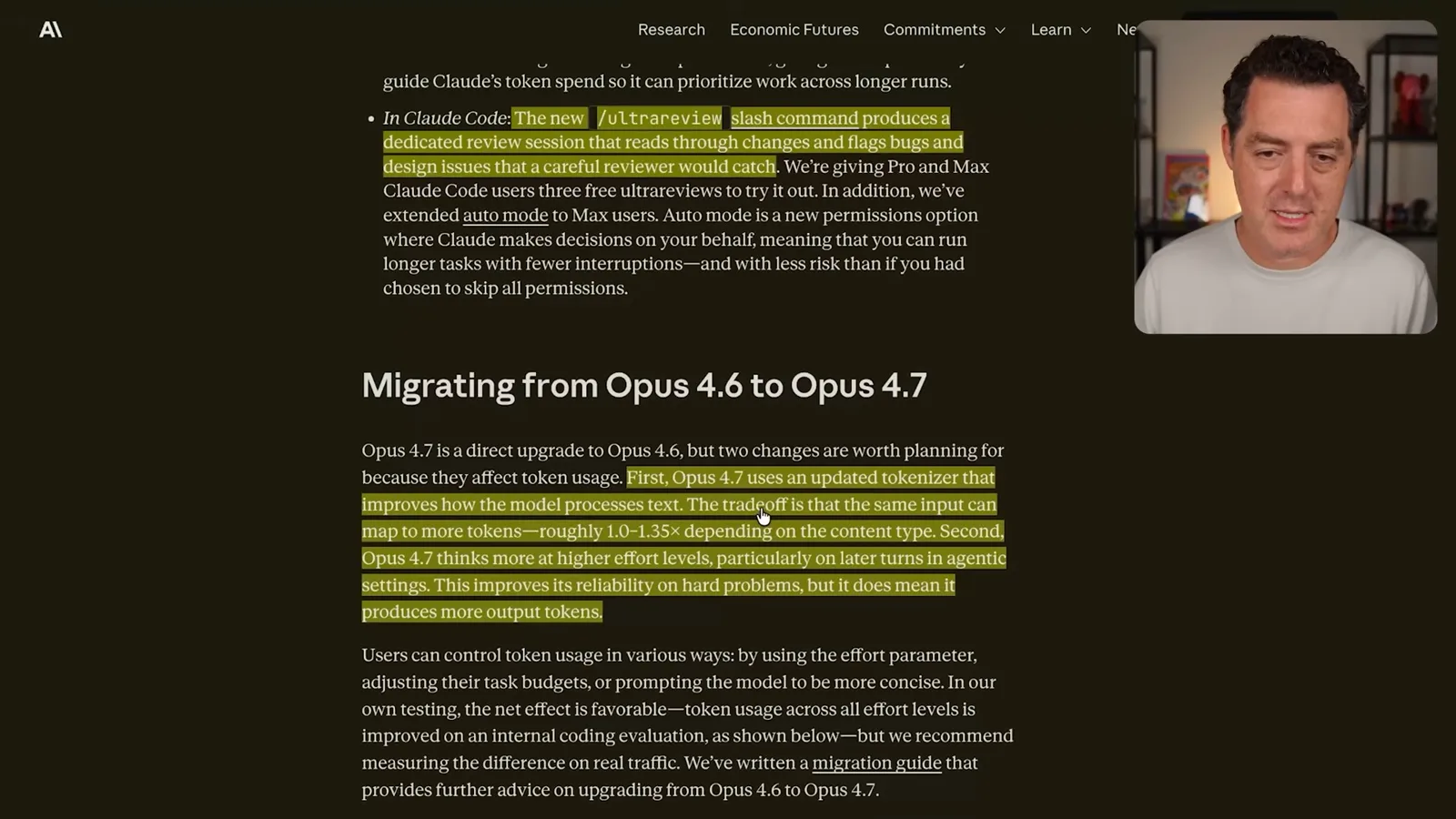
I like Opus 4.7 even though some users call it a regression. Anthropic explained that its updated tokenizer may map the same input to roughly one to 1.35 times as many tokens depending on content, while higher effort can separately use more reasoning tokens. Those figures are context-dependent, not a universal 35% increase.
I speculate that Anthropic and OpenAI sell every token at a loss and that the heaviest users are the least profitable. Their per-token costs, pricing mix and margins are not established here, so this should not be treated as a verified financial fact. Different workloads and subscriptions may have different economics.
I argue that the policy changes can feel like price increases in practice if customers receive less usable access for the same subscription. I also think competition limits the company’s room to raise prices. Both are economic interpretations; the effect depends on the actual plan, terms and individual usage.
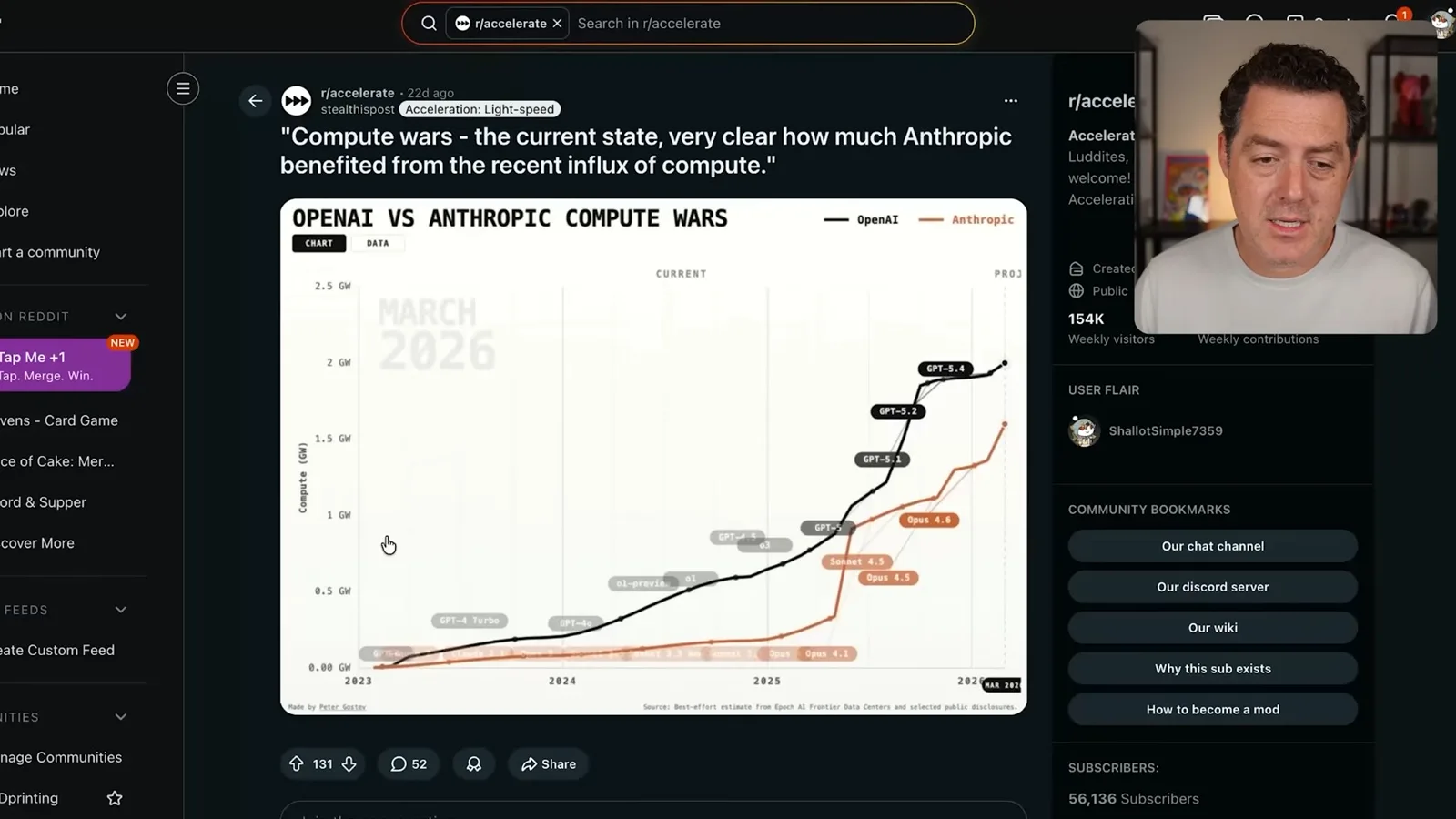
I look at a third-party chart of estimated compute capacity and compare OpenAI with Anthropic. The chart is not an audited inventory of deployed, available inference capacity, and agreements for future capacity should not be confused with capacity already operating. I cannot establish a definitive ranking or utilization rate from it.
I sketch a spectrum from compute-rich to demand-rich firms, placing xAI, Google, OpenAI and Anthropic based on my impression. These are rough judgments, not disclosed company utilization data. My suggestion that Google has no downtime is too broad; any provider can experience incidents.
On the compute-rich side of my sketch I place xAI, arguing that its infrastructure grew faster than demand for its models. I place Anthropic toward the demand-heavy side. These placements are qualitative impressions, not measured estimates of idle hardware or unmet demand.
I put Google closer to the middle because it supplies hardware and inference capacity as well as serving its own models. I describe it as having no downtime, but that absolute claim is not supported by the diagram: service incidents and available capacity vary over time.
I place OpenAI between Google and Anthropic, with substantial demand and compute. I acknowledge that a two-axis chart would better represent the two quantities. The sketch is a way to express my theory, not a calculation based on comparable company disclosures.
AWS, Cursor and the competitive outlook
Berman discusses Anthropic’s staged AWS capacity agreement and the SpaceXAI–Cursor partnership. He discloses receiving tokens from Cursor and closes with a case for competition.
Anthropic announced a deeper AWS agreement: it committed more than $100 billion over ten years and secured up to five gigawatts of capacity. The company said some new Trainium2 capacity would come online in the first half of 2026, with nearly one gigawatt of Trainium2 and Trainium3 by year-end. The maximum is a future capacity commitment, not five gigawatts instantly available.
I discuss the newly announced SpaceXAI and Cursor collaboration. At the time SpaceX had an option to acquire Cursor for $60 billion later in the year or pay $10 billion for the work together; it was not yet a completed acquisition when I recorded. Cursor later announced that it had joined SpaceX in August 2026.
I think the partnership could pair infrastructure with Cursor’s developer distribution and experience. My claims about an unmatched coding dataset and idle capacity are speculative and do not establish what customer data is accessible or how much hardware is unused.
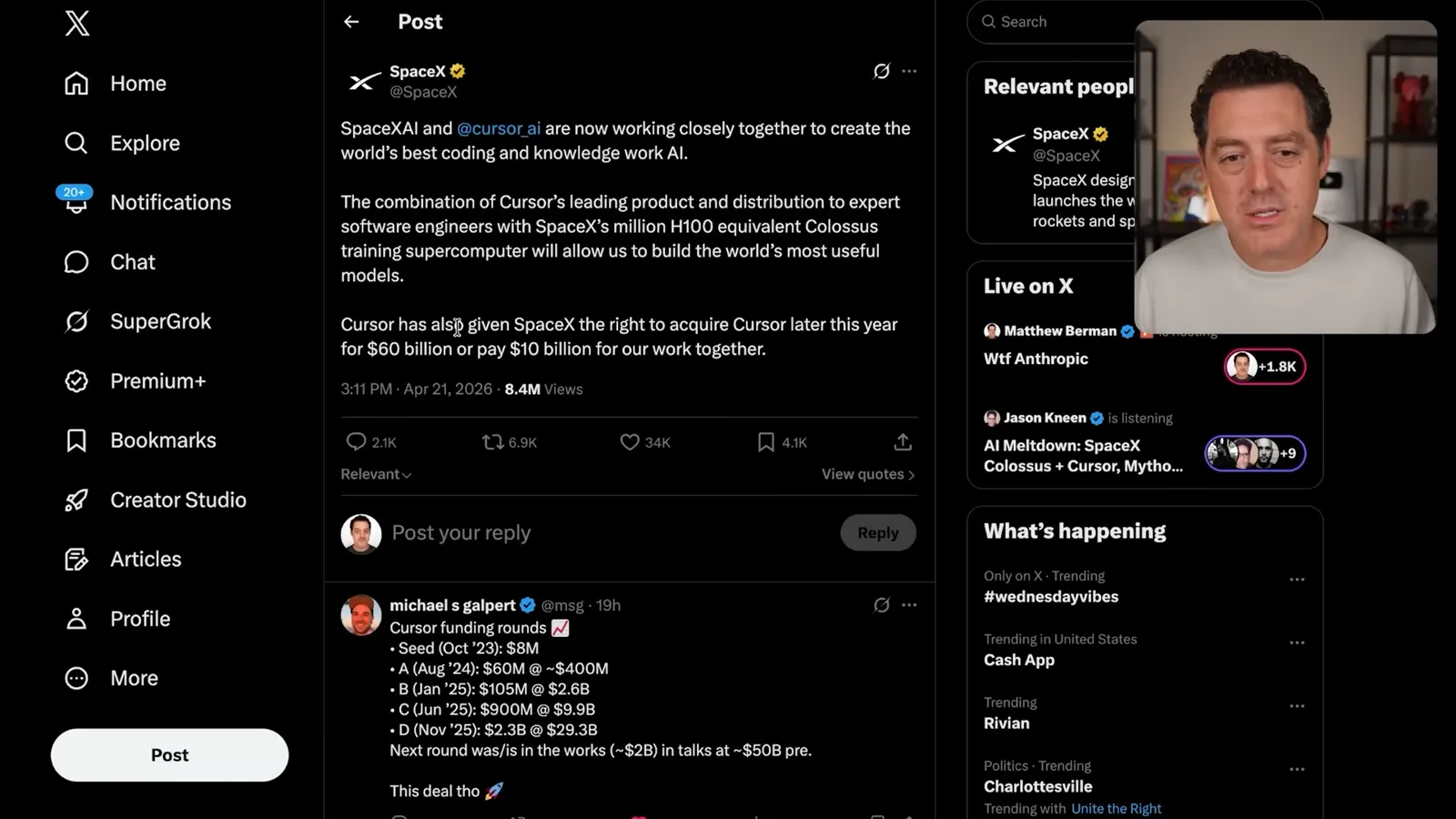
I disclose that Cursor provides me with tokens but does not sponsor my videos. I wrap up by arguing that Anthropic underestimated demand and OpenAI took a different risk on capacity. Those are my judgments about competitive choices, not proof that either CEO’s financial strategy was ultimately correct.
I believe customers can benefit when coding providers compete on model quality, access and communication. The video reflects product terms, reported plans and my experiences from April 2026; availability and policies can change.
More from this channel
 34:21EN
 Matthew Berman· Oct 27, 2026Matthew Berman Examines Anthropic’s IPO Filing, AI Growth and GovernanceMatthew Berman, Sam Altman · Forward FutureThe presenter reviews the S-1’s financial metrics, compute strategy and voting structure while questioning the tension between rapid AI development and safety.
 0:26ENMatthew Berman· Oct 25, 2026Sam Altman on Human Values and Problem-Solving in an AI WorldSam Altman · OpenAIIn a short interview excerpt, Altman considers the enjoyment of solving hard problems and the human role in interpreting results.
 0:36ENMatthew Berman· Oct 25, 2026Kimi K3.1 and a Rubik’s Cube Solver DemonstrationMatthew Berman · Forward FutureMatthew Berman shows a scrambled virtual cube being solved and gives the Kimi K3.1 test a favorable assessment.
 0:21ENMatthew Berman· Oct 24, 2026An AI-Generated Kimi Benchmark Chart Used Invented ScoresMatthew Berman · Forward FutureMatthew Berman asks for a graph of Kimi K3.1 Pro benchmarks, then discovers that the displayed figures are illustrative placeholders.
 25:50ENMatthew Berman· Oct 24, 2026Kimi K3.1 Pro Tested: Strong 3D Demos, Uneven Results and Competitive PricingMatthew Berman · Forward FutureMatthew Berman tests the open-weight model on coding, 3D rendering and visual explanations, then compares benchmark results and prices.
 32:20ENMatthew Berman· Oct 23, 2026Who Is Local AI For? The Costs, Trade-offs and a Hybrid FutureMatthew Berman · Forward FutureMatthew Berman weighs data control and independence against hardware cost, setup complexity and inference speed.