In 30 seconds
In December 2023, Matthew Berman examines Sam Altman's return to OpenAI, a new initial board, reports about Q*, Elon Musk's claims about copyright and AI timelines, and Nathan Lambert's essay on synthetic data. Berman speculates that a research breakthrough and a safety-versus-commercialization disagreement drove the leadership crisis, and that Q* involved self-improving synthetic data. Neither claim was established by the sources he presents. A later independent review summarized by OpenAI in March 2024 said the prior board's decision did not arise from product safety, security or the pace of development. The video contains no identified sponsor segment.
- 1Leadership returnsOpenAI announced Altman's return, Mira Murati's return as CTO, Greg Brockman's return as president and a new initial board.
- 2A theory about the boardBerman speculates that an AI breakthrough and a safety dispute caused Altman's firing. The sources shown do not establish that; a later review summarized by OpenAI said the decision did not arise from safety or development pace concerns.
- 3The Q* interviewAltman declined to discuss reports and referred to an unfortunate leak. He did not confirm specific technical claims or a connection to the board's decision.
- 4Copyright and timelinesMusk alleges that AI companies train on copyrighted material and predicts rapid progress; copyright questions and future capabilities are not resolved by his interview.
- 5Synthetic data and feedbackBerman uses Nathan Lambert's essay to explain generated training examples, the possible benefit of scale and concerns over quality and alignment.
- 6Self-play and evaluationGo provides clear win-or-loss feedback, whereas evaluating open-ended language is harder and benchmark contamination can distort results.
Takeaways
- OpenAI announced Altman's return as CEO and an initial board of Bret Taylor, Larry Summers and Adam D'Angelo in November 2023.
- Altman's reference to an 'unfortunate leak' did not confirm the details, capabilities or role of a purported Q* system.
- Berman's proposed link between Q*, commercialization and the board's action was speculation, and OpenAI's later review reported a different account.
- Musk's claims about copyright and predictions of very rapid AI progress are his statements, not settled legal conclusions or established forecasts.
- Synthetic data can provide training examples and feedback at scale, but quality, diversity, evaluation and alignment remain open challenges.
- AlphaGo used both human game data and self-play; Berman's account should not be read as saying self-play was used only after defeating human experts.
Read the edited text by chapter
OpenAI leadership and board speculation
Berman reviews Altman's return and the new board, then offers a theory about the prior board's motives. That theory was not confirmed by the evidence presented.
Several stories are colliding: Sam Altman's return to OpenAI, reports about a project called Q*, Elon Musk's comments on copyrighted training data, and the potential of synthetic data. I think they may be connected, but the connections I propose are hypotheses rather than facts established by the available public evidence.
OpenAI's November 29, 2023 announcement says Altman is returning as CEO, Mira Murati as CTO and Greg Brockman as president. The initial board consists of Bret Taylor as chair, Larry Summers and Adam D'Angelo. The company says it will work on governance and an independent review of recent events ([OpenAI's announcement](https://openai.com/index/sam-altman-returns-as-ceo-openai-has-a-new-initial-board/)).
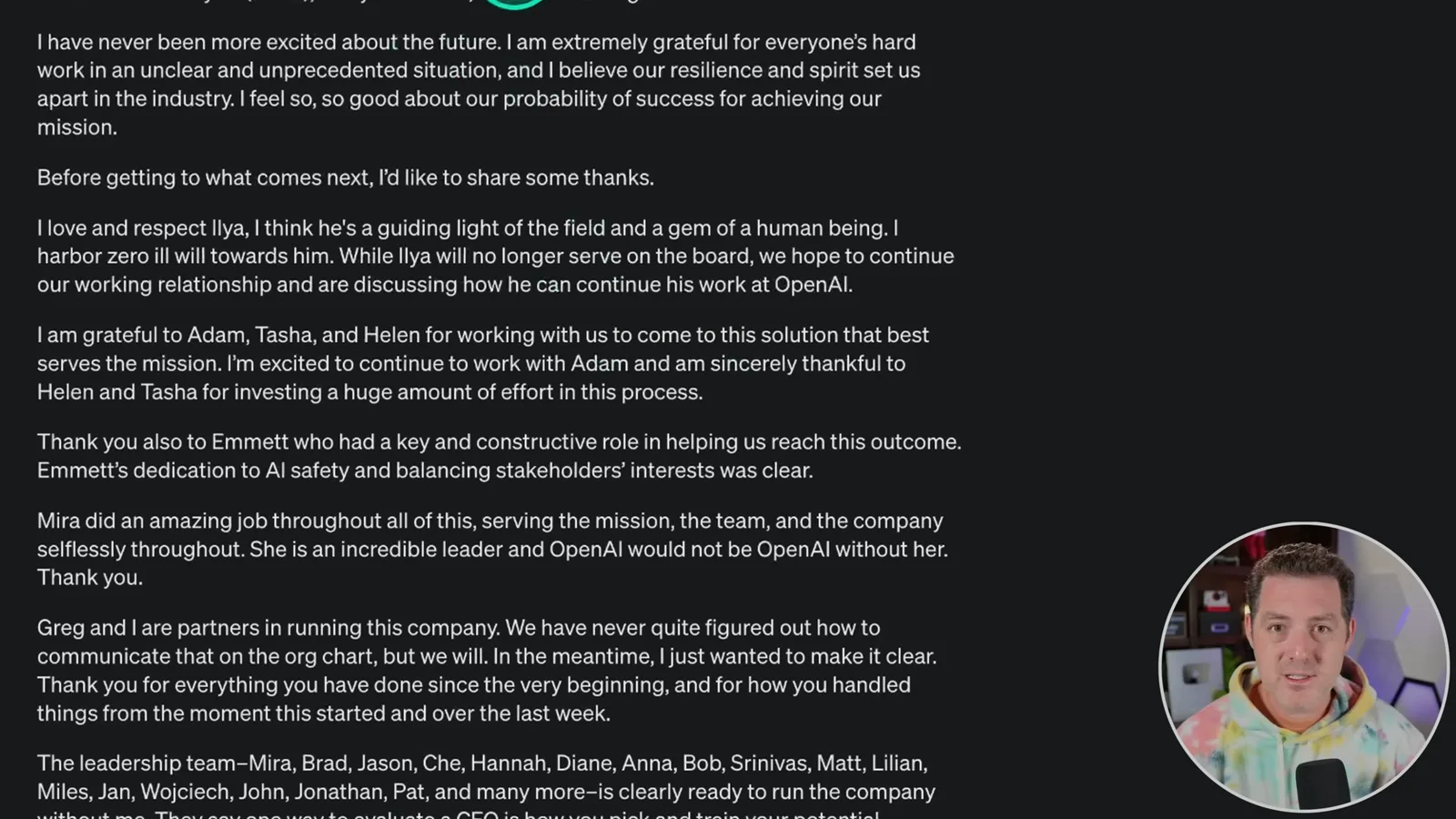
Altman says Ilya Sutskever will no longer serve on the board and that they hope to continue working together. I speculate that a major AI discovery and disagreement over whether to commercialize it triggered the firing. The announcement does not say that, and Sutskever's departure from the board did not itself establish that he was leaving the company.
I also wonder whether Musk might try to recruit Sutskever, given their prior relationship. That is my conjecture, not evidence of a job offer. I read Altman's language as an attempt to repair a difficult relationship, but the personal motives behind the board's actions are not established by this note.
Altman thanks the outgoing directors and Emmett Shear, who briefly served as interim CEO, and emphasizes his partnership with Brockman. I discuss D'Angelo's continued board role and his connection to Poe. Those observations do not by themselves establish a conflict of interest or explain the board decision.
The leadership list in the announcement does not include Sutskever, which I interpret as a possible sign of a future departure. Altman also praises the team and says no employee was lost during the episode. My interpretation of the missing name is not a confirmed employment decision.
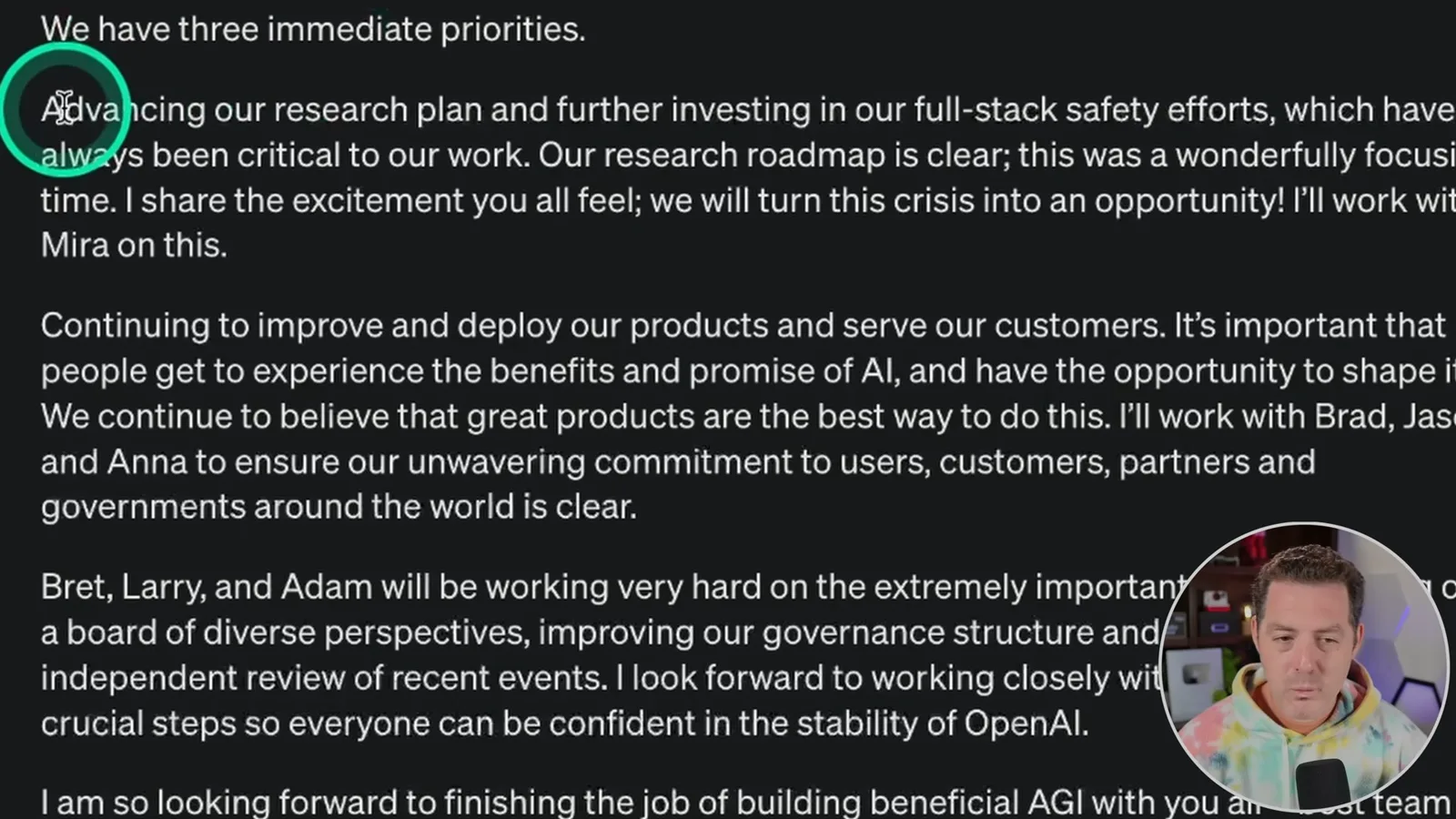
Altman lists research and safety, product deployment, and rebuilding the board and governance among the immediate priorities. I infer that safety may have driven the dispute, but the statement itself does not support that conclusion. In March 2024, OpenAI's summary of an independent review said the prior board's decision did not arise from product safety, security or development pace concerns ([review summary](https://openai.com/index/review-completed-altman-brockman-to-continue-to-lead-openai/)).
Altman's interview and Q*
Altman declines to explain the firing or discuss reported Q* details. Berman interprets his reference to a leak more broadly than the interview establishes.
In a November 29 interview with The Verge, Altman describes being asked to return and says he initially needed a few minutes to work through the emotions. When pressed about why he was fired, he does not give a detailed explanation and welcomes an independent investigation. I remain curious and speculate about a Q* connection, but the interview does not verify one.
Asked about reports of a Q* breakthrough, Altman says he has no particular comment on the 'unfortunate leak' and speaks generally about rapid progress and safety. I take the wording as acknowledgment of a leak, but he does not confirm the reported system's architecture, capabilities or role in the governance crisis. The broader claims in the video's title should be read with that limit ([The Verge interview](https://www.theverge.com/2023/11/29/23982046/sam-altman-interview-openai-ceo-rehired)).
Musk on copyright and AI risk
An interview excerpt presents Musk's claims about AI training and his forecast of rapid progress. Berman adds his own views about X's data and pending lawsuits.
In an excerpt from Andrew Ross Sorkin's interview, Elon Musk alleges that AI companies train on copyrighted data and disputes contrary claims. That is Musk's allegation. Whether particular uses infringe copyright or qualify for a legal exception depends on facts and law and cannot be settled by the interview alone.
Sorkin asks about articles and quotations uploaded to X and what their aggregation could mean for original rights holders. I argue that X gives Musk access to a valuable stream of user-created material and suggest that restricting API access reflects its strategic value. Those are my interpretations; individual quotations being posted on a platform does not automatically resolve the copyright status of their use for training.
Musk says he expects AI progress to outpace the resolution of lawsuits and describes becoming fatalistic about AI risk. The interview also displays his prediction that AI could surpass the smartest human within three years. That was a forecast made in 2023, not an established timetable or a reason to assume any legal dispute has become irrelevant.
I connect Musk's forecast to my theory that OpenAI could use synthetic data to advance beyond models trained on existing material. I think this might be related to Q*, but neither the interview nor the public material shown demonstrates that connection. The claim that legal outcomes will no longer matter is likewise a prediction, not a legal conclusion.
Synthetic data, self-play and benchmarks
Berman explains Lambert's essay and debates whether generated data can improve models beyond their sources. He discusses self-play, evaluation contamination and open-model fine-tuning.
Nathan Lambert's [essay on synthetic data](https://www.interconnects.ai/p/llm-synthetic-data) provides the next piece of the discussion. Synthetic data is produced by a machine rather than directly authored by a human; generated instructions, preferences and critiques can supply examples for training or evaluation. It is not inherently accurate simply because it can be produced at scale.
I argue that human-created text is finite and that generated material could greatly expand the volume available for training. I speculate that Q* may generate high-quality data and use it for self-improvement, but this is a hypothesis without confirmation in the sources presented. More data alone does not guarantee better models or AGI.
Lambert discusses the prospect of using AI-generated feedback in alignment work, including OpenAI's then-new Superalignment effort. I see the appeal of reducing a human feedback bottleneck, while worrying about handing over too much oversight. Automating feedback creates its own questions about what the evaluator rewards and whether mistakes or biases are amplified.
One argument for synthetic data is that more diverse examples could improve performance on rare tasks. A counterargument is that outputs generated by existing models may carry their limitations and biases rather than automatically push the state of the art forward. I lean toward the concern that generated examples can be derivative, while acknowledging that the outcome depends on how they are generated, filtered and evaluated.
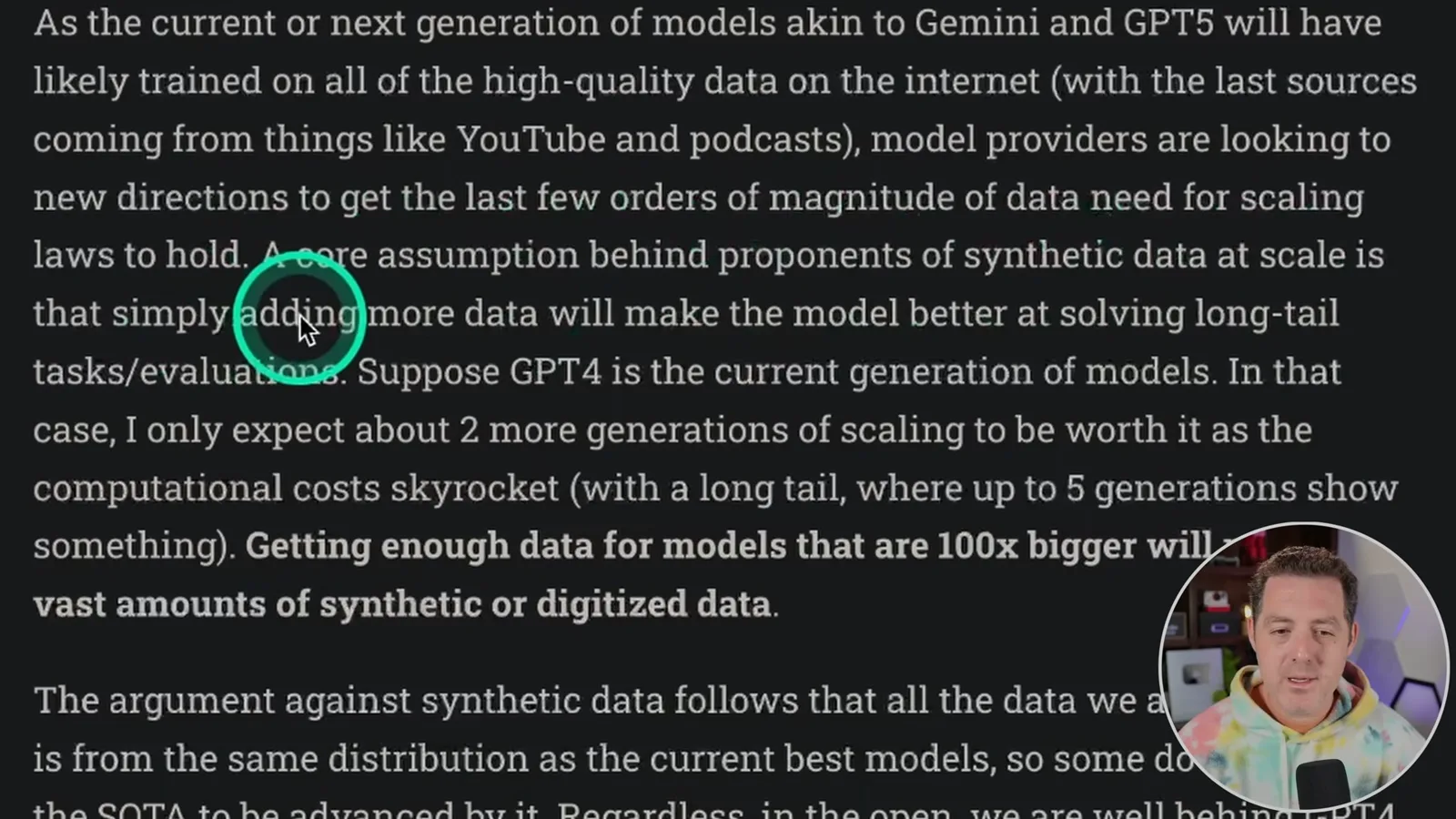
I compare the issue with AlphaGo learning from games against itself. Go offers a clear win-or-loss signal, making iterative evaluation more direct than for open-ended language. The historical account needs a qualification: the original AlphaGo used both human game data and reinforcement learning through self-play before its famous victory over Lee Sedol; AlphaGo Zero later trained without human game examples ([Google DeepMind](https://deepmind.google/research/alphago/)).
With language models, it can be much harder to decide which answer is better. Automated benchmarks help, but contamination occurs when evaluation examples or closely related material appear in training data, making a score less informative about generalization. My own test prompts are one way to inspect behavior, though a small personal test is not immune to limitations either.
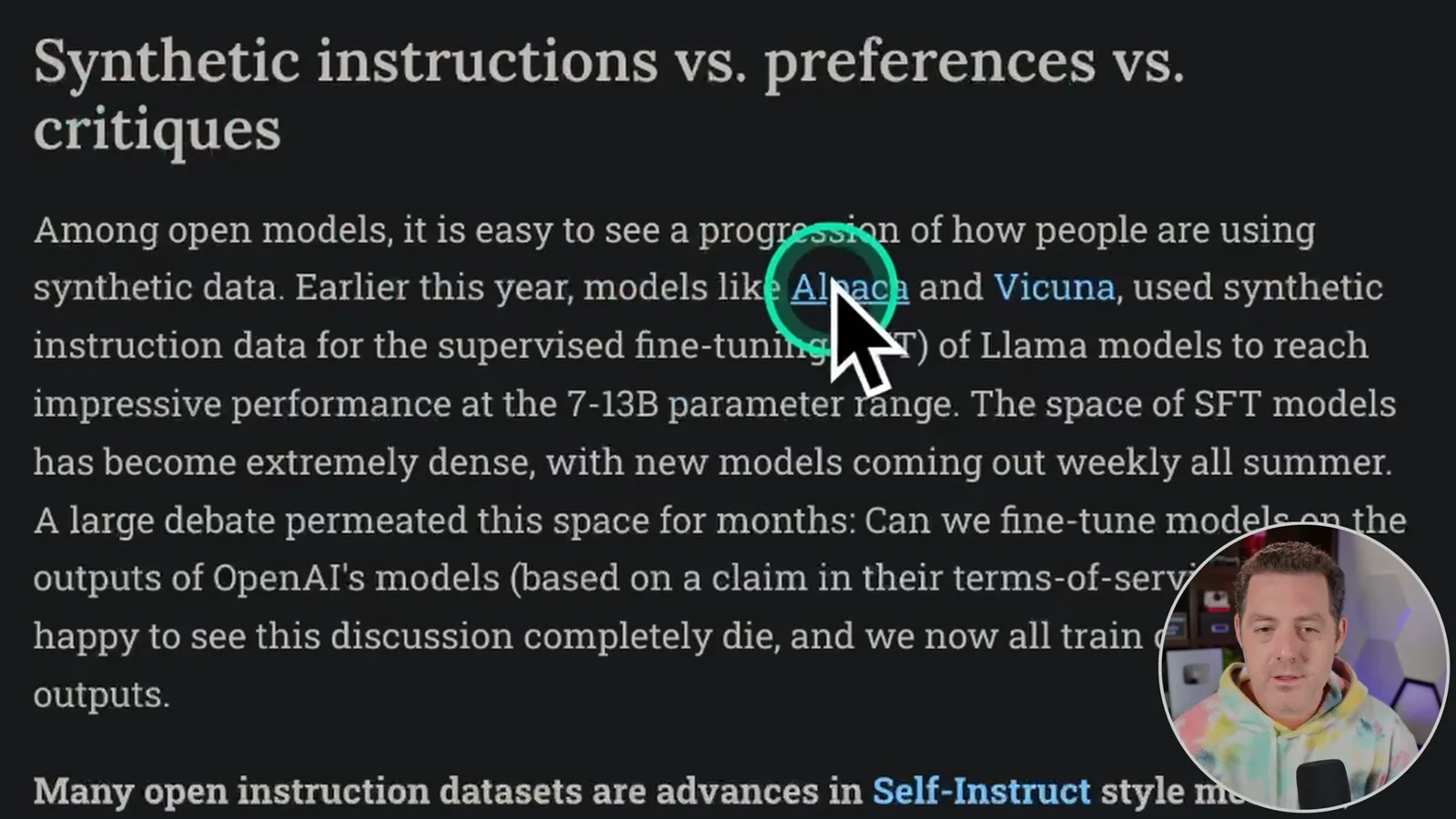
I return to open models: groups without a proprietary data source or large budget may find generated data especially attractive. Lambert notes examples such as Alpaca and Vicuna that used synthetic instruction data to fine-tune Llama-based models. These show a use of generated examples, not proof that synthetic data alone can build any frontier model.
I plan to explore synthetic data and benchmark contamination in more detail. The possibility of rapid progress is exciting to me and also raises concerns about safety and oversight. My optimism about the future is a view, not evidence that a particular forecast or rumored breakthrough has been realized.
More from this channel
 34:21EN
 Matthew Berman· Oct 27, 2026Matthew Berman Examines Anthropic’s IPO Filing, AI Growth and GovernanceMatthew Berman, Sam Altman · Forward FutureThe presenter reviews the S-1’s financial metrics, compute strategy and voting structure while questioning the tension between rapid AI development and safety.
 0:26ENMatthew Berman· Oct 25, 2026Sam Altman on Human Values and Problem-Solving in an AI WorldSam Altman · OpenAIIn a short interview excerpt, Altman considers the enjoyment of solving hard problems and the human role in interpreting results.
 0:36ENMatthew Berman· Oct 25, 2026Kimi K3.1 and a Rubik’s Cube Solver DemonstrationMatthew Berman · Forward FutureMatthew Berman shows a scrambled virtual cube being solved and gives the Kimi K3.1 test a favorable assessment.
 0:21ENMatthew Berman· Oct 24, 2026An AI-Generated Kimi Benchmark Chart Used Invented ScoresMatthew Berman · Forward FutureMatthew Berman asks for a graph of Kimi K3.1 Pro benchmarks, then discovers that the displayed figures are illustrative placeholders.
 25:50ENMatthew Berman· Oct 24, 2026Kimi K3.1 Pro Tested: Strong 3D Demos, Uneven Results and Competitive PricingMatthew Berman · Forward FutureMatthew Berman tests the open-weight model on coding, 3D rendering and visual explanations, then compares benchmark results and prices.
 32:20ENMatthew Berman· Oct 23, 2026Who Is Local AI For? The Costs, Trade-offs and a Hybrid FutureMatthew Berman · Forward FutureMatthew Berman weighs data control and independence against hardware cost, setup complexity and inference speed.