In 30 seconds
In this March 2024 video, Matthew Berman reviews Elon Musk's February 29 state-court complaint against OpenAI, Sam Altman and Greg Brockman. The suit alleged a departure from an agreed nonprofit mission and speculated about GPT-4, Microsoft's license and the 2023 board crisis. Berman finds the case persuasive but recognizes Musk's competing interests. Musk withdrew that case in June 2024, then filed a separate federal case; in May 2026 a jury found the later claims untimely and the court dismissed them on limitations grounds, not a general ruling that every allegation was true or false.
- 1A disputed founding agreementThe February 2024 complaint alleged that OpenAI and its leaders departed from a nonprofit, public-benefit understanding. The defendants disputed Musk's account.
- 2OpenAI's original purposeBerman examines the certificate's public-benefit language and its qualified commitment to seek open sourcing when applicable. The complaint's legal interpretation remained contested.
- 3GPT-4 and the AGI allegationMusk's filing asserted GPT-4 was AGI and outside Microsoft's license. A pleading is not a technical or judicial determination that AGI exists.
- 4The board crisisBerman considers a possible link between Q*, AGI and Altman's firing. The link was speculative; a later OpenAI-commissioned review reported different findings.
- 5The nonprofit and for-profit structureThe complaint recounts Musk's donations and the 2019 formation of a for-profit subsidiary. Berman questions the resulting incentives.
Takeaways
- Musk's complaint alleged a founding agreement to develop AI for public benefit and accused OpenAI's leaders of departing from it; defendants disputed the account.
- OpenAI began as a nonprofit and announced a for-profit structure in 2019, but the legal implications of those events were contested.
- The complaint's assertions about GPT-4, Q* and the reasons for Altman's 2023 removal did not establish that AGI had been achieved or caused the board crisis.
- Musk withdrew the February 2024 state suit and filed a separate federal action; a 2026 jury found the later claims time-barred.
- Berman's assessment that Musk had a strong case is commentary, and Musk's ownership of competing AI interests is relevant context.
Read the edited text by chapter
The complaint and AI background
Berman introduces Musk's lawsuit and explains the complaint's account of early AI, deep learning and potential AGI risks. Allegations are not established facts.
Matthew Berman opens with a nonprofit analogy and reviews Elon Musk's February 29, 2024 complaint against OpenAI, Sam Altman and Greg Brockman. Musk alleged that the organization departed from an agreed public-benefit mission in favor of commercial interests. Those assertions are allegations from a plaintiff, not court findings, and OpenAI later disputed his account.
Berman says the complaint connects two themes: whether OpenAI remained faithful to its founding purpose and whether it had internally achieved artificial general intelligence. He finds the filing compelling, while acknowledging Musk's competing interests. Neither the filing nor Berman's interpretation proves that AGI had been achieved.
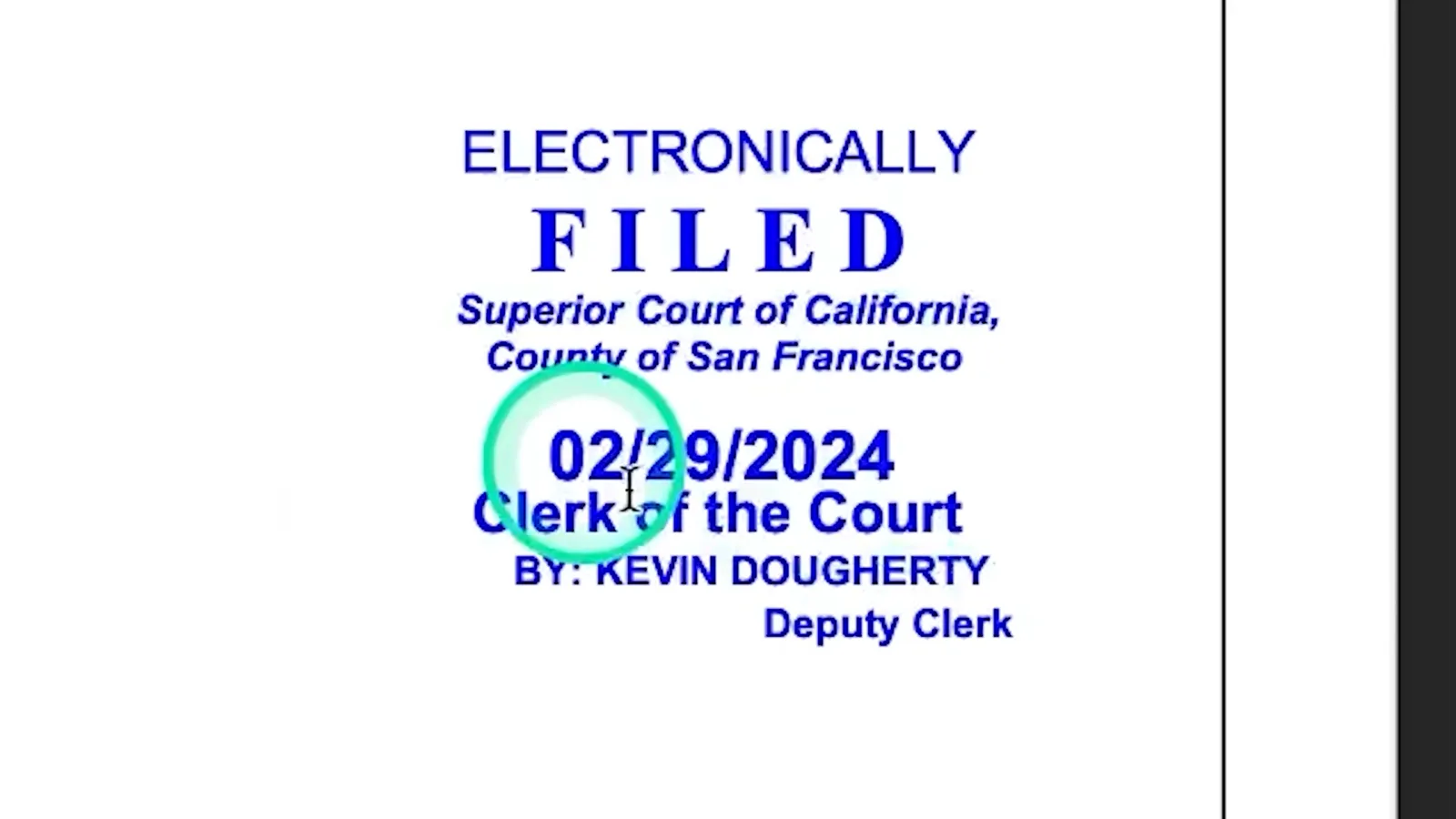
The complaint describes Musk as an early founder and donor and asks for a jury trial. Berman examines OpenAI's 2015 nonprofit incorporation and explains AGI as a system with broadly applicable abilities, contrasting it with early programs built for narrow tasks. The legal meaning of any founding agreement was disputed.
Berman follows the complaint's account of earlier AI, including pathfinding and IBM's Deep Blue, which defeated Garry Kasparov in chess. He contrasts specialized systems with the aspiration to more general capabilities. Strong performance in a specific task does not by itself establish general intelligence.
He describes the renewed practical use of deep learning as hardware improved and gives examples such as speech recognition, translation and image classification. He presents the complaint's broader claim that neural networks can learn from data rather than requiring a hand-written rule for every case; different systems nevertheless depend on task choices, data and design.
The complaint presents Musk as concerned that powerful AI could threaten humanity, referencing warnings from other scientists and his calls for safety measures. Berman notes that Musk has personal and commercial interests as well as stated concerns, but says those interests do not automatically settle whether the allegations are right or wrong.
Berman discusses Google's acquisition of DeepMind and AlphaZero's self-play approach. AlphaZero was developed for chess, shogi and Go, not Dota 2 as he suggests; OpenAI Five was a separate Dota 2 project. Its historical game results do not establish that it remains the strongest chess system today.
Founding OpenAI and its mission
He recounts Musk's concerns about DeepMind, the founders' discussions, OpenAI's nonprofit purpose and early research. The parties later disputed the meaning of their discussions.
The complaint recounts Musk's concern about concentrated control over advanced AI and discussions with Altman and Brockman about an alternative research lab. It characterizes the founders' shared understanding as nonprofit and publicly beneficial. OpenAI later published emails and disputed Musk's description, including his account of for-profit discussions.
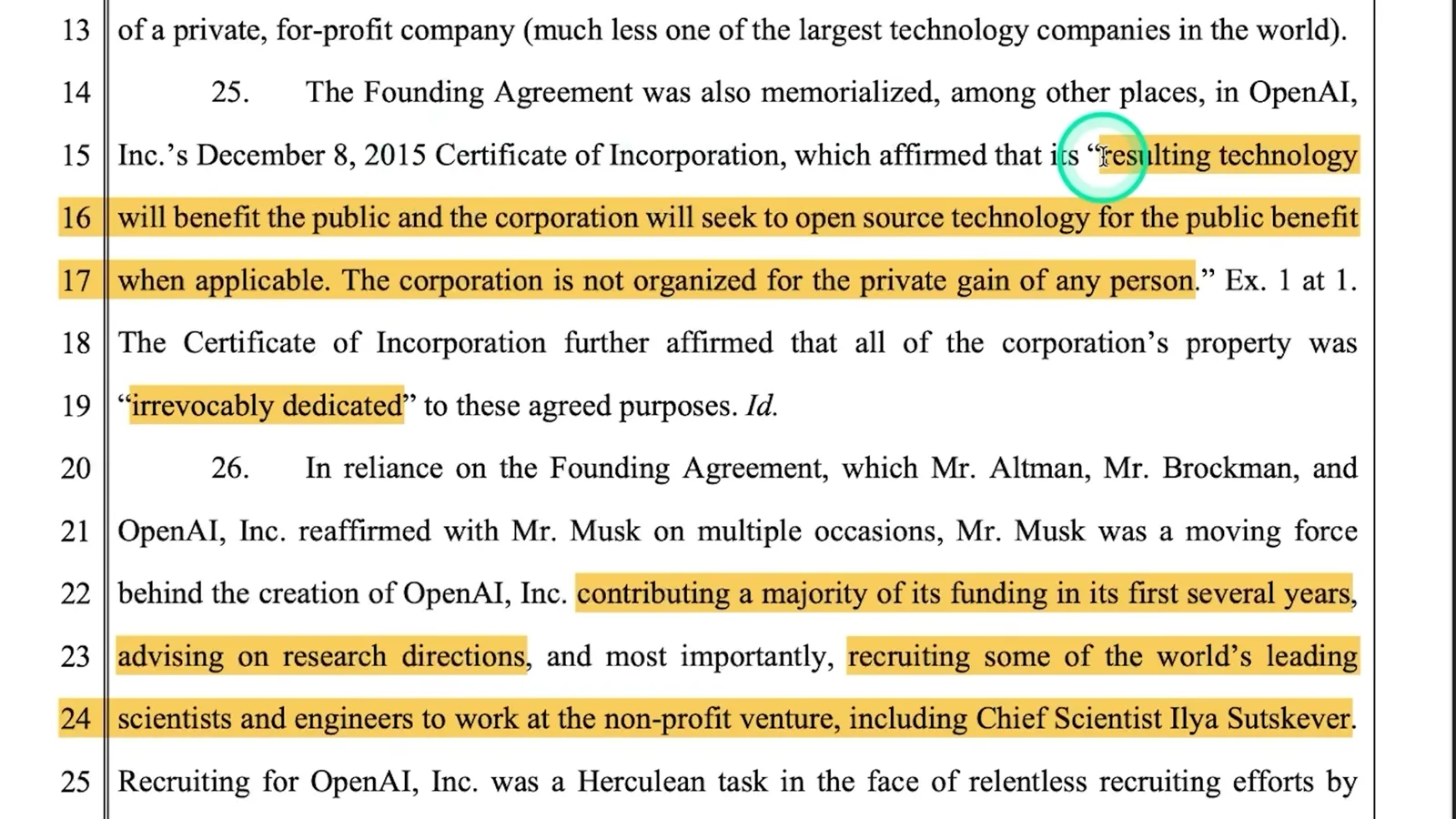
Berman reads language from OpenAI's 2015 certificate saying the resulting technology would benefit the public and that the organization would seek to open-source technology when applicable. He regards the later direction as a dramatic departure. The document's qualified wording and the legal consequences were contested; a nonprofit can also pay employees and operate through related entities subject to applicable rules.
The complaint describes Musk's fundraising, recruiting and early support, including his role in bringing Ilya Sutskever to the organization. Berman imagines the benefits of broader access to model weights and code. His preference for openness is a policy judgment and does not itself determine the legal obligation to publish a specific model.
Berman traces OpenAI's work on transformer-based models and its relationship with Microsoft, including a 2020 GPT-3 licensing announcement. He credits Google's 2017 transformer research and argues that OpenAI exploited the architecture effectively. The historical partnership and model releases are distinct from whether a contract was breached.
Microsoft, GPT-4 and board governance
The complaint argues that GPT-4 and the Microsoft relationship conflicted with the alleged founding agreement. Berman discusses an unproven connection to the 2023 board crisis.
The complaint asserts that Microsoft's license excluded AGI and that OpenAI's nonprofit board would decide when AGI was reached. Berman asks how such a determination could be made and whether the board was equipped to make it. The exact scope and application of contractual terms are not established by his commentary alone.
Musk's complaint points to GPT-4's performance on exams and alleges that it constituted AGI. Berman finds the results striking. Exam scores measure performance under particular conditions; they do not, by themselves, resolve a disputed definition of AGI or demonstrate that a licensing threshold was met.
The filing also alleges that GPT-4's internal design was kept secret largely for commercial reasons and that Microsoft benefited. Berman discusses speculation about model architecture and Microsoft's influence. Those details and motivations are disputed or unverified; the complaint's phrase 'on information and belief' signals an allegation, not a public finding of fact.
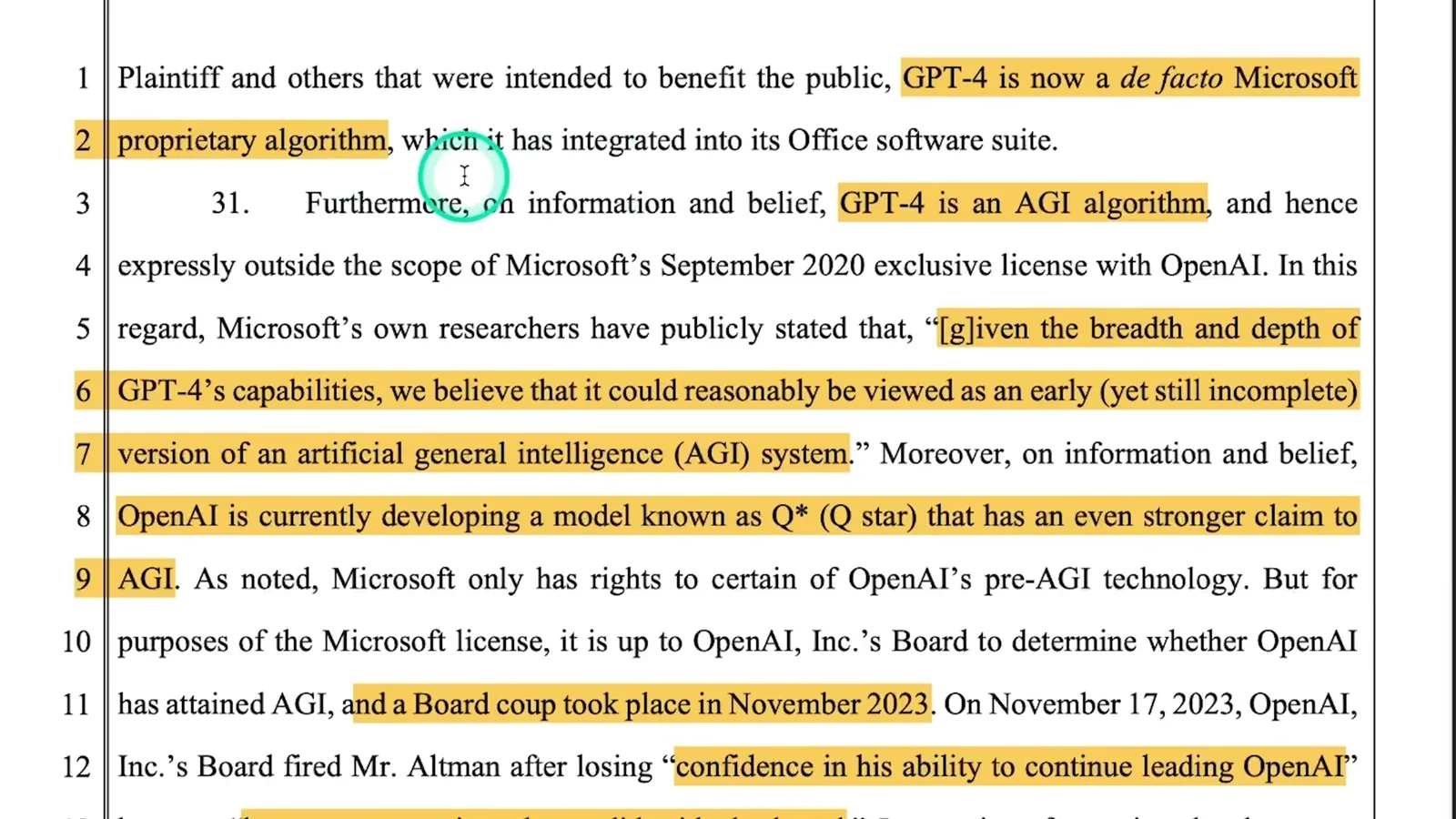
The suit invokes a Microsoft research paper describing GPT-4 as an early, incomplete example of general intelligence and refers to the reported Q* project. The paper expresses its authors' assessment, and the complaint relies on reporting for Q*; neither establishes that OpenAI secretly achieved AGI. Berman's separate inference about a hidden breakthrough is speculative.
The video revisits the November 2023 removal and reinstatement of Altman. Berman considers whether a safety or AGI breakthrough might have caused the board's decision and whether Microsoft exerted pressure. That causal account was not established in the complaint. In a later OpenAI summary, the WilmerHale review said the decision arose from a breakdown in the board's relationship and trust with Altman, not concerns about product safety, security or development speed.
The complaint alleges changes to the board impaired independent oversight and argues that OpenAI became too close to Microsoft. Berman also discusses Microsoft's public statements and its offer to employ Altman and colleagues during the crisis. Commercial influence and the implications of any AGI clause are disputed; the video does not prove an automatic obligation to open-source a system.
Musk's history and the organizational transition
Berman returns to Musk's reported conversations, contributions and the 2019 for-profit subsidiary. He also acknowledges Musk's competitive interests.
Returning to the history, Berman recounts the complaint's descriptions of Musk's conversations with Demis Hassabis and Larry Page about AI risk and Google's acquisition of DeepMind. These accounts are presented as the complaint's narrative of the founders' motivations, not independently verified transcripts of every conversation.
Berman follows the alleged exchanges between Musk and Altman about nonprofit ownership, public benefit and compensation for researchers. He questions how startup-like compensation would fit a nonprofit mission. Compensation alone does not decide whether a nonprofit structure is lawful, and the parties dispute what promises were made.
The certificate shown in the video describes charitable and educational purposes and a public-benefit mission. Berman believes the subsequent commercial direction reversed the founders' intentions, while noting that Musk also founded a competing AI company. Corporate purpose, model openness and compliance involve separate factual and legal questions.
The complaint details early donations, alleging Musk contributed more than $44 million between 2016 and 2020. Berman argues that returning money alone would not address the benefits OpenAI gained from its early support. His view that the complaint is strong is personal commentary, not a legal conclusion.
Berman recounts the complaint's account of 2017 discussions about a for-profit structure and Musk's objections, followed by OpenAI's 2019 announcement of a for-profit subsidiary. The filing argues that this change conflicted with the alleged founding agreement. OpenAI subsequently disputed the narrative and published correspondence about discussions of a for-profit entity.
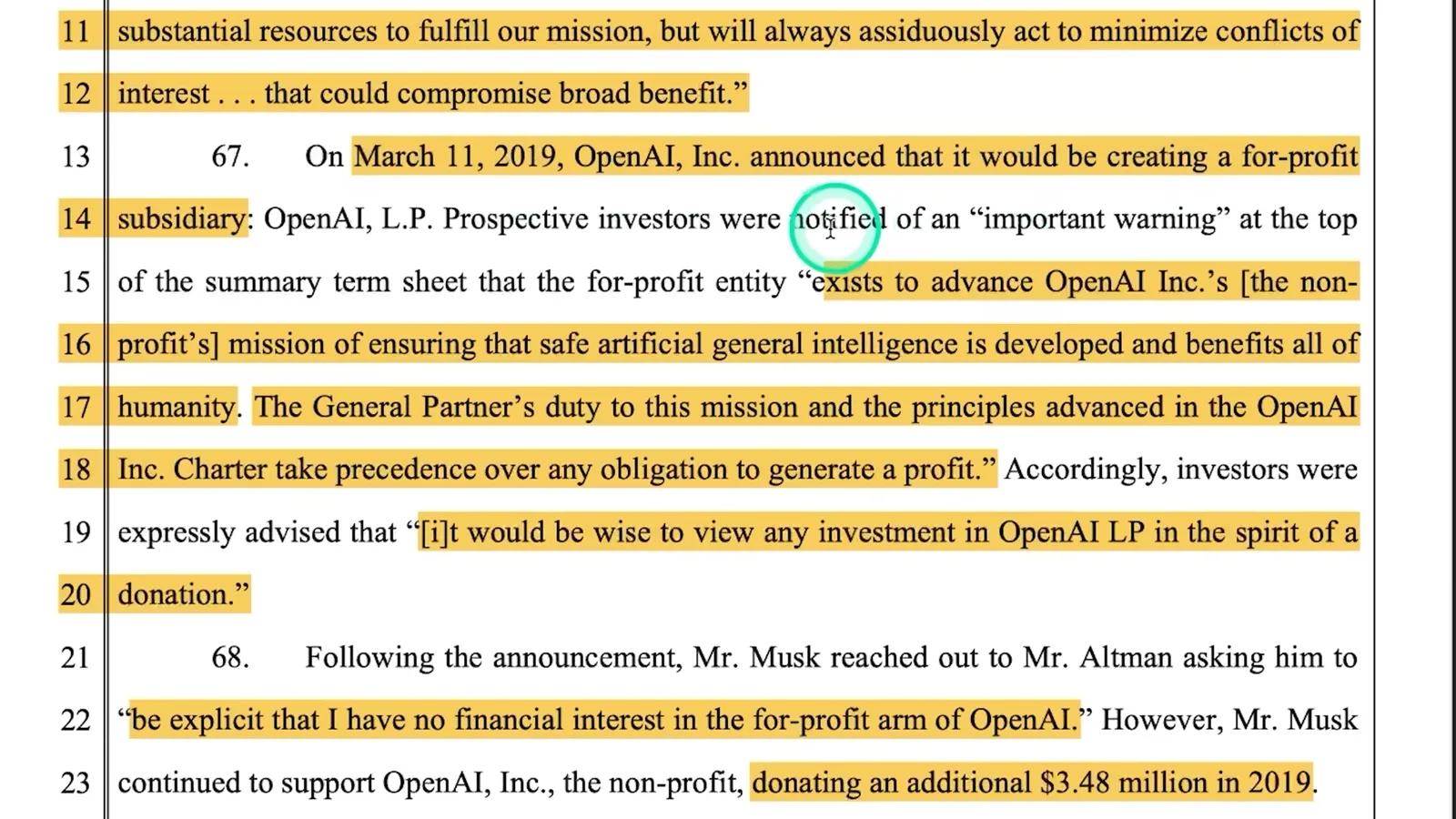
He reads that the for-profit entity was described as advancing the nonprofit's mission and questions whether profit and public-benefit incentives can coexist. He then revisits Microsoft's pre-AGI license and the increasingly complex corporate structure. His assertion that the structure necessarily evaded nonprofit control is an interpretation, not a court finding.
Technology, Q* and potential conflicts
The video reviews transformers and allegations about Q*, investor influence and a proposed chip purchase. Berman concludes that he considers Musk's case strong.
The video revisits transformers, GPT-3, chain-of-thought prompting and GPT-4 as background to the suit's AGI allegations. Berman argues that prompting can improve some reasoning tasks and that GPT-4 meets his own view of AGI. Results depend on the task and evaluation, and no universally accepted test follows from these examples.
Berman returns to the complaint's account of Q* and the board dispute, including reports that staff had raised concerns. He connects these reports to Altman's firing, but no such causal link is established by the complaint. OpenAI's later summary of the independent review reported that product safety and security concerns were not the basis for the board's decision.
He discusses reported chip-funding talks and an alleged 2019 letter of intent to buy chips from a startup in which Altman had invested. Berman sees potential conflicts of interest; the complaint's allegation and a letter of intent do not alone establish an improper transaction or a legal violation.
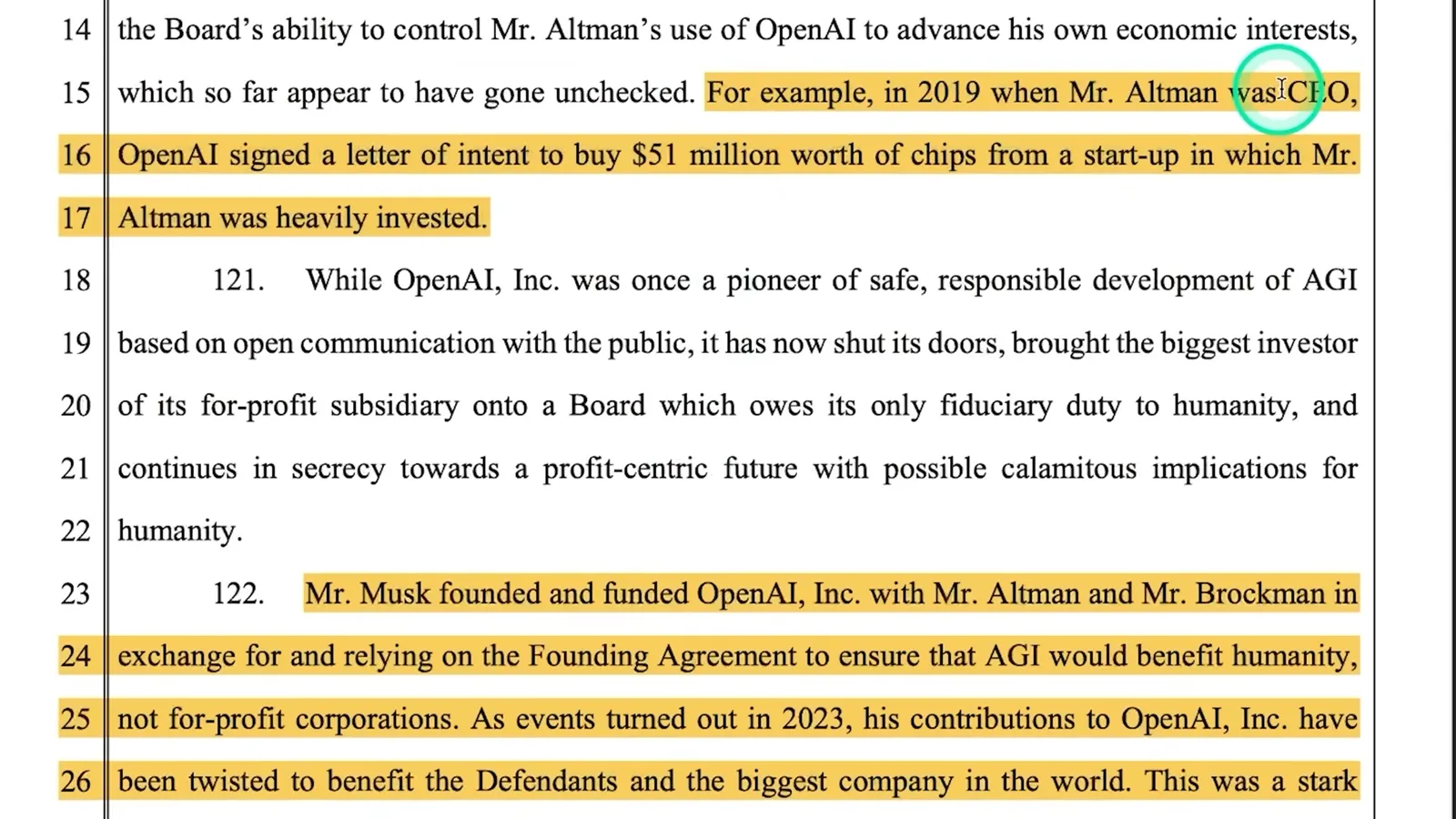
Berman concludes that Musk has a strong case and asks viewers what they think. Subsequent proceedings changed the legal picture: Musk voluntarily withdrew the February 2024 California state case in June, then filed a separate federal suit. In May 2026 a jury found his later claims untimely and the court dismissed them on limitations grounds; that outcome did not resolve every factual allegation on its merits.
More from this channel
 34:21EN
 Matthew Berman· Oct 27, 2026Matthew Berman Examines Anthropic’s IPO Filing, AI Growth and GovernanceMatthew Berman, Sam Altman · Forward FutureThe presenter reviews the S-1’s financial metrics, compute strategy and voting structure while questioning the tension between rapid AI development and safety.
 0:26ENMatthew Berman· Oct 25, 2026Sam Altman on Human Values and Problem-Solving in an AI WorldSam Altman · OpenAIIn a short interview excerpt, Altman considers the enjoyment of solving hard problems and the human role in interpreting results.
 0:36ENMatthew Berman· Oct 25, 2026Kimi K3.1 and a Rubik’s Cube Solver DemonstrationMatthew Berman · Forward FutureMatthew Berman shows a scrambled virtual cube being solved and gives the Kimi K3.1 test a favorable assessment.
 0:21ENMatthew Berman· Oct 24, 2026An AI-Generated Kimi Benchmark Chart Used Invented ScoresMatthew Berman · Forward FutureMatthew Berman asks for a graph of Kimi K3.1 Pro benchmarks, then discovers that the displayed figures are illustrative placeholders.
 25:50ENMatthew Berman· Oct 24, 2026Kimi K3.1 Pro Tested: Strong 3D Demos, Uneven Results and Competitive PricingMatthew Berman · Forward FutureMatthew Berman tests the open-weight model on coding, 3D rendering and visual explanations, then compares benchmark results and prices.
 32:20ENMatthew Berman· Oct 23, 2026Who Is Local AI For? The Costs, Trade-offs and a Hybrid FutureMatthew Berman · Forward FutureMatthew Berman weighs data control and independence against hardware cost, setup complexity and inference speed.