In 30 seconds
In July 2025, Matthew Berman describes Mark Zuckerberg’s formation of Meta Superintelligence Labs and the hiring push behind it. He discusses the Scale AI investment, competing compensation offers, OpenAI’s reported response, and the backgrounds of Meta’s new hires. The deal left Scale independent, and some of the video’s claims about its data and the form of compensation are disputed or unsupported.
- 1Llama 4 and a new hiring driveBerman argues that the reception of Llama 4 motivated a more aggressive search for top researchers. Two models had been released while the larger Behemoth was still in development.
- 2Scale investment and Wang’s moveMeta took a minority stake in Scale AI and recruited its founder. Scale says the transaction did not give Meta access to confidential customer information.
- 3OpenAI countersBerman discusses a reported internal memo describing compensation reviews and concern about pressure from Meta’s offers.
- 4The organizationA reported Zuckerberg memo grouped foundation, product and FAIR teams with a new lab under Meta Superintelligence Labs.
- 5Researchers recruitedThe disclosed hires had experience across OpenAI, Google DeepMind and Anthropic, spanning reasoning, multimodal models and inference.
Takeaways
- Meta invested about $14.3 billion for a minority stake in Scale AI and recruited its founder Alexandr Wang to lead its AI organization.
- Scale said it remained independent and that Meta would not gain access to confidential customer data or internal systems.
- Sam Altman described $100 million signing bonuses, while a Meta executive disputed that characterization of the offers.
- An internal memo reported by WIRED described OpenAI recalibrating compensation and warning employees about pressure to decide quickly.
- Zuckerberg’s reported memo placed foundation models, product teams, FAIR and a new research lab under Meta Superintelligence Labs.
Read the edited text by chapter
Why Meta is recruiting
Berman connects the Llama 4 rollout to Zuckerberg’s hiring campaign. Altman publicly claimed Meta made unusually large offers.
Mark Zuckerberg has been recruiting AI researchers from rival companies, especially OpenAI, and a reported internal memo gives us a clearer picture of the new Meta Superintelligence Labs. I want to walk through how Meta got here, how OpenAI has reacted, and who is joining the effort.
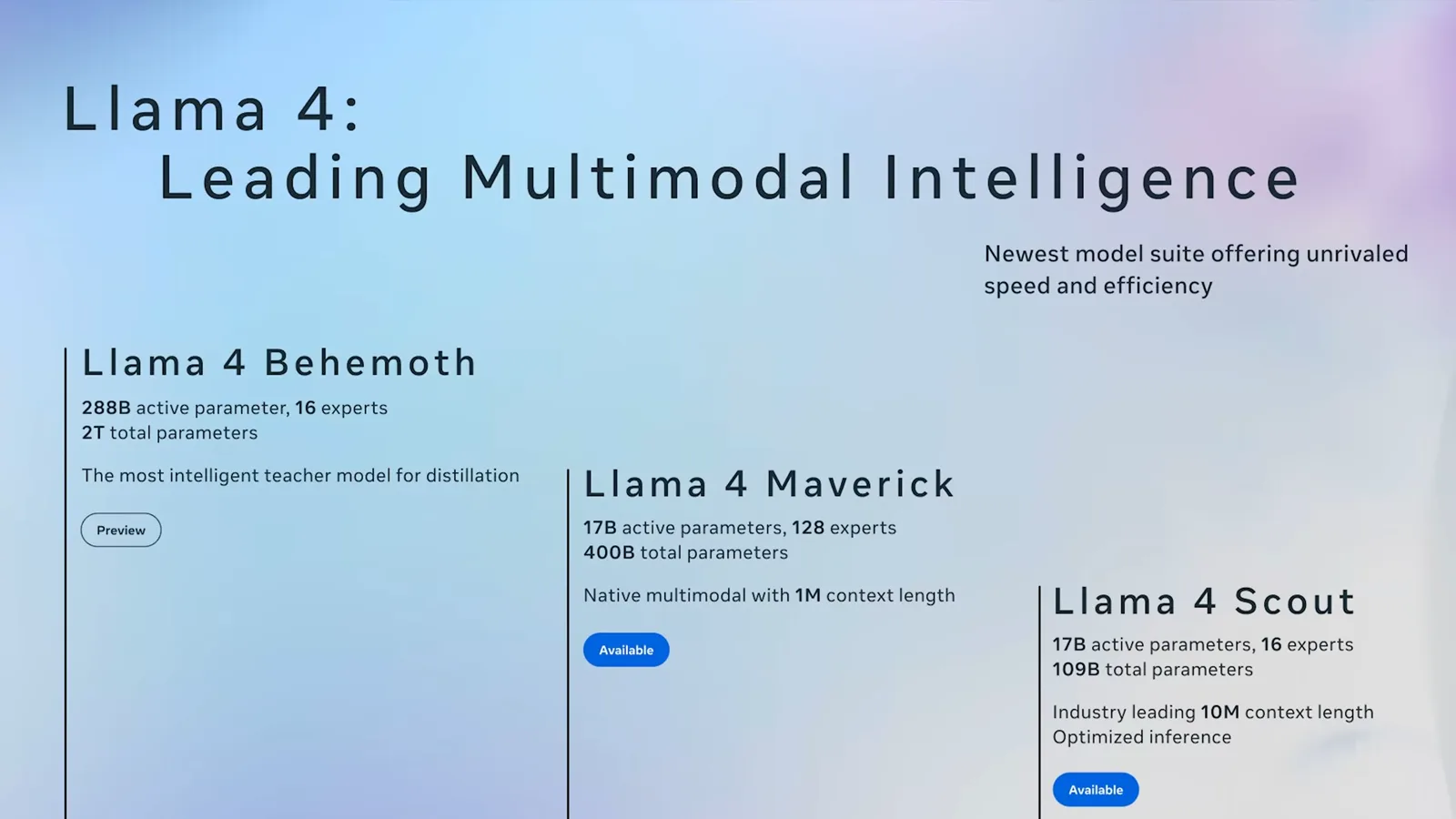
A few months earlier, Meta released Llama 4 Scout and Maverick, while its larger Behemoth model was still in training. I thought the released models were good, but good may not be enough for Meta to compete at the frontier. Zuckerberg reportedly began personally pursuing leading researchers with exceptionally large offers.
In an excerpt, OpenAI CEO Sam Altman says Meta made offers to people on his team including $100 million signing bonuses. That is Altman’s characterization, not independent confirmation of each offer: Meta’s CTO later disputed the signing-bonus description, saying the largest packages were structured differently ([TechCrunch](https://techcrunch.com/2025/06/27/meta-is-offering-multimillion-dollar-pay-for-ai-researchers-but-not-100m-signing-bonuses/)).
Scale AI and Alexandr Wang
Meta invested in Scale AI and brought its founder to lead its AI initiative. Berman speculates about the deal and customer reactions.
Meta also invested approximately $14.3 billion for a 49% minority stake in Scale AI, which supplies data services including labeling for AI development. Scale founder and CEO Alexandr Wang joined Meta to lead the superintelligence effort. The transaction was not an outright purchase of Scale; the company said it would remain independent ([Scale AI](https://scale.com/blog/scale-ai-announces-next-phase-of-company-evolution)).
I suspect speed and the regulatory review associated with a full acquisition helped explain the structure, but those motives are my interpretation. I also suggest that rival customers might pull away from Scale because Meta is a competitor. Reports did describe customer concerns and changes in plans, but that does not establish that every OpenAI or Google contract was cancelled or that Scale’s business would die.
I claim that Meta got all of Scale’s data in the transaction. That claim is not established: Scale stated that Meta would not get access to its internal systems or customers’ confidential information, and that Wang would continue to be bound by confidentiality obligations as a Scale board member ([Scale’s customer statement](https://scale.com/blog/customer-trust-scale-meta-deal)).
Departures and OpenAI’s response
Berman lists researchers joining Meta and reviews a reported OpenAI memo about counteroffers, fairness and pressure to decide.
Altman had initially said OpenAI’s best people were not accepting Meta’s offers, but subsequent reporting described several departures. I discuss researchers including Shengjia Zhao, Jiahui Yu, Hongyu Ren and Shuchao Bi, whose earlier work covered reasoning models, perception and multimodal systems. The video describes the Zurich office as entirely recruited; the reports cited here do not establish that the entire office moved.
OpenAI chief research officer Mark Chen addressed the departures in a reported internal memo. According to WIRED, he compared the feeling to a break-in and said OpenAI was working to retain researchers, including by recalibrating compensation and finding ways to reward leading talent ([WIRED](https://www.wired.com/story/openai-meta-leadership-talent-rivalry/)).
Chen also stressed fairness to other employees while saying he would fight to keep people. I see a financial imbalance: Meta is a large public company with substantial resources, while OpenAI was still private. That does not by itself establish what either company could or would pay an individual researcher.
OpenAI leadership also warned that fast-expiring offers could pressure employees during a scheduled week off. The advice in the reported messages was to ask for more time and reach out to leadership rather than make a major career decision in isolation. The alleged pressure is OpenAI’s account of the recruiting tactics.
Superintelligence as the goal
OpenAI leaders urge staff to stay focused on research. Berman then introduces Zuckerberg’s new organization and its leadership.
Chen urged colleagues to keep their attention on turning more compute into intelligence, treating the contest with Meta as a side quest. I think that focus on superintelligence captures why the battle for researchers has become so intense, even as labs continue to ship more incremental products.
Zuckerberg’s memo, obtained by WIRED, called the overall organization Meta Superintelligence Labs. It included Meta’s foundation model, product and FAIR teams and a new lab focused on its next generation of models. I wonder whether Yann LeCun’s role might have been deprioritized, but the memo’s description of FAIR does not establish that claim.
The memo identified Wang as Meta’s chief AI officer and MSL leader. Former GitHub CEO Nat Friedman would co-lead the new lab with Wang, focusing on AI products and applied research. The announced group brought together people with experience at several competing labs.
The new hires
Berman walks through the researchers and their work on reasoning, multimodal systems, inference and Gemini.
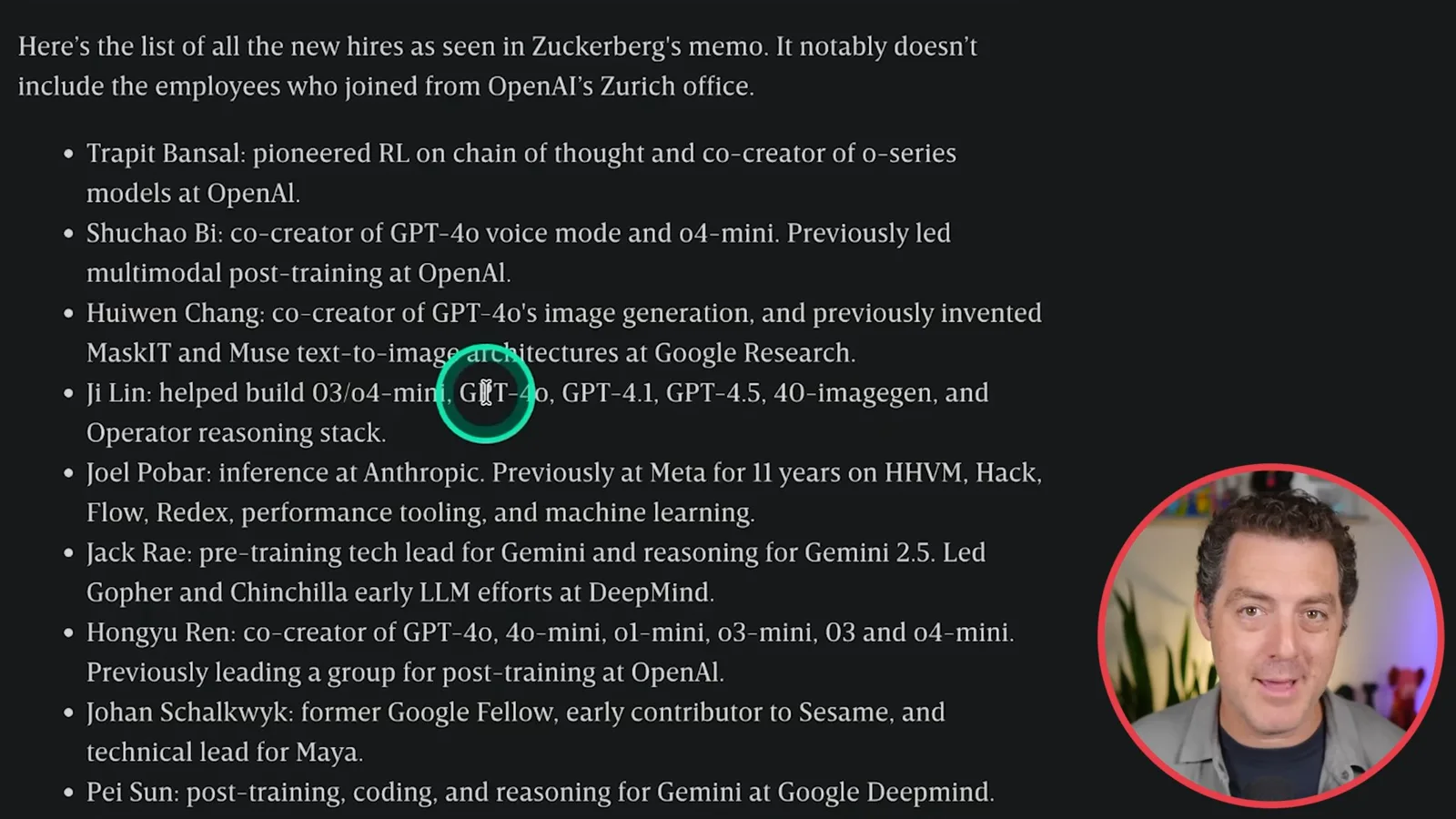
The reported list includes Trapit Bansal, associated with reinforcement learning and OpenAI’s o-series, and Shuchao Bi, who worked on GPT-4o voice and multimodal post-training. Huiwen Chang worked on GPT-4o image generation, while Ji Lin contributed to OpenAI models and the Operator reasoning stack. These are the backgrounds described in Zuckerberg’s reported memo, not evidence that any one person built a product alone.
Other hires in the memo include Joel Pobar, who worked on inference at Anthropic; Jack Rae, a Gemini pre-training and reasoning lead; Hongyu Ren, who worked on several GPT and o-series models; and Johan Schalkwyk, a former Google Fellow and contributor to Sesame’s Maya. Pei Sun worked on Gemini post-training and reasoning, while Jiahui Yu and Shengjia Zhao brought experience across OpenAI’s multimodal and reasoning models ([WIRED’s list](https://www.wired.com/story/mark-zuckerberg-welcomes-superintelligence-team/)).
Taken together, I see an unusually strong collection of researchers aimed at the goal Zuckerberg calls superintelligence. The personnel list shows Meta’s ambition and spending power; whether the new organization can deliver a better model is a separate question that remains to be seen.
More from this channel
 34:21EN
 Matthew Berman· Oct 27, 2026Matthew Berman Examines Anthropic’s IPO Filing, AI Growth and GovernanceMatthew Berman, Sam Altman · Forward FutureThe presenter reviews the S-1’s financial metrics, compute strategy and voting structure while questioning the tension between rapid AI development and safety.
 0:26ENMatthew Berman· Oct 25, 2026Sam Altman on Human Values and Problem-Solving in an AI WorldSam Altman · OpenAIIn a short interview excerpt, Altman considers the enjoyment of solving hard problems and the human role in interpreting results.
 0:36ENMatthew Berman· Oct 25, 2026Kimi K3.1 and a Rubik’s Cube Solver DemonstrationMatthew Berman · Forward FutureMatthew Berman shows a scrambled virtual cube being solved and gives the Kimi K3.1 test a favorable assessment.
 0:21ENMatthew Berman· Oct 24, 2026An AI-Generated Kimi Benchmark Chart Used Invented ScoresMatthew Berman · Forward FutureMatthew Berman asks for a graph of Kimi K3.1 Pro benchmarks, then discovers that the displayed figures are illustrative placeholders.
 25:50ENMatthew Berman· Oct 24, 2026Kimi K3.1 Pro Tested: Strong 3D Demos, Uneven Results and Competitive PricingMatthew Berman · Forward FutureMatthew Berman tests the open-weight model on coding, 3D rendering and visual explanations, then compares benchmark results and prices.
 32:20ENMatthew Berman· Oct 23, 2026Who Is Local AI For? The Costs, Trade-offs and a Hybrid FutureMatthew Berman · Forward FutureMatthew Berman weighs data control and independence against hardware cost, setup complexity and inference speed.