In 30 seconds
In January 2026, Matthew Berman discusses a report that OpenAI CFO Sarah Friar raised the possibility of value-sharing arrangements in drug discovery. He compares biotech partnerships and Stanford’s invention policy, then imagines broader implications for access to AI compute. The remarks did not establish a blanket claim on ordinary users’ ideas; legal rights and individual agreements depend on their terms. The video contains a Dell Technologies sponsorship.
- 1A proposed business modelFriar discussed possible value sharing in drug discovery, while the details and terms of any arrangement were not established.
- 2Revenue and advertisingThe video describes an annualized revenue figure and plans for a limited advertising test; historical rollout and regional pricing matter.
- 3Research partnershipsThe 2018 GSK–23andMe collaboration is an example of a research arrangement, not proof that ordinary ChatGPT output is owned by OpenAI.
- 4Stanford’s policyThe actual policy specifies qualifying university responsibilities, research or resource use rather than every personal idea.
- 5Compute for a potential shareBerman sketches a hypothetical trade of compute for participation in future value; he assumes the parties would negotiate.
- 6A speculative futureHis scenario about concentrated AI resources and economic power is a thought experiment, not a demonstrated consequence.
Takeaways
- Friar discussed potential licensing or outcome-based arrangements in drug discovery; a reported idea is not an announced universal claim on ChatGPT users’ work.
- OpenAI’s consumer terms assign users output rights as between user and company to the extent allowed by law, subject to applicable terms and non-uniqueness.
- The $20 billion figure cited for 2025 was annualized recurring revenue, not confirmed total revenue booked during the year.
- Stanford’s invention policy applies to specified patentable inventions connected to university responsibilities, research or more-than-incidental resources; it does not say every off-campus thought belongs to Stanford.
- 23andMe entered Chapter 11 in 2025 and its assets were subsequently sold; the video establishes no causal link to its GSK partnership.
- Predictions about AI-driven drug discovery and a permanent economic underclass are speculative, not established outcomes.
Read the edited text by chapter
Friar’s remarks and OpenAI’s revenue
Berman reviews a report on proposed value sharing and responds to viral interpretations. The reported discussion does not establish a universal ownership rule.
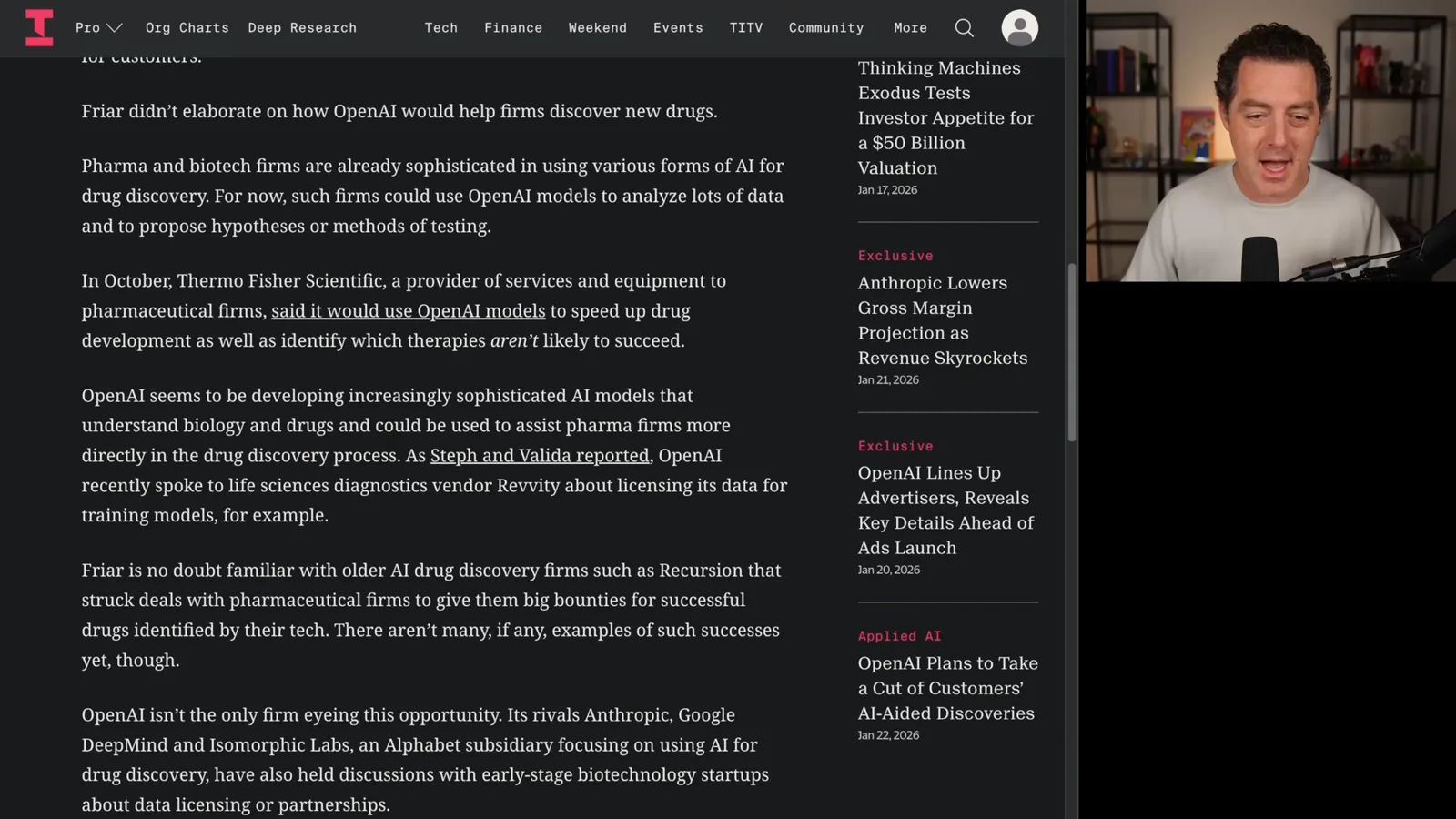
I discuss a report that OpenAI CFO Sarah Friar raised the idea of sharing value from drug discoveries made using its technology. That is a proposed business model for potential partnerships, not evidence that OpenAI automatically takes a share of everything a ChatGPT user creates.
Some viral interpretations suggested that any code, company or idea developed with ChatGPT would belong partly to OpenAI. The reporting does not establish such a universal rule. Applicable contracts matter, and OpenAI’s consumer terms say that, as between the user and OpenAI and to the extent permitted by law, the user owns output; output may not be unique.
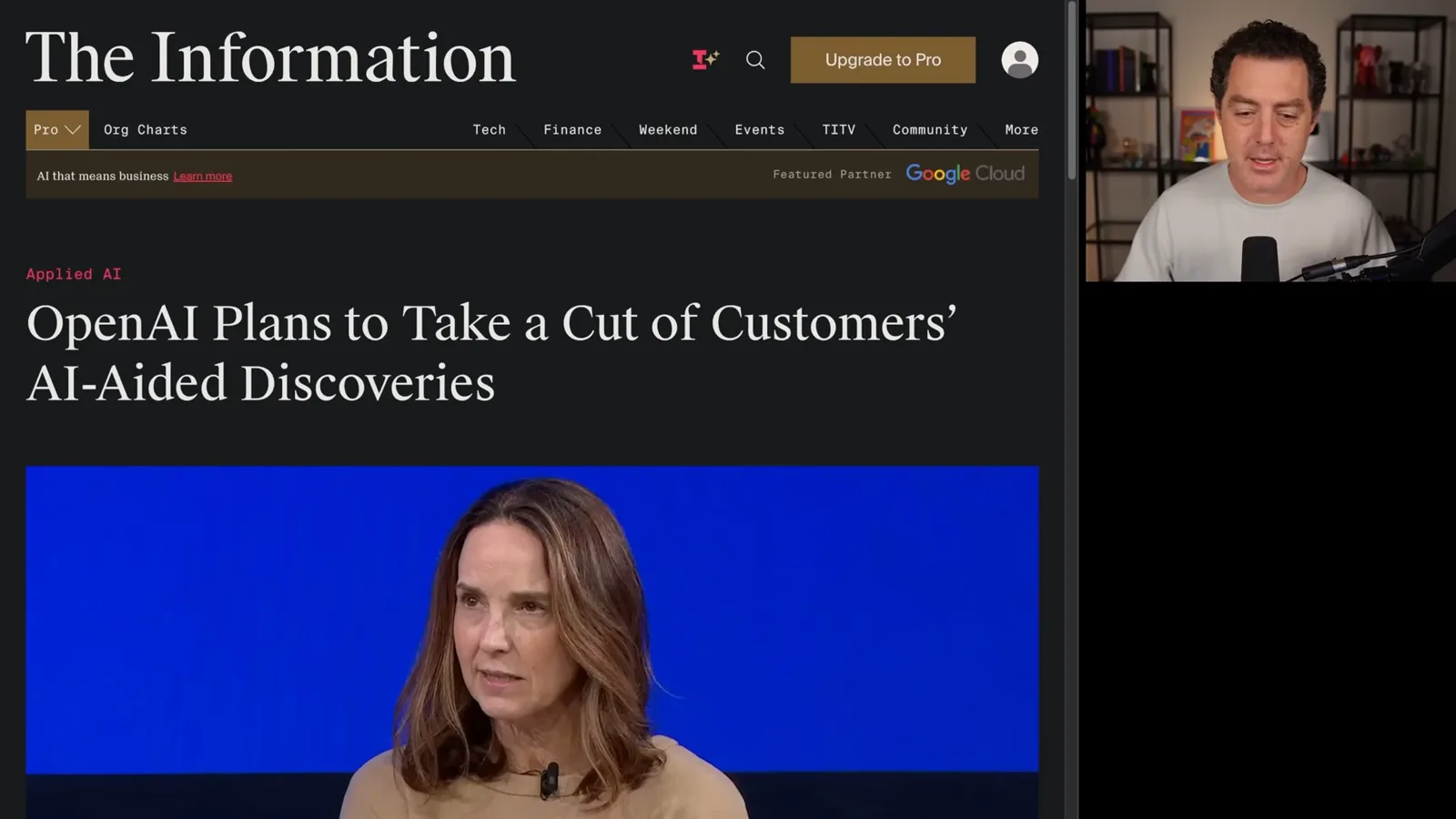
The Information reported Friar’s remarks at Davos and described a possible license to a drug discovered using OpenAI technology. The public discussion did not spell out a finalized deal, the price, the rights covered or how any particular customer would opt in.
I relate the report to OpenAI’s recent revenue, pricing and advertising announcements. Friar reported more than $20 billion in annualized recurring revenue for 2025; that is a run rate, not proof that the company booked $20 billion of revenue during the full year.
ChatGPT Go was introduced worldwide with a US price of $8 per month and localized pricing elsewhere. OpenAI said it planned to test ads in the US for Free and Go users; the actual US test began in February 2026. These are historical launch details, not a statement that all users everywhere were shown ads.
My initial reaction to value sharing was disbelief. I started asking how such deals work and whether they might make sense when a company needs resources to pursue research faster; my reaction is an opinion, not a description of an existing contract.
Partnerships, bankruptcy and university policy
He compares GSK and 23andMe with university invention rules. The details and limits of each arrangement differ.
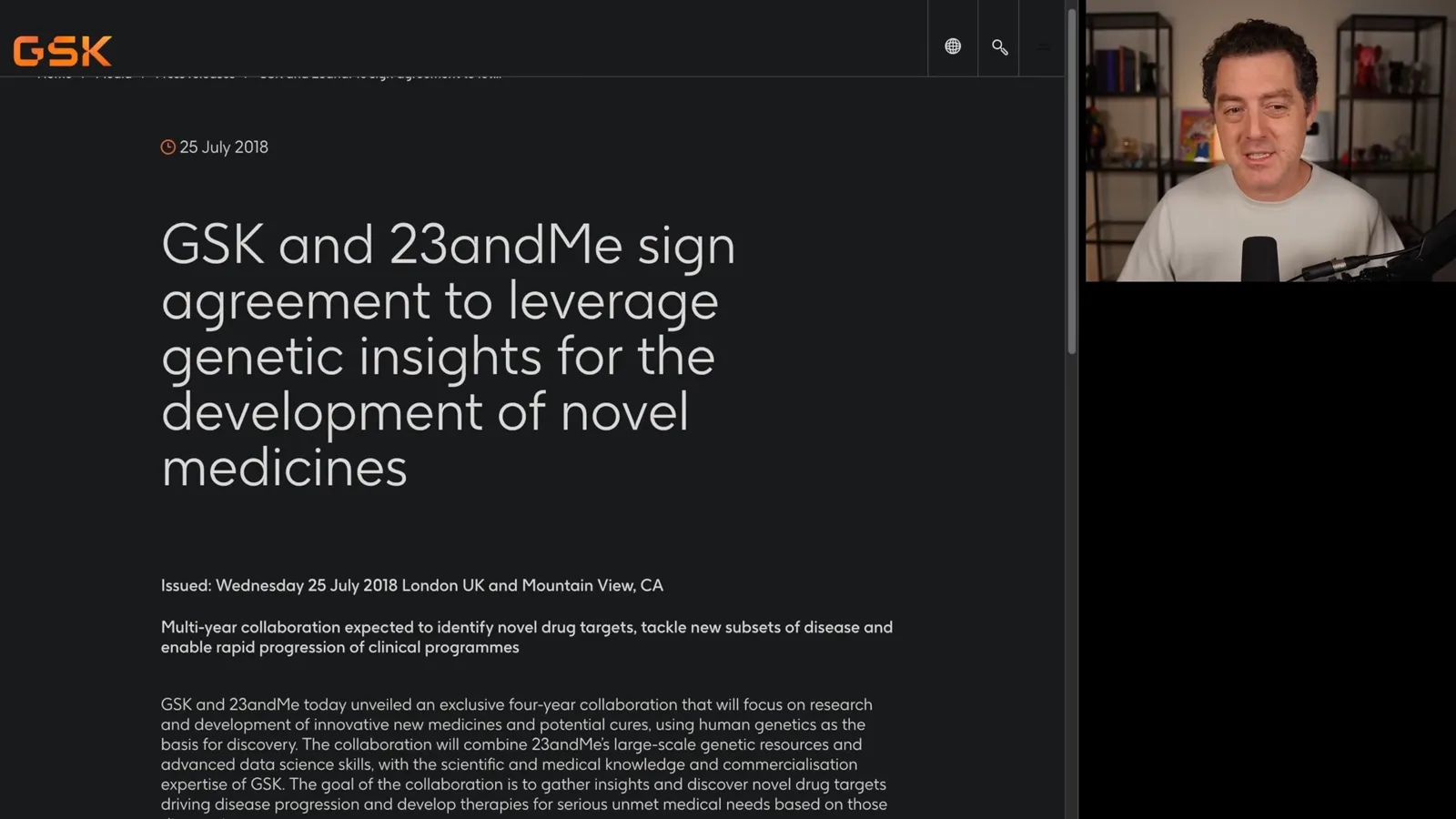
I look at the 2018 collaboration between GSK and 23andMe, which combined genetic insights and drug-development research. Commercial research partnerships can allocate rights, investment and proceeds in different ways; that agreement is not equivalent to a blanket claim on an AI user’s work.
As a business owner I would be reluctant to give up part of my own business and might prefer slower growth. Drug development presents different incentives: partners may seek resources or expertise to accelerate research, while medicines still require careful testing for safety and effectiveness.
I mention 23andMe’s March 2025 bankruptcy filing without asserting it resulted from the partnership. It was a Chapter 11 process, and substantially all the company’s assets were later sold to the nonprofit TTAM Research Institute; the video supplies no evidence of a causal connection to the GSK deal.
I next compare university research, where ownership and licensing can be governed by institutional policy and agreements. A researcher’s relationship to a university laboratory differs from a customer’s use of a commercial AI tool, so the analogy has limits.
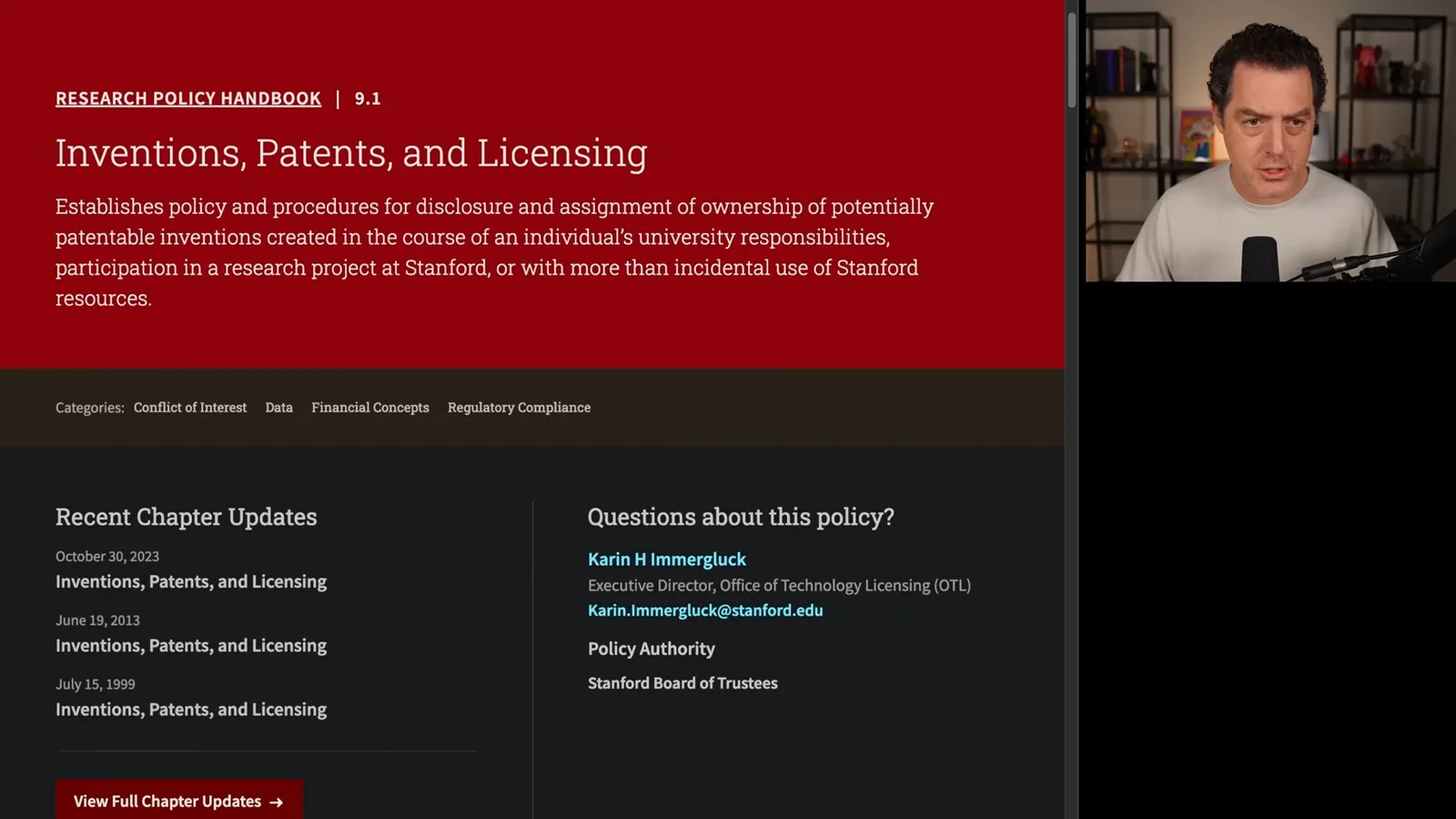
Stanford’s published invention policy covers potentially patentable inventions conceived or first reduced to practice in specified circumstances, including university responsibilities, relevant research participation or more than incidental use of university resources. Its rules also address disclosure, assignment and sharing licensing income with inventors.
I worry about ideas arising away from campus or outside normal working hours. But the policy does not say Stanford automatically owns every thought a student or employee has at home: how it applies depends on responsibilities, resources, agreements and the facts of a particular invention.
I compare private-sector side projects and suggest they generally belong to the employee. That is too categorical: ownership and enforceability can depend on the employment agreement, local law, the relationship to the employer’s business and the circumstances. Neither generalization resolves an individual dispute.
A hypothetical compute partnership
Berman illustrates how a drug company might exchange future value for compute. He questions incentives and notes the video’s sponsor.
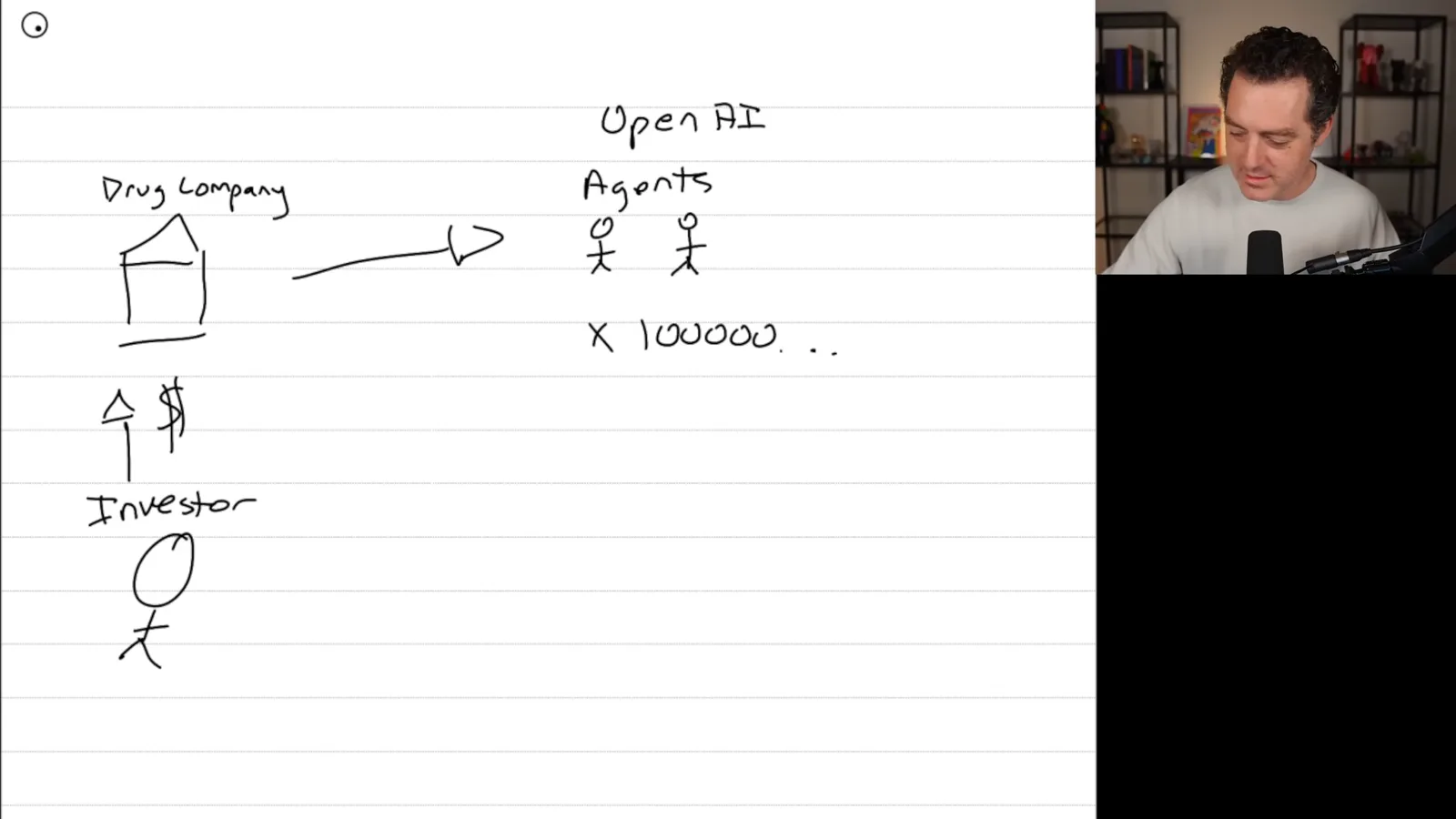
Returning to Friar’s example, I imagine a drug company needing a large amount of AI compute to explore hypotheses. It might pay for services directly or negotiate some other arrangement tied to future outcomes. No specific transaction or scientific result is established by this hypothetical.
I draw a diagram in which a company raises investment to buy compute, then consider whether a provider could offer compute in exchange for a share of value. I assume that any such arrangement would be negotiated by both parties; the report does not provide a complete contract to verify that assumption.
I return to concern about training data and compensation. The origins and licensing of training data are complex and contested; saying all model training used only public data, or that use of a model automatically transfers a customer’s intellectual property, would overstate what is established here.
The video includes a paid Dell Technologies promotion for Pro Max workstations and NVIDIA hardware. Performance statements in the sponsorship are promotional claims rather than independent tests.
Broader speculation about AI and power
He discusses potential partnerships and imagines a future of concentrated resources. These are scenarios, not predictions established by the report.
The article also reports that other companies have discussed data licensing or biotechnology partnerships. Such discussions may differ in structure and do not demonstrate that all firms have signed the same kind of value-sharing deal or that AI-generated hypotheses are validated treatments.
I wonder whether a similar pricing model could spread beyond drug discovery, with access to compute exchanged for a share of what a customer builds. This is my hypothetical, not a policy announced for all OpenAI users.
I explore a darker scenario in which AI compute and capital become concentrated and economic position becomes hard to change. This is a thought experiment about possible incentives, not evidence that artificial general intelligence has arrived or that social mobility is destined to freeze.
I extend the scenario to systems that improve themselves and discover science independently, asking why their owners would sell access rather than sell resulting products. Those assumptions about capabilities, economics and regulation are speculative, and do not follow automatically from the reported remarks.
I remain an optimist and do not predict that this future will happen, but find it useful to consider. The concrete question raised by the report is how any proposed partnership would allocate rights and payment, which must be assessed from its actual terms.
More from this channel
 34:21EN
 Matthew Berman· Oct 27, 2026Matthew Berman Examines Anthropic’s IPO Filing, AI Growth and GovernanceMatthew Berman, Sam Altman · Forward FutureThe presenter reviews the S-1’s financial metrics, compute strategy and voting structure while questioning the tension between rapid AI development and safety.
 0:26ENMatthew Berman· Oct 25, 2026Sam Altman on Human Values and Problem-Solving in an AI WorldSam Altman · OpenAIIn a short interview excerpt, Altman considers the enjoyment of solving hard problems and the human role in interpreting results.
 0:36ENMatthew Berman· Oct 25, 2026Kimi K3.1 and a Rubik’s Cube Solver DemonstrationMatthew Berman · Forward FutureMatthew Berman shows a scrambled virtual cube being solved and gives the Kimi K3.1 test a favorable assessment.
 0:21ENMatthew Berman· Oct 24, 2026An AI-Generated Kimi Benchmark Chart Used Invented ScoresMatthew Berman · Forward FutureMatthew Berman asks for a graph of Kimi K3.1 Pro benchmarks, then discovers that the displayed figures are illustrative placeholders.
 25:50ENMatthew Berman· Oct 24, 2026Kimi K3.1 Pro Tested: Strong 3D Demos, Uneven Results and Competitive PricingMatthew Berman · Forward FutureMatthew Berman tests the open-weight model on coding, 3D rendering and visual explanations, then compares benchmark results and prices.
 32:20ENMatthew Berman· Oct 23, 2026Who Is Local AI For? The Costs, Trade-offs and a Hybrid FutureMatthew Berman · Forward FutureMatthew Berman weighs data control and independence against hardware cost, setup complexity and inference speed.