In 30 seconds
In this January 2026 video, Matthew Berman discusses LabCoatz's proposed cola recipe, outlining its two flavor solutions and the secrecy surrounding Coca-Cola's formula. Berman calls the result a perfect replication, but the short presents no independent verification that it matches the confidential original.
- 1A yearlong recreationBerman says YouTuber LabCoatz used organic chemistry over a year to recreate Coca-Cola. His claim of a perfect replication is not independently established in this short.
- 2Two flavor solutionsThe displayed formulation uses carbonated water, sugar, and small amounts of two flavor solutions. Berman lists citrus and spice oils in the first, and caramel color, acids, vanilla and caffeine among the ingredients in the second.
- 3A guarded trade secretBerman contrasts the proposed mixture with Coca-Cola's closely guarded formula. The company says its recipe is a trade secret; the experiment does not establish that the confidential original has been revealed.
Takeaways
- LabCoatz developed a proposed cola formulation over roughly a year, according to Berman.
- The displayed mixture combines carbonated water and sugar with two flavor solutions containing oils, acids, color and caffeine.
- Coca-Cola describes its formula as a trade secret, and a proposed taste-alike does not prove that the original formula has been discovered.
Read the edited text by chapter
A cola recreation
Berman introduces LabCoatz's yearlong chemistry project and its proposed cola formulation. He describes the result as a perfect replication, a claim the short does not independently establish.
YouTuber LabCoatz spent about a year using organic chemistry to develop a Coca-Cola recreation, Matthew Berman says. Berman calls it a perfect replication, although this short does not establish that the experiment reproduced Coca-Cola's confidential formula or provide independent testing of an exact match.
The proposed ingredients
Berman reads the components of the two flavor solutions, from citrus and spice oils to caramel color, acids and caffeine. The on-screen recipe also specifies water, sugar and the amount of each solution per liter.
The formulation on screen uses carbonated water and sugar, plus 1 milliliter of flavor solution A and 10 milliliters of flavor solution B per liter. Berman lists lemon, lime, tea tree, cassia cinnamon, nutmeg, orange and coriander oils in solution A, as well as fenchol, an ingredient he says he does not recognize.
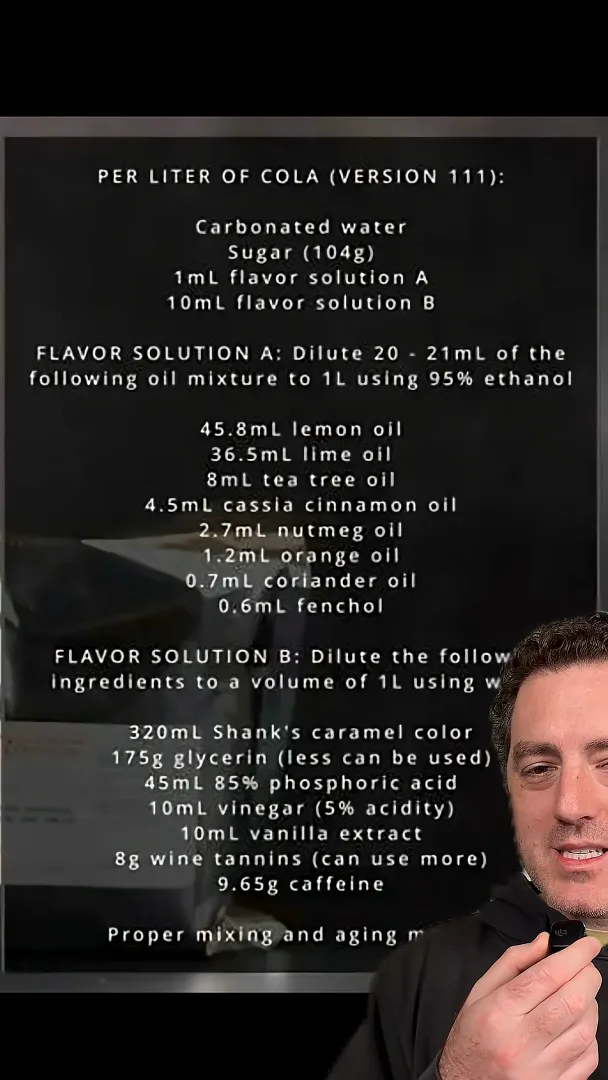
For solution B, Berman reads out Shank's caramel color, glycerin, phosphoric acid, vinegar, vanilla extract, wine tannins and caffeine. These are ingredients in the creator's proposed mixture; the list alone does not show that the original Coca-Cola formula uses the same ingredients or proportions.
Secrecy and the limits of the claim
Berman describes Coca-Cola's formula as closely guarded and says it is kept in an Atlanta vault. His conclusion that the world now knows the recipe goes beyond the evidence shown: a proposed recreation is not proof of the original formula.
Berman calls Coca-Cola's recipe one of the world's most closely guarded secrets. He says only a handful of people know it, that it was not patented because a patent would require disclosure, and that the recipe is held in a vault in Atlanta.
Berman concludes that, with the recreation, the whole world now knows the recipe. That conclusion is stronger than the evidence shown: [Coca-Cola describes its formula as a trade secret](https://www.coca-cola.com/ke/en/about-us/faq/is-the-coca-cola-formula-kept-secret-because-the-company-has-som), and the proposed formulation has not been shown to reveal the company's original recipe.
More from this channel
 14:45EN
 Matthew Berman· Oct 29, 2026Matthew Berman Examines Google’s Gemini 4 Carbon AnnouncementMatthew Berman · Forward FutureMatthew Berman reviews Google’s reported benchmark results, staged rollout and pricing for Gemini 4 Carbon, while noting he has not yet used the model.
 21:11ENMatthew Berman· Oct 28, 2026Matthew Berman tests DeepSeek V4.1 Flash: coding, vision and local appsMatthew Berman · Forward FutureA hands-on tour of visual coding, image reasoning, local applications and provider economics reveals both impressive results and visible flaws.
 34:21ENMatthew Berman· Oct 27, 2026Matthew Berman Examines Anthropic’s IPO Filing, AI Growth and GovernanceMatthew Berman, Sam Altman · Forward FutureThe presenter reviews the S-1’s financial metrics, compute strategy and voting structure while questioning the tension between rapid AI development and safety.
 0:26ENMatthew Berman· Oct 25, 2026Sam Altman on Human Values and Problem-Solving in an AI WorldSam Altman · OpenAIIn a short interview excerpt, Altman considers the enjoyment of solving hard problems and the human role in interpreting results.
 0:36ENMatthew Berman· Oct 25, 2026Kimi K3.1 and a Rubik’s Cube Solver DemonstrationMatthew Berman · Forward FutureMatthew Berman shows a scrambled virtual cube being solved and gives the Kimi K3.1 test a favorable assessment.
 0:21ENMatthew Berman· Oct 24, 2026An AI-Generated Kimi Benchmark Chart Used Invented ScoresMatthew Berman · Forward FutureMatthew Berman asks for a graph of Kimi K3.1 Pro benchmarks, then discovers that the displayed figures are illustrative placeholders.