In 30 seconds
In this January 2025 partnered video, Matthew Berman discusses excerpts from Salesforce CEO Marc Benioff’s Agentforce 2.0 presentation. Salesforce invited him to the event and partnered with him on the video. Berman highlights Slack as an interface for agents, their access to customer data and his own lead-qualification demonstration. Benioff’s support numbers are Salesforce’s own account of a particular deployment. Berman’s predictions about productivity, GDP, jobs and abundance are opinions about the future, and the product’s availability was phased according to Salesforce’s contemporaneous announcement.
- 1Salesforce partnershipBerman attended the Agentforce 2.0 event at Salesforce’s invitation and discloses a partnership on the video.
- 2Slack as the agent interfaceHe describes using Slack to communicate with agents alongside human colleagues; features were announced on a phased schedule.
- 3A market forecastBenioff calls digital labor a multitrillion-dollar opportunity, a prospective estimate rather than achieved revenue.
- 4Support escalationsBenioff reports a fall from roughly 10,000 to 5,000 escalations at Salesforce; the video does not establish resolution quality.
- 5A lead-qualification demoBerman describes building a workflow with a Salesforce sales engineer during the event.
Takeaways
- Salesforce presented AI agents as digital labor that can work alongside people in business workflows.
- Agentforce 2.0 was announced in December 2024 with features scheduled to roll out in stages, including Slack integrations.
- Agents can use business data and tools for customer-support or sales tasks, but access to data does not guarantee correct answers or actions.
- Salesforce reported support escalations falling from about 10,000 to 5,000 in its own example; the video does not establish resolution quality or a controlled causal comparison.
- Berman’s predictions about productivity, GDP and reduced need for work are forecasts, not demonstrated outcomes.
- The video was made in partnership with Salesforce, which also invited Berman to its event.
Read the edited text by chapter
Digital labor and Salesforce’s event
Benioff describes agents as digital labor. Berman discloses Salesforce’s invitation and partnership and introduces the event.
At Salesforce’s Agentforce 2.0 event, CEO Marc Benioff describes AI agents as “digital labor,” using a driverless ride as an analogy for work performed by a digital system. Matthew Berman reviews excerpts from the presentation and explains why he expects agents to become more common at work. The video was published in January 2025; its claims and forecasts should be read in that historical context.
Salesforce invited Berman to the event and partnered with him on the video, a relationship he explicitly discloses. He says his most interesting takeaway is Salesforce’s plan to make Slack an interface where people can interact with both human colleagues and agents. His enthusiasm for the product is part of that partnered presentation.
Benioff says Salesforce is already using agents to work with customers on its help site. Berman identifies him as Salesforce’s CEO and describes the company’s move toward agent-oriented products. He contrasts Salesforce’s positioning with Benioff’s criticism of Microsoft Copilot, but those competitive claims do not establish how widely either product was used or how well it performed.
Agents, interfaces and Slack
Berman explains Salesforce’s agent strategy and compares it with a predicted shift in software interfaces. He focuses on Slack as a shared workspace for people and agents.
Benioff frames the shift as managing software agents alongside people rather than only managing human employees. Berman says agents were already deployed on Salesforce’s support site and notes the company’s emphasis on using its own products. The examples are Salesforce’s accounts of its own deployment, not an independent comparison with competing tools.
Berman connects this to a view he attributes to Microsoft CEO Satya Nadella: that agents may mediate access to the data layer and reduce the role of conventional software interfaces. He sees Salesforce pursuing a similar transition, where a user could request an action through an agent rather than navigating every part of a CRM interface. This is a prediction about interface design, not proof that conventional interfaces will disappear.
Salesforce presented both its conventional interface and tools for creating agents that work with customer data. Berman says the demonstrations impressed him. The company’s [December 2024 announcement](https://www.salesforce.com/news/press-releases/2024/12/17/agentforce-2-0-announcement/) described a phased rollout: Slack integration and natural-language agent creation were scheduled for January 2025, while other Agentforce 2.0 capabilities were scheduled for February.
Berman focuses on the interface between a person and an agent. Text was then a common interaction method, while voice offered another route. In the demonstrations he saw, Slack served as the place to create or contact agents, assign tasks and receive results, bringing automated work into the same communication environment as human teamwork.
Predictions about work and the economy
Benioff and Berman discuss digital labor, voice and robots. Their market and productivity claims are forecasts.
Benioff says he now thinks of agents as a new category of digital labor and expects them to change how businesses operate. He uses the self-driving ride to illustrate a service delivered through software and machines. Berman treats voice, avatars and physical robots as different possible interfaces or embodiments for agentic systems.
Berman predicts a near- and medium-term rise in productivity and GDP, followed potentially by a world where robots and digital agents reduce the necessity for people to work. He imagines an abundance of resources while saying he personally enjoys working. These are his optimistic forecasts about economic and social outcomes, not results demonstrated by the event.
Benioff predicts a large market for digital labor and characterizes the total addressable market as worth trillions. Berman agrees and says he expects agents to help in personal and business life. The market-size claim is a prospective estimate, not revenue already earned or a measured result.
Customer data and support metrics
Berman explains why he considers tools and customer data important for agents. Benioff reports Salesforce’s own help-site escalation figures.
For this vision, Berman argues that agents need access to tools and business data. He describes possible customer-service and sales applications: answering inquiries, following up, identifying customers at risk of leaving and suggesting upsells. Access to a company’s data can provide context, but retrieving data alone does not guarantee that a model’s answer or action is correct.
Benioff describes the help-site agent drawing on a logged-in customer’s information and connected data sources to address support needs. He says Salesforce saw escalations to humans fall by about half, from roughly 10,000 to 5,000, while handling about 32,000 conversations per week. These are figures presented by Salesforce for its own service; the video does not provide a controlled study, comparable time periods or evidence that every non-escalated conversation was successfully resolved.
Berman interprets the decrease as a potential way to give human support staff time for other initiatives. Whether it increases capacity, changes staffing or affects service quality depends on what happens to those conversations and how the organization responds; the figures alone do not answer those questions.
Platform design and a demo
Berman describes the data and application layers around Agentforce. He closes with his lead-qualification demonstration.
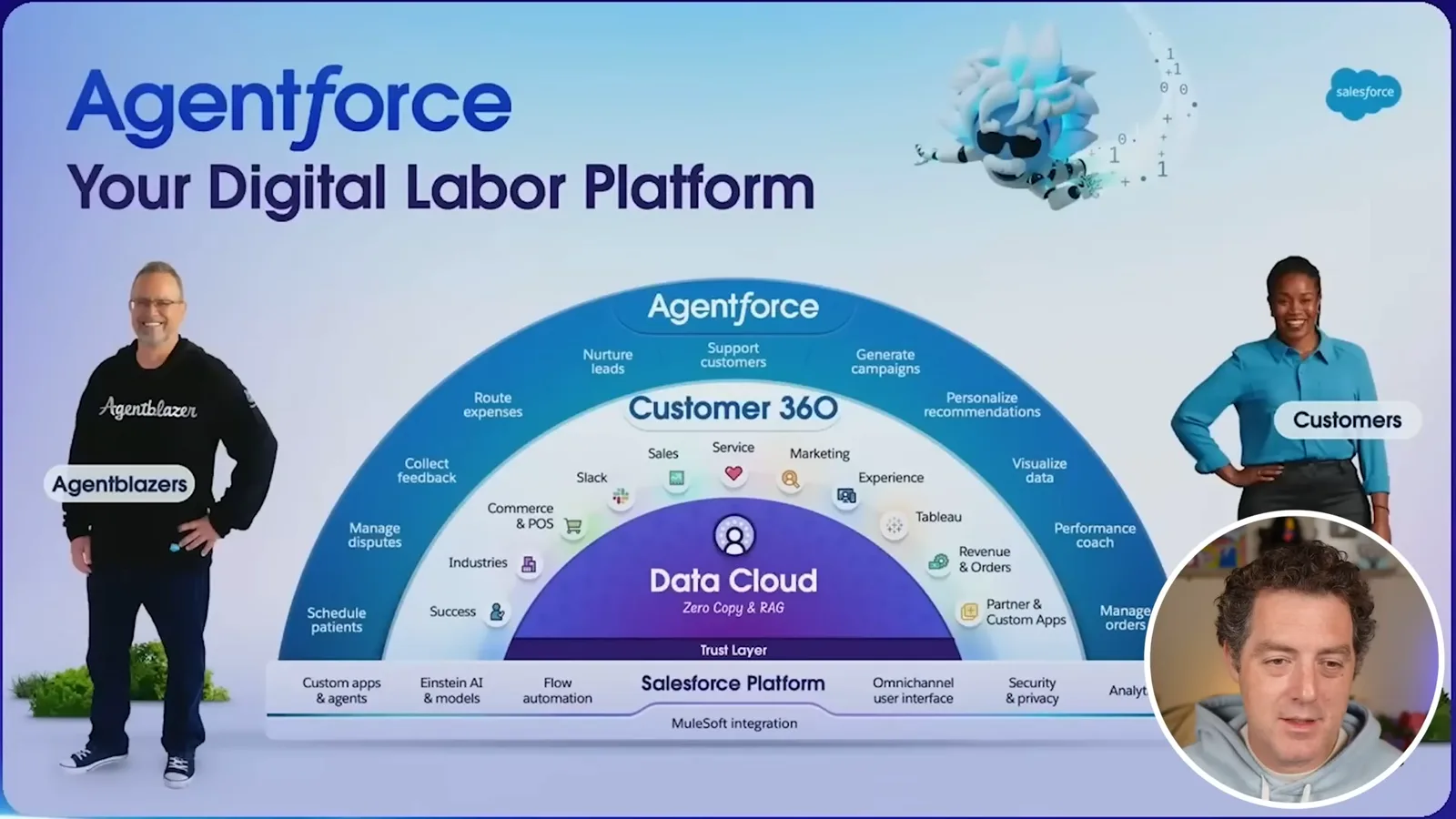
He walks through Salesforce’s platform diagram: the Data Cloud provides business data, agents retrieve information and use actions across Customer 360 applications and channels, and results feed back into the workflow. Berman expects software to become increasingly adaptable to agents, pointing to Salesforce’s integration of its applications and data layer as its approach.
Berman closes with an example from his own event demonstration. He wanted to qualify people approaching his business, add them to a CRM and follow up as needed; he says a Salesforce sales engineer helped him describe an agent in natural language to do this. It is a demonstration of a proposed workflow, not evidence of independently verified production results. He expects agents to remain a major AI theme during 2025.
More from this channel
 34:21EN
 Matthew Berman· Oct 27, 2026Matthew Berman Examines Anthropic’s IPO Filing, AI Growth and GovernanceMatthew Berman, Sam Altman · Forward FutureThe presenter reviews the S-1’s financial metrics, compute strategy and voting structure while questioning the tension between rapid AI development and safety.
 0:26ENMatthew Berman· Oct 25, 2026Sam Altman on Human Values and Problem-Solving in an AI WorldSam Altman · OpenAIIn a short interview excerpt, Altman considers the enjoyment of solving hard problems and the human role in interpreting results.
 0:36ENMatthew Berman· Oct 25, 2026Kimi K3.1 and a Rubik’s Cube Solver DemonstrationMatthew Berman · Forward FutureMatthew Berman shows a scrambled virtual cube being solved and gives the Kimi K3.1 test a favorable assessment.
 0:21ENMatthew Berman· Oct 24, 2026An AI-Generated Kimi Benchmark Chart Used Invented ScoresMatthew Berman · Forward FutureMatthew Berman asks for a graph of Kimi K3.1 Pro benchmarks, then discovers that the displayed figures are illustrative placeholders.
 25:50ENMatthew Berman· Oct 24, 2026Kimi K3.1 Pro Tested: Strong 3D Demos, Uneven Results and Competitive PricingMatthew Berman · Forward FutureMatthew Berman tests the open-weight model on coding, 3D rendering and visual explanations, then compares benchmark results and prices.
 32:20ENMatthew Berman· Oct 23, 2026Who Is Local AI For? The Costs, Trade-offs and a Hybrid FutureMatthew Berman · Forward FutureMatthew Berman weighs data control and independence against hardware cost, setup complexity and inference speed.