In 30 seconds
In this September 18, 2025 news roundup, Matthew Berman discusses leaked Meta glasses footage, OpenAI’s reported ICPC result, the REFRAG paper and Groq funding. He also covers a rumored Gemini model, ARC-AGI submissions, Google’s agent payment protocol, World Labs and Tongyi DeepResearch. Later stories include Waymo’s phased SFO pilot, reported Codex demand, Veo in YouTube Shorts, Hunyuan3D and a humanoid robot demonstration. Research metrics and product plans are presented in their historical context rather than as current rankings or guarantees.
- 1OpenAI’s ICPC resultOpenAI researchers reported a 12-of-12 result within five hours, compared with 11 solved by the leading human team. The result concerns a particular contest and system.
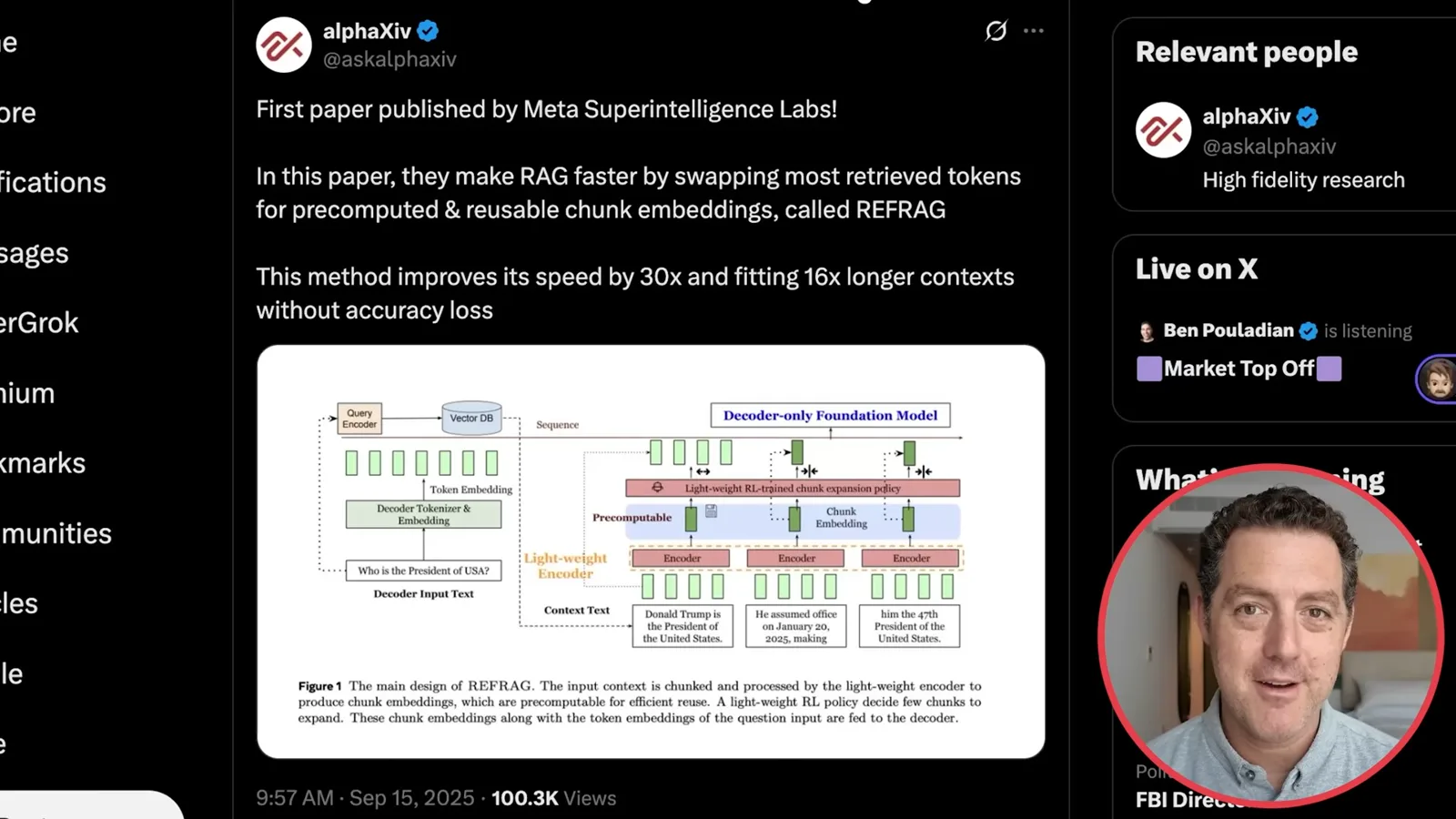
- 2REFRAG researchThe authors report reducing retrieval context computation using compressed chunks and selective expansion, with gains measured under specific conditions.
- 3ARC-AGI submissionsThe displayed post reports 79.6% at $8.42 per task on ARC-AGI-1 and 29.4% at $30.40 per task on ARC-AGI-2.
- 4Agent paymentsGoogle introduced AP2 as an open payment protocol intended to work with agent communication frameworks and merchants.
- 5Waymo’s SFO pilotThe airport approved a phased permit; Waymo said initial testing would involve employees and the Kiss & Fly area.
Takeaways
- OpenAI researchers reported solving all 12 ICPC World Finals problems within five hours using a reasoning system; this is a specific programming result, not proof of general superhuman intelligence.
- REFRAG researchers reported up to roughly 30-fold faster time to first token and a 16-fold context expansion in their evaluated settings, not a universal end-to-end speedup.
- ARC-AGI submissions in the displayed September 2025 post reported 79.6% on version 1 at $8.42 per task and 29.4% on version 2 at $30.40 per task.
- Google announced AP2 as a protocol for agent payments; a proposed standard does not itself guarantee secure transactions or universal deployment.
- Waymo’s 2025 SFO permit began a phased pilot, starting with employee testing rather than immediate availability to all travelers.
- Berman disclosed in the video description that he was a small investor in Groq.
Read the edited text by chapter
Glasses, competition coding and retrieval
Berman begins with leaked glasses footage and a reported OpenAI programming-contest result. He then introduces REFRAG and its measured retrieval efficiency gains.
Reporting from Meta Connect in September 2025, I start with leaked footage suggesting a future version of Meta Ray-Ban glasses could let an assistant see and hear the world while displaying information to the wearer. The video is a preview, not proof that every depicted capability is available. I remain unsure whether people who do not already wear glasses will want them all day.
OpenAI researchers report that a reasoning system solved all 12 problems from the 2025 ICPC World Finals within the five-hour limit. The best human team solved 11. This is an impressive reported outcome on a particular programming competition, but it does not establish general superhuman intelligence.
According to the account I read, the system received the same PDF problems and selected answers without a bespoke test-time harness. Eleven problems were solved on the first submission; the hardest took nine submissions. OpenAI described an ensemble involving GPT-5 and an experimental reasoning model, and I speculate about whether another model might eventually be released.
Cognition CEO Scott Wu praised the result, and OpenAI’s Mark Chen placed it alongside other competition achievements. I see these as signs of substantial progress in reasoning and think the surrounding tools and scaffolding will matter for putting the models to use.
Next is REFRAG, a research approach to retrieval-augmented generation. Instead of processing every retrieved passage at full token detail, the method uses compressed, reusable chunk representations and selectively expands relevant material. The paper reports roughly 30-fold improvement in time to first token and a 16-fold context extension under its experimental conditions, not a guarantee of 30-fold faster end-to-end applications or no accuracy loss on every task.
Funding, rumors and ARC results
The roundup covers Groq funding and speculation about Gemini 3. ARC-AGI submissions illustrate the role of program synthesis and test-time adaptation.
AI chip company Groq raised $750 million at a reported $6.9 billion post-money valuation. I discuss plans to expand data-center capacity and an Asia-Pacific location as described by CEO Jonathan Ross. I am enthusiastic about inference infrastructure; the video description discloses that I am a small Groq investor.
A social-media post points to a Gemini 3.0 Ultra reference in Google’s open-source Gemini CLI repository. I treat this as a rumor about a possible model and beta timing, not confirmation that Google has launched such a model. A code reference alone does not establish a release date or capabilities.
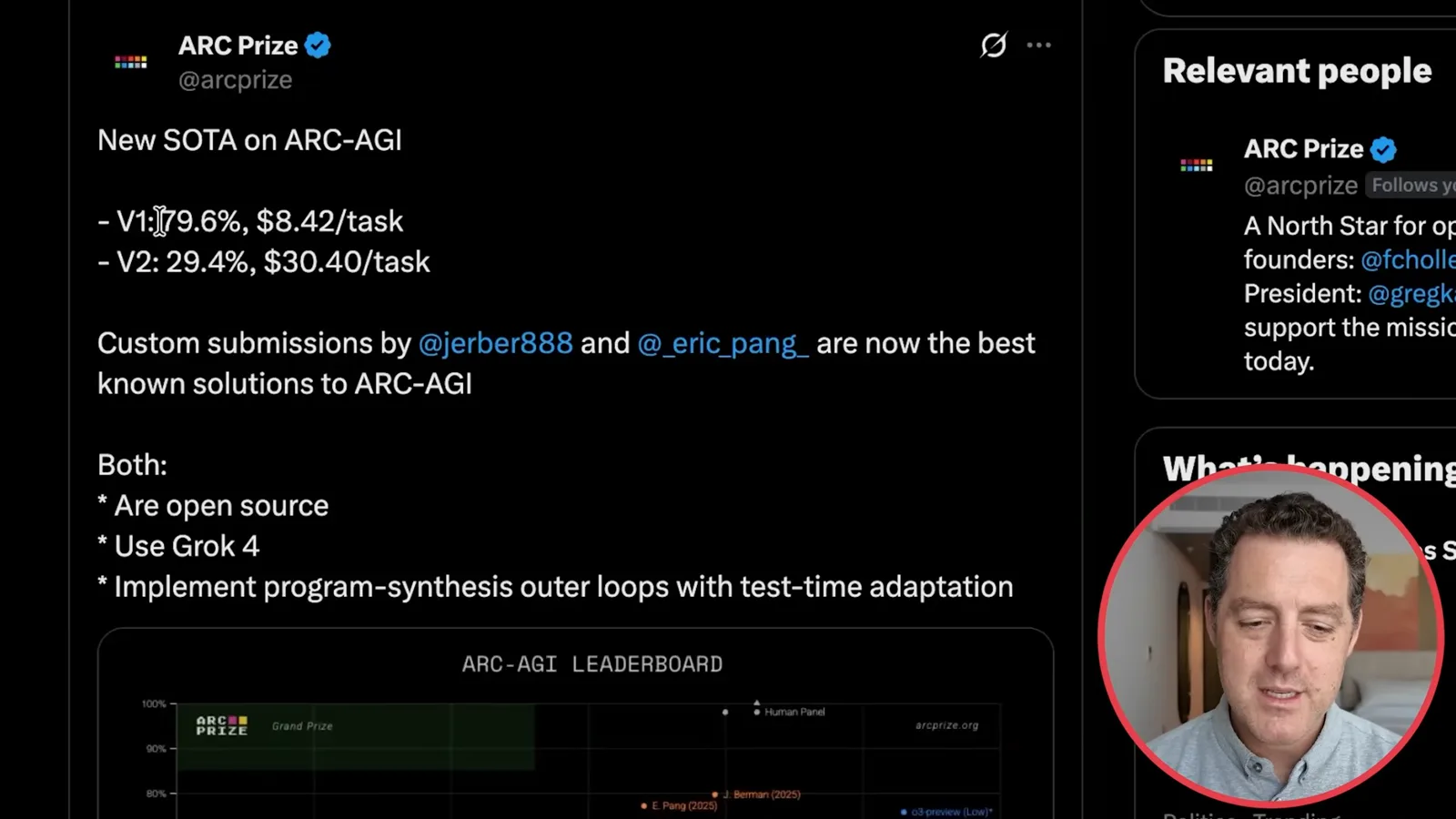
The displayed ARC Prize post reports custom submissions reaching 79.6% on ARC-AGI-1 at $8.42 per task and 29.4% on ARC-AGI-2 at $30.40 per task. The screenshots give those dollar amounts; automatic captions can misread the decimal places. The figures are a September 2025 snapshot, not a current leaderboard.
The post attributes the open-source submissions to Jeremy Berman and Eric Pang and says they use Grok 4 with program-synthesis loops and test-time adaptation. I mention a DreamCoder-inspired approach that stores and reuses learned concepts, noting that my description is simplified. Elon Musk also says Grok 5 training will begin in a few weeks; that is his stated plan at the time, not a confirmed launch.
Agent payments and generated worlds
Google’s AP2 announcement, a World Labs demonstration and Tongyi DeepResearch show distinct uses of agents and generated media. Reported benchmark figures are specific to the tests shown.
Google announces the Agent Payments Protocol, or AP2, as an open way to coordinate payments involving agents and merchants. It can extend A2A and MCP, and the announcement lists a range of partners. The goal is interoperability and secure payment workflows; announcing a protocol does not by itself prove every implementation is secure or ready for unrestricted use.

World Labs shows a navigable 3D environment generated from an image. I am impressed by the ability to move around the scene, although creating one’s own world was waitlisted at the time. This is a demonstration of a specific environment, not a guarantee that every input produces a complete or accurate world.
Tongyi Lab introduces Tongyi DeepResearch, an open research agent built around a roughly 30-billion-parameter mixture-of-experts model with about 3 billion active parameters. The team reports results on several web research benchmarks and describes a multistage data strategy. Active parameters are not the same as total model size, and the benchmark numbers depend on each evaluation setup.
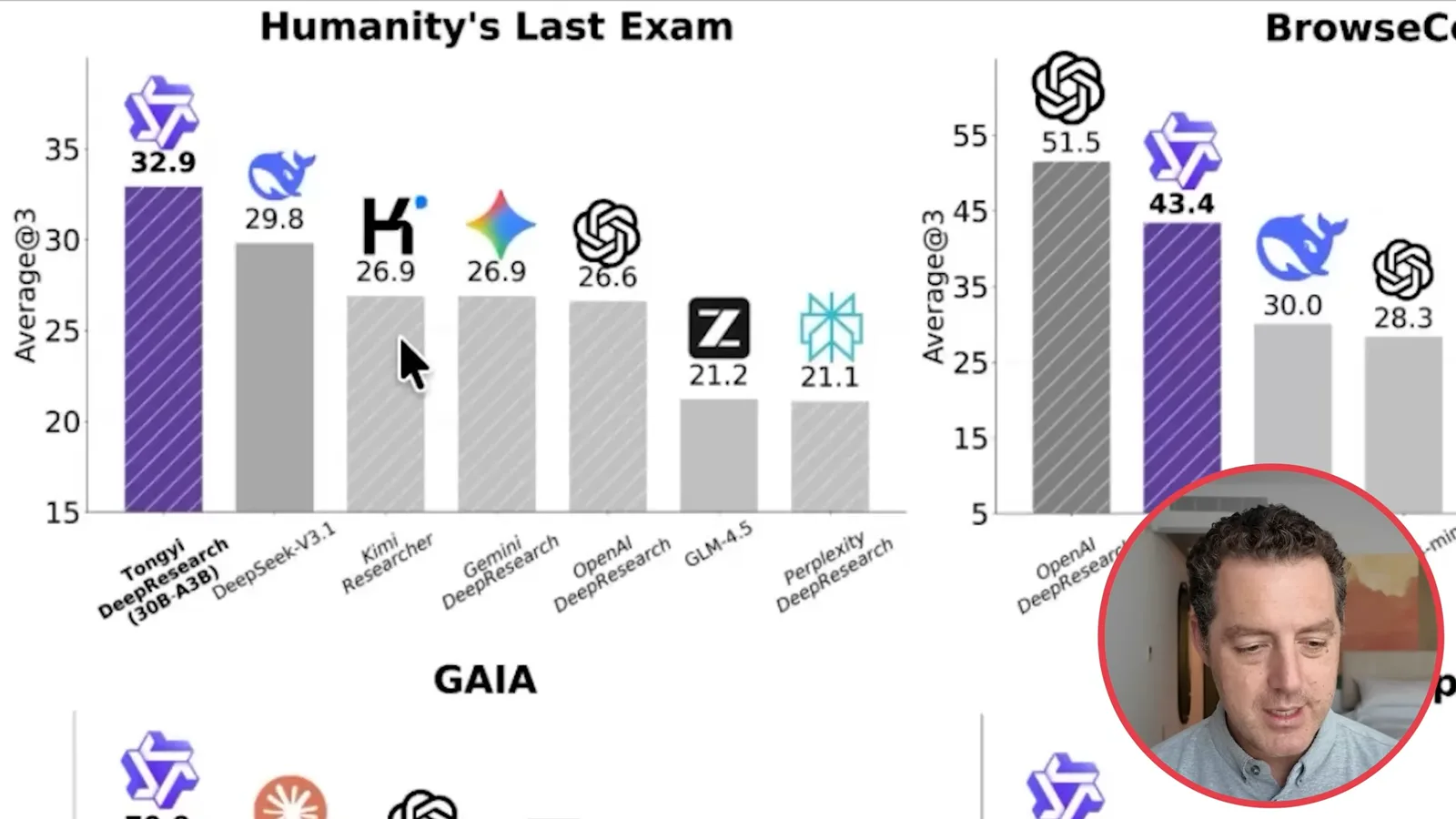
In the displayed chart, Tongyi’s reported Humanity’s Last Exam score is 32.9 and its BrowseComp score is 43.4; the latter corrects the number spoken in the video. The comparisons are useful for examining this release but do not demonstrate that the agent is best at every research task. I note the reported use of automatically produced training data, while my broader suggestion that humans must be removed from training is an opinion.
Transport, video and robotics
Berman discusses Waymo’s phased airport permit, Codex demand, YouTube’s AI video feature and Hunyuan3D. He ends with a humanoid robot recovering from a fall.
Waymo received a pilot permit for San Francisco International Airport. At the time, Waymo said rollout would proceed in phases, beginning with employee testing; initial pickups and drop-offs were planned for the Kiss & Fly area via AirTrain. That did not mean all passengers could immediately request a terminal pickup. I also mention Amazon-owned Zoox testing autonomous vehicles in San Francisco.
OpenAI’s Alexander Embiricos said demand for GPT-5-Codex exceeded the forecast and that the service was running at roughly half its target speed while the team added capacity. I connect this report to the continuing need for inference infrastructure, though future demand and investment are uncertain.
YouTube announced a custom Veo 3 Fast integration for generating Shorts clips with sound. I worry that easier generation could flood feeds with low-quality videos, while recognizing that creators can use the same tools to make interesting work. Whether novelty fades and how audiences respond are predictions, not established outcomes.
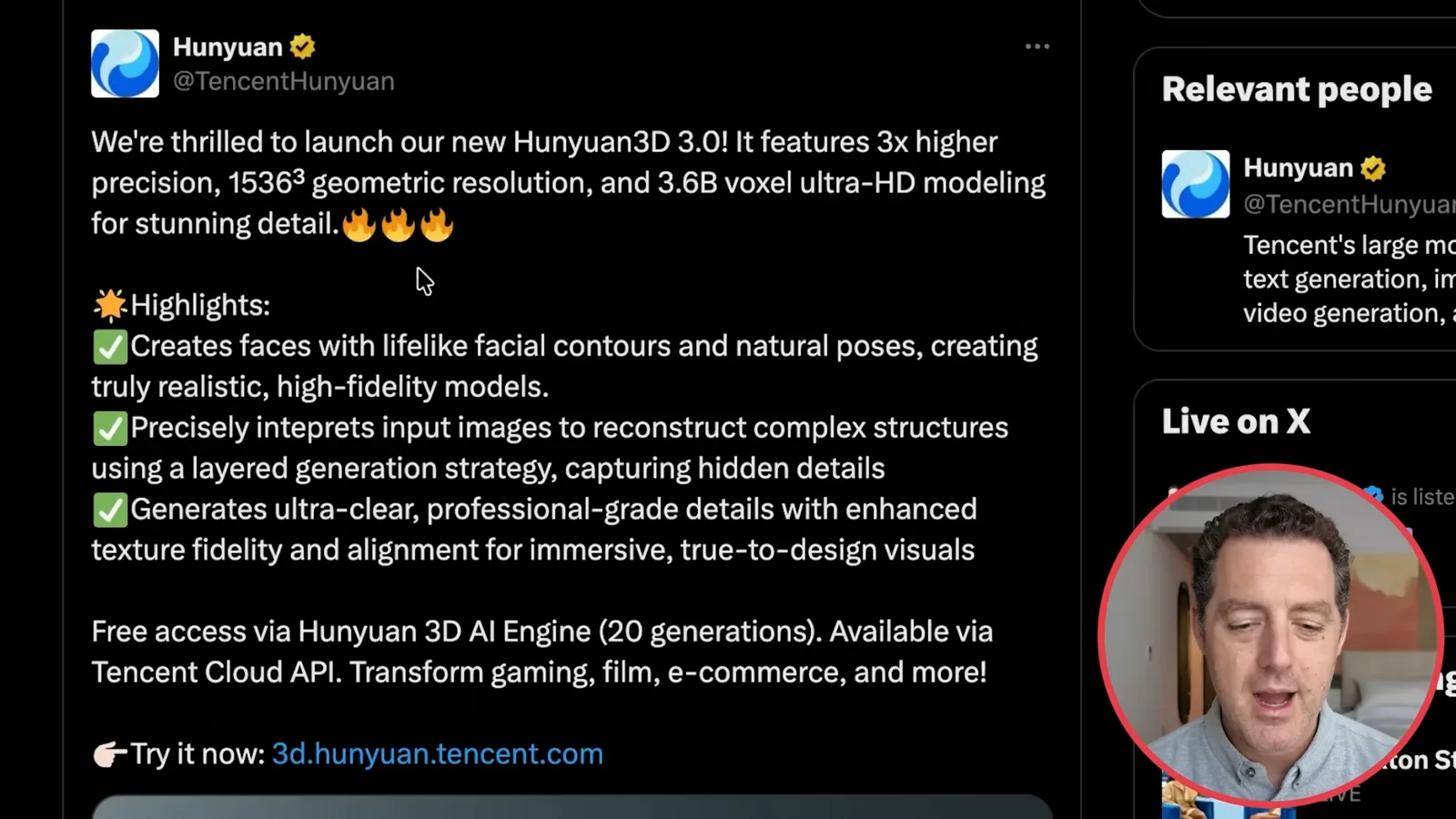
Tencent announces Hunyuan3D 3.0, describing higher geometric resolution and more detailed 3D reconstruction and textures. Those are the company’s stated capabilities; I encourage designers to inspect the examples and test the tool for their own purposes.
I close with footage of a humanoid robot recovering rapidly after being knocked down. The speed of the movement is striking, though the clip alone does not establish how reliable the behavior is outside the demonstration. I joke about robot combat and express discomfort with people striking robots.
More from this channel
 34:21EN
 Matthew Berman· Oct 27, 2026Matthew Berman Examines Anthropic’s IPO Filing, AI Growth and GovernanceMatthew Berman, Sam Altman · Forward FutureThe presenter reviews the S-1’s financial metrics, compute strategy and voting structure while questioning the tension between rapid AI development and safety.
 0:26ENMatthew Berman· Oct 25, 2026Sam Altman on Human Values and Problem-Solving in an AI WorldSam Altman · OpenAIIn a short interview excerpt, Altman considers the enjoyment of solving hard problems and the human role in interpreting results.
 0:36ENMatthew Berman· Oct 25, 2026Kimi K3.1 and a Rubik’s Cube Solver DemonstrationMatthew Berman · Forward FutureMatthew Berman shows a scrambled virtual cube being solved and gives the Kimi K3.1 test a favorable assessment.
 0:21ENMatthew Berman· Oct 24, 2026An AI-Generated Kimi Benchmark Chart Used Invented ScoresMatthew Berman · Forward FutureMatthew Berman asks for a graph of Kimi K3.1 Pro benchmarks, then discovers that the displayed figures are illustrative placeholders.
 25:50ENMatthew Berman· Oct 24, 2026Kimi K3.1 Pro Tested: Strong 3D Demos, Uneven Results and Competitive PricingMatthew Berman · Forward FutureMatthew Berman tests the open-weight model on coding, 3D rendering and visual explanations, then compares benchmark results and prices.
 32:20ENMatthew Berman· Oct 23, 2026Who Is Local AI For? The Costs, Trade-offs and a Hybrid FutureMatthew Berman · Forward FutureMatthew Berman weighs data control and independence against hardware cost, setup complexity and inference speed.