In 30 seconds
In January 2025, Matthew Berman comments on excerpts from a No Priors interview with NVIDIA CEO Jensen Huang. Huang envisions general robotics, AI workers and a broad scientific impact; Berman adds his own views on agent onboarding, software and recursive research. The video includes an Emergence AI sponsorship, and its timelines and claims about future capabilities are forecasts rather than established results.
- 1General roboticsHuang says he sees progress toward general robotics and draws an analogy between generating video and robot actions.
- 2Existing environmentsHe highlights autonomous cars and humanoid robots as forms that can operate in environments designed for cars and people.
- 3Emergence AI sponsorshipBerman promotes the sponsor’s multi-agent orchestration product and its claimed web automation capabilities.
- 4AI workersHuang imagines digital employees working alongside people; Berman discusses providing agents with business context.
- 5Science and engineeringHuang expects AI to influence research broadly, while Berman explores a speculative recursive-improvement scenario.
Takeaways
- Huang suggests that representations used in generative AI could help robots plan actions, but tokenizing motion does not itself solve physical robotics.
- He calls cars and humanoid robots examples of systems designed for environments already built around those forms.
- Huang anticipates AI agents working alongside people, while Berman imagines automated onboarding; both are projections.
- Berman discusses recursive AI research as a possible intelligence-explosion scenario, not an observed inevitability.
- Huang predicts generative AI will underpin a broad range of future research; Berman’s claim that all software may eventually be generated is also speculative.
- The video’s Emergence AI product segment is a paid partnership and its performance claims are promotional.
Read the edited text by chapter
Tokenization and general robotics
Berman introduces Huang’s No Priors remarks on representing actions and general-purpose robotics. The discussion concerns future possibilities, not demonstrated general capability.
Matthew Berman reviews excerpts from NVIDIA CEO Jensen Huang’s No Priors interview, recorded before the January 2025 video. Huang says he sees progress toward both artificial general intelligence and more general robotics. These are his expectations, not a finding that either capability has been achieved.
Berman connects the interview to Huang’s CES 2025 keynote and his optimism about humanoid robots. NVIDIA promoted physical AI and robotics at that event. Predictions about widespread deployment, however, do not establish that general-purpose robots can already operate reliably in every setting.
Huang asks whether generating a video of a person reaching for a cup can be related to generating a robot’s action. Berman explains the intuition as representing information or movement in tokens so a model can predict what comes next. Representation alone does not resolve sensing, control, safety or the difference between simulation and physical execution.
Robots in existing environments
Huang describes autonomous cars and humanoids as forms suited to existing infrastructure. Berman discusses the potential and limitations of that argument.
Huang calls autonomous vehicles and humanoid robots promising examples of systems that could operate in existing, or brownfield, environments. Berman explains the appeal: roads and buildings are already built around cars and people, so those form factors may avoid some redesign.
Berman lists humanoid work by Figure, Unitree, Boston Dynamics and Tesla and expects the form to be important. A human-shaped robot may fit some spaces and tools, but the video’s assertion that little further adaptation is needed is a prediction, not proof that present systems work reliably across those environments.
Huang says the world has been built for vehicles and people, making those forms attractive starting points for embodied robotics. He also turns to digital agents. Berman suggests that the scale of these opportunities may help explain interest in both autonomous cars and humanoids.
Sponsored agent orchestration and AI workers
Berman presents a paid Emergence AI segment. Huang then discusses AI workers and Berman considers onboarding them.
Berman discloses a paid partnership with Emergence AI and promotes its multi-agent orchestration product. He describes claimed capabilities such as navigating websites, handling forms and extracting documents, as well as hosted and private-cloud options. These are sponsor claims presented in the video, not independent validation of reliability or security.
In the interview excerpt, Huang predicts organizations will have both human and AI workers, assigning tasks with context and iterating on the results. He imagines digital roles in marketing, design and supply chains, and says he hopes NVIDIA will grow in both human and artificial capacity.
Berman sees agent onboarding as a practical challenge. He suggests giving agents relevant business goals, constraints, documents and tools automatically instead of repeating the context each time. His expectation that agents could be onboarded in minutes is a proposed workflow, not a measured guarantee.
AI in science and software
Huang predicts wide scientific impact and recalls early computer-vision research. Berman considers speculative recursive improvement and generative software.
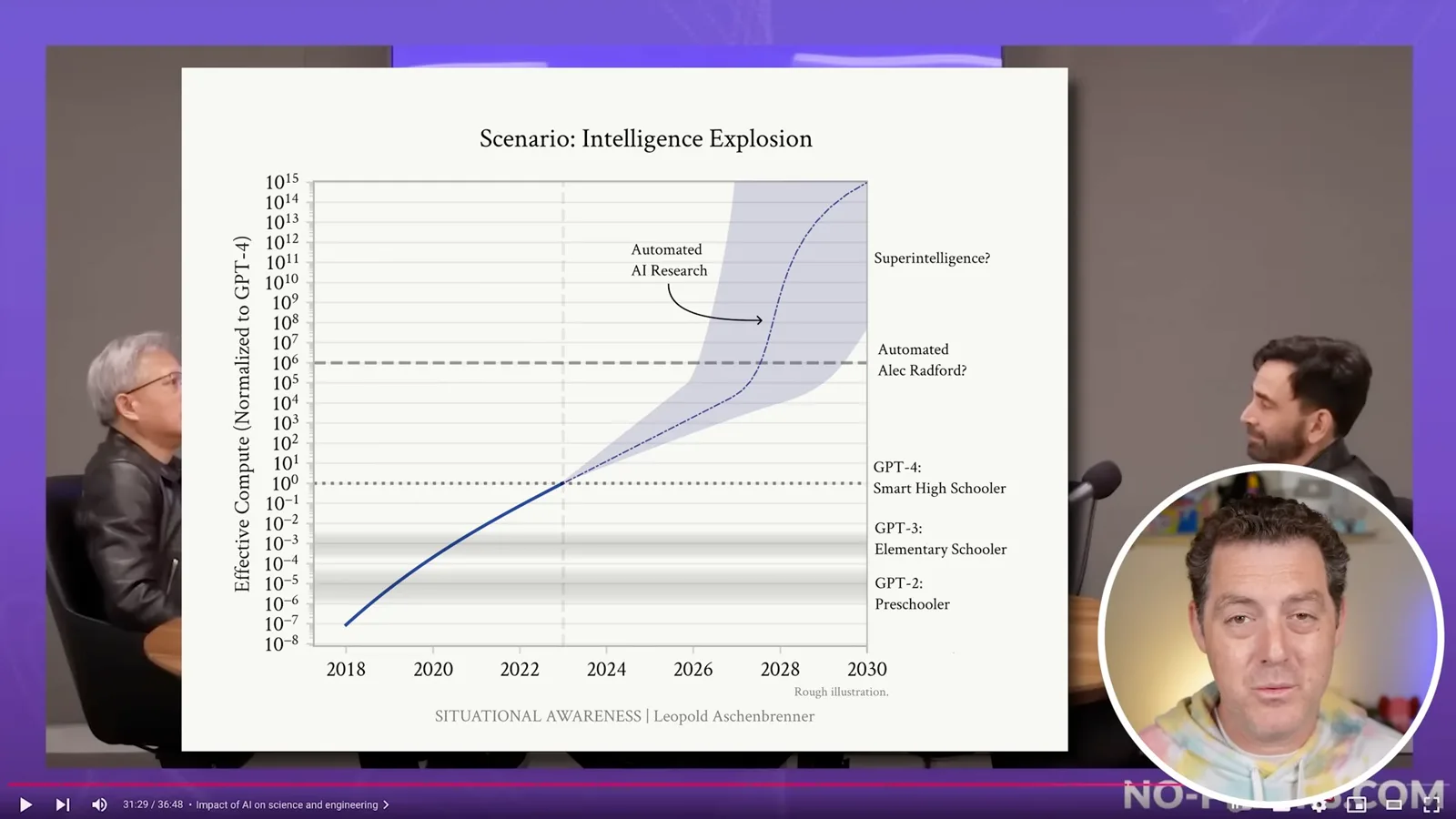
Turning to science, Berman describes the hypothesis that AI could eventually conduct research, improve its own design and accelerate further progress. He relates this to Leopold Aschenbrenner’s proposed intelligence-explosion scenario. Such recursive acceleration is speculative and should not be treated as an observed or inevitable trajectory.
Huang argues that AI and machine learning are already influencing work across scientific and engineering fields and predicts that this impact will become much larger. Berman notes the importance of extrapolating from early signs, while the breadth and timing of those future effects remain Huang’s forecast.
Huang recalls early computer-vision work associated with Alex Krizhevsky, Ilya Sutskever, Geoffrey Hinton and other researchers. Berman points to AlexNet, introduced in 2012, and explains how parallel GPU computation used in graphics could also accelerate neural-network calculations.
Berman praises Huang for recognizing AI’s potential and positioning NVIDIA around it. Huang says the company changed its approach after seeing early results and describes progress in image recognition over the following years. Berman’s assessment of Huang’s foresight is commentary rather than a measure of a single person’s contribution.
Huang predicts that generative AI will become foundational across science and engineering within a few years. He argues that the computing stack and the way software encodes knowledge are changing. This broad claim is a forward-looking view, not evidence that every future paper or breakthrough will rely on generative AI.
Berman extends the argument to software: he imagines more code being written by AI and, eventually, interfaces or game behavior generated dynamically. He refers to a Doom-like generative demonstration as an illustration, not evidence that all software can already run that way.
He imagines a database retaining ground truth while the software layer above it is generated as needed. This is his speculative architecture for the future, with unresolved questions about correctness, security and reliability. Huang closes by saying the computing change will affect the startups, scientists and engineers he works with.
Berman concludes that Huang’s remarks remain relevant after CES and encourages viewers to consider how robotics, agents and scientific tools might develop. The video’s views and dates reflect a January 2025 discussion, not a current inventory of deployment or capabilities.
More from this channel
 34:21EN
 Matthew Berman· Oct 27, 2026Matthew Berman Examines Anthropic’s IPO Filing, AI Growth and GovernanceMatthew Berman, Sam Altman · Forward FutureThe presenter reviews the S-1’s financial metrics, compute strategy and voting structure while questioning the tension between rapid AI development and safety.
 0:26ENMatthew Berman· Oct 25, 2026Sam Altman on Human Values and Problem-Solving in an AI WorldSam Altman · OpenAIIn a short interview excerpt, Altman considers the enjoyment of solving hard problems and the human role in interpreting results.
 0:36ENMatthew Berman· Oct 25, 2026Kimi K3.1 and a Rubik’s Cube Solver DemonstrationMatthew Berman · Forward FutureMatthew Berman shows a scrambled virtual cube being solved and gives the Kimi K3.1 test a favorable assessment.
 0:21ENMatthew Berman· Oct 24, 2026An AI-Generated Kimi Benchmark Chart Used Invented ScoresMatthew Berman · Forward FutureMatthew Berman asks for a graph of Kimi K3.1 Pro benchmarks, then discovers that the displayed figures are illustrative placeholders.
 25:50ENMatthew Berman· Oct 24, 2026Kimi K3.1 Pro Tested: Strong 3D Demos, Uneven Results and Competitive PricingMatthew Berman · Forward FutureMatthew Berman tests the open-weight model on coding, 3D rendering and visual explanations, then compares benchmark results and prices.
 32:20ENMatthew Berman· Oct 23, 2026Who Is Local AI For? The Costs, Trade-offs and a Hybrid FutureMatthew Berman · Forward FutureMatthew Berman weighs data control and independence against hardware cost, setup complexity and inference speed.