In 30 seconds
In this November 20, 2023 video, Matthew Berman recounts OpenAI’s history, its nonprofit-controlled corporate structure, Sam Altman’s dismissal and the reported plan for him and Greg Brockman to lead a Microsoft AI team. He also relays employee objections, Emmett Shear’s interim appointment and competing theories about the board’s decision. The story was still developing: OpenAI announced Altman’s return as CEO on November 29, and its board’s March 2024 summary of a WilmerHale review attributed the removal to a breakdown of trust, not concerns about safety or development pace.
- 1OpenAI’s early historyBerman traces the organization from its nonprofit founding through its 2019 capped-profit structure and later products.
- 2Altman’s dismissalThe board announced Altman’s removal and initially named Mira Murati interim CEO.
- 3Employee oppositionAn employee letter challenged the board and said signatories might leave; its allegations represent the employees’ position.
- 4The unknown causeBerman presents a speculative safety-versus-speed theory, which a later review summary did not support.
- 5An interim CEO and a changing outcomeEmmett Shear became interim CEO and Microsoft announced plans involving Altman and Brockman; Altman subsequently returned to OpenAI.
Takeaways
- OpenAI’s board removed Altman on November 17, 2023, citing concerns about his candor in communications with the board.
- Many employees challenged the decision and threatened to leave; the letter’s accusations were the employees’ account.
- The video’s anticipated Microsoft destination was overtaken by Altman and Brockman returning to OpenAI.
- OpenAI’s March 2024 summary of an independent review said the decision followed a breakdown of trust, not concerns about product safety or development pace.
- The video’s account of a safety-driven technical breakthrough was speculation, not an established reason for the dismissal.
- The nonprofit-controlled capped-profit structure discussed in the video describes the 2023 arrangement, not necessarily the current structure.
Read the edited text by chapter
OpenAI’s origins and structure
Berman reviews the organization’s early research and its historical nonprofit-controlled capped-profit arrangement. He explains why the board’s authority matters to his account.
The events around OpenAI’s leadership have been extraordinary. In this November 20, 2023 video, I review the organization’s history, Sam Altman’s dismissal and what appeared to be the next move. The story was not actually over: Altman subsequently returned to OpenAI as CEO, so the video’s account is a snapshot of a fast-changing situation.
Berman begins with OpenAI’s 2015 founding as a nonprofit with a mission to advance AI for broad human benefit. He names founders including Sam Altman, Elon Musk, Ilya Sutskever and Greg Brockman and describes early research and experimentation. His account is a simplified history, not a complete list of founding contributors.
He highlights OpenAI Five, a system of five agents trained to play Dota 2, and the 2018 work on generative pre-training. The latter built on the Transformer architecture introduced in earlier research by Google-affiliated authors, while applying pre-training to language understanding.
In 2019 OpenAI created a capped-profit structure controlled by its nonprofit. Berman explains the stated objective of raising capital while retaining the mission and describes Microsoft’s investment. This describes the arrangement at the time of the video; the organization’s structure has changed since.
Berman shows a diagram of the 2023 corporate structure, in which the nonprofit board controlled entities associated with the for-profit operation. He emphasizes the board’s governance role and the mission’s definition of AGI, arguing that the arrangement created potential tension between commercial development and nonprofit oversight.
Products and the board’s decision
The video moves from OpenAI’s product history to Altman’s November 17 dismissal. The board cited concerns over communication and named Murati interim CEO.
He moves through OpenAI’s product history, including GPT-3, Codex, DALL·E, ChatGPT and GPT-4. ChatGPT launched in November 2022; Berman’s reference to December and GPT-3.5 is a shorthand, not the exact launch date. He also recalls the November 2023 DevDay announcements of custom GPTs and a planned store.
On November 17, 2023, OpenAI announced that its board had removed Altman as CEO and named chief technology officer Mira Murati interim CEO. The board said it had concluded that Altman was not consistently candid in communications with it, impairing its ability to exercise its responsibilities. That was the board’s stated rationale, not a publicly detailed finding of particular misconduct.
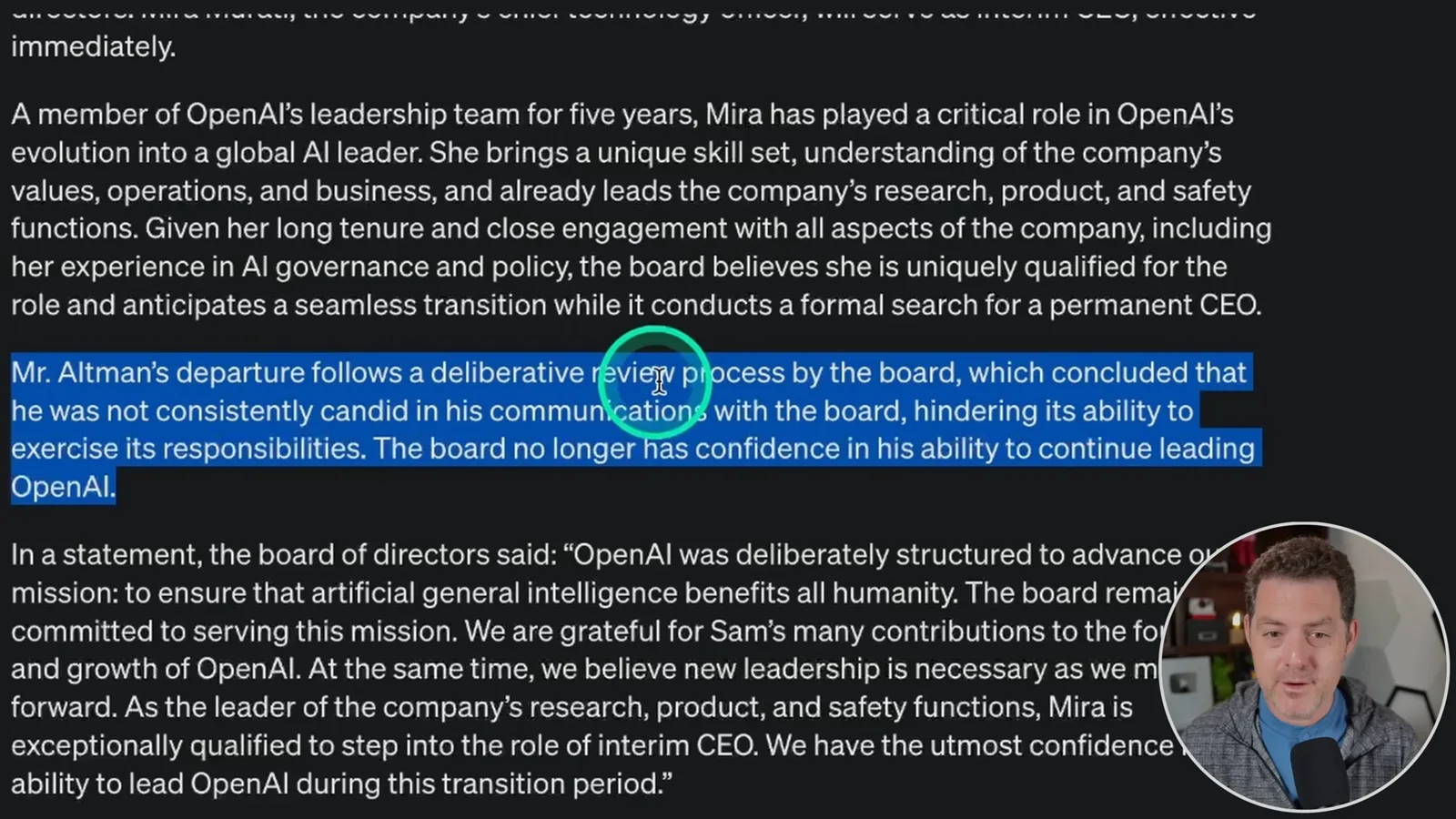
The board also removed Greg Brockman as chair while initially expecting him to stay at the company; he resigned. Berman describes employees and technology leaders publicly supporting Altman, including many employees sharing expressions of solidarity. His favorable impression of Altman is personal commentary.
Employee response and negotiations
Employees expressed support for Altman and criticized the board in a letter. Berman recounts reported attempts to negotiate a resolution.
Berman reads from an employee letter challenging the board’s handling of Altman and Brockman. The letter alleged that the board had not supplied written evidence supporting its concerns and questioned its competence. These are claims made by the employees, not independently established findings.
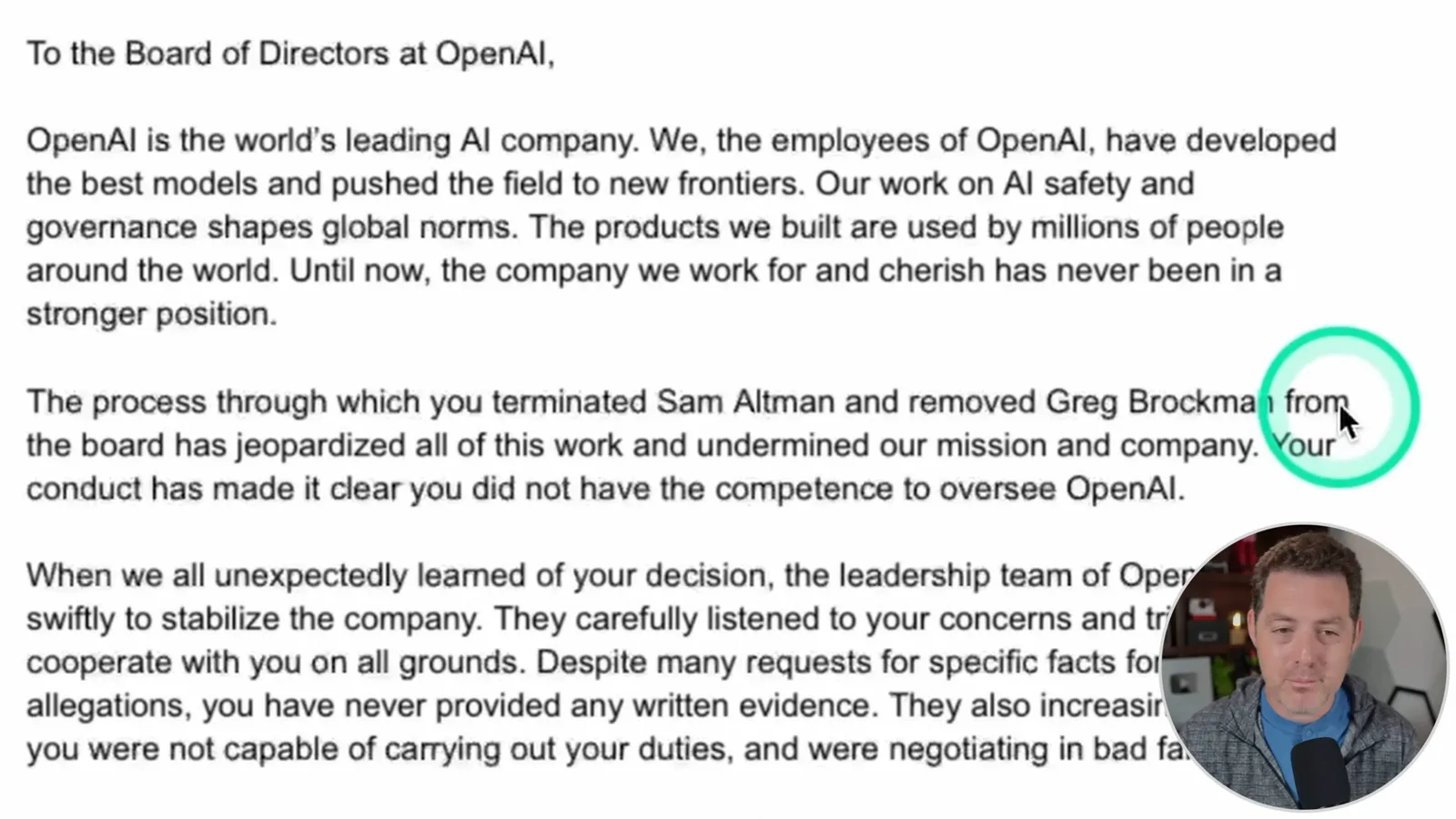
The letter also objected to replacing Murati as interim CEO and said signatories might resign and join a newly announced Microsoft team. Berman describes attempts to negotiate a resolution and the display of employee solidarity through the phrase that OpenAI is nothing without its people.
Berman discusses a photograph of Altman visiting OpenAI with a guest badge during the negotiations. He relays rumors that a dispute over how to characterize Altman’s conduct contributed to an impasse. The video does not establish those private negotiations as fact.
Speculation and interim leadership
Berman discusses possible reasons for the decision and reports Microsoft’s planned team and Shear’s appointment. He notes that the precise cause was not public at the time.
At the time, the detailed reasons for the board’s action were not publicly clear. Berman considers a theory that a technical breakthrough and disagreement over the speed of releasing AI divided leadership and the board. He presents this as speculation; it should not be treated as an established explanation.
Later context: in March 2024, OpenAI published a summary of a WilmerHale review commissioned by a board committee. The summary said the prior board’s decision followed a breakdown of trust with Altman, and did not arise from concerns about product safety or security, development pace, finances or statements to partners. It also said the board acted within its discretion, while Altman’s conduct did not mandate removal.
Microsoft announced plans for Altman and Brockman to lead a new advanced AI research team. Berman speculates about potential financing and Altman’s future at Microsoft; those ideas were not confirmed. The planned Microsoft move was overtaken by subsequent negotiations and Altman’s return to OpenAI.
OpenAI appointed former Twitch CEO Emmett Shear as interim CEO after Murati. Berman reviews Shear’s stated plan to investigate the process, consult stakeholders and reform management. Shear said the board had not removed Altman over a specific disagreement on safety, although he did not publicly supply a complete explanation.
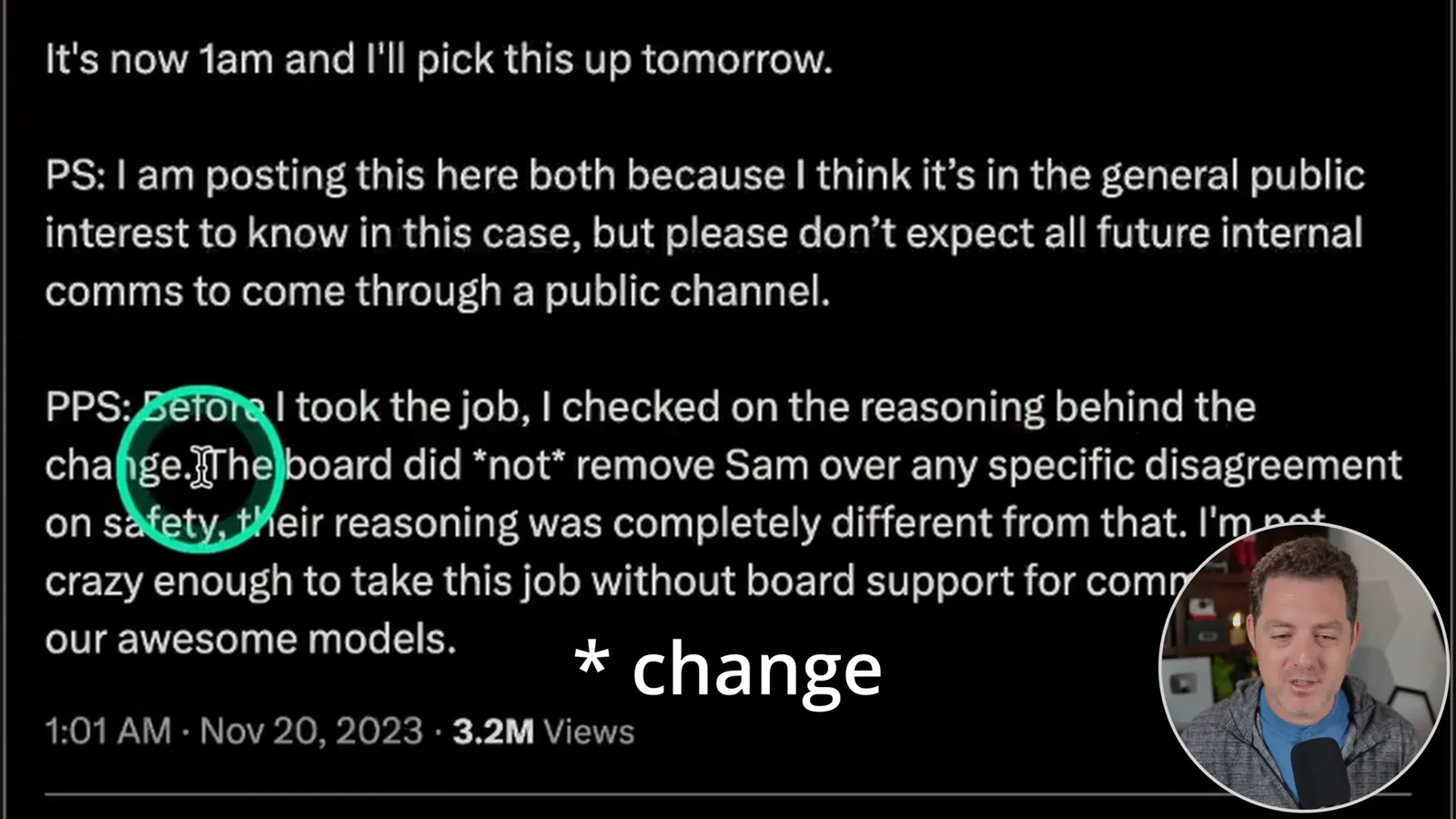
The situation on November 20
Berman reviews announcements and Sutskever’s regret. The eventual return of Altman and the later review were not yet known when the video was recorded.
Berman reads Microsoft CEO Satya Nadella’s statement expressing continued commitment to OpenAI and announcing the planned research team. He summarizes what appeared on November 20 to be a new Microsoft destination and a change in OpenAI leadership, while anticipating further board and structural changes.
Ilya Sutskever publicly expressed regret for participating in the board’s actions and said he wanted to reunite the company. Berman interprets the message as a sign of reconciliation, while saying he still wants to know what happened internally.
The later outcome differed from the video’s apparent conclusion. On November 29, OpenAI announced Altman’s return as CEO, Brockman’s return as president, Murati’s return as CTO and a new initial board. The March 2024 review summary supplied additional context, though it did not publish every underlying detail of the dispute.
More from this channel
 34:21EN
 Matthew Berman· Oct 27, 2026Matthew Berman Examines Anthropic’s IPO Filing, AI Growth and GovernanceMatthew Berman, Sam Altman · Forward FutureThe presenter reviews the S-1’s financial metrics, compute strategy and voting structure while questioning the tension between rapid AI development and safety.
 0:26ENMatthew Berman· Oct 25, 2026Sam Altman on Human Values and Problem-Solving in an AI WorldSam Altman · OpenAIIn a short interview excerpt, Altman considers the enjoyment of solving hard problems and the human role in interpreting results.
 0:36ENMatthew Berman· Oct 25, 2026Kimi K3.1 and a Rubik’s Cube Solver DemonstrationMatthew Berman · Forward FutureMatthew Berman shows a scrambled virtual cube being solved and gives the Kimi K3.1 test a favorable assessment.
 0:21ENMatthew Berman· Oct 24, 2026An AI-Generated Kimi Benchmark Chart Used Invented ScoresMatthew Berman · Forward FutureMatthew Berman asks for a graph of Kimi K3.1 Pro benchmarks, then discovers that the displayed figures are illustrative placeholders.
 25:50ENMatthew Berman· Oct 24, 2026Kimi K3.1 Pro Tested: Strong 3D Demos, Uneven Results and Competitive PricingMatthew Berman · Forward FutureMatthew Berman tests the open-weight model on coding, 3D rendering and visual explanations, then compares benchmark results and prices.
 32:20ENMatthew Berman· Oct 23, 2026Who Is Local AI For? The Costs, Trade-offs and a Hybrid FutureMatthew Berman · Forward FutureMatthew Berman weighs data control and independence against hardware cost, setup complexity and inference speed.