In 30 seconds
Matthew Berman covers a public dispute over App Store promotion, Anthropic’s Claude Sonnet 4 long-context beta, video generation, Matrix-Game 2.0, an AI-focused fund, an OpenAI programming competition result and Mistral Medium 3.1. The video was published in August 2025; pricing, quotas and availability are historical. Musk’s and Altman’s accusations are disputed claims. Anthropic’s original price table corrects the video’s long-context output price to $22.50 per million tokens.
- 1App Store disputeMusk alleges unfair promotion of ChatGPT, while Altman raises separate allegations about X. The claims remain attributed to their speakers.
- 2One-million-token betaAnthropic announced longer context for Claude Sonnet 4 in August 2025, with availability and rates that varied by plan and prompt length.
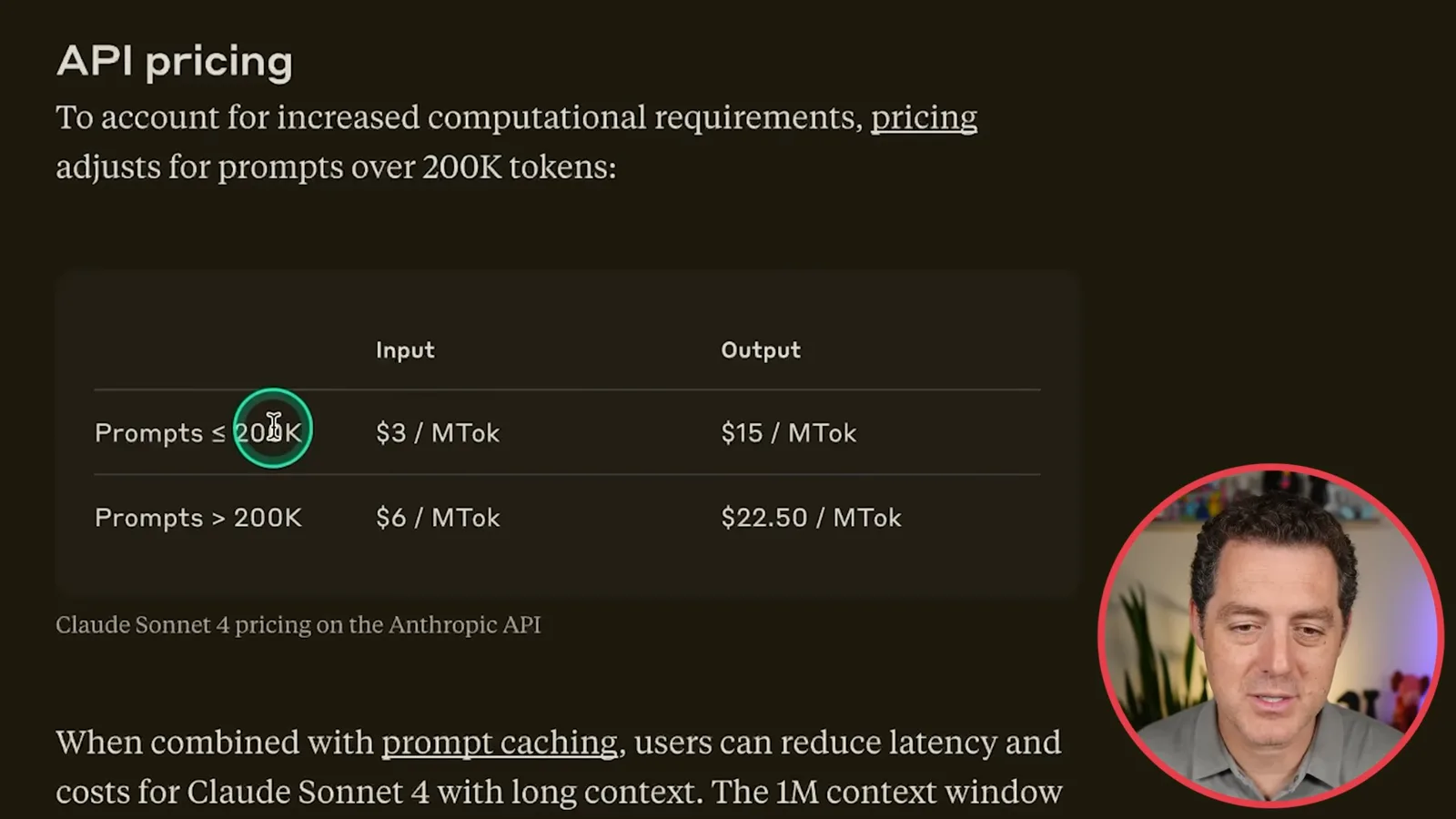
- 3Corrected output priceAnthropic listed $22.50 per million output tokens for prompts over 200,000, not the higher figure spoken in the video.
- 4An interactive world modelSkywork reports real-time generation for Matrix-Game 2.0 under a particular setup.
- 5Programming competitionOpenAI reported a gold-medal-level result in the 2025 IOI AI track under defined time and submission constraints.
Takeaways
- App Store editorial placement and download rankings are distinct; opposing allegations are not proof of legal violations.
- Chatbot answers about who is trustworthy are not independent evidence about disputed claims.
- Claude Sonnet 4’s 2025 beta supported a larger context window, with higher rates for prompts over 200,000 tokens.
- Skywork’s 25-frames-per-second world-model result is an authors’ claim under a specific setup.
- The fund return and programming score describe specific historical reports, not guarantees or general performance measures.
Read the edited text by chapter
The App Store dispute
Berman reviews Musk’s claims, Altman’s response and different chatbot answers. The underlying allegations require independent evidence.
In this August 2025 news roundup, I review Elon Musk’s dispute with Sam Altman over Apple’s App Store, then cover longer Claude context, video and world models, an AI-focused investment fund and programming results. The companies’ claims and the prices and availability described here belong to that time.
Musk asks why Apple’s editorial “Must Have” section features ChatGPT but not X or Grok, despite their app rankings. He alleges that Apple favors OpenAI and threatens antitrust action. Editorial recommendations and download-chart rankings are different things, and a public allegation alone does not establish an antitrust violation.
A note displayed beneath Musk’s post points to DeepSeek reaching the top of the US free-app chart in January 2025 and Perplexity reaching the top in India in July. Those examples challenge the absolute claim that another AI app could not reach number one; they do not resolve the separate question of editorial treatment or the legal dispute.
The Apple–OpenAI partnership announced in 2024 brought optional ChatGPT integration to Apple experiences. Altman responds to Musk by referring to allegations that Musk manipulated X to favor his own interests or disadvantage competitors. Those are Altman’s allegations, not established findings in the video.
The exchange escalates into competing questions about trust and a proposed affidavit. I find it unproductive to ask rival chatbots which person is more trustworthy: their answers can vary with prompts and context, and they are not independent arbiters of disputed facts.
Musk and another user show different chatbot answers to essentially the same trust question. To me, that illustrates why a generated answer should not be used as proof of someone’s character or of the underlying claims. Both the Apple allegations and the counter-allegations require evidence beyond chatbot responses.
After this video, X and xAI [filed an antitrust lawsuit against Apple and OpenAI](https://cdn.arstechnica.net/wp-content/uploads/2025/10/xAI-c-OpenAI-Apple-Apples-Brief-in-Support-of-Motion-to-DIsmiss-9-30-25.pdf) on August 25, 2025. Apple challenged the claims. The filing and response are positions of the parties, not a finding that either side’s allegations are true.
Long context and video generation
He discusses Claude Sonnet 4’s historical beta and pricing, then Perplexity’s video product.
Anthropic announced a one-million-token context window for Claude Sonnet 4, initially in public beta for qualifying API customers. A larger window can allow more documents or code to be supplied in one request; it does not guarantee that every detail will be used accurately. The announcement estimated more than 75,000 lines of code as an example, not a fixed limit.
The [August 2025 Anthropic pricing table](https://claude.com/resources/articles/1m-context) listed $3 per million input tokens and $15 per million output tokens for prompts at or below 200,000 tokens. Above 200,000, the rates were $6 input and $22.50 output per million. The output rate is $22.50, correcting the video’s spoken figure; prompt caching could reduce cost and latency.
Perplexity also announced video generation on web, iOS and Android. At the time, the video says Pro subscribers could create five videos per month and Max subscribers 15 at higher quality. I have not tested it yet, and those historical quotas should not be assumed to describe current plans.
World models, investment and coding
The roundup covers Matrix-Game 2.0, an AI-focused fund, the IOI AI track and Mistral Medium 3.1.
Skywork introduces Matrix-Game 2.0, an open-source interactive world model. Its authors report generating minute-scale interactive video at 25 frames per second; I compare the idea with Google DeepMind’s Genie 3, while the products’ capabilities and evaluations are not identical.
The presentation says users can move and explore generated scenes and describes a 1.3-billion-parameter model trained on interactive video. The reported 25 frames per second depends on its hardware and setup, rather than being a guarantee on any single GPU. The [project paper](https://arxiv.org/abs/2508.13009) describes the model and its evaluation.
I turn to a Wall Street Journal report about former OpenAI researcher Leopold Aschenbrenner’s AI-focused investment fund. The report says the fund gathered more than $1.5 billion and describes investments in sectors such as semiconductors, infrastructure and power, along with startup investments and smaller short positions.
The video cites a reported 47% after-fee return for the first half of 2025. That is a reported historical figure for a particular period, not an independently verified prediction of future returns. The discussion is news commentary, not a recommendation to invest.
An OpenAI reasoning system achieved a gold-medal-level score in the 2025 International Olympiad in Informatics AI track, according to the OpenAI announcement displayed in the video. It competed under a five-hour limit and a 50-submission cap, without internet or retrieval, and placed first among AI participants. This was a separate AI track, not an individual human contestant receiving a medal.
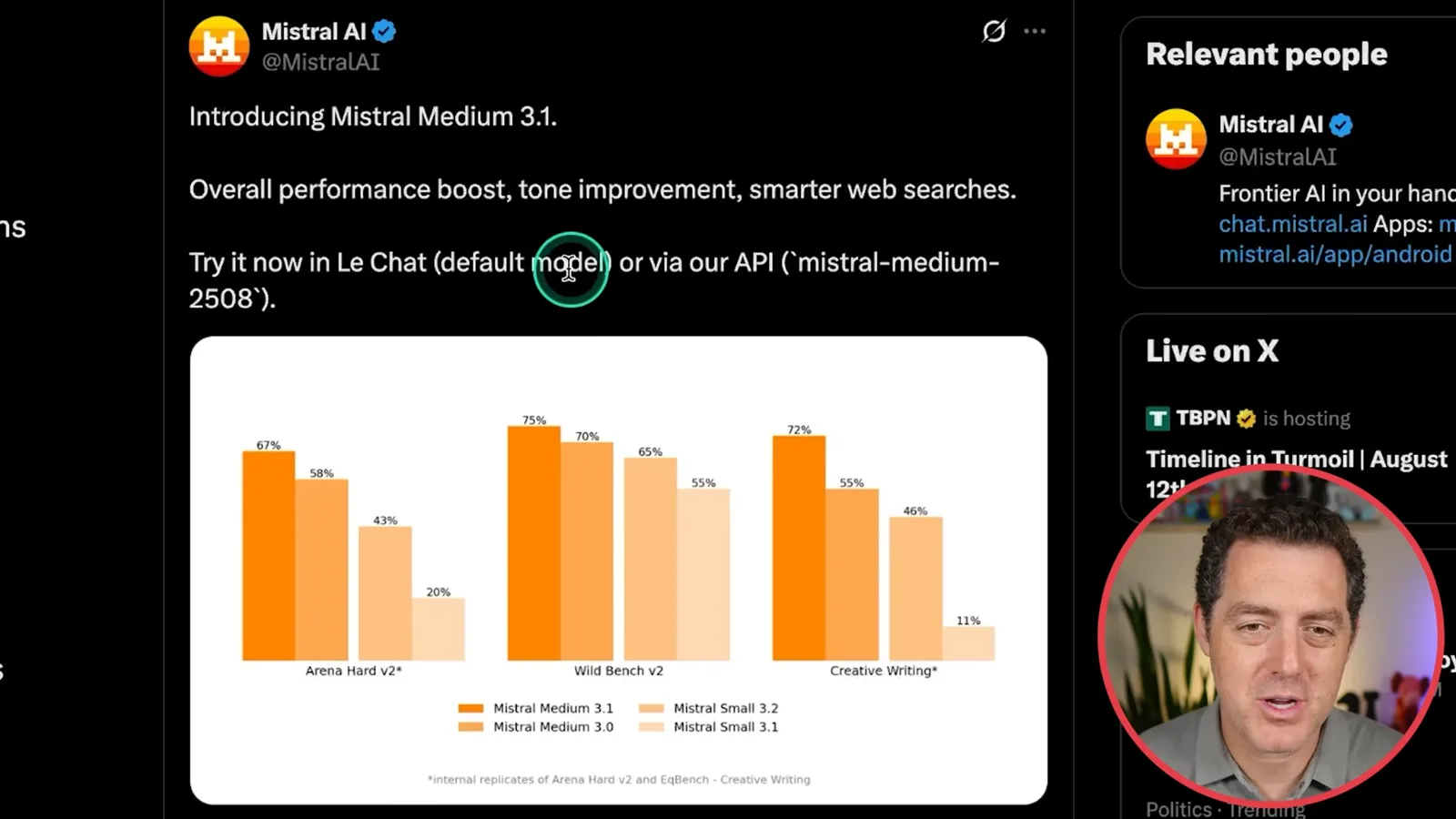
Finally, Mistral AI announces Mistral Medium 3.1 with claimed improvements in performance, tone and web search. Its displayed chart compares the company’s own models on several evaluations. These are provider-reported test results for specific benchmarks, not a universal ranking of model quality.
More from this channel
 34:21EN
 Matthew Berman· Oct 27, 2026Matthew Berman Examines Anthropic’s IPO Filing, AI Growth and GovernanceMatthew Berman, Sam Altman · Forward FutureThe presenter reviews the S-1’s financial metrics, compute strategy and voting structure while questioning the tension between rapid AI development and safety.
 0:36ENMatthew Berman· Oct 25, 2026Kimi K3.1 and a Rubik’s Cube Solver DemonstrationMatthew Berman · Forward FutureMatthew Berman shows a scrambled virtual cube being solved and gives the Kimi K3.1 test a favorable assessment.
 25:50ENMatthew Berman· Oct 24, 2026Kimi K3.1 Pro Tested: Strong 3D Demos, Uneven Results and Competitive PricingMatthew Berman · Forward FutureMatthew Berman tests the open-weight model on coding, 3D rendering and visual explanations, then compares benchmark results and prices.
 32:20ENMatthew Berman· Oct 23, 2026Who Is Local AI For? The Costs, Trade-offs and a Hybrid FutureMatthew Berman · Forward FutureMatthew Berman weighs data control and independence against hardware cost, setup complexity and inference speed.
 1:03:37ENMatthew Berman· Oct 23, 2026Matthew Berman’s Team Tests Kimi K3.1 on Animation, Games, and ChartsMatthew Berman, Alex, Brian · Forward FutureA live team AMA turns into an informal test of Kimi K3.1, from personal-agent workflows to motion graphics, a browser game, and a benchmark chart.
 0:53ENMatthew Berman· Oct 22, 2026Sam Altman on AI and the Discovery of New KnowledgeSam Altman · OpenAIAltman expects progress in mathematical discovery to extend to biology, materials and energy.