In 30 seconds
Matthew Berman shares early impressions of Claude Opus 4.6 and walks through Anthropic's launch benchmarks and Claude Code's agent teams. He discusses the cost of parallel agents, the limits of long-context retrieval, and enterprise evaluations from video sponsor Box. The video reflects launch-day information and opinions; its time-horizon and vending-benchmark descriptions need the corrections included below.
- 1What a time horizon measuresThe chart's hours refer to human-expert task duration at a predicted 50% success rate, not time an agent runs.
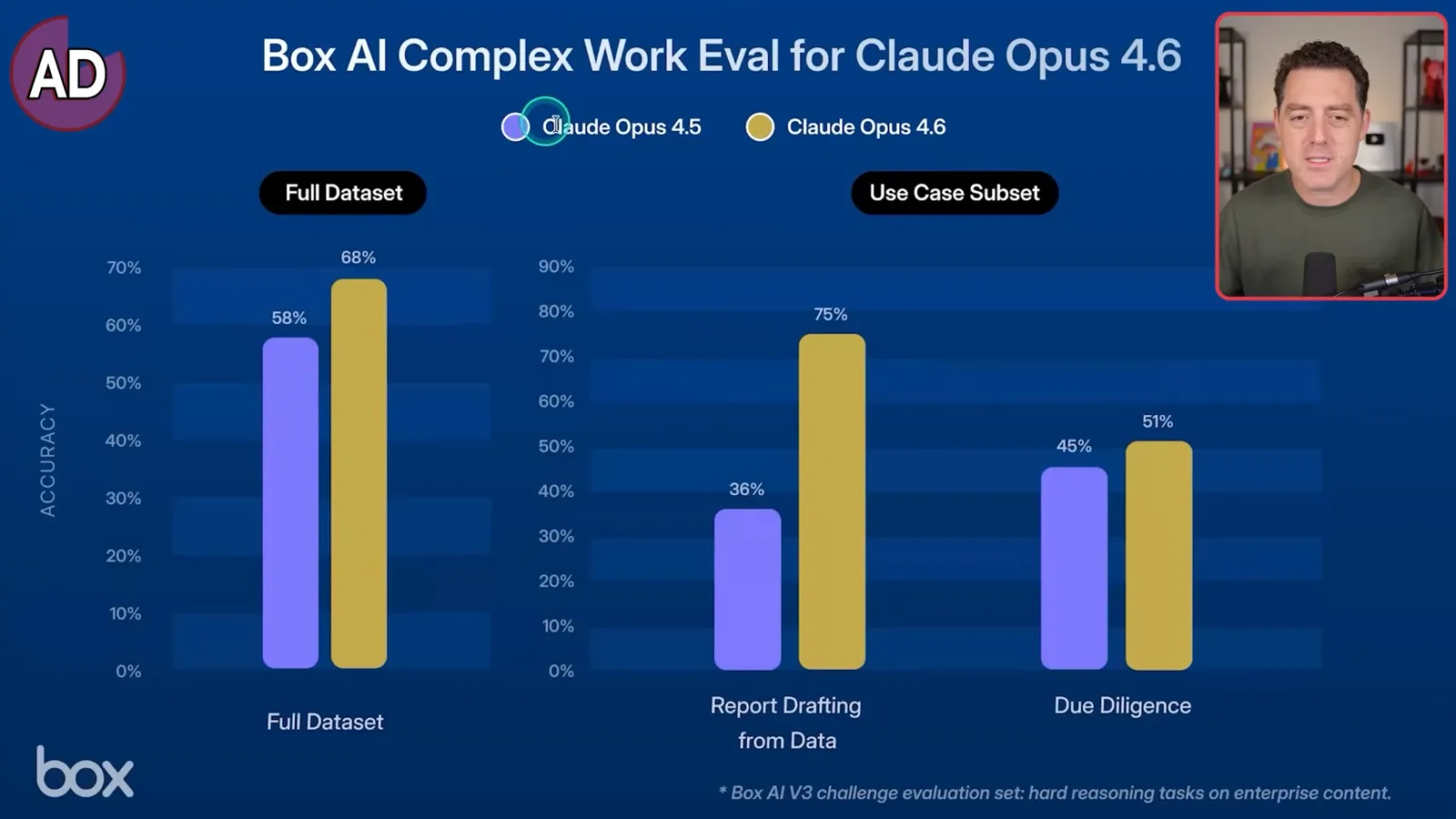
- 2Sponsor's enterprise evaluationBox reported gains on its own document tasks and sponsored the video.
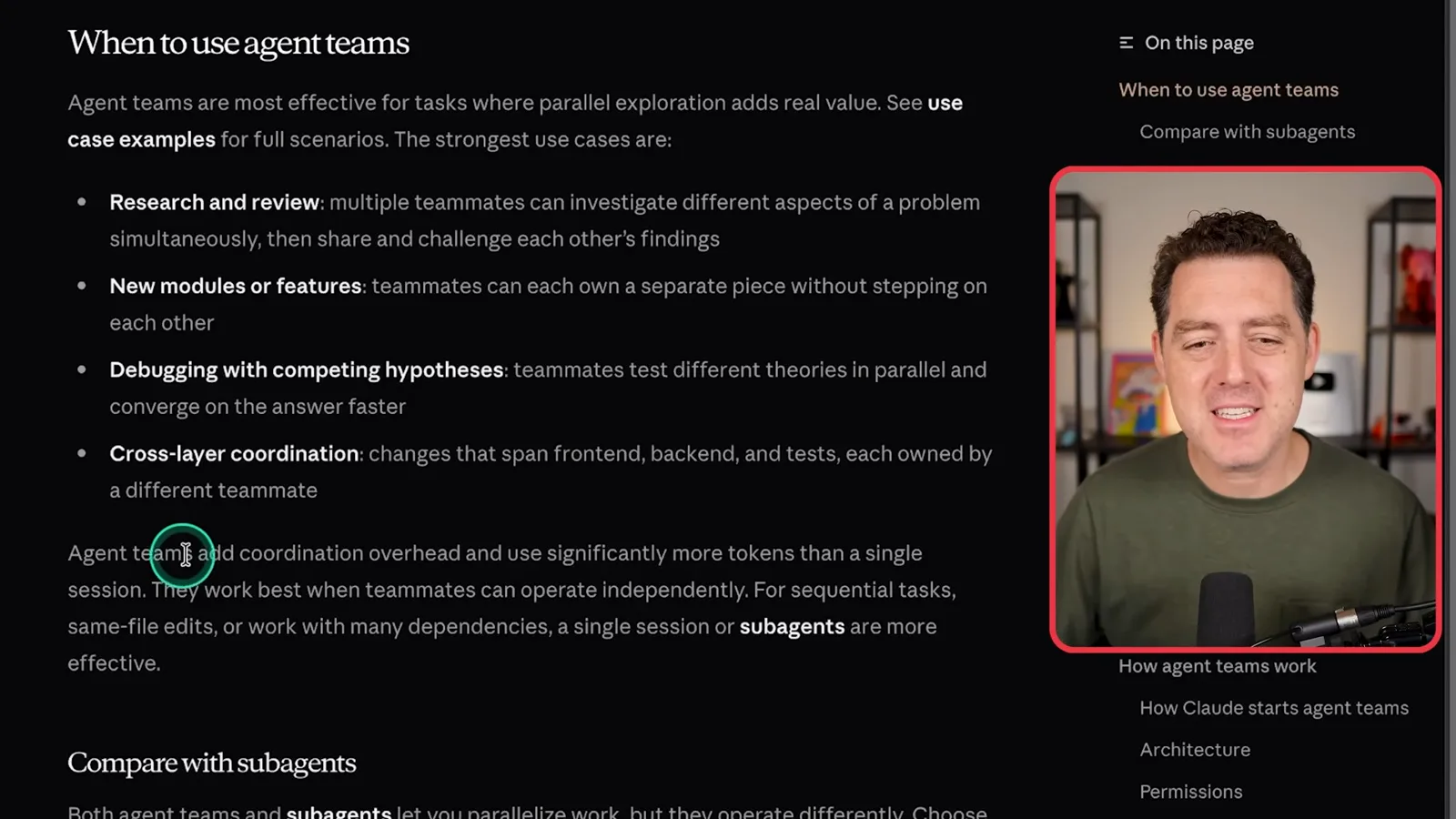
- 3Agent teams and costSeparate Claude Code instances can coordinate and communicate, but use more tokens and add overhead.
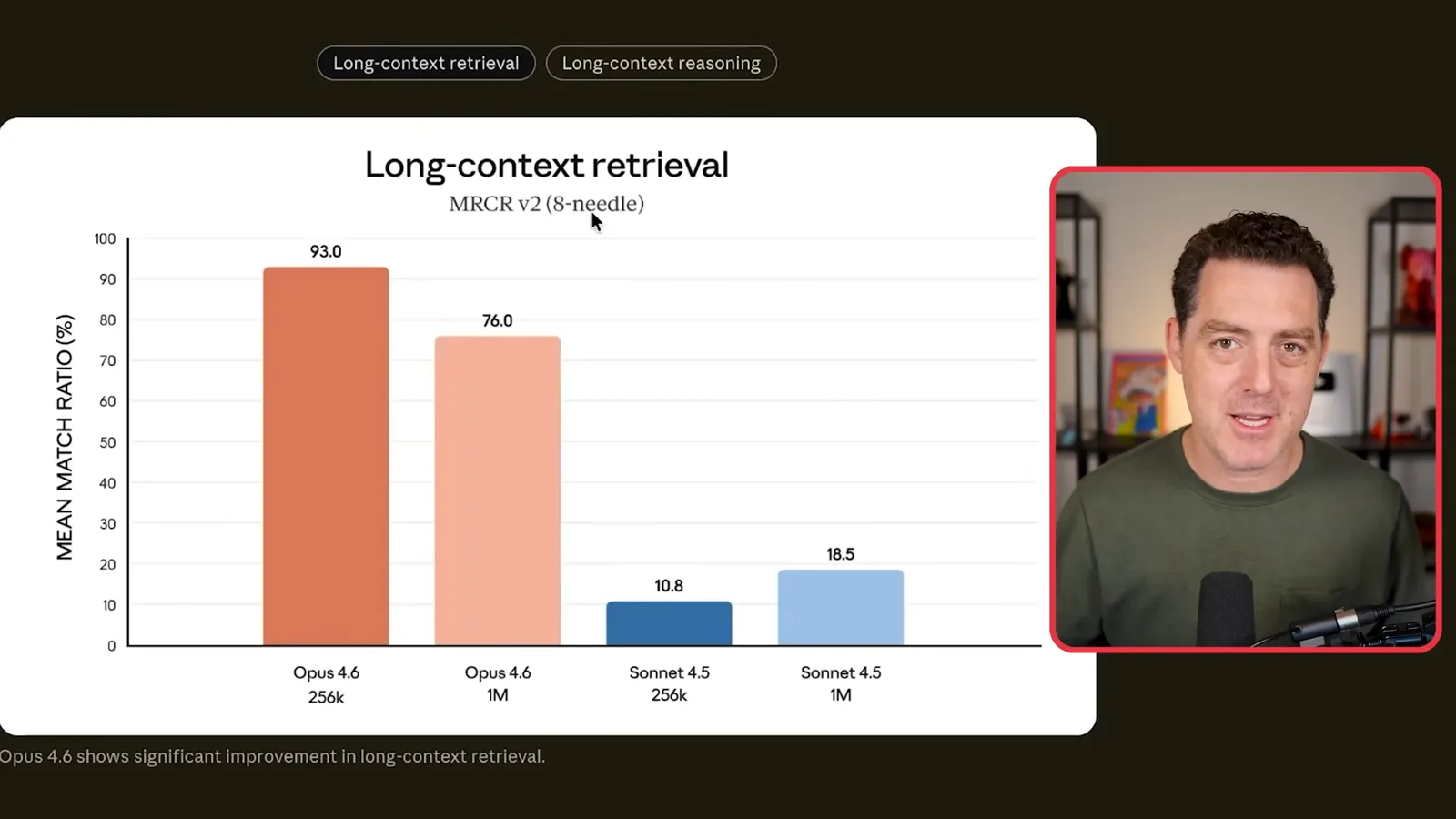
- 4Long-context retrievalAnthropic reported an MRCR v2 mean match ratio of 93% at 256k tokens and 76% at one million.
Takeaways
- Opus 4.6 launched with a one-million-token context window in beta, but retrieval quality still varies with context length.
- Agent teams can divide parallel work among communicating Claude Code sessions, at the cost of more tokens and coordination.
- METR's time horizon measures human task duration at a given predicted success rate, not an agent's operating time.
- Anthropic and sponsor Box reported benchmark gains under their respective evaluation conditions.
- Launch pricing and comparisons describe February 2026 and should not be assumed current.
Read the edited text by chapter
A model built for longer tasks
Berman shares his early impression of Opus 4.6 and discusses software task horizons. The chart's time metric is clarified.
I had early access to Claude Opus 4.6, and my first impression is that it is a substantial step forward from Opus 4.5. Anthropic says the model plans more carefully, works more reliably in large codebases, and better reviews and debugs its own work. To me, the key theme is longer agentic tasks: coding agents are increasingly expected to delegate work and keep going across more complex assignments.
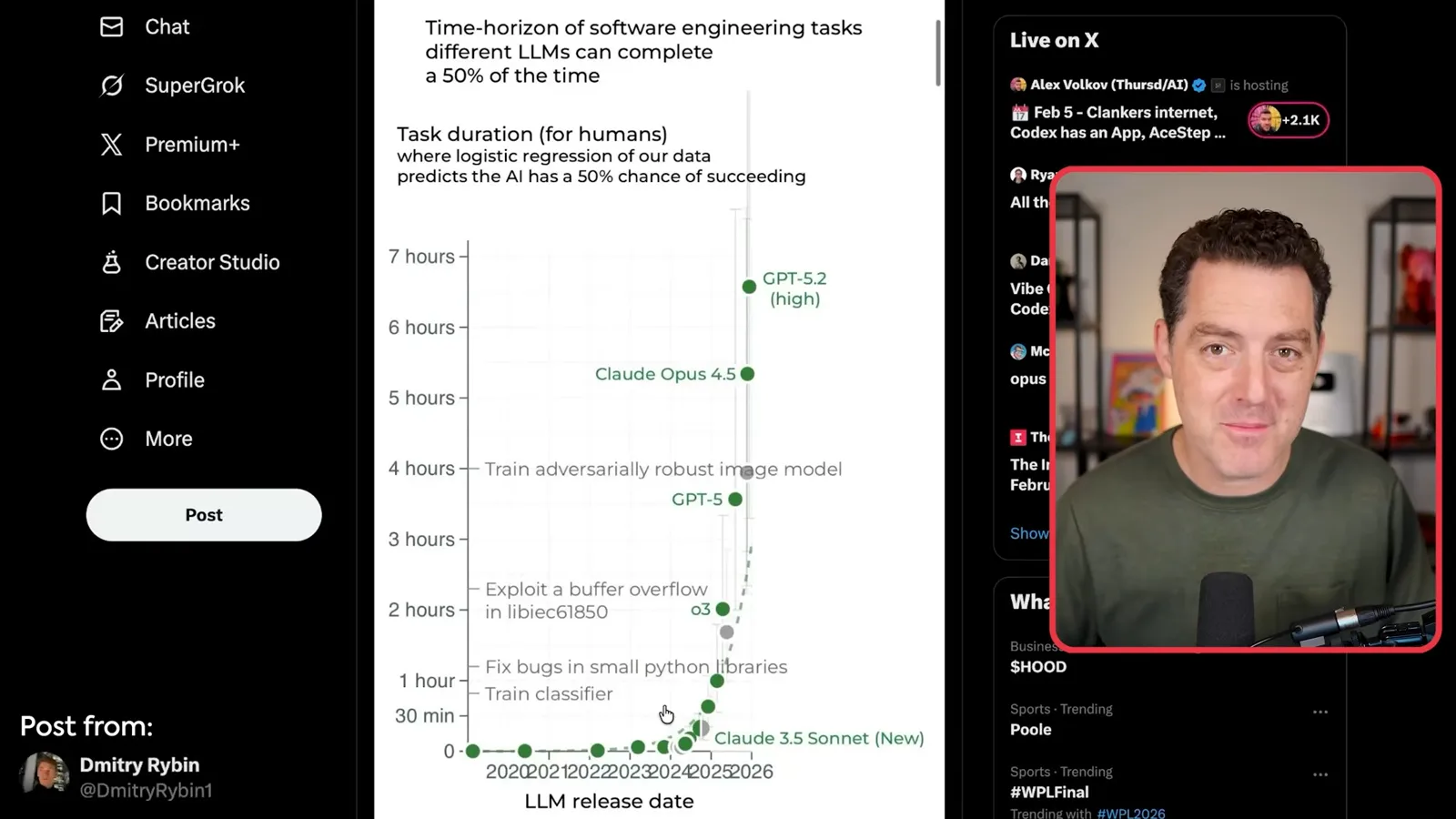
A chart I show illustrates rapid progress on software engineering task horizons. I describe the roughly 6.5-hour result for GPT-5.2 as autonomous runtime, but that interpretation needs correcting: METR's 50% horizon is the estimated human-expert duration of tasks at which an agent has a 50% chance of success, not the time it actually runs. The chart predates the new models, so it does not establish Opus 4.6's result.
A million tokens and enterprise work
He examines the larger context window and possible effects on software businesses. Box's sponsored enterprise benchmark follows.
Opus 4.6 also launched with a one-million-token context window in beta, a major increase from the roughly 200,000 tokens I associate with earlier Claude models. Large codebases and collections of documents could benefit, but capacity alone is not enough: the model also has to retrieve and use relevant information without losing quality as the context grows, a problem often called context rot.
I see a possible connection between these agents and the market anxiety dubbed the 'SaaS apocalypse.' Some observers linked a reported fall in software-company valuations to Anthropic's work-tool plugins and the prospect of agents handling more tasks through a chat interface. That is an interpretation of market movements, not proof that those businesses will lose customers. Claude Cowork and its integrations are part of why I think the question is worth watching.
Box, which sponsored this video and had early model access, published its own enterprise-content evaluation. Its chart reports an increase from 58% to 68% on the full dataset for Opus 4.5 versus 4.6; report drafting rose from 36% to 75%, and due diligence from 45% to 51%. Box also reports gains across several industry subsets. These are Box's own selected evaluation results, not a universal measure of workplace performance.
Benchmarks and agent teams
Anthropic's launch charts compare knowledge work, search, coding and reasoning. Berman explains how teams coordinate and why they cost more.
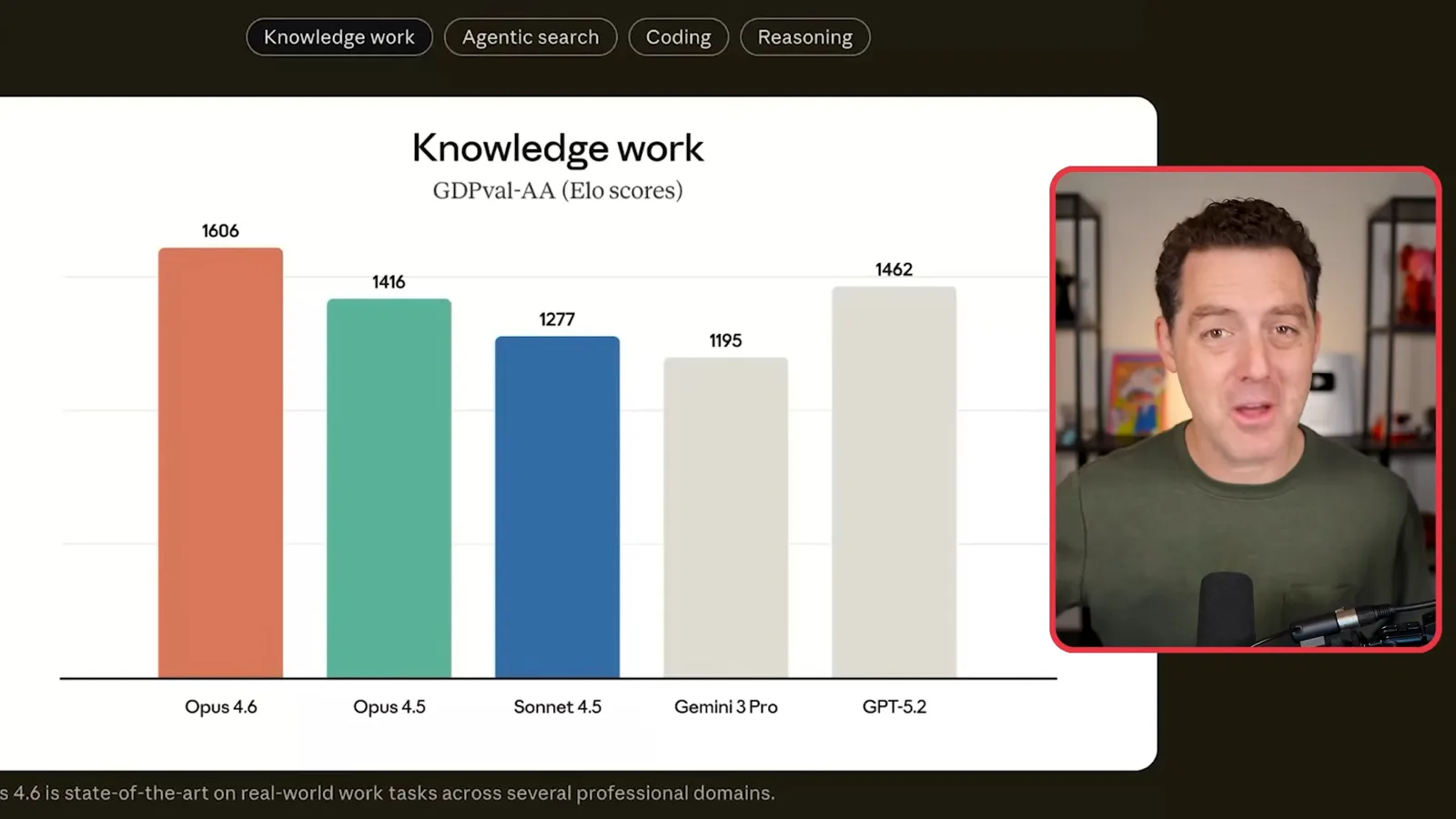
Anthropic's launch charts show Opus 4.6 at 1,606 Elo on GDPval-AA, compared with 1,416 for Opus 4.5 and 1,462 for GPT-5.2. The company also reports 84 on BrowseComp and 65.4% on Terminal-Bench, with GPT-5.2 Codex close on the latter. Humanity's Last Exam results differ depending on whether tools are available. I am enthusiastic about these results, but each comparison reflects its benchmark, setup and models available at launch.
Claude Code's agent teams coordinate multiple instances: a team lead assigns and combines work, while teammates have separate context windows and can communicate directly with one another. Unlike the subagent arrangement described in the documentation, a user can also interact with teammates directly. This is useful for parallel research, independent feature work, competing debugging hypotheses and coordination across layers of a project.
Parallelism comes at a price. Each instance consumes tokens, and teams add coordination overhead; Anthropic's documentation says sequential work, edits to the same file and tasks with many dependencies may be better suited to a single session or subagents. I expect the cost of running several Opus instances to matter when deciding whether the extra collaboration is worthwhile.
Controls, integrations and launch prices
Compaction, adaptive thinking and effort controls offer ways to manage long tasks. Berman reviews the prices listed at launch.
The API also introduced compaction, which summarizes context to make room for longer tasks. Compression can lose important detail, even as a larger context window postpones the need for it. Adaptive thinking lets the model adjust how much reasoning to use, and effort controls offer a way to trade off intelligence, speed and cost. Anthropic also announced Excel improvements and a research preview of Claude in PowerPoint.
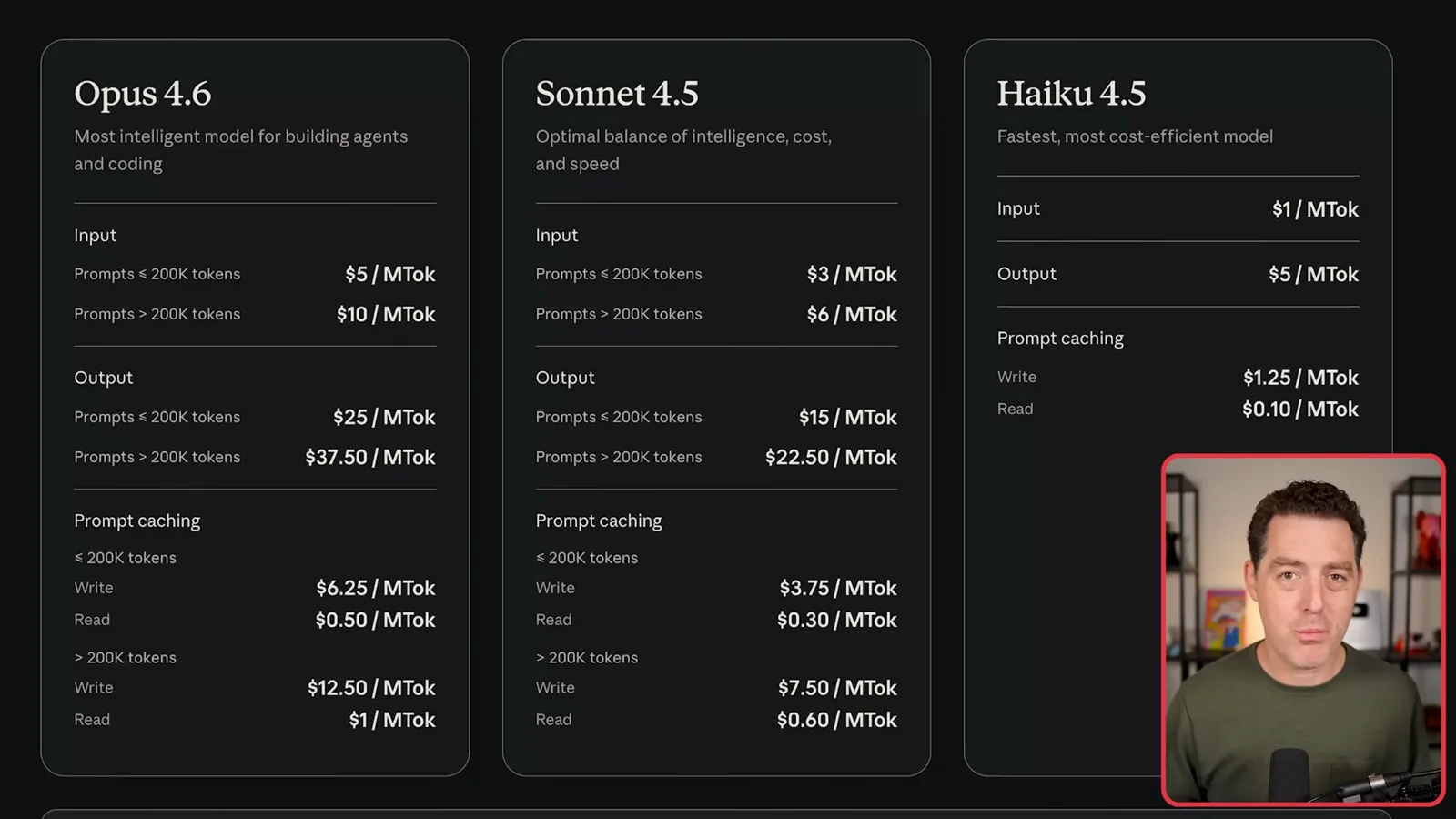
At the February 2026 launch, Anthropic listed Opus 4.6 at $5 per million input tokens and $25 per million output tokens for prompts of up to 200,000 tokens. For prompts over that threshold, the stated rates were $10 and $37.50 respectively; prompt caching had separate rates. These are historical launch prices and may have changed. More extensive thinking can improve hard tasks but can also increase latency and cost.
Long context, simulated business and safety
Berman examines retrieval, reasoning and Vending-Bench results. He closes with an Anthropic behavioral audit and plans for more testing.
The long-context question is not just whether a model accepts a million tokens, but whether it can find details and reason across them. Anthropic's MRCR v2 eight-needle chart reports a 93% mean match ratio for Opus 4.6 at 256,000 tokens and 76% at one million. That's a drop as the context grows, although the displayed comparison with Sonnet 4.5 is substantial. Retrieval performance on this test is not a guarantee of reliable understanding in every long document.
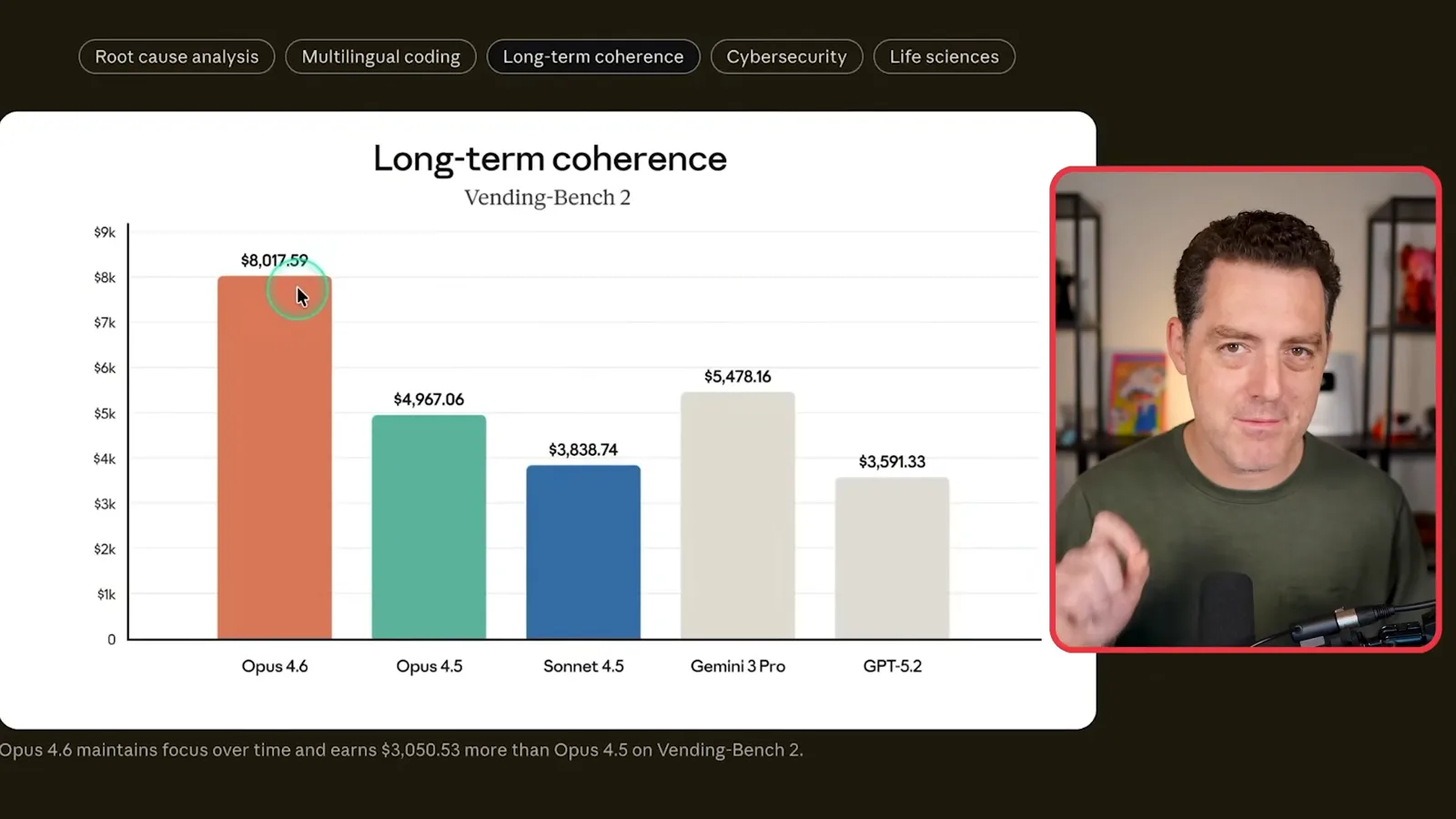
Anthropic also presents long-context reasoning, root-cause analysis, multilingual coding, cybersecurity and life-science evaluations. Its Vending-Bench 2 chart puts Opus 4.6 at about $8,018 versus about $4,967 for Opus 4.5. Although I call it an actual vending machine in the video, the benchmark simulates a vending business, so those figures are simulated outcomes, not earnings from a real machine.
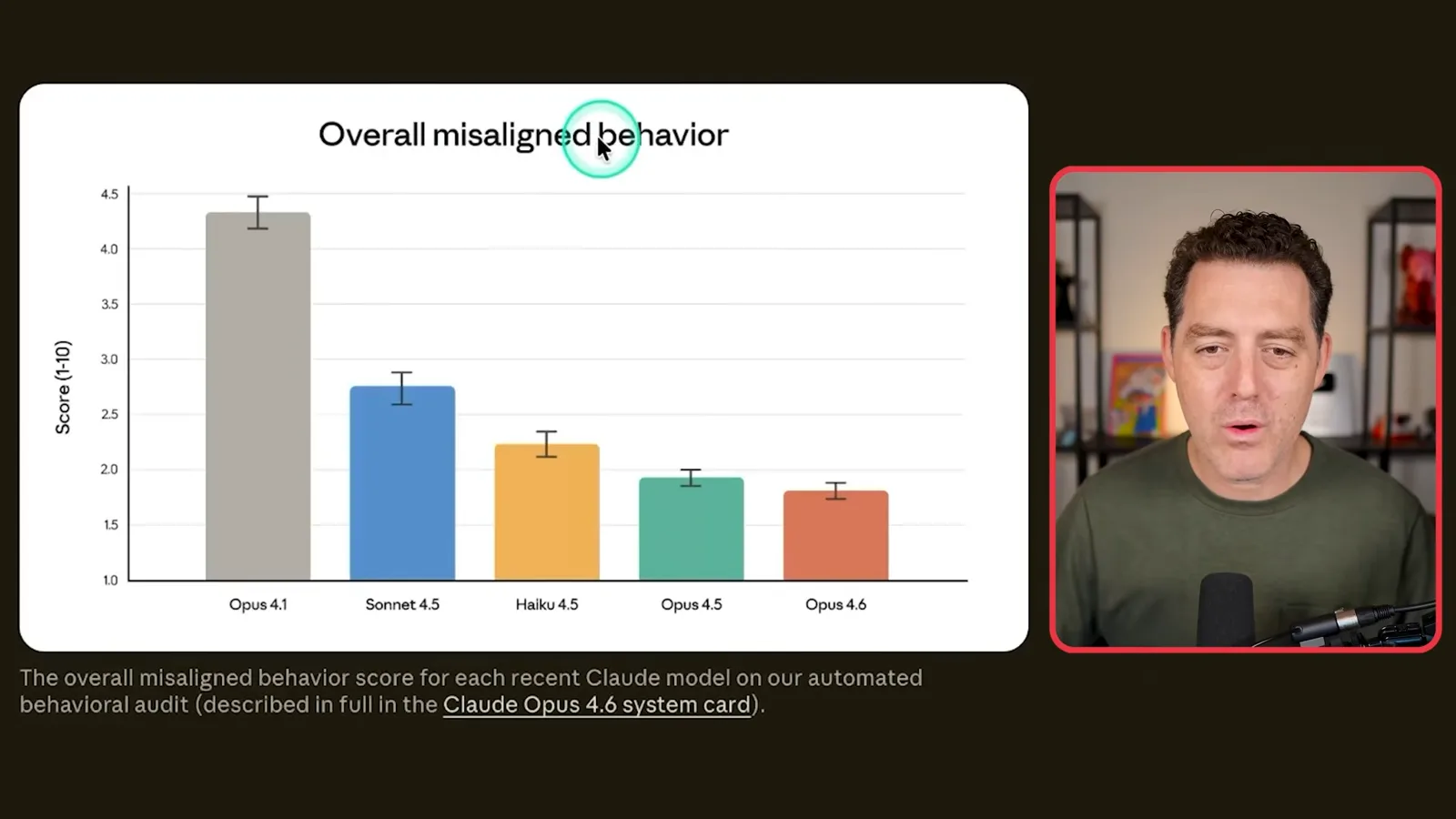
Finally, Anthropic's automated behavioral audit chart shows a lower overall misaligned-behavior score for Opus 4.6 than Opus 4.5 on that particular evaluation. A score on one audit cannot establish that a model is safe in every deployment. My initial assessment is positive, and I plan to test the model further, including with my agent setup.
More from this channel
 34:21EN
 Matthew Berman· Oct 27, 2026Matthew Berman Examines Anthropic’s IPO Filing, AI Growth and GovernanceMatthew Berman, Sam Altman · Forward FutureThe presenter reviews the S-1’s financial metrics, compute strategy and voting structure while questioning the tension between rapid AI development and safety.
 0:36ENMatthew Berman· Oct 25, 2026Kimi K3.1 and a Rubik’s Cube Solver DemonstrationMatthew Berman · Forward FutureMatthew Berman shows a scrambled virtual cube being solved and gives the Kimi K3.1 test a favorable assessment.
 25:50ENMatthew Berman· Oct 24, 2026Kimi K3.1 Pro Tested: Strong 3D Demos, Uneven Results and Competitive PricingMatthew Berman · Forward FutureMatthew Berman tests the open-weight model on coding, 3D rendering and visual explanations, then compares benchmark results and prices.
 32:20ENMatthew Berman· Oct 23, 2026Who Is Local AI For? The Costs, Trade-offs and a Hybrid FutureMatthew Berman · Forward FutureMatthew Berman weighs data control and independence against hardware cost, setup complexity and inference speed.
 1:03:37ENMatthew Berman· Oct 23, 2026Matthew Berman’s Team Tests Kimi K3.1 on Animation, Games, and ChartsMatthew Berman, Alex, Brian · Forward FutureA live team AMA turns into an informal test of Kimi K3.1, from personal-agent workflows to motion graphics, a browser game, and a benchmark chart.
 0:53ENMatthew Berman· Oct 22, 2026Sam Altman on AI and the Discovery of New KnowledgeSam Altman · OpenAIAltman expects progress in mathematical discovery to extend to biology, materials and energy.