In 30 seconds
Matthew Berman reviews reactions to OpenAI’s December 2024 o3 preview. Commentators celebrated reported FrontierMath and ARC-AGI results while debating cost, generalization and whether the system qualified as AGI. Later benchmark disclosures and revised cost estimates add context; the video includes a Vultr sponsorship.
- 1FrontierMathOpenAI claimed 25.2% on a particular version of a difficult mathematics benchmark; human and model comparisons have limits.
- 2ARC scores and computeThe preview achieved different scores at different compute levels on a semi-private evaluation.
- 3Competition rulesThe prize used a separate private set, an open-source requirement and a fixed compute budget.
- 4A biomedical anecdoteDerya Unutmaz described o1 Pro’s review feedback; the account is an individual experience.
- 5Cost estimatesThe 5.7 billion token figure describes a high-compute run, while dollar estimates depend on assumptions.
Takeaways
- OpenAI reported 25.2% on a specific FrontierMath version, a benchmark it helped fund and had access to under disclosed arrangements.
- The 2024 preview scored 75.7% and 87.5% on ARC’s semi-private evaluation at different compute levels.
- The high-compute score did not satisfy the separate open-source ARC Prize competition rules or prove AGI.
- Cost estimates for the benchmark depended on pricing assumptions and were revised later.
- A scientist’s positive review experience concerned o1 Pro and is not a controlled evaluation of o3.
Read the edited text by chapter
FrontierMath and first reactions
Berman surveys early responses to the o3 preview. The mathematics scores and human comparisons require benchmark-specific context.
OpenAI's December 2024 preview of o3 produced striking benchmark results and a range of reactions. I gathered responses from researchers, entrepreneurs and commentators, from enthusiasm about mathematics to warnings about cost and reliability. These reactions concern the preview evaluated at the time; ARC Prize later said the publicly released April 2025 o3 was not the same system it had tested.
Balaji Srinivasan focused on FrontierMath, a collection of challenging mathematical problems. OpenAI claimed a 25.2% score after earlier models had scored much lower. This was a reported benchmark result, not evidence that o3 could solve 25% of all research mathematics or outperform every mathematician.
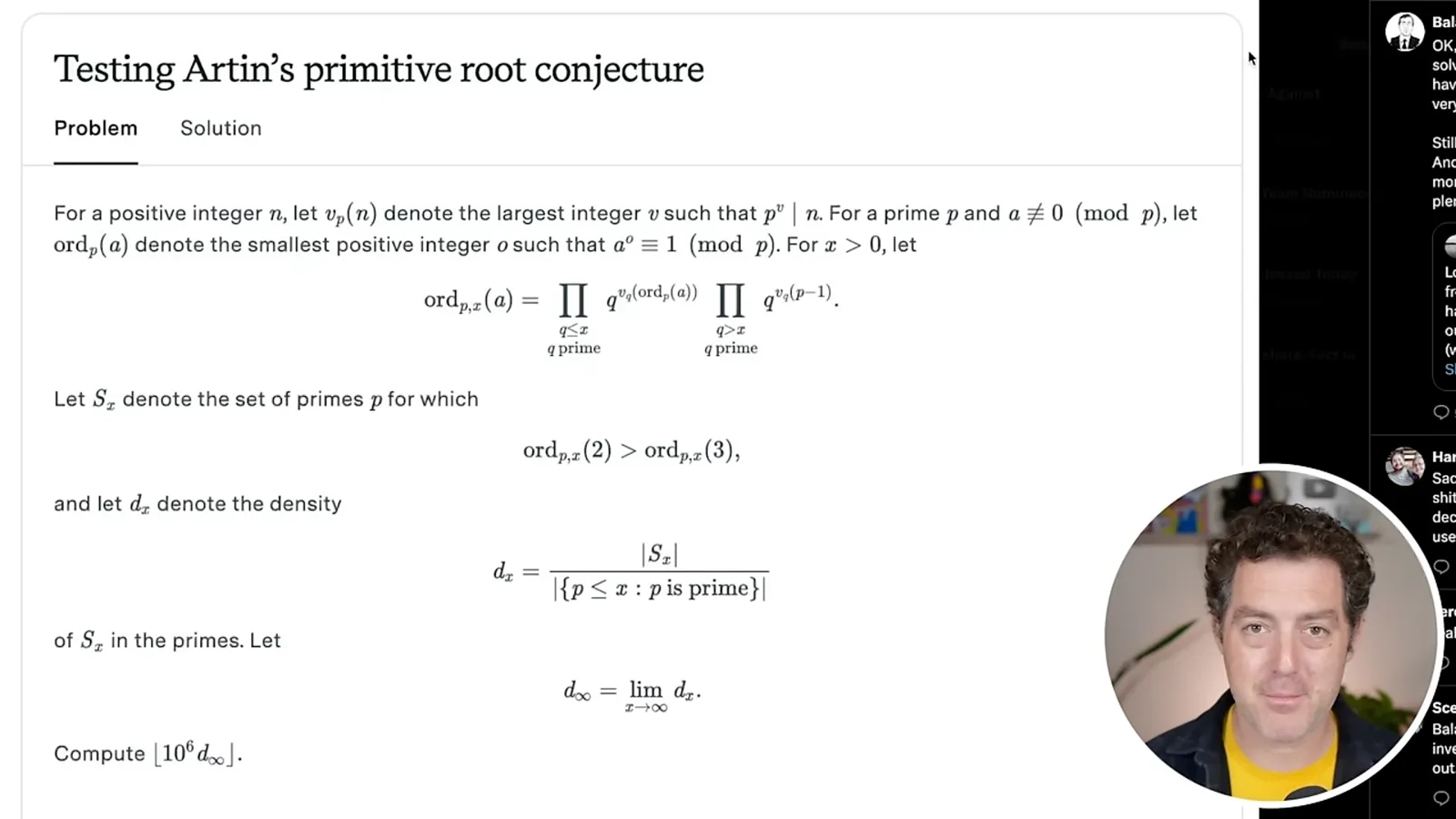
The sample problem shown involves number theory, and FrontierMath's creators say many tasks require hours or days of specialist work. I found the result remarkable. Individual problems vary in difficulty, and the video does not establish how many problems any particular human expert could solve.
Srinivasan also pointed to ARC and competitive programming. The figures show performance under specific benchmark and testing conditions, not a universal rank among all human coders or a direct head-to-head contest. The value of these comparisons depends on the task, rules, tools and evaluation method.
Mathematicians Terence Tao and Timothy Gowers had described reviewed FrontierMath problems as extremely difficult. Those comments concern the problems they examined; they do not establish that no mathematician could solve 25% of the full benchmark. The video’s broader comparison is speculation.
Compute and ARC-AGI
Mollick and Chollet discuss test-time computation and ARC results. The semi-private evaluation is distinct from the open-source prize competition.
Ethan Mollick likened more inference-time computation to the fictional supercomputer in Douglas Adams's work: difficult answers may require more time and the right question. His analogy highlights both potential and cost, not proof that more computation always yields a correct answer.
The video includes a sponsored segment for Vultr, a cloud-computing provider. The claims about availability, performance and pricing in that segment are sponsor claims.
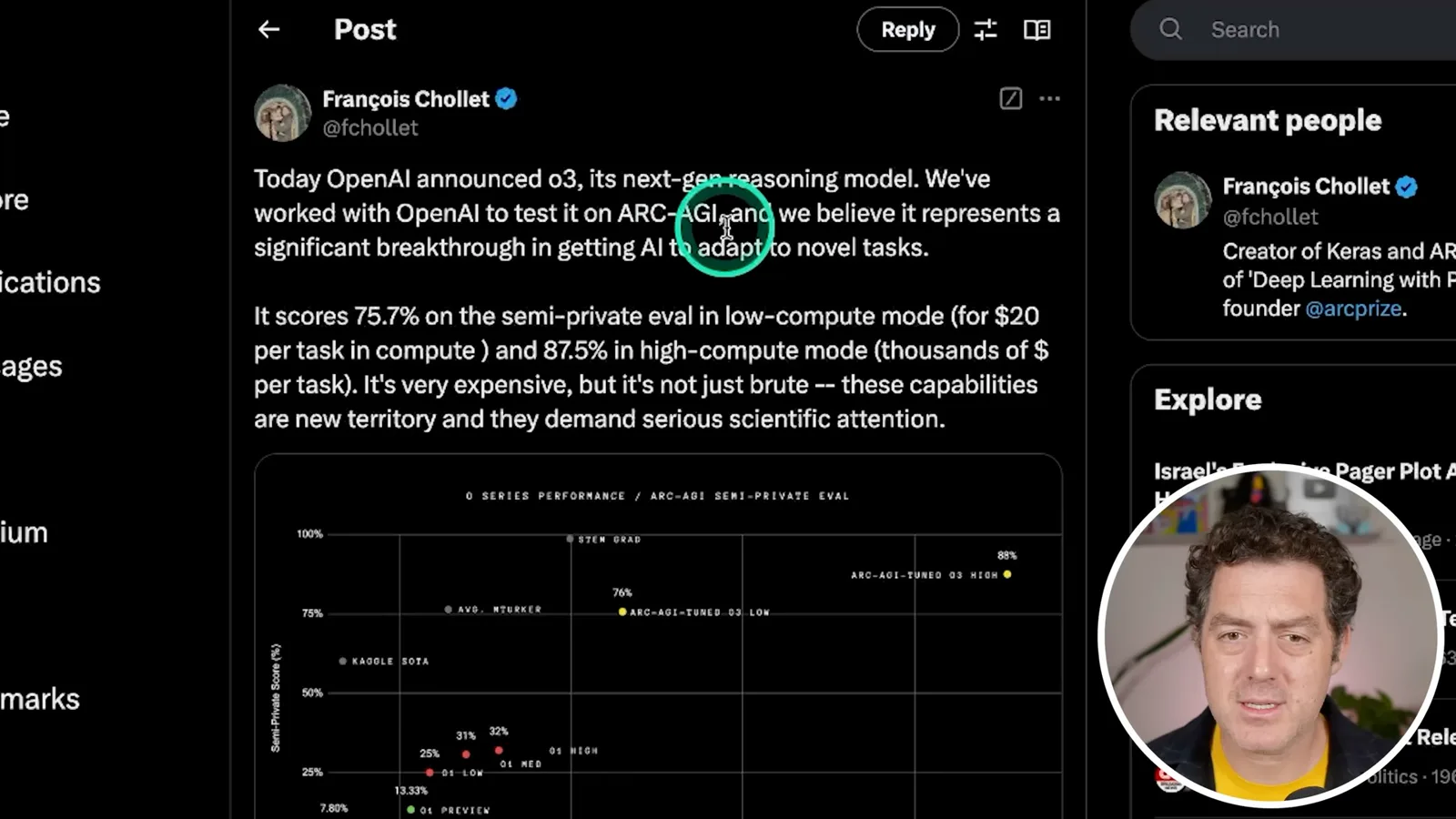
ARC creator François Chollet reported 75.7% on the ARC-AGI-1 semi-private evaluation in a lower-compute configuration and 87.5% with much higher compute. ARC Prize said the tested system had been trained on part of the public training set. These scores measure that evaluation setup, not a general percentage of progress toward AGI.
Chollet called the result a significant advance in adapting to novel tasks, while noting its expense. I suggested costs could improve over time; that is a forecast. ARC Prize later revised its estimated retail costs as pricing assumptions changed, so the video’s rough dollar figures are not a settled invoice or current price.
Chollet did not consider the result AGI: the model still failed some apparently simple ARC tasks. An 85% threshold in a particular competition is a prize condition, not an agreed definition of AGI. The video speculates about his incentives, but provides no evidence that they determined his assessment.
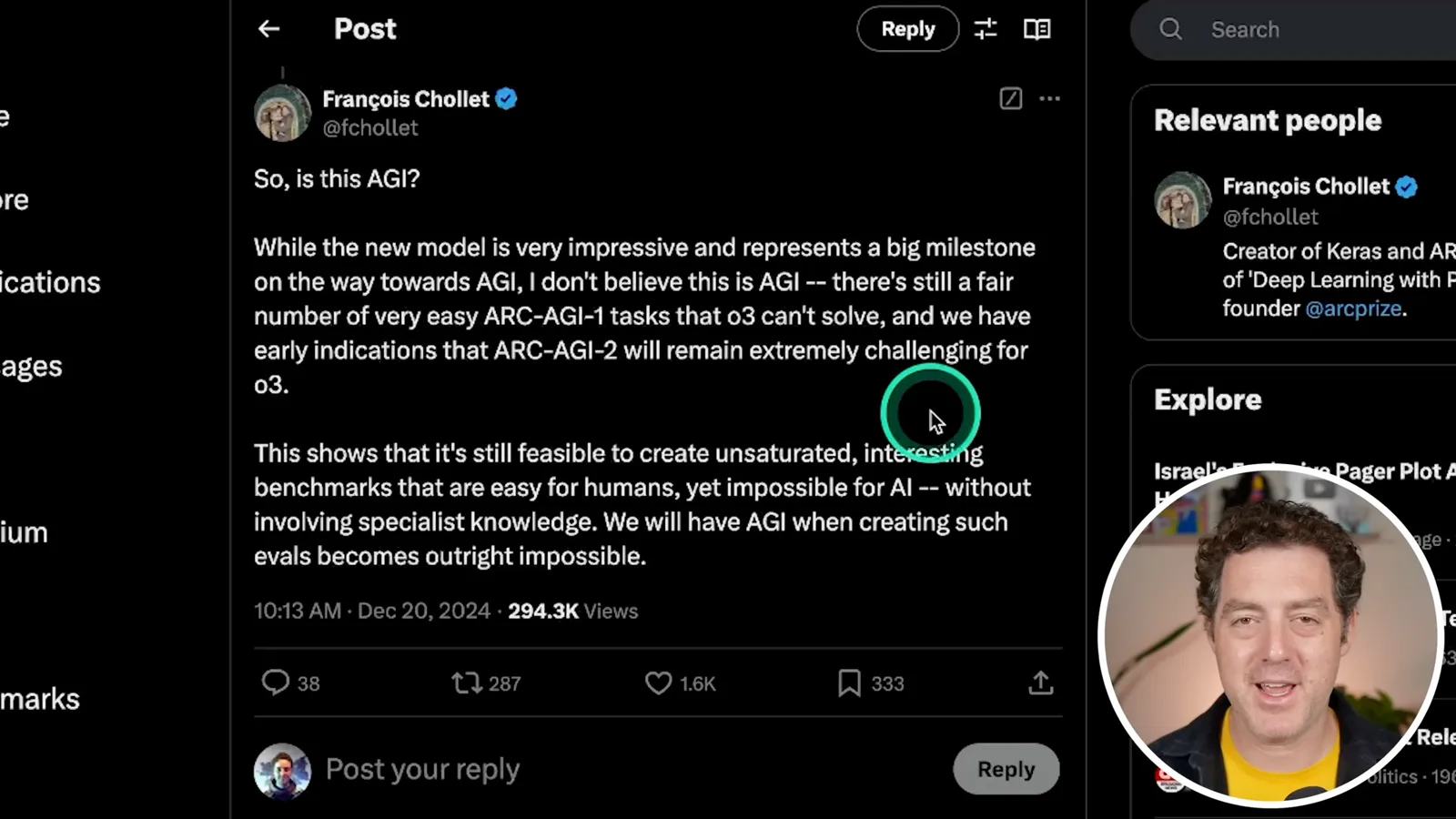
The ARC Prize competition had separate rules: a fully private set, an open-source submission and a fixed compute budget, described in the video as ten cents per task. The high-compute semi-private score did not by itself win that competition. Benchmark versions, access and budgets matter when comparing scores.
Failures and scientific reactions
Berman shows a failed grid puzzle and reports comments on economic change and biology. The biomedical anecdote concerns o1 Pro, not an o3 clinical study.
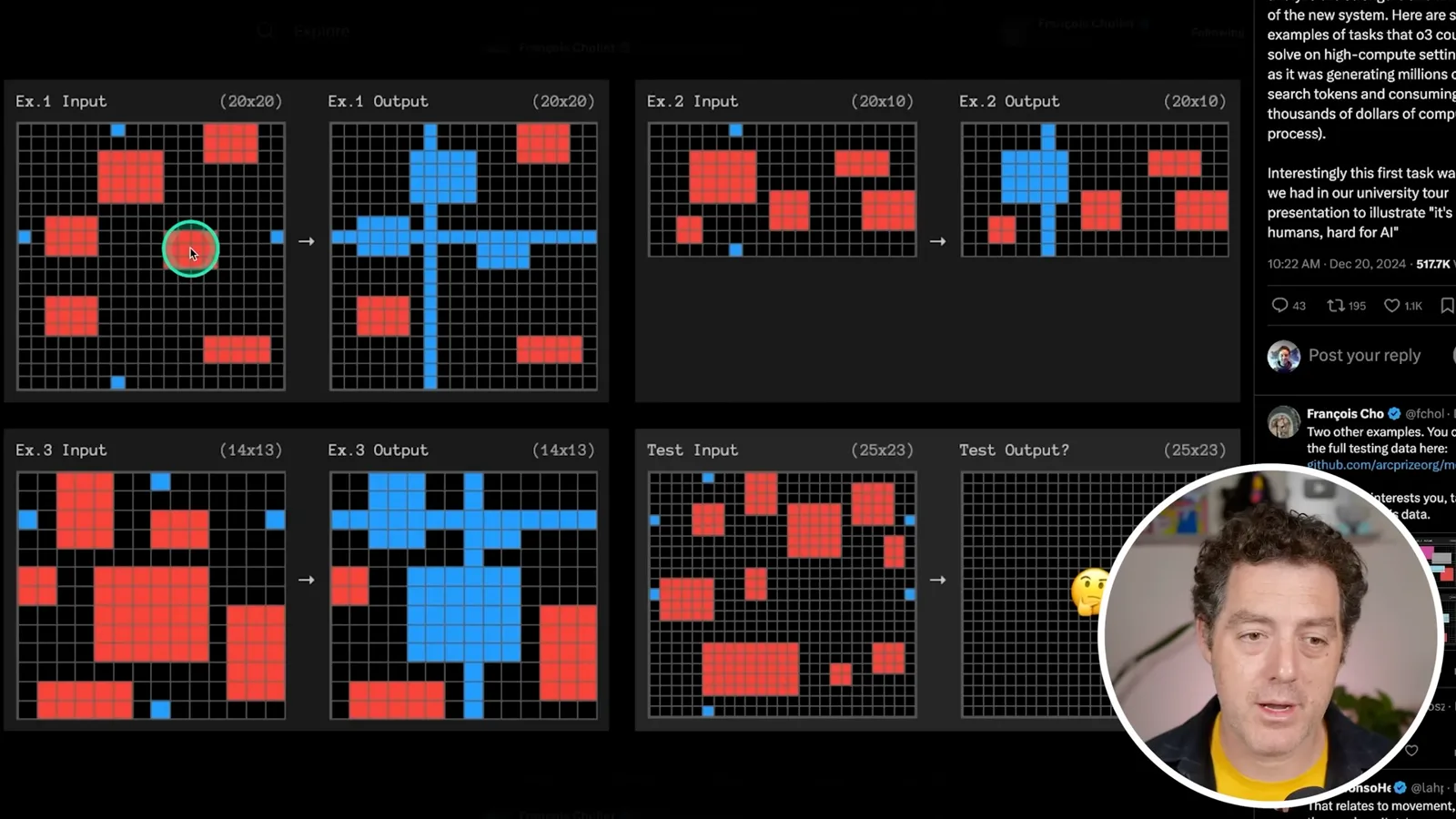
One example o3 failed shows red shapes and blue markers in grids. I infer a cross from the blue markers, with intersected red shapes turning blue. It feels simple to me, but individual human reactions are not a controlled measurement of how easily all people solve it.
OpenAI researcher Steven Heidel described the moment in AGI-like terms, while Emad Mostaque predicted major economic disruption as AI performs computer-based work more cheaply. These are reactions and forecasts, not established conclusions. My suggestion that an AGI declaration would automatically end Microsoft's agreement is not supported by the information shown.
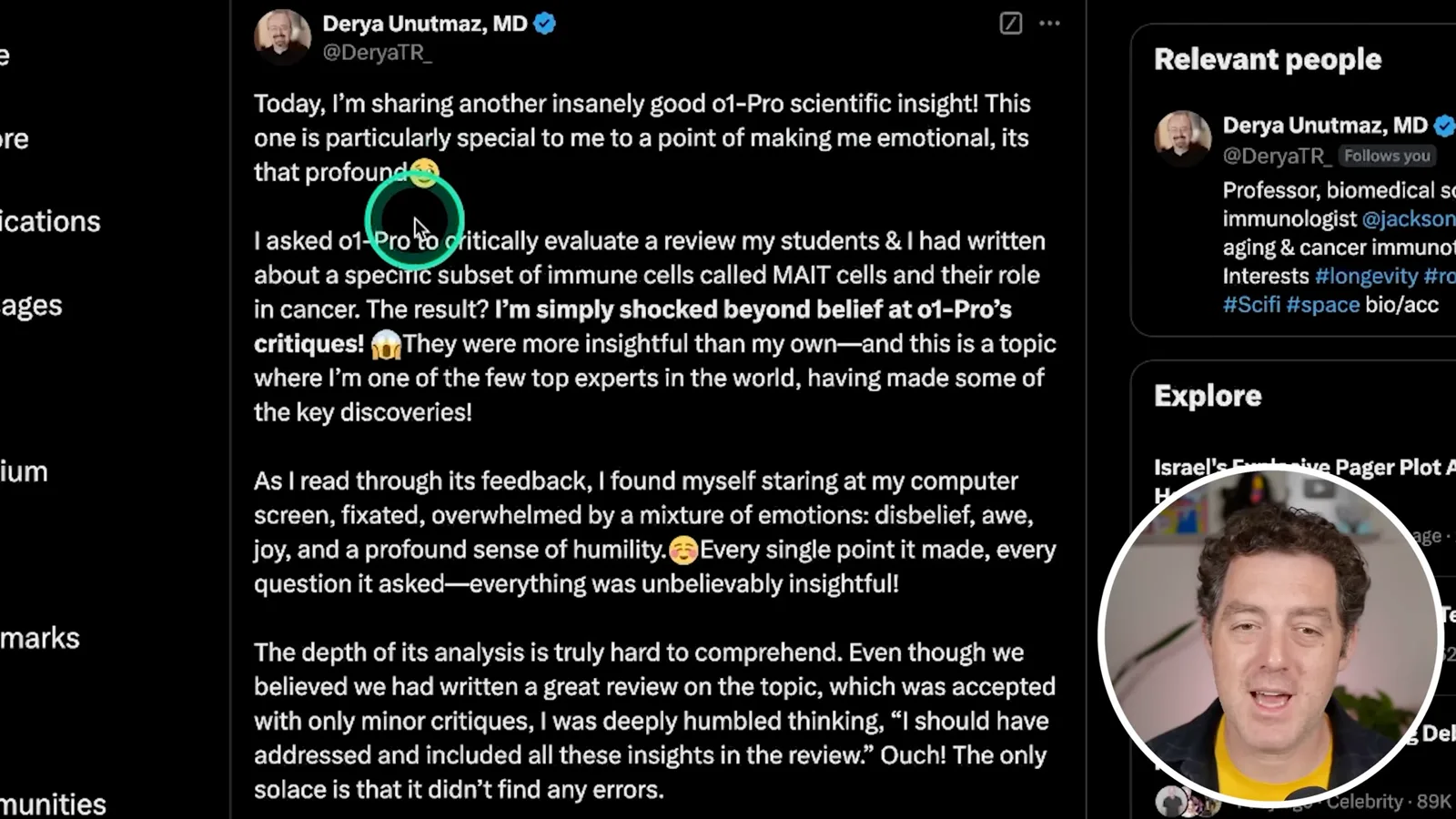
Immunologist Derya Unutmaz described a different model, o1 Pro, critiquing a review of MAIT cells and cancer. He found the feedback unusually insightful and wondered what a stronger model might mean for biology. This is one expert's reported experience, not an independently controlled evaluation of o3 or evidence of a clinical discovery.
Cost, skepticism and next steps
Commentators debate scaling, cost, reliability and generalization. Later disclosures clarify benchmark access and the estimated costs.
Riley Goodside shared a graph of ARC scores rising across model generations. The jump in this particular benchmark is notable, but plotting a few historical results does not establish an exponential law or guarantee future progress. Deedy Das and others also emphasized the reported FrontierMath jump.
OpenAI researcher Noam Brown highlighted the roughly three months between o1 and the o3 announcement. David Dohan discussed a 16-hour figure and improving ARC results; the video interprets it as time spent on each answer, which is not established by that post alone. ARC Prize's later table reports about 13.8 minutes per task on average in the high-compute semi-private run, alongside substantial parallel sampling.
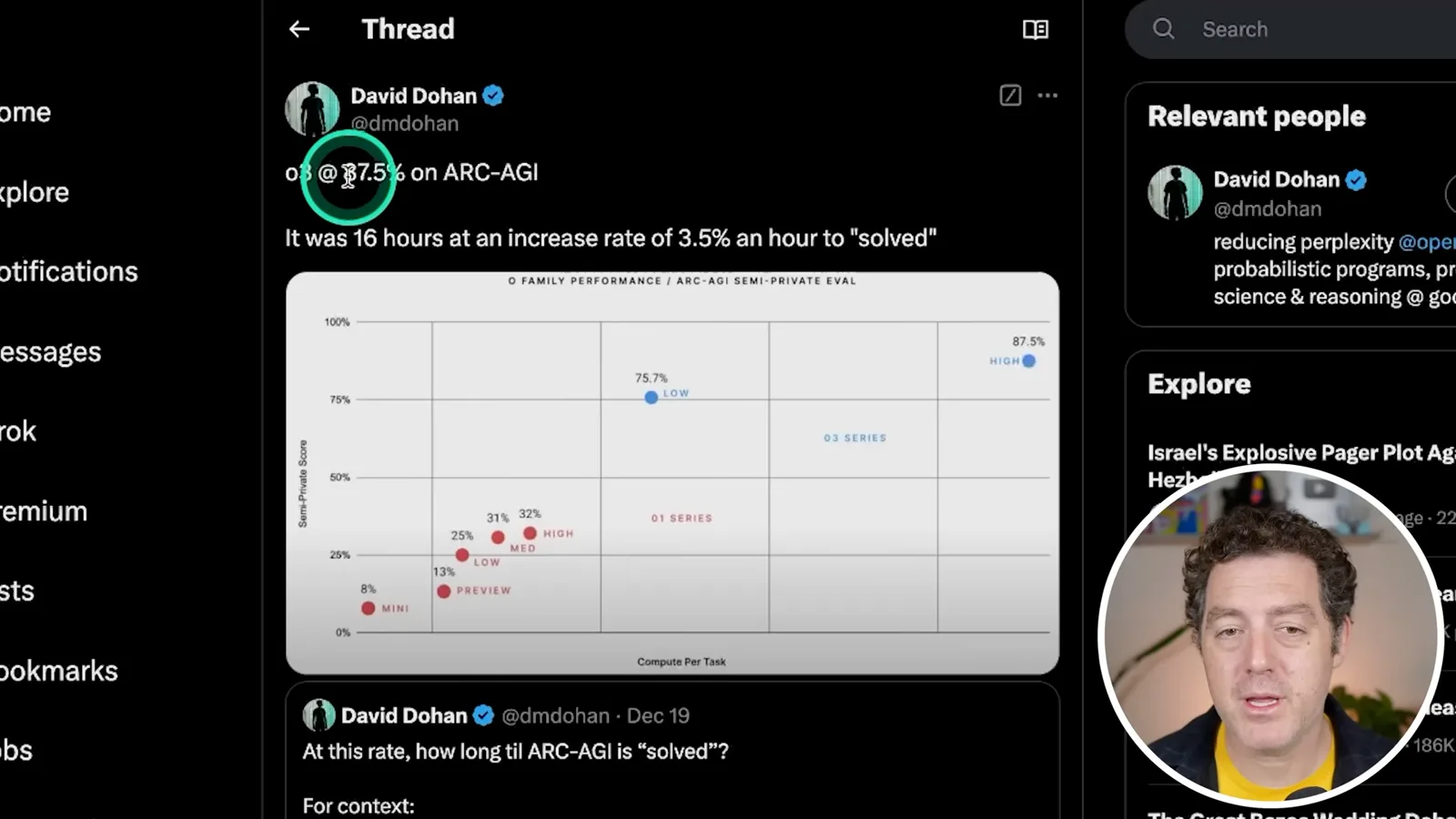
I repeated an estimate of roughly $350,000 and 5.7 billion tokens for the high-compute test. ARC Prize did report 5.7 billion tokens and a 172-fold compute increase, but its cost estimates depend on pricing assumptions and were subsequently revised. These are estimates for the benchmark run, not a confirmed per-user charge or an amount spent on one answer.
Gary Marcus predicted that the system would impress initially but might be unreliable, especially outside closed domains. I wanted hands-on testing before drawing that conclusion. ARC puzzles probe a form of adaptation, but their performance alone does not settle reliability in open-ended real-world situations.
Santiago Valdarrama called o3 a significant advance while arguing it was not AGI, remained costly and still failed easy tasks; he cautioned that generalization to other domains was uncertain. Ben Thompson saw it as a consequence of the earlier o1 insight that inference-time scaling can matter. Neither view proves that more computation always improves an answer.
Epoch AI's Tamay Besiroglu regarded the reported 25.2% FrontierMath score as earlier progress than he expected. Epoch later clarified that OpenAI commissioned and owned core benchmark questions and had access to statements and solutions, with a holdout arrangement. The access and funding relationship matters when interpreting the reported result; it does not by itself prove training contamination.
Sam Altman predicted that o3-mini would surpass o1 on many coding tasks at lower cost, while extra performance could demand much greater spending. These were 2024 forward-looking product claims, not independent results for every task.
NVIDIA researcher Jim Fan compared specialized AI achievements in Go, StarCraft, robotics and mathematical benchmarks. He argued that exceptional performance in a domain can coexist with failures on simple tasks, an illustration of the gap between narrow prowess and broad competence. I found the reactions compelling, especially the mathematical results, while the limitations remain important.
More from this channel
 34:21EN
 Matthew Berman· Oct 27, 2026Matthew Berman Examines Anthropic’s IPO Filing, AI Growth and GovernanceMatthew Berman, Sam Altman · Forward FutureThe presenter reviews the S-1’s financial metrics, compute strategy and voting structure while questioning the tension between rapid AI development and safety.
 0:36ENMatthew Berman· Oct 25, 2026Kimi K3.1 and a Rubik’s Cube Solver DemonstrationMatthew Berman · Forward FutureMatthew Berman shows a scrambled virtual cube being solved and gives the Kimi K3.1 test a favorable assessment.
 25:50ENMatthew Berman· Oct 24, 2026Kimi K3.1 Pro Tested: Strong 3D Demos, Uneven Results and Competitive PricingMatthew Berman · Forward FutureMatthew Berman tests the open-weight model on coding, 3D rendering and visual explanations, then compares benchmark results and prices.
 32:20ENMatthew Berman· Oct 23, 2026Who Is Local AI For? The Costs, Trade-offs and a Hybrid FutureMatthew Berman · Forward FutureMatthew Berman weighs data control and independence against hardware cost, setup complexity and inference speed.
 1:03:37ENMatthew Berman· Oct 23, 2026Matthew Berman’s Team Tests Kimi K3.1 on Animation, Games, and ChartsMatthew Berman, Alex, Brian · Forward FutureA live team AMA turns into an informal test of Kimi K3.1, from personal-agent workflows to motion graphics, a browser game, and a benchmark chart.
 0:53ENMatthew Berman· Oct 22, 2026Sam Altman on AI and the Discovery of New KnowledgeSam Altman · OpenAIAltman expects progress in mathematical discovery to extend to biology, materials and energy.